Next Article in Journal
Planovalgus foot deformity revisited
Previous Article in Journal
Management of heel pain syndrome with acetic acid iontophoresis
 
 
Journal of the American Podiatric Medical Association is published by MDPI from Volume 116 Issue 1 (2026). Previous articles were published by another publisher in Open Access under a CC-BY (or CC-BY-NC-ND) licence, and they are hosted by MDPI on mdpi.com as a courtesy and upon agreement with American Podiatric Medical Association.
Article

Reevaluation of the relaxed calcaneal stance position. Reliability and normal values in children and adults

by
Ellen Sobel
,
Steven J. Levitz
,
Mark A. Caselli
,
Michael Tran
,
Frank Lepore
,
Erik Lilja
,
Moshe Sinaie
and
Elisa Wain
Division of Orthopedic Sciences, New York College of Podiatric Medicine, NY 10035, USA
J. Am. Podiatr. Med. Assoc. 1999, 89(5), 258-264; https://doi.org/10.7547/87507315-89-5-258
Published: 1 May 1999

Abstract

Reliability and normal values for the relaxed calcaneal stance position were determined in a nonclinic population of healthy adults and children (88 adults and 124 children) ranging in age from 5 to 36 years. The mean relaxed calcaneal stance position for adults was 6.07° valgus (SD 2.71°) (range, 1° varus to 14° valgus). The mean relaxed calcaneal stance position for children was 5.6° valgus (SD 2.9°) (range, 6° varus to 12° valgus). There was no significant difference between the relaxed calcaneal stance positions of adults and children. In children the relaxed calcaneal stance position did not correlate with age, height, or weight and did not decrease with age to the theoretical normal value of 0° ± 2° as postulated by Root et al. The relaxed calcaneal stance position was found to be a reliable measurement; however, the theoretical normal value of 0° ± 2° was not found. The values reported in the present study correspond with the results of other empirical studies; thus the theoretical normal value for the relaxed calcaneal stance position of 0° ± 2° may be invalid.

The relaxed calcaneal stance position is the angle formed by the bisection of the posterior aspect of the calcaneus and a line drawn perpendicular to the resting surface during relaxed standing in the angle and base of gait.[1] The normal value for the relaxed calcaneal stance position in adults has been defined as 0° ± 2° (varus or valgus).[1] This angle has been used extensively in the examination and treatment of pediatric and adult flatfoot.[2,3,4,5,6,7,8,9,10,11,12,13,14,15,16,17,18] One study measured the effectiveness of a pediatric foot orthosis by the finding that the relaxed calcaneal stance position averaged 11° valgus barefoot and decreased to an average of 6° varus when the orthosis was worn.[8] In a study of 49 patients with flat feet, who were 8 years old on average, an operation to correct flatfoot was deemed successful after the average relaxed calcaneal stance position decreased from 9.6° valgus prior to surgery to 2.7° valgus postoperatively.[9]
The relaxed calcaneal stance position has been reported to be normally everted from 5° to 10° at the start of ambulation.[1] Valmassy[16,17] has reported that with normal development, calcaneal eversion decreases approximately 1° per year and the normal relaxed calcaneal stance position of 0° ± 2° should be reached by approximately age 7. He provided a formula for approximating the relaxed calcaneal stance position in children; it consists of subtracting the child’s age from the number 7. By this method, a normal 5-year-old should have about 2° of calcaneal eversion in the standing position and a normal 7-year-old should have 0°. However, neither the reduction of the relaxed calcaneal stance position in children nor the adult normal value itself was based on empirical data.
Recently, the theoretical normal values for the relaxed calcaneal stance position have been challenged because they do not correspond with results from empirical studies. In one study, the normal value for the relaxed calcaneal stance position in asymptomatic normal adults was found to be 7° everted.[19] The authors concluded that the “ideal foot,” as defined by Root et al,[20] was based on an invalid theoretical concept, and should be redefined on the basis of normative data from a large sample of healthy individuals. Other recent empirical studies have reported a rearfoot angle, measured as the angle between a calcaneal bisection and a bisection of the lower one-third of the leg, of 4° valgus in healthy adults.[21,22] In a study of 250 children aged 5 to 18, calcaneal eversion in the standing position was measured by the tendo Achillis angle, which is similar to the relaxed calcaneal stance position.[23] In this study, calcaneal eversion was measured as 7° valgus in the youngest children and decreased to 4° valgus by age 18. The heel position did not become vertical as reported by Root et al.[20]
The reliability and accuracy of frontal plane measurement of the rearfoot itself have also been challenged.[24,25,26,27,28] In one study, examiners disagreed not only on the magnitude of the relaxed calcaneal stance position, but also on the general position of the joint (ie, varus, valgus, or straight).[25] Alternative techniques for the clinical assessment of foot pronation have been proposed.[29]
The purpose of the present study was to determine the reliability of the relaxed calcaneal stance position and, if it was found to be reliable, to determine the normal values in a nonclinic population of healthy adults and children.

Methods

Population

The total study population consisted of 212 individuals. There were 88 adults (50 men, 38 women) between the ages of 21 and 36 years (average age, 27 years). There were 124 children (90 girls, 34 boys) between the ages of 5 and 17. Seventy-two children were of elementary-school age (5 through 11 years, average 9 years). The mean relaxed calcaneal stance position for this elementary-age subgroup was compared with that of the adult study population.

Design

One examiner measured the relaxed calcaneal stance position of the 212 individuals ranging in age from 5 to 36 years. Both feet of each subject were measured. In each case, the subject was prone and was aligned with the ankle dorsiflexed to 90° so that the plantar surface of the heel was perpendicular to the leg in the sagittal plane; the examiner made sure that the subtalar joint was not rotated in either a varus or a valgus attitude. No attempt was made through palpation to align the subtalar joint with the neutral position as defined by Root et al.[1] The posterior aspect of the calcaneus for both feet was then bisected with a fine marking pen. Each subject was then asked to stand and march in place five times until achievement of a comfortable angle and base of stance. A two-arm goniometer that provided measurements in 2° increments (PICA, Brentwood, Tennessee) was then placed on the calcaneal bisection lines with the base arm on the ground. The measurement was stated aloud by the examiner and recorded by another person.

Reliability

Intratester reliability was determined by having three examiners measure the relaxed calcaneal stance position two separate times on 14 volunteers. Both feet were measured for each subject. The subjects were seen in a different order in the second trial so that the examiners would not be influenced by the first measurement. Separate recorders wrote down the results, which made it more difficult for examiners to keep track of their previous measurements. No examiner was aware of the measurements of the other two examiners. Intratester reliability was also determined through the use of a second instrument, the electrogoniometer (Penny and Giles Ltd, Blackwood, United Kingdom). The electrogoniometer readings were covered with tape so that the examiners were unable to see the results of their measurement. The recorders lifted up the tape in each trial and recorded the measurement. Intertester reliability was assessed by comparing the results of the three examiners.

Data Analysis

Intraobserver reliability was assessed by means of the intraclass correlation coefficient. An intraclass correlation coefficient of 0.61 or greater indicated moderately strong agreement based on the work of Landis and Koch.[30] A two-tailed t-test was also used to determine differences in the intraobserver data. A one-factor analysis of variance was used to examine intraobserver reliability.
An evaluation of the data showed normal distribution; therefore, a two-tailed t-test was used to analyze data. Pearson’s correlation coefficient was used to determine whether age, height, and weight were correlated with the relaxed calcaneal stance position.

Results

Intratester Reliability

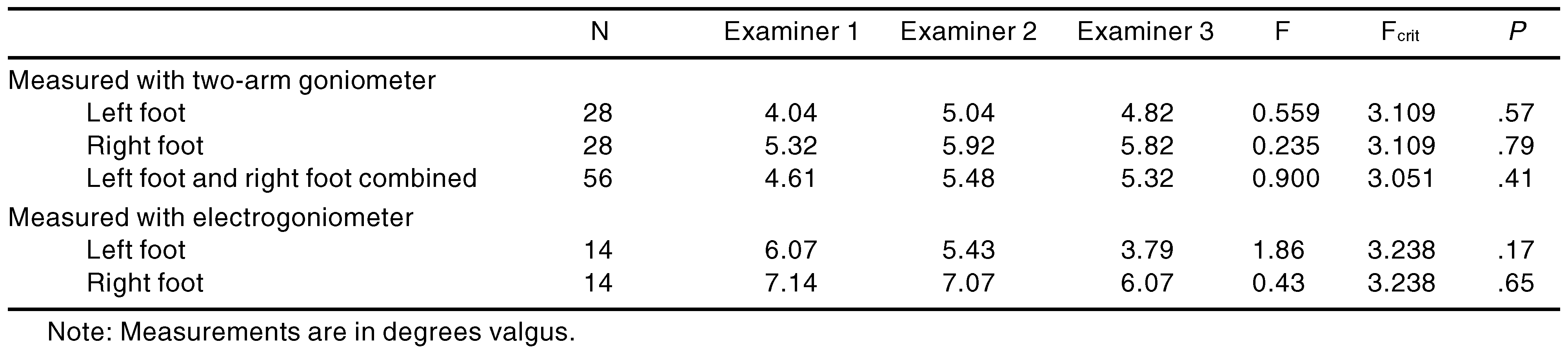
The intraclass correlation coefficient for the three examiners ranged from 0.61 to 0.90 (Table 1). No significant difference was found for any of the three examiners between the first and second measurements of the relaxed calcaneal stance position with a twoarm goniometer (Table 1). The greatest mean difference between the two measurements was 0.5°, obtained by the least experienced examiner (a student examiner). The least mean difference between the two measurements was 0.04°, obtained by the most experienced examiner.
Table 1. Mean Relaxed Calcaneal Stance Position Measured with Goniometer: Intratester Reliability (N = 14).
Japma 89 00258 i001

Intertester Reliability

There was no significant difference between the three examiners in measurement of the relaxed calcaneal stance position with a two-arm goniometer (Table 2). The greatest mean difference between any two measurements was 1.23°. An electrogoniometer was used to measure the relaxed calcaneal stance position in 14 individuals for both left and right feet. The electrogoniometer reading was covered with tape so that the examiner could not read the number, and the recorder transcribed it silently. There was also no significant difference between examiners in measurement of the relaxed calcaneal stance position with an electrogoniometer (Table 2). The greatest mean difference recorded between any two examiners was 2.28°, which was not statistically significant (Table 2). Given the acceptable intraexaminer reliability obtained with a two-arm goniometer, it was possible to proceed with analyzing the results of the study.
Table 2. Mean Relaxed Calcaneal Stance Position: Intertester Reliability.
Japma 89 00258 i002

Relaxed Calcaneal Stance Position Values

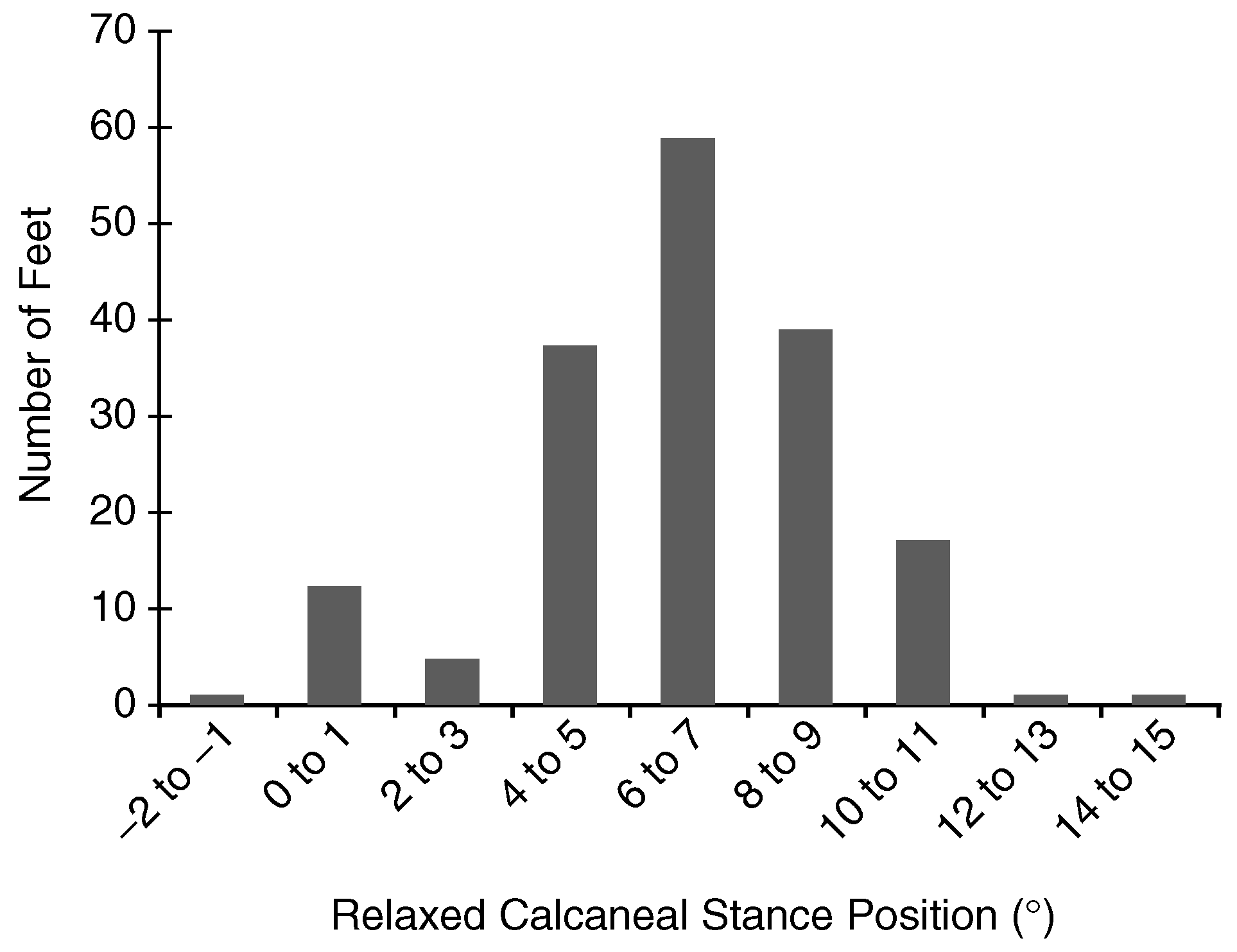
The average relaxed calcaneal stance position was 6.41° valgus for men and 5.63° valgus for women (t = 1.89; not significant [NS]). The average relaxed calcaneal stance position for all adults was 6.17° valgus for the left foot and 5.98° valgus for the right foot (t = 0.47; NS). Because there was no significant difference by sex or sidedness, these results were combined for the remainder of the analysis. The overall average relaxed calcaneal stance position for all adults in this study was 6.07° valgus (SD 2.71°) with a range of 1° varus to 14° valgus (Fig. 1).
Figure 1. Relaxed calcaneal stance position values in adults (N = 176, mean = 6.07° valgus). Positive values indicate valgus, and negative values indicate varus.
Japma 89 00258 g001
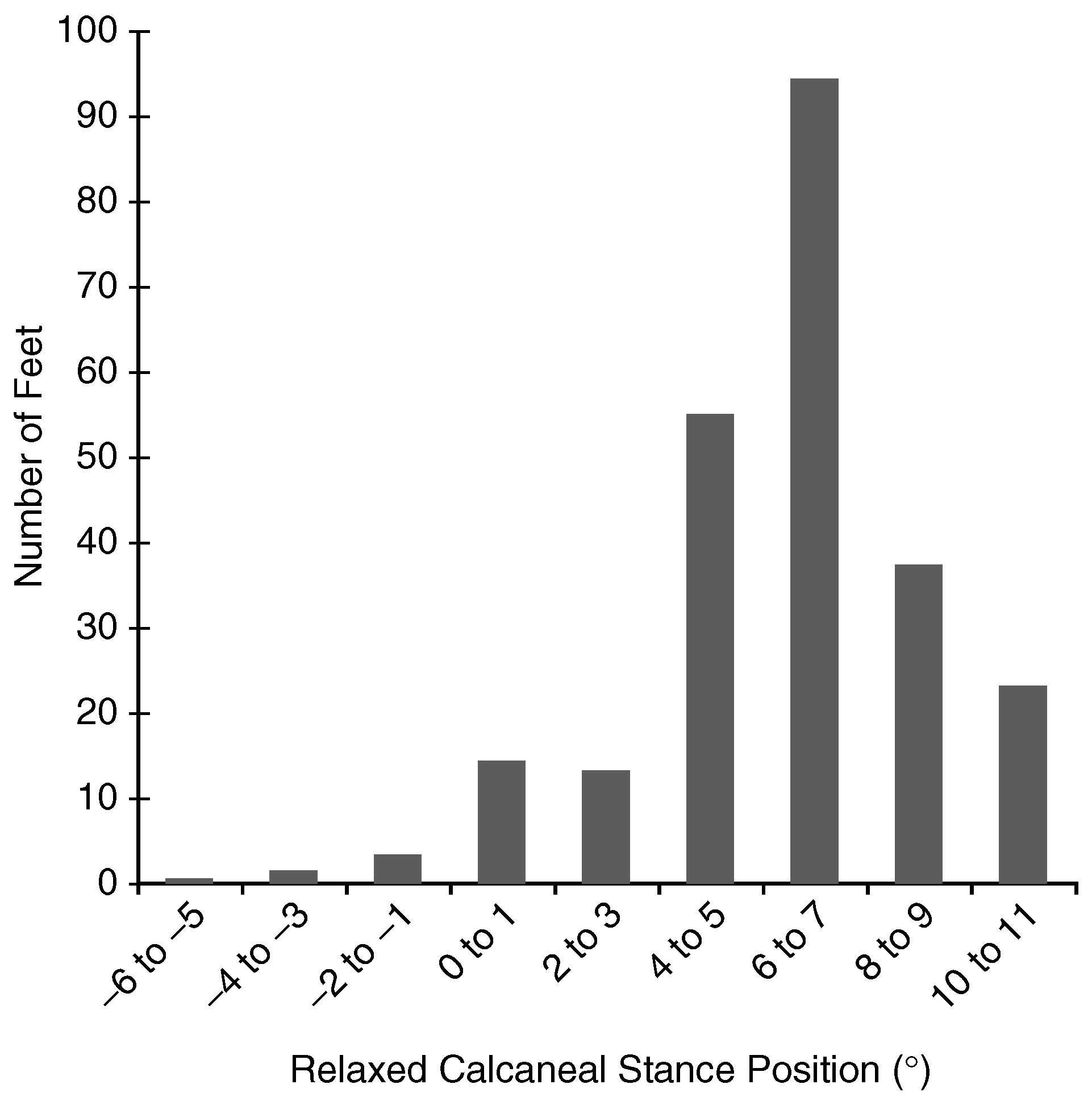
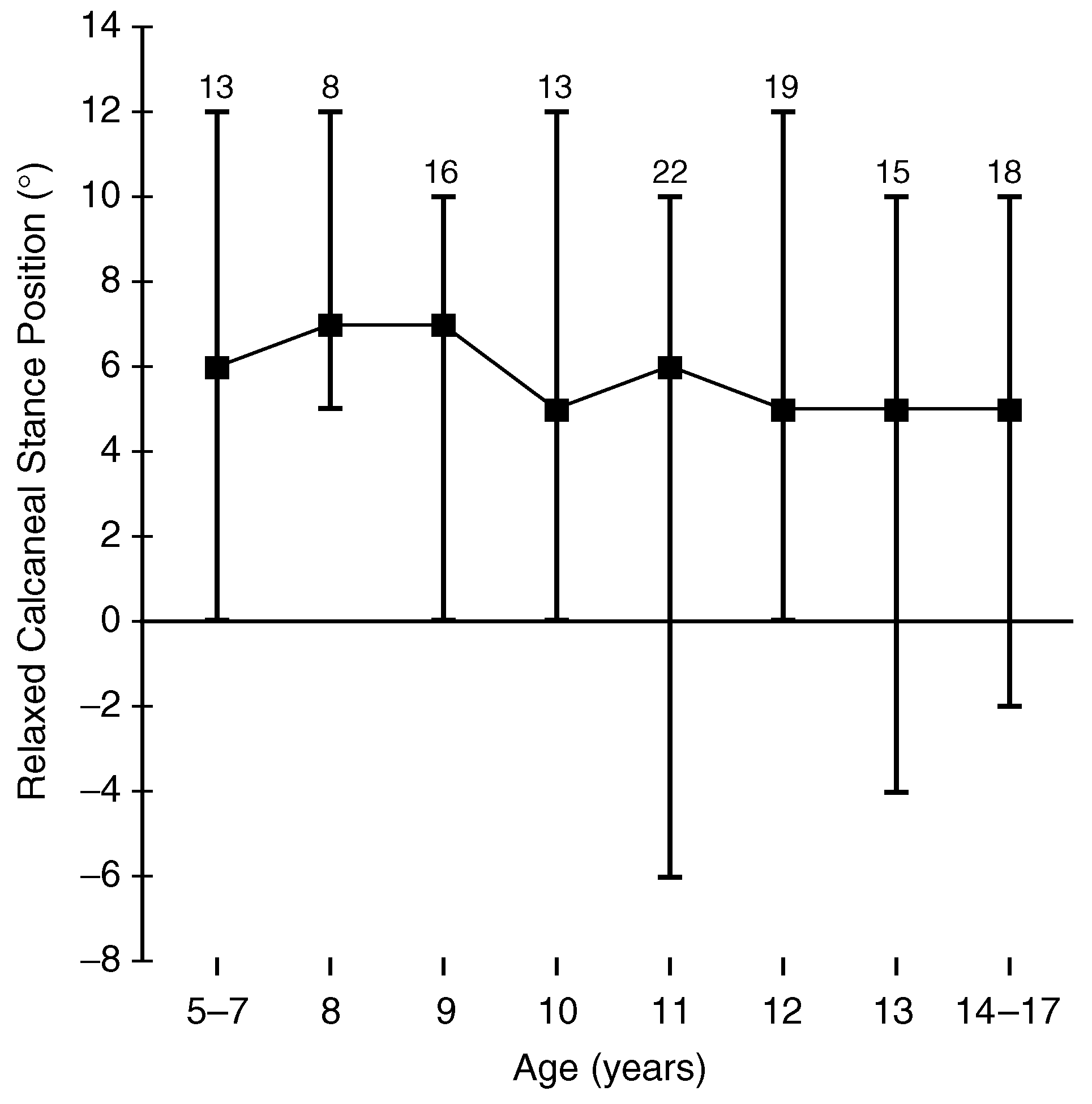
The average relaxed calcaneal stance position was 5.4° valgus for boys and 5.6° valgus for girls (t = 0.59; NS). The average relaxed calcaneal stance position for all children was 5.63° valgus for the left foot and 5.48° valgus for the right foot (t = 1.03; NS). Because there was no significant difference by sex or sidedness, these results were combined for the remainder of the analysis. The average relaxed calcaneal stance position for all children in this study was 5.6° valgus (SD 2.9°) with a range of 6° varus to 12° valgus (Fig. 2). Relaxed calcaneal stance position was not correlated with age (r = −0.19), height (r = −0.17), or weight (r = −0.12). Height, however, was strongly correlated with weight (r = 0.80). There was no significant difference in the relaxed calcaneal stance position between elementary-age children (aged 5 to 11 years) and adults (t = 0.58; NS). The relaxed calcaneal stance position values did not decrease with age (Fig. 3).
Figure 2. Relaxed calcaneal stance position values in children (N = 248, mean = 5.6° valgus). Positive values indicate valgus, and negative values indicate varus.
Japma 89 00258 g002
Figure 3. Age and relaxed calcaneal stance position. Solid squares indicate mean relaxed calcaneal stance position, with vertical lines representing ranges. Numbers above vertical lines are numbers of children. On the y-axis, positive values indicate valgus, and negative values indicate varus.
Japma 89 00258 g003

Discussion

Most of the reliability studies that pertain to the subtalar joint have focused on the neutral subtalar joint position and the range of motion of the subtalar joint rather than on the relaxed calcaneal stance position.[24,25,31,32,33,34] This is surprising, as the relaxed calcaneal stance position is widely used in clinical practice and cited extensively in the literature.[2,3,4,5,6,7,8,9,10,11,12,13,14,15,16,17,18] Reliability of goniometry depends on standardized measurement,[25,35,36,37] and subtalar joint measurement is particularly difficult to standardize because of the complex motion of the subtalar joint.[38] The reliability of rearfoot measurements has recently been challenged.[27,28,29] The relaxed calcaneal stance position has been questioned because the irregularity of the calcaneal tuberosity makes the posterior heel bisection difficult.[27,29,39]
The results of this study showed acceptable intratester and intertester reliability for all three examiners measuring the relaxed calcaneal stance position with a two-arm goniometer. There also seems to have been a learning curve, with the most experienced examiner having the greatest reliability (Table 1). For example, the greatest mean difference between the first and second relaxed calcaneal stance position measurements was 0.5°, obtained by a student examiner. The most experienced examiner obtained virtually identical measurements from one trial to the next, with a mean difference of as little as 0.04° (Table 1).
Intertester reliability of rearfoot measurements is generally less than intratester reliability.[25,26,27,39,40] There were no significant differences between examiners measuring the relaxed calcaneal stance position with a two-arm goniometer or an electrogoniometer. The greatest mean difference between any two examiners was 2.28°. While this difference was greater than the mean differences obtained for intratester reliability, it was still not statistically significant (Table 1 and Table 2). The reliability of the electrogoniometer was particularly impressive because the instrument’s reading scale was taped to prevent the examiner from reading his or her measurement from the scale. The electrogoniometer has been reported to be highly accurate and reliable in joint range-ofmotion measurements.[41,42,43,44] High intratester reliability of biomechanical measurements that included the relaxed calcaneal stance position has been obtained with a two-arm goniometer in patients in a diabetic foot care clinic.[45]
Given the recent criticisms of the reliability of the relaxed calcaneal stance position, the original purpose of this study was to reexamine the reliability of this measurement, which is heavily relied upon in clinical settings. The authors had not expected the reliability to be as high as it was, especially for the electrogoniometer measurements. Differences of approximately 0.5° for one examiner and 2.5° between examiners demonstrate reasonable reliability for clinical measurements and for use in a study.[45]
The mean relaxed calcaneal stance position for all adults in this study was 6.07° valgus (SD 2.71°), with a range of 1° varus to 14° valgus. This contrasts dramatically with the original theoretical normal range for the relaxed calcaneal stance position of 0° ± 2° (varus or valgus) as postulated by Root et al.[20] The mean relaxed calcaneal stance position for all children in this study was 5.6° valgus (SD 2.9°), with a range of 6° varus to 12° valgus. The average relaxed calcaneal stance position did not decrease with age to the theoretical adult normal value of 0° ± 2° as reported by Root and colleagues.[20] The average relaxed calcaneal stance position of approximately 6° valgus for children and adults obtained in the present study is in agreement with the findings of other studies, which reported that adults and adolescents stand with the calcaneus everted between 3.64° and 7°.[19,21,22,23] Seltzer et al[46] measured the angle between the long axis of the tibia and the calcaneus (rearfoot valgus angle) by computed tomography and found it to be 5.2° valgus in healthy adult volunteers as compared with more than 10° valgus in patients with rheumatoid arthritis, pes planovalgus, or trauma to the rearfoot and ankle. In another radiographic study to determine the normal range of rearfoot alignment, the authors found that the rearfoot was everted 3° with a range of 4° varus to 6° valgus, which these authors referred to as the “physiological valgus of the normal hindfoot.”[47]
Normal values for an orthopedic measurement should include plus or minus two standard deviations from the mean value, which encompasses more than 95% of the population. In this study, 95% of adults had a relaxed calcaneal stance position between 3° valgus and 9° valgus. This means that less than 2% of adults had a relaxed calcaneal stance position within the normal range of 0° ± 2° as postulated by Root et al.[20] Similarly, 64% of children in the present study had a relaxed calcaneal stance position between 3° valgus and 9° valgus, and 95% of children had a relaxed calcaneal stance position between about 1° varus and 12° valgus. Therefore, more than 80% of normal children fell outside the normal ideal range for the relaxed calcaneal stance position of 0° ± 2° as defined by Root et al.[20] The authors’ results and those of others consistently indicate heel valgus in the relaxed calcaneal stance position in healthy children and adults. Asymptomatic individuals in this study demonstrated wide ranges for the relaxed calcaneal stance position, from 6° varus to 14° valgus. Therefore, the authors believe that the original “ideal” value for the relaxed calcaneal stance position of 0° ± 2° as defined by Root et al[20] is invalid. The average relaxed calcaneal stance position reported here was 5° to 6° everted in healthy children and adults. Ninetyfive percent of the population had relaxed calcaneal stance position values between 1° varus and 14° valgus. Thus the relaxed calcaneal stance position should not be used as an indicator of pathology.

References

  1. ROOT, ML; ORIEN, WP; WEED, JH. Biomechanical Examination of the Foot; Clinical Biomechanics Corp: Los Angeles, 1971. [Google Scholar]
  2. ADDANTE, JB; CHIN, MW; LOOMIS, JC; ET, AL. Subtalar joint arthroereisis with Silastic silicone sphere: a retrospective study. J Foot Ankle Surg 1992, 31, 47. [Google Scholar]
  3. BANKS, AS; SMITH, TF. “Operative Treatment of Non-neurogenic Pes Valgus Foot,” in Foot and Ankle Disorders in Children; DeValentine, S, Ed.; Churchill Livingstone: New York, 1992; p. 329. [Google Scholar]
  4. BECK, EL; MCGLAMRY, ED. Modified young tendosuspension technique for flexible flatfoot: analysis of rationale and results. a preliminary report on 20 operations. JAPA 1973, 63, 582. [Google Scholar] [CrossRef]
  5. COHEN-SOBEL, E; GIORGINI, R; VELEZ, Z. Combined technique for surgical correction of pediatric severe flexible flatfoot. J Foot Surg 1995, 34, 183. [Google Scholar] [CrossRef] [PubMed]
  6. DOCKERY, GL. Surgical treatment of the symptomatic juvenile flexible flatfoot condition. Clin Podiatr Med Surg 1987, 4, 99. [Google Scholar] [CrossRef]
  7. GIORGINI, RJ; SCHIRALDI, FG; HERNANDEZ, PA. Subtalar arthroereisis: a combined technique. J Foot Surg 1988, 27, 157. [Google Scholar]
  8. JAY, R; SCHOENHAUS, HD; SEYMOUR, C; ET, AL. The Dynamic Stabilizing Innersole System (DSIS): the management of hyperpronation in children. J Foot Ankle Surg 1995, 34, 1124. [Google Scholar] [CrossRef] [PubMed]
  9. LUNDEEN, RO. The Smith STA-peg operation for hypermobile pes planovalgus in children. JAPMA 1985, 4, 177. [Google Scholar] [CrossRef]
  10. MAHAN, KT. “Pes Planovalgus Deformity,” in Surgery of the Foot and Ankle, 2nd ed; McGlamry, ED, Ed.; Williams & Wilkins: Baltimore, 1992; p. 769. [Google Scholar]
  11. MCCREA, JD. Pediatric Orthopedics of the Lower Extremity; Futura Publishing: Mt Kisco, NY, 1985. [Google Scholar]
  12. SMITH, SD; MILLAR, EA. Arthrorisis by means of a subtalar polyethylene peg implant for correction of hindfoot pronation in children. Clin Orthop 1983, 181, 15. [Google Scholar] [CrossRef]
  13. SMITH, SD; WAGREICH, CR. Review of postoperative results of the subtalar arthrorisis operation: a preliminary study. J Foot Ankle Surg 1984, 23, 253. [Google Scholar]
  14. SPINNER, SM; CHUSSID, F; LONG, DH. Criteria for combined procedure selection in the surgical correction of the acquired flatfoot. Clin Podiatr Med Surg 1989, 6, 561. [Google Scholar] [CrossRef]
  15. SUBOTNICK, SI. The subtalar joint lateral extra-articular arthroereisis: a preliminary report. JAPA 1974, 64, 701. [Google Scholar] [CrossRef] [PubMed]
  16. VALMASSY, RL. Biomechanical evaluation of the child. Clin Podiatr Med Surg 1984, 1, 563. [Google Scholar] [CrossRef]
  17. VALMASSY, RL. Lower Extremity Treatment Modalities for the Pediatric Patient. In Clinical Biomechanics of the Lower Extremities; CV Mosby, New York, 1996; p. 426. [Google Scholar]
  18. YU, GV; BOBERG, J. Subtalar Arthroereisis. In Surgery of the Foot and Ankle, 2nd Ed; McGlamry, ED, Ed.; Williams & Wilkins: Baltimore, 1992; p. 818. [Google Scholar]
  19. ASTROM, M; ARVIDSON, T. Alignment and joint motion in the normal foot. J Orthop Sports Phys Ther 1995, 22, 216. [Google Scholar] [CrossRef]
  20. ROOT, ML; ORIEN, WP; WEED, JH; et al. Normal and Abnormal Function of the Foot; Clinical Biomechanics Corp: Los Angeles, 1977. [Google Scholar]
  21. MCPOIL, T; CORNWALL, MW. Relationship between neutral subtalar joint position and pattern of rearfoot motion during walking. Foot Ankle 1994, 15, 141. [Google Scholar] [CrossRef]
  22. MCPOIL, TG; CORNWALL, MW. Relationship between three static angles of the rearfoot and the pattern of rearfoot motion during walking. J Orthop Sports Phys Ther 1996, 23, 370. [Google Scholar] [CrossRef][Green Version]
  23. SCHUSTER, RO. Children’s Foot Survey, Harpursville Central School. J Podiatry 1956, 17, 13. [Google Scholar]
  24. BUCKLEY, RE; HUNT, DV. Reliability of clinical measurement of subtalar joint movement. Foot Ankle Int 1997, 18, 229. [Google Scholar] [CrossRef] [PubMed]
  25. ELVERU, RA; ROTHSTEIN, JM; LAMB, RR. Goniometric reliability in a clinical setting: subtalar and ankle joint measurements. Phys Ther 1988, 68, 672. [Google Scholar] [CrossRef]
  26. FREEMAN, AC. A study of the inter-tester and intra-tester reliability in the measurement of resting calcaneal stance position and neutral calcaneal stance position. Aust Podiatrist 1990, 24, 10. [Google Scholar]
  27. MENZ, HB. Clinical hindfoot measurement: a critical review of the literature. Foot 1995, 5, 57. [Google Scholar] [CrossRef]
  28. PAYNE, CB. The past, present, and future of podiatric biomechanics. JAPMA 1998, 88, 53. [Google Scholar] [CrossRef]
  29. MENZ, HB. Alternative techniques for the clinical assessment of foot pronation. JAPMA 1998, 88, 119. [Google Scholar] [CrossRef]
  30. LANDIS, RJ; KOCH, GG. The measurement of observer agreement for categorical data. Biometrics 1977, 33, 159. [Google Scholar] [CrossRef] [PubMed]
  31. COOK, A; GORMAN, I; MORRIS, J. Evaluation of the neutral position of the subtalar joint. JAPMA 1988, 78, 449. [Google Scholar] [CrossRef]
  32. MILGROM, C; GILADI, M; SIMKIN, A; ET, AL. The normal range of subtalar inversion and eversion in young males as measured by three different techniques. Foot Ankle 1985, 6, 1143. [Google Scholar] [CrossRef]
  33. NIGG, BM; FISHER, V; ALLINGER, TI; et al. Range of motion of the foot as a function of age. Foot Ankle 1992, 13, 336. [Google Scholar] [CrossRef]
  34. SMITH-ORICCHIO, K; HARRIS, BA. Interrater reliability of subtalar neutral, calcaneal inversion and eversion. Phys Ther 1988, 68, 828. [Google Scholar] [CrossRef]
  35. GAJDOSIK, RL; BOHANNON, RW. Clinical measurement of range of motion. Phys Ther 1987, 67, 1867. [Google Scholar] [CrossRef]
  36. LEA, RD; GERHARDT, JJ. Range-of-motion measurements: current concept review. J Bone Joint Surg Am 1995, 77, 784. [Google Scholar] [CrossRef] [PubMed]
  37. YOUDAS, JW; CONNIE, PT; BOGARD, L; ET, AL. Reliability of goniometric measurements and visual estimates of ankle joint active range of motion obtained in a clinical setting. Arch Phys Med Rehabil 1993, 74, 1113. [Google Scholar] [CrossRef] [PubMed]
  38. VAN LANGELAAN, EJ. A kinematical analysis of the tarsal joints: an X-ray photogrammetric study. Acta Orthop Scand Suppl 1983, 54 (suppl 204), 1. [Google Scholar]
  39. SIMS, DS; CAVANAGH, PR. Selected Foot Mechanics Related to the Prescription of Foot Orthoses. In Disorders of the Foot and Ankle: Medical and Surgical Management, 2nd Ed; Jahss, MH, Ed.; WB Saunders: Philadelphia, 1991; p. 469. [Google Scholar]
  40. LOW, JL. The reliability of joint measurement. Physiotherapy 1976, 62, 227. [Google Scholar]
  41. BALL, P; JOHNSON, DR. Reliability of hindfoot goniometry when using a flexible electrogoniometer. Clin Biomech 1993, 8, 13. [Google Scholar] [CrossRef]
  42. BEVANS, JS. Repeatability study using the electrogoniometer. J Br Podiatr Med 1993, 48, 137. [Google Scholar]
  43. NICOL, AC. Measurement of joint motion. Clin Rehabil 1989, 3, 1. [Google Scholar] [CrossRef]
  44. ROWE, PJ; NICOL, AC; KELLY, IG. Flexible goniometer computer system for the assessment of hip function. Clin Biomech 1989, 4, 68. [Google Scholar] [CrossRef]
  45. DIAMOND, JE; MUELLER, MJ; DELITTO, A; et al. Reliability of a diabetic foot evaluation. Phys Ther 1989, 69, 797. [Google Scholar] [CrossRef]
  46. SELTZER, SE; WEISSMAN, BN; BRAUNSTEIN, EM; et al. Computed tomography of the hindfoot. J Comput Assist Tomogr 1984, 8, 488. [Google Scholar] [CrossRef]
  47. HEPPLE, S; DOLING, N; WINSON, IG; ET, AL. Hindfoot alignment: normal values and their relevance to tibial-calcaneal arthrodesis. J Bone Joint Surg Br 1998, 80 (suppl), 251. [Google Scholar]