A retrospective study was conducted on the use of the ROC (Radial Osteo Compression) soft-tissue anchor in foot and ankle surgery. This article describes how the anchor is deployed, problematic aspects of using the anchor, and complications and success rates associated with the anchor in ankle stabilizations, posterior tibial tendon reconstruction, peroneus brevis tendon reconstruction after fracture of the base of the fifth metatarsal, and detachment and reattachment of the Achilles tendon. The ROC anchor consists of the anchor with nonabsorbable suture attached to the shaft, the deployment handle, and drill bits. The anchor and shaft are snapped into the deployment handle and inserted into the drill hole. Compression of the trigger deploys the anchor into the hole. The ROC anchor was found to be reliable, useful, and relatively easy to deploy, with outcomes similar to those of other soft-tissue anchors.
Foot and ankle surgery sometimes requires modification of an established procedure. This occurs when the patient’s anatomy varies markedly from normal limits, the classic procedure fails to accomplish the surgical goal, or an iatrogenic incident requires altering the procedure. These surgical encounters provide the impetus to delve seriously into ways of adjusting a procedure, devising a new procedure, or inventing new surgical devices.
The use of soft-tissue anchors in foot and ankle surgery is a good example of this process. Prior to the introduction of soft-tissue anchors, surgeons had to resort to using drill holes, trephine holes, buttons, screws with washers, or other ingenious anchoring methods. Each of these methods poses problems.
Drill holes must be deep enough so that there is good cortical bone bridge, and they must be angled to accommodate a needle with suture. If the hole is superficial, the bridge may fracture during loading of the tendon or ligament. A drill was made specifically to meet the needs of foot and ankle surgery. The Romano drill (Romano, Inc, Seattle, Washington) has a dual drill bit head forming an arc; these drill bit heads come together in the center, thereby providing the proper depth and the correct angle to accommodate a needle with suture [1]. The drill is powered by a 700-rpm pneumatic motor and has various disposable drill bit heads in different shapes and sizes. The drill holes range from 2.5 mm to 5 mm in depth and are 2 mm wide, with the distance between the holes ranging from 3.5 mm to 8 mm.
In the case of tendon transfers, using a trephine hole, transferring the tendon into the hole, and then tapping the bone back into the hole creates the potential for tendon pullout during its loading. If the bone is soft, or the surgeon is careless while tapping the bone plug back into the hole, the bone plug can crumble. If this occurs, the surgeon must devise a way of modifying the procedure.
Surgical buttons are anchored plantarly. When the transferred tendon is solidly embedded in its new location, the button is removed. The key is determining the appropriate time to remove the button.
Finally, using a bone screw with washer—another way to anchor ligaments into bone—may irritate surrounding soft tissue. If there is pain from the protrusion, the bone screw and washer are removed, potentially compromising the procedure.
With soft-tissue anchors, a drill hole is made at the appropriate location and the anchor is deployed with nonabsorbable suture. In 1988, the Statak (Acufex Microsurgical, Inc, Mansfield, Massachusetts) softtissue anchor was introduced and used for rotator cuff surgery [2]. Other soft-tissue anchors were developed and introduced to reattach tendons, repair ligaments, and perform arthroscopic surgery in knees [3–5]. Eventually, the anchors were used for foot and ankle as well as hand surgery. Mitek (Mitek Surgical Products, Inc, Norwood, Massachusetts), mini-Mitek (Mitek Surgical Products, Inc, Norwood, Massachusetts), TAG (Zimmer, Inc, Warsaw, Indiana), Wedge (Zimmer, Inc, Warsaw, Indiana), Rod (Zimmer, Inc, Warsaw, Indiana), and Arthrex (Arthrex, Inc, Naples, Florida) are among the soft-tissue anchors used in foot and ankle surgery. The anchors vary in terms of number of parts, method of deployment, type of anchor, and type of suture (ie, with or without a needle) [3]. With so many choices available, the surgeon must decide which device is easiest and most reliable to deploy and hardest to pull out. The problem of using soft-tissue anchors in soft bone is addressed by having the shell expand wider than the drill hole or by deploying two to four anchor spikes to grip more deeply into the bone. The question of cost is of prime importance in this age of managed care.
To address some of these concerns, a study was conducted to compare several anchoring devices along with suturing [6]. The study determined the mean failure load and the pullout percentage for each of the anchors. The suture withstood the highest load before failure, while the Statak withstood the lowest load. The Mitek G-II had the lowest rate of pullouts (32.3%), while the Rod had the highest (62.6%) [6]. This study demonstrated the need for continued improvement in these areas. In another study, the Mitek G-II had the greatest strength with the lowest pullout rate in 198 tests in which five different anchors were evaluated in the proximal tibia of cadaveric specimens [7].
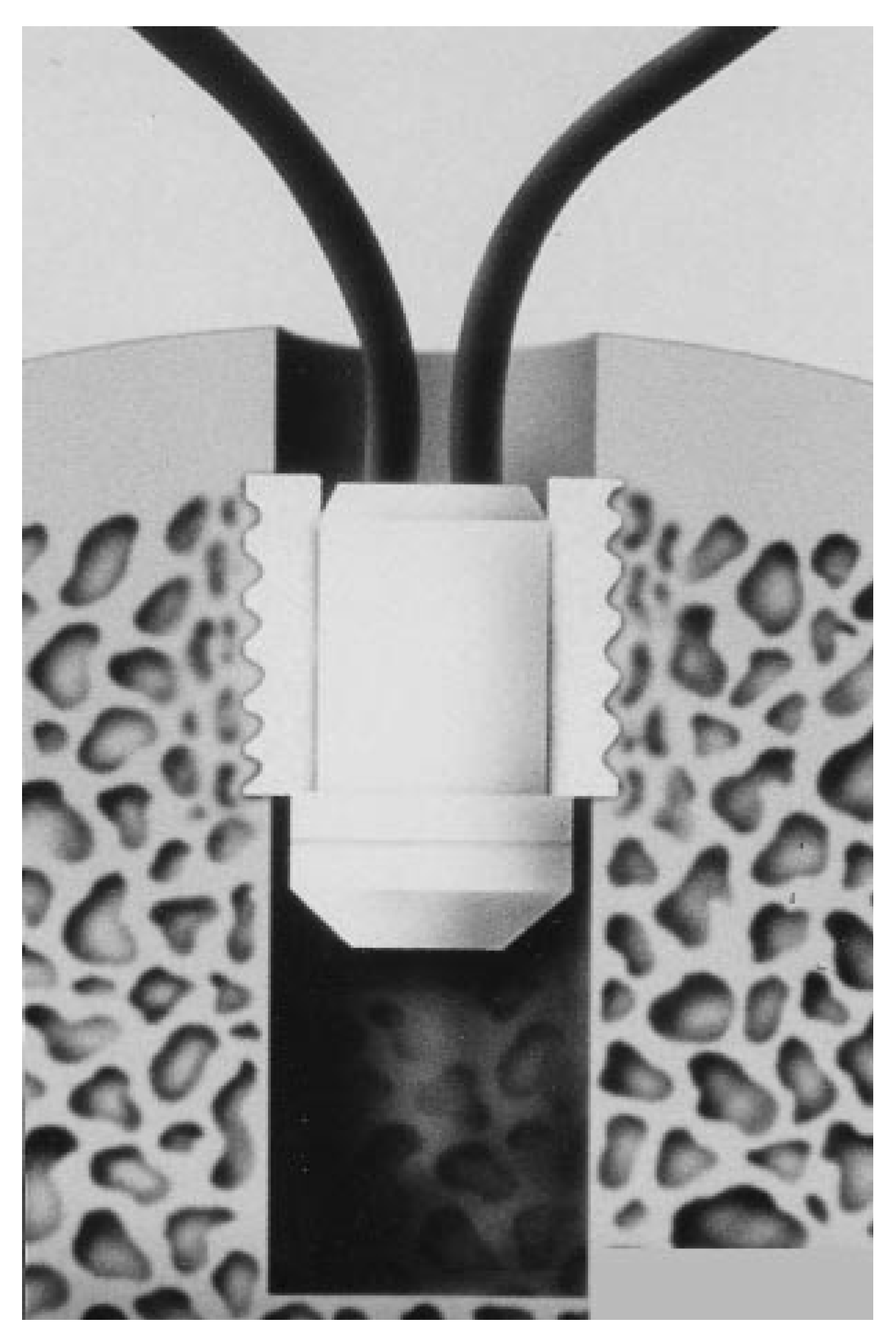
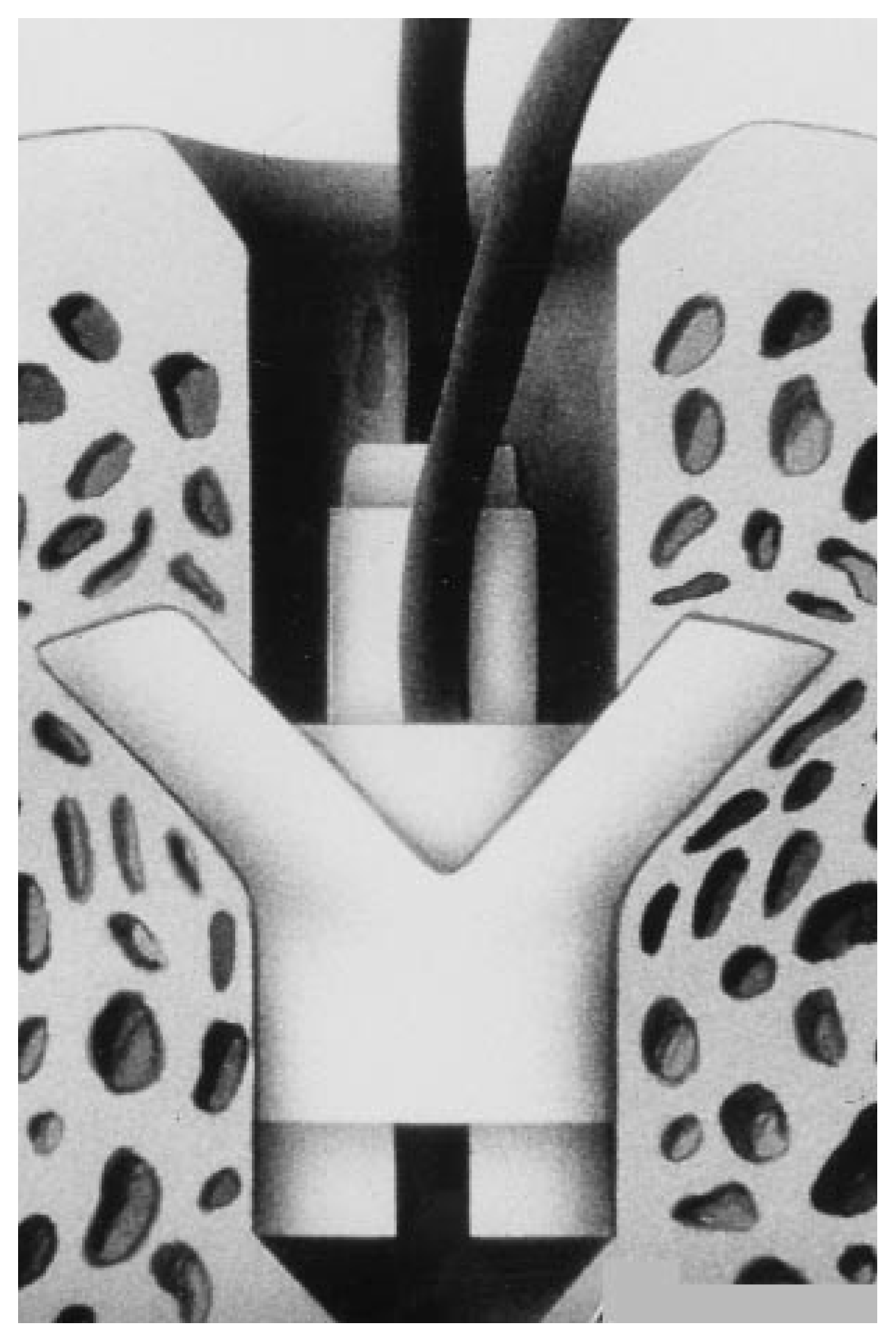
The ROC (Radial Osteo Compression) (Innovasive Devices, Inc, Marlboro, Massachusetts) 2.8-mm- and 3.5-mm-diameter anchors were introduced in 1995 for tendon and ligament anchoring. A mini-ROC (1.9-mm- and 2.3-mm-diameter sizes) was introduced in 1996 for hand and forefoot surgery. In 1997, the ROC EZ (
Figure 1) and XS (
Figure 2) were introduced as modifications of the original ROC anchor.
The ROC anchor has two components. The first is the drill bit and guide, which comes in three sizes, 2.7 mm, 2.8 mm, and 3.5 mm. The second component is the anchor; this is affixed to either a 10-cm shaft (for open procedures) or an 18-cm shaft (for arthroscopy). The handle consists of a trigger that deploys the anchor. The anchor and shaft form a unit, which is snapped onto the handle prior to use. The anchor is placed into the drill hole and the triggering mechanism is pulled, deploying the anchor into the drill hole. The anchor then expands within the drill hole, securing the anchor to medullary bone. The 2-0 non-absorbable suture is incorporated into the anchor with or without a large cutting needle. The anchor consists of a polypropylene shell with the suture incorporated inside the anchor so that there is no detachment when a pulling force is applied. In situations warranting anchor in soft bone, a ROC XS 3.5-mm anchor is used. It is several millimeters wider than the drill hole, and a portion of the shell expands outward into the soft bone for improved anchoring. According to studies by Innovasive Devices, the manufacturer of the ROC anchors, the pullout strength of the ROC EZ 2.7-mm anchor is 35 to 45 pounds; the pullout strength of the ROC EZ 3.5-mm anchor is 45 to 60 pounds; and the pullout strength of the ROC XS 3.5-mm anchor is 40 to 60 pounds. Pullout is defined as the anchor’s being pulled out of the drill hole, as opposed to the suture’s breaking. The BioROC EZ (Innovasive Devices, Inc, Marlboro, Massachusetts) is a bioabsorbable suture fastener that was recently introduced. This anchor was not included in the current study because it was just released for use in 1997.
This article presents a retrospective study on the use of the ROC EZ 2.7-mm, 2.8-mm, and 3.5-mm and ROC XS 3.5-mm anchors for rearfoot and ankle surgery. The author was interested in determining the ease of deployment of the anchor, the incidence of pullout both intraoperatively and postoperatively, the rate of complications, and the overall success rates of use of this anchor in foot and ankle surgery.
Methods
A 2-year study on the use of the ROC anchor for rearfoot and ankle procedures was conducted. Thirty patients participated in the study. The 2.7-mm, 2.8-mm, and 3.5-mm EZ and 3.5-mm XS anchors were used for rearfoot tendon repairs and ankle stabilizations. The study recorded the success rate and any problems or complications with the anchor, such as pullout after insertion intraoperatively or postoperatively, failure of the handle to deploy the anchor into the bone, suture reaction, and infections. The surgical procedures included detachment and reattachment of the Achilles tendon for removal of insertional calcaneal exostosis, ankle stabilization procedures, posterior tibial tendon transposition, and detachment and reattachment of the peroneus brevis tendon to repair styloid fracture of the fifth metatarsal.
Results
A total of 32 procedures were performed during the 2-year study. There were 26 patients who had ankle stabilizations (1 of whom had bilateral ankle stabilizations), 2 patients with Achilles tendon detachment and reattachment after removal of the calcaneal exostosis, 2 patients who had posterior tibial tendon repair, and 1 patient who had peroneus brevis tendon reattachment to repair a styloid fracture of the fifth metatarsal. A total of 55 anchors were used in the study.
All patients were followed postoperatively for a minimum of 6 months. One patient had less than 50% correction of the talar tilt 3 months postoperatively. The remaining 25 patients who had ankle stabilizations had from 90% to 100% correction of the talar tilt. Two patients had no correction after the anterior talofibular ligament was corrected surgically. This was due to failure of the surgical procedure, not of the anchor; careful review of these cases showed that the drill for the anchor missed the mark, causing the anchor to be deployed incorrectly. In two cases, the ROC anchor pulled out of the drill hole in the neck of the talus after an acute ankle sprain in the first 3 months after surgery. For both of these patients, new anchors were inserted into the neck of the talus where the anterior talofibular ligament graft had been disrupted by the injury. One patient had a pullout of another type of anchor, which was replaced with a ROC EZ 3.5-mm anchor. There was one case of wound dehiscence, and no infections occurred. Intraoperatively, there were ten failures involving the firing mechanism. There were two cases in which the drill hole was too large for the anchor, although the appropriate drill bit for the anchor was purportedly used. There were four intraoperative pullouts of the anchor. Four more failures occurred during deployment of the anchors.
Two patients had preexisting conditions that were exacerbated after the postoperative recovery period. One patient had ongoing pain in the Achilles tendon insertion owing to heavy adhesions and nerve entrapment from a severe suture reaction; most of the suture was removed from the dehisced wound. There was subsequent loss of correction, and another surgery was necessary to reattach the Achilles tendon to the posterior calcaneus. The first anchor used was a Mitek and the second was a ROC XS 3.5-mm anchor. After considerable rehabilitation, the patient did not lose any function but continued to experience periods of severe pain.
Discussion
The results of this study indicate that the ROC anchor is a reliable instrument for forefoot, rearfoot, and ankle surgery. There were ten failures intraoperatively and two pullouts postoperatively due to acute ankle sprains. Four intraoperative failures were attributed to operator error and improper use of the equipment. In one case, the surgeon applied excessive pressure on the handle, causing the anchor interface to loosen and bend. In another case, when the anchor was deployed, it failed to expand properly within the drill hole. On two occasions, a 2.8-mm drill bit was used instead of a 2.7-mm bit; the 2.8-mm drill bit was for the old ROC unit, and a 2.7-mm ROC EZ was deployed but failed to hold within the drill hole, which was too large. A ROC XS was then used and the procedure was completed successfully.
For ankle stabilizations, the postoperative results, as determined by postoperative stress x-rays, were at least equal to the results obtained with the use of other anchoring devices. A minor radiographic disadvantage is that the ROC anchor is not seen on x-rays. However, in most cases, especially after surgery, the drill hole sites are easily seen on lateral views. The pullout strength of the ROC and other anchors was tested, and the ROC was found to be equally strong in terms of both the suture material and the amount of force needed to pull the anchor out of the test material.
All of the anchoring devices used by the author, including the ROC anchors, have a shaft-anchor interface that allows the anchor to be inserted into the drill hole. The difference is that the ROC anchor requires a deployment mechanism, which can create problems. However, the author has experienced similar problems with other anchoring devices when inserting the anchor into the drill hole or directly into the bone. When the ROC or other anchors are used, the suture should be covered with copious soft tissue to avoid irritation of vital structures such as tendons, nerves, and vessels. Likewise, the anchor should be positioned away from joints and tendon insertions to prevent irritation and adhesions.
If it is necessary to remove the ROC anchor, this can be difficult. However, this is true with all anchors. The author uses a trephine over the anchor, and the anchor and some of the bone are removed simultaneously. In this study, no cases required removal of the ROC anchor with the use of a trephine.
Conclusion
The ROC anchor is a useful and reliable device. Modification in the shaft-anchor interface is recommended to reduce the intraoperative failure rate and to make it more difficult for operator error to affect deployment of the anchor. For example, the shaft-anchor interface could be made stronger so that it does not easily bend during deployment. It is also recommended that surgeons practice deploying the ROC anchor prior to surgery if they have not used this anchor before. A certain amount of pressure is needed to deploy the anchor properly.
Acknowledgment. Innovasive Devices, Inc, Marlboro, Massachusetts, for the illustrations.
References
DOCKERY GL: The Romano drill: a new surgical curved drill system. J Foot Ankle Surg 34: 273, 1995.
RICHMOND JC, DONALDSON WR, FU F, ET AL: Modification of the Bankart reconstruction with a suture anchor: report of a new technique. Am J Sports Med 19: 343, 1991.
YU GV, CHANG T, WHITE JM: Soft tissue anchor systems. JAPMA 84: 157, 1994.
PEDERSEN B, TESORO D, WERTHEIMER SJ: A new technique for tenodesis and ligamentous repair of the foot and ankle. J Foot Surg 30: 48, 1991.
HANNA JR, RUSSELL DR, GIACOPELLI JA: Repair of distal tendo Achillis rupture with the use of the Mitek Anchor System. JAPMA 83: 663, 1993.
CAWLEY P: Technical Report: Comparative Evaluation of Bone Suture Anchor Systems in Human Cadaveric Shoulders, DonJoy Biomechanics Research Laboratory, Carlsbad, CA, 1989.
EDELMAN W: Five suture anchors undergo bench comparison. Orthop Today 12: 7, 1992.