This study sought to investigate the short-term efficacy of the modified Austin bunionectomy. The authors undertook a comparative examination of preoperative and postoperative weightbearing dorsoplantar x-rays of the feet of patients who had undergone an Austin bunionectomy procedure for the correction of hallux abducto valgus deformity.
The Austin bunionectomy has been refined over the years; the modified procedure used in this study is that described by Boberg et al. [
1] It includes a trans-positional V metatarsal head osteotomy, a lateral first metatarsophalangeal joint capsulotomy, an aductor hallucis tenectomy, a medial first metatarsophalangeal joint capsulorraphy, and internal Kirschner wire fixation of the osteotomy.
Various authors [
2,
3,
4,
5] have emphasized the importance of using radiographic measurements as an aid in planning the surgical technique to be used in the correction of hallux abducto valgus deformities. These measurements include the hallux abductus angle, metatarsus primus adductus angle, first metatarsal protrusion distance, and tibial sesamoid position.
Despite the popularity of the Austin bunionectomy, there are surprisingly few reports in the literature of radiographic changes following the procedure.
Most reports have discussed certain radiographic measurements to the exclusion of others. A summary of reported radiographic changes following the Austin bunionectomy is given in
Table 1. [
5,
6,
7,
8,
9,
10,
11,
12,
13] Only two previously published reports comment on radiographic changes in hallux abductus angle, metatarsus primus adductus angle, first metatarsal protrusion distance, and tibial sesamoid position. [
5,
6]
Materials and Methods
Thirty patients of one of the authors, selected at random, who had undergone a standard modification of the Austin bunionectomy for the correction of hallux abducto valgus deformity were included in the study. Of the 30 subjects, 27 were female and 3 were male. The mean age for the female subjects was 45 years (range, 24 to 63 years), and the mean age for the male subjects was 46 years (range, 42 to 53 years).
Patients with hallux limitus or degenerative joint disease of the first metatarsophalangeal joint affecting the range of motion of the joint were not included in the study. Similarly, patients who had a transfer of the adductor hallucis tendon rather than an adductor hallucis tenectomy, which may have had an effect on the postoperative radiographic measurements of hallux abductus angle, metatarsus primus adductus angle, or tibial sesamoid position, were also excluded from the study. In all cases, the axis of the first metatarsal osteotomy was angled perpendicular to the second
metatarsal and internal fixation was achieved with a single buried 1.6-mm Kirschner wire.
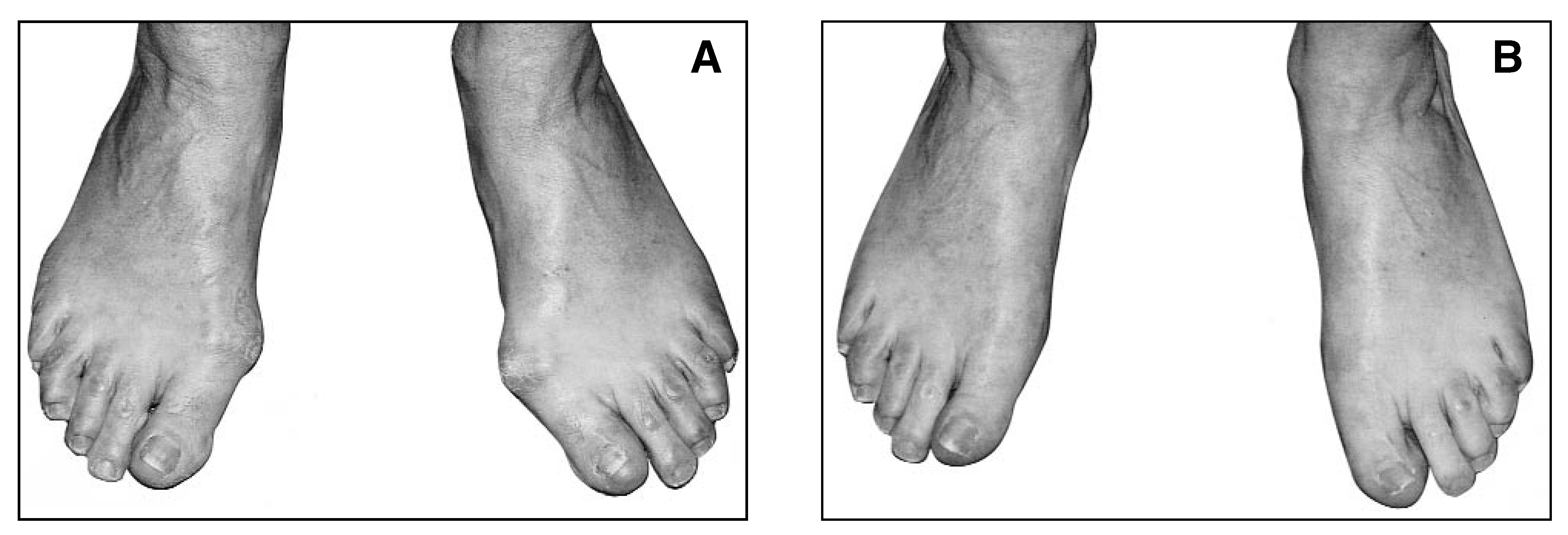
Figure 1 and
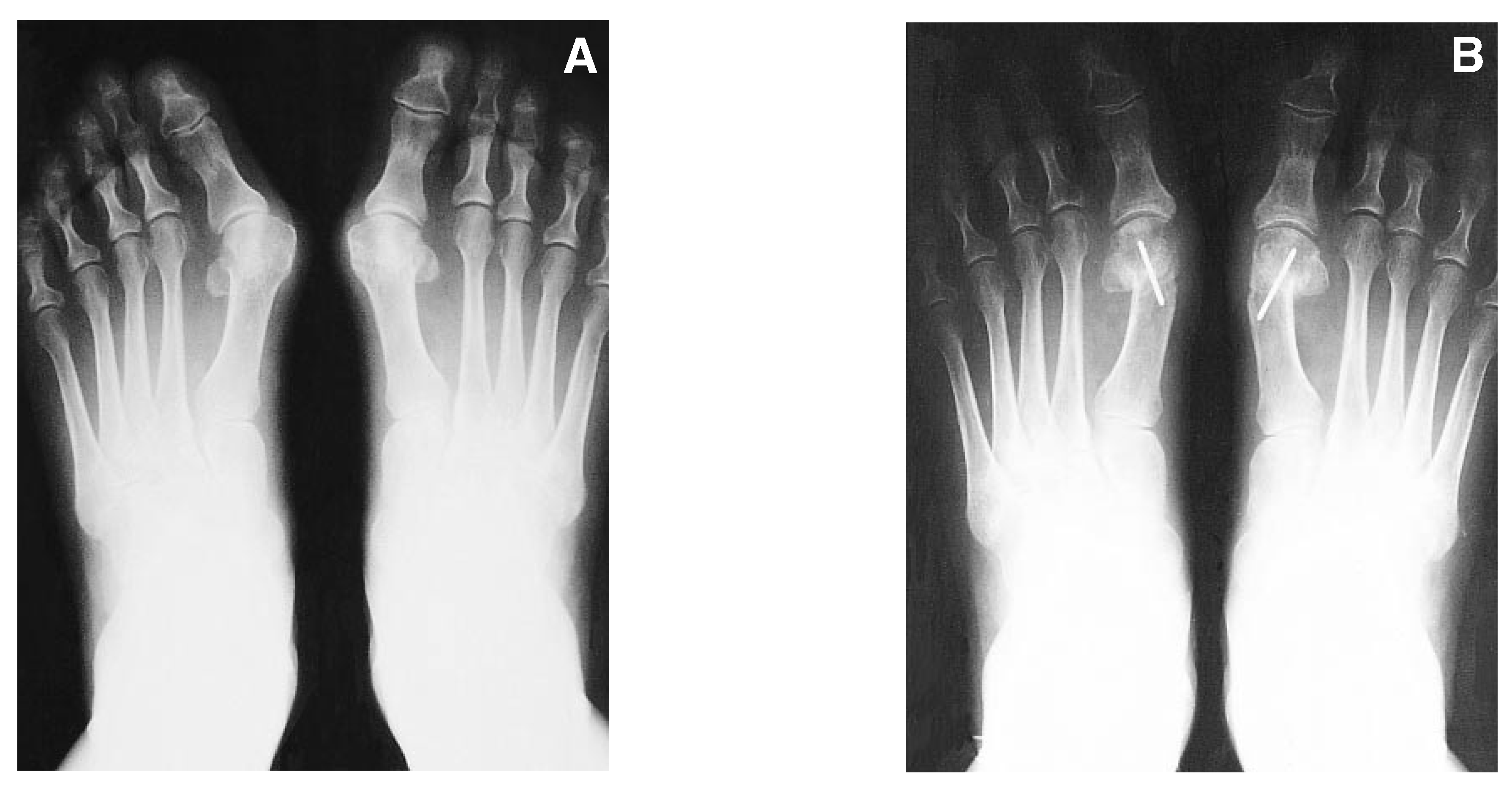
Figure 2 show representative clinical and radiographic appearances both before and after the Austin bunionectomy. Preoperative and postoperative weightbearing dorsoplantar x-rays were examined. Postoperative x-rays were taken as a matter of routine to assess osseous healing and alignment at a mean time of 10 weeks (range, 6 to 46 weeks) following the surgery. Radiographic measurements were made in the standard podiatric manner in accordance with previously reported methods. [
2,
3,
14] The radiographs were marked with a fine-pointed x-ray pencil and angles were read using a Picket Tractograph.® (MDM Manufacturing Co, New York, NY.) Measurement of the relative lengths of the first and second metatarsals was accomplished using a standard drawing compass and transparent metric ruler.
The 30 subjects participating in the study generated 42 separate sets of preoperative and postoperative x-ray measurements that were then used in the analysis of measurement relationships. For all statistical tests, a probability level of P < 0.05 was used to determine significant differences. To assess the reproducibility of the authors’ measurement of the radiographs, repeated trials were conducted on a series of measurements of hallux abductus angle, metatarsus primus adductus angle, and first metatarsal protrusion distance, which indicated satisfactory measurement reliability. The coefficient of variation was 3% for hallux abductus angle measurements, 5% for metatarsus primus adductus angle measurements, and 10% for first metatarsal protrusion distance estimations. While the last figure may seem unacceptably high, this translates to ±1 mm, which was the minimum unit of linear measurement used. Tibial sesamoid position was categorized with absolute consistency; thus no statistical analysis was thought to be necessary for this measurement.
The means and standard deviations of the preoperative and postoperative x-ray measurements of the hallux abductus angle, metatarsus primus adductus angle, and first metatarsal protrusion distance were calculated and a paired Student’s t-test was used to assess the results for significant changes in the measurements.
To determine whether the surgical procedure had reduced the measurements of hallux abductus angle and metatarsus primus adductus angle to reported normal values, the “accepted normal values” summarized by Laden and Marcus [
15] were compared with the calculated mean preoperative and postoperative values.
Results
A significant reduction of approximately 50% was noted for the postoperative mean values of hallux abductus angle, metatarsus primus adductus angle, and tibial sesamoid position. An average shortening of 4 mm for first metatarsal protrusion distance was also noted. Preoperative and postoperative radiographic measurements are presented in
Table 2.
The postoperative changes in hallux abductus angle, metatarsus primus adductus angle, and first metatarsal protrusion distance were found to be significant (
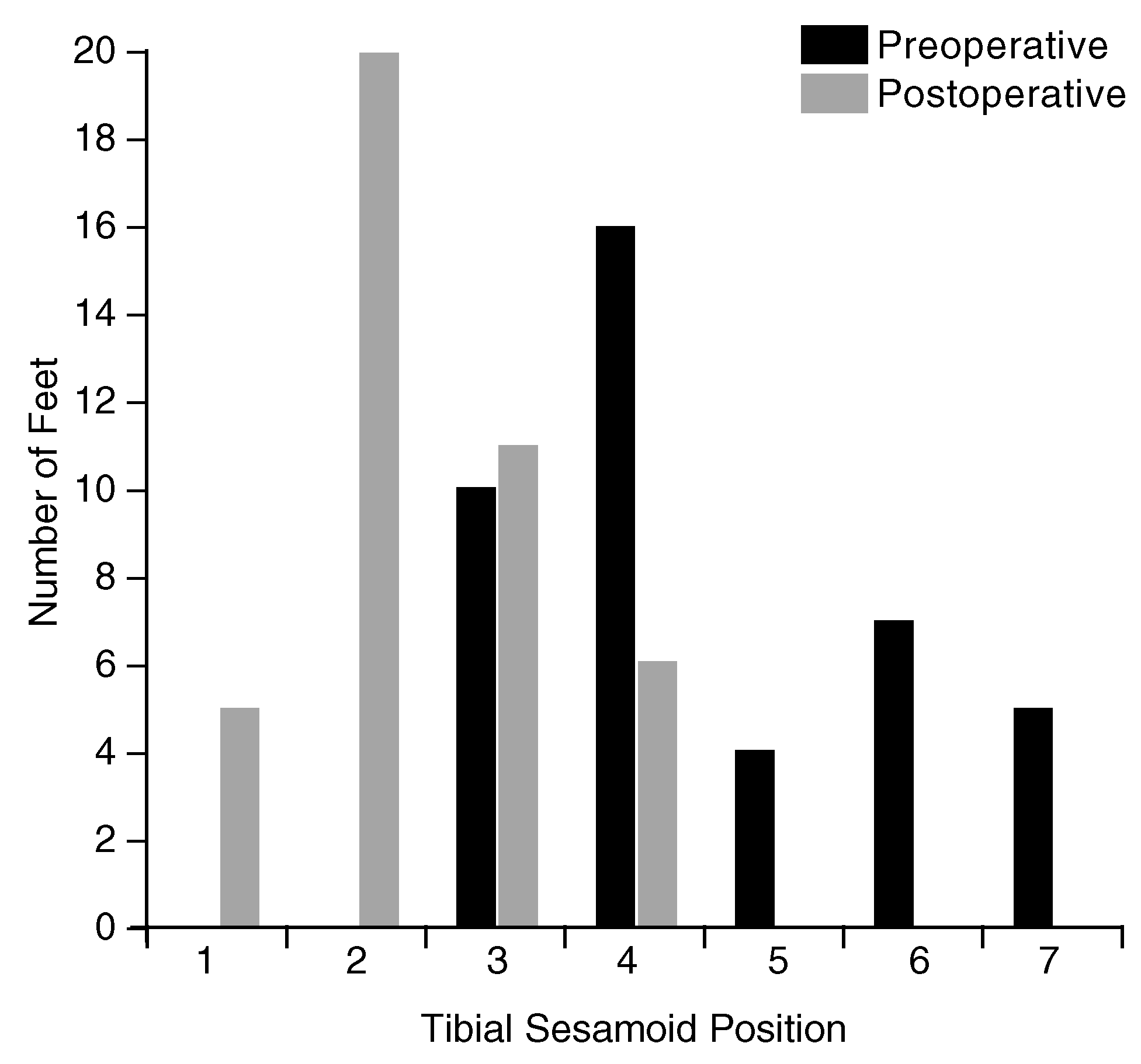
P = 0.0001). The postoperative changes in tibial sesamoid position demonstrate a reduction of an average of 2.2 positions compared with the preoperative values and are illustrated in
Figure 3.
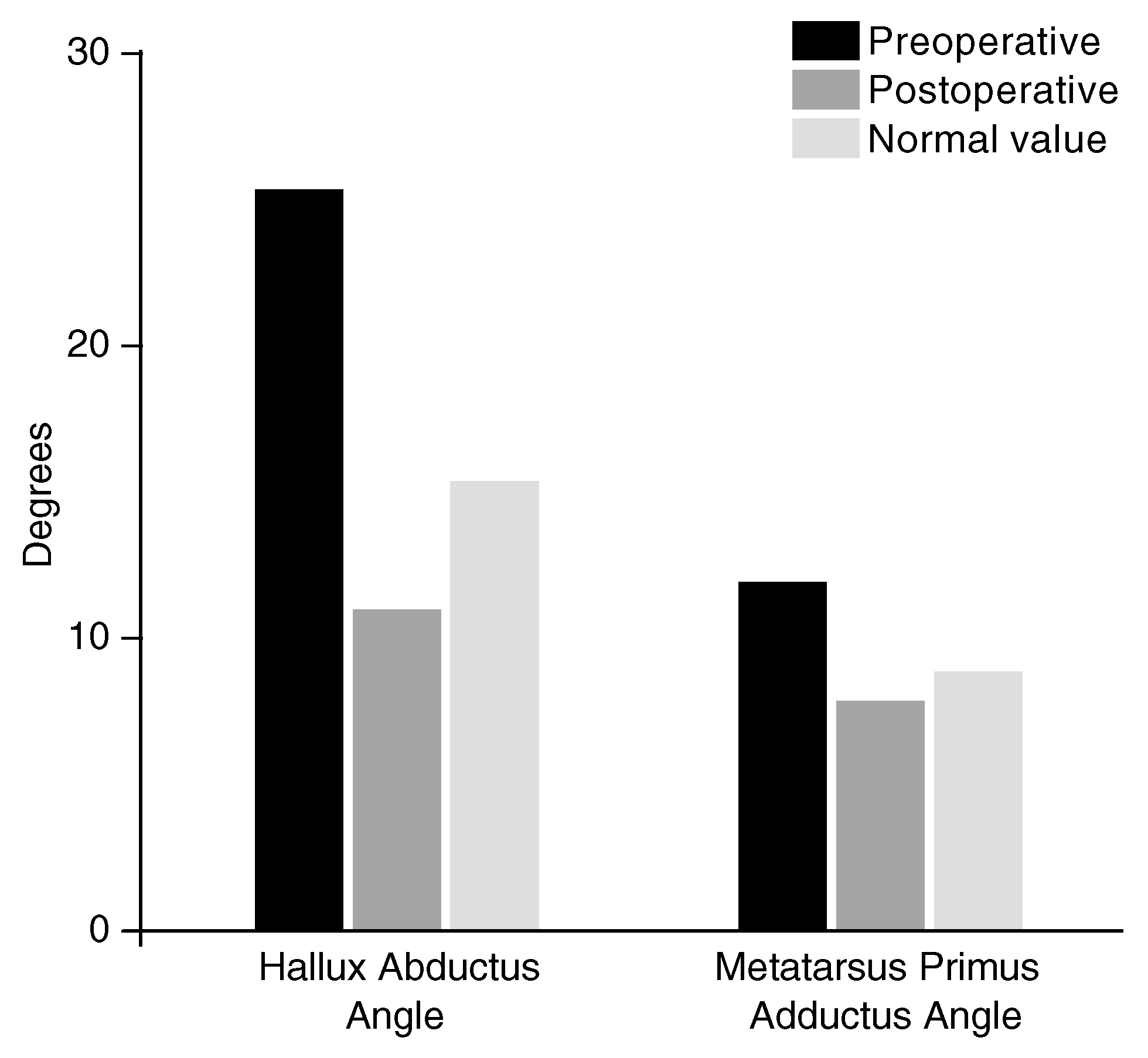
Analysis of preoperative and postoperative measurements was conducted to determine whether the surgical procedure significantly reduced the hallux abducto valgus deformity to normal values.
Figure 4 summarizes the radiographic findings that demonstrate significant changes as a result of the operation, producing measurements below reported normal values.
Discussion
To the authors’ knowledge, no research has been published that specifically assesses whether the Austin bunionectomy would reliably reduce preoperative x-ray measurements to the accepted age-referenced, normal values of hallux abductus angle and metatarsus primus adductus angle. This study shows that the modified Austin procedure, as performed on this group of subjects, significantly reduced the postoperative measurements of hallux abductus angle, metatarsus primus adductus angle, tibial sesamoid position, and first metatarsal protrusion distance to below-normal values, indicating that the procedure is capable of producing considerable postoperative changes in radiographic parameters of the forefoot.
In this study, the preoperative hallux abductus angle values ranged from 16° to 41° (mean, 25.2°) and metatarsus primus adductus angle values ranged from 9° to 16° (mean, 12°). The mean postoperative reduction in hallux abductus angle was 14.3°, and the mean reduction in metatarsus primus adductus angle was 5.2°. The tibial sesamoid position was reduced by a mean of 2.2 positions, while the length of the first metatarsal was reduced by a mean of 4.1 mm. These findings compare favorably with those of the studies reported in
Table 1.
Postoperative hallux abductus angle may depend on a number of factors, including metatarsus primus adductus angle, first metatarsal protrusion distance, metatarsus adductus, sesamoid function, and the success of soft-tissue balancing around the first metatarsophalangeal joint. It seems logical, however, that a high preoperative value of the hallux abductus angle would be more difficult to correct than a lesser degree of deformity.
Postoperative findings with regard to metatarsus primus adductus angle and first metatarsal protrusion distance may be explained in structural terms. The amount of correction of the metatarsus primus adductus angle possible at surgery via metaphyseal osteotomy is related to the extent of the preoperative deformity and limited by the width of the metatarsal head. With regard to first metatarsal protrusion distance, the causes of metatarsal shortening following osteotomy are well established and include loss of bone due to the thickness of the saw blade as well as to thermonecrosis, and bone absorption from the surfaces of an osteotomy site during normal healing. [
16,
17] Angulation of the axis of the osteotomy relative to the second metatarsal has been described to lengthen, shorten, or maintain the relative length of the first metatarsal. [
1] The results of this study suggest that to maintain the relative length of the first meta-tarsal, the guide wire used to direct the apex of the osteotomy should be directed to slightly lengthen the first metatarsal during surgery, to allow for some shortening during bone healing.
The results of this study should be interpreted in light of possible sources of bias and experimental error. No control group was used to compare the results of the surgical procedure with those of an alternative procedure or operator. The degree of variation for possible interobserver bias was not examined.
The preoperative and postoperative radiographs were not performed under controlled circumstances but were carried out by qualified radiographers without supervision by the authors. Therefore, there exists the possibility of intrasubject and intersubject x-ray image distortion or magnification due to slight variations in patient positioning and radiographer technique. This study was restricted both in terms of sample size and through the lack of a control group. Further research on similar bunionectomy procedures conducted with more patients over a longer period of time would provide a useful comparison of the effectiveness of the modified Austin procedure with other techniques.
Conclusion
The modified Austin bunionectomy procedure produced significant reductions in all x-ray parameters associated with this deformity, to below-normal values.