Talonavicular coalitions are reported to be among the most uncommon and least documented of all tarsal coalitions. Thus far only 46 cases have been documented, with the first case reported in 1879 by Anderson [
1,
2,
3,
4,
5,
6]. However, Schreiber [
7] asserted that talonavicular coalitions may be more common than the literature indicates [
7], as these types of coalitions are frequently noted as secondary findings on radiographs.
Tarsal coalitions may be caused by a failure of differentiation and segmentation of the primitive mesenchymal tissue, resulting in lack of joint formation [
8]. It was theorized that talonavicular fusion may be caused by the accessory bone os tibiale externum [
1,
2,
3,
7,
8,
9]. However, this theory failed to explain the presence of tarsal coalitions in the fetus [
8]. There have been several documented cases of a familial inheritance of talonavicular coalitions. Leonard [
10] conducted hereditary studies of tarsal coalitions and concluded that congenital tarsal fusions are most likely an inherited unifactorial autosomal dominant disorder, with almost full penetrance. There have been additional reports of talonavicular synostosis occurring simultaneously with symphalangia of certain digits of the hand [
11]. In 1969, Geelhoed et al11 documented a hand-and-foot syndrome showing talonavicular fusions occurring simultaneously with symphalangia found on an inherited basis. There have also been several reports documenting the coexistence of carpal and tarsal coalitions [
6]. The talonavicular coalition ossifies between 3 and 5 years of age. The occurrence of symptoms and the age of onset depend on the period during which ossification of the coalition takes place [
5]. Thus clinical symptomatology related to the fusion may be noticed in a child as young as 2 to 3 years of age [
1,
6,
9,
12,
13].
Talonavicular coalitions have been associated with a variety of biomechanical abnormalities, including peroneal spastic flatfoot, pronatory deformities, and biomechanical imbalances generally due to improper insertions of muscle tendons at the joint coalition [
6].
Talonavicular fusions usually occur bilaterally. It is believed that this condition is usually asymptomatic and seldom recognized during infancy and early childhood.1 Symptoms often begin between the ages of 12 and 15 years. However, symptomatic talonavicular coalitions have been reported in patients as young as 2 years of age [
1].
Various factors are associated with the symptomatology of talonavicular coalitions and coalitions in general. All fusions at birth are fibrous or cartilaginous in nature, allowing some motion. Once ossification of the coalition has taken place, motion is more restricted, which precipitates the symptoms and adaptive changes. A logical assumption is that when a child first begins to walk, he or she experiences limitation of motion to some degree. This leads to increased stress and strain on the foot, which becomes even more apparent as the child develops and grows and the feet support additional body weight. This excess stress makes the patient more susceptible to degenerative changes during adult life. As the child experiences a progressive restriction of lower-extremity biomechanical range of motion, the body will begin to compensate for this limitation of motion either proximal or distal to the joint coalition [
5].
Patients with talonavicular coalitions commonly complain of a hard prominence on the medial side of the foot rather than pain [
14]. However, the prominence is usually noticed when a child changes shoes or begins to participate in a new sporting activity.
The discomfort that the patient may experience is usually relieved with rest. It should be noted that patients may present with a history of trauma or other multiple deformities [
4,
6]. Although more common with other tarsal coalitions, peroneal spastic flatfoot can be associated with talonavicular fusions [
13]. In a gaitanalysis study done by Pontious et al [
1]. a 13-year-old patient with bilateral talonavicular synostosis had diminished contact and midstance phase, with a resultant prolonged propulsive phase. An additional finding was increased pressure under the first metatarsophalangeal joint, with hyperkeratosis noted under the first metatarsal head.
Case Presentation
A 5-year-old girl presented with her mother to the pediatrics department at the Foot Clinics of New York. The patient’s mother complained that her child had an enlarged bone on the instep of each of her feet, causing her child pain and discomfort. Although the mother had noticed the problem at the patient’s birth, it had not become symptomatic until her child attempted to wear a conventional shoe. Previously, the patient’s primary shoes had been sneakers. The patient denied any history of trauma. The patient’s medical history, family history, and review of systems proved noncontributory. There was no history of prior surgeries.
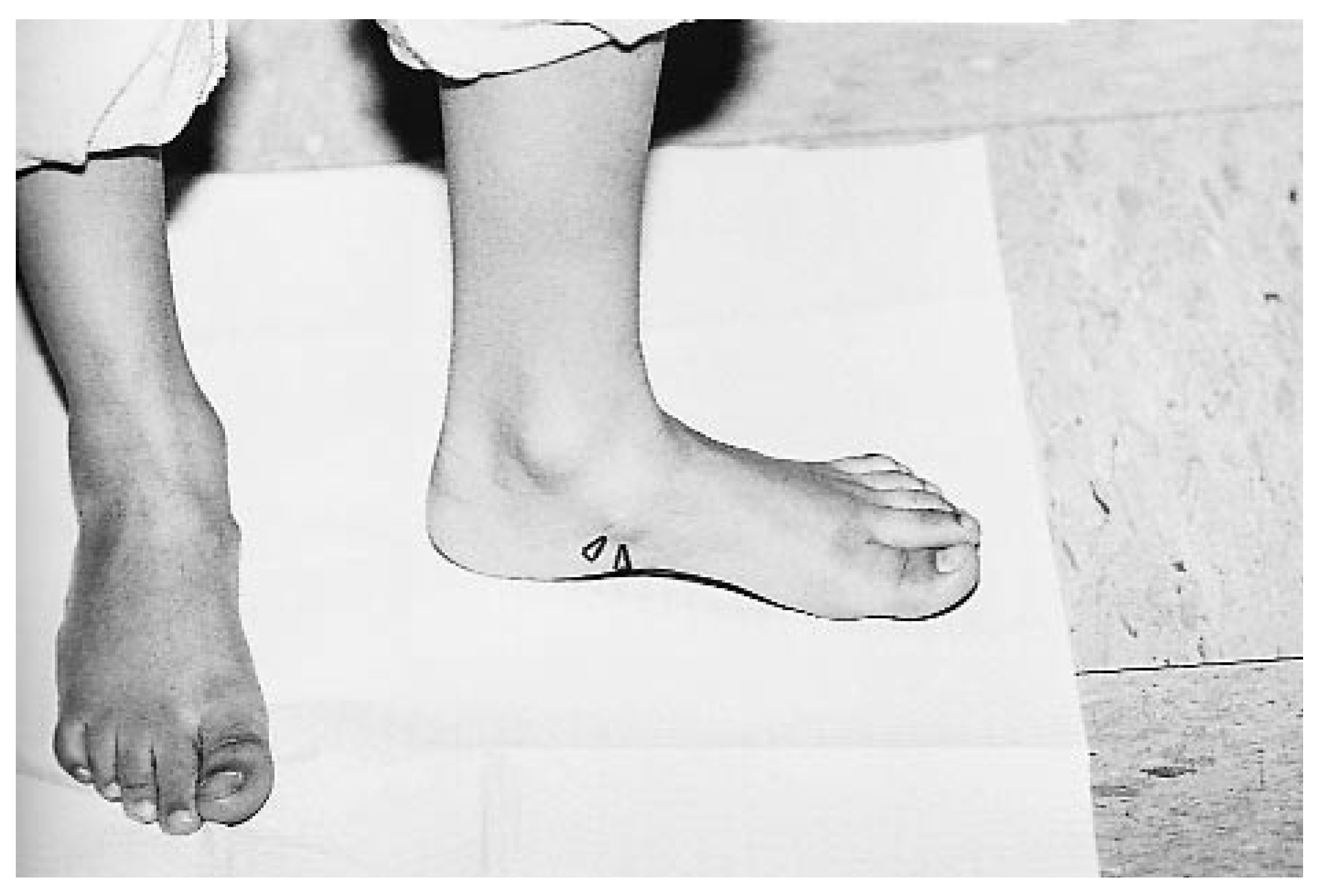
On physical examination, the patient’s neurovascular status was intact, and muscle power was within normal limits. The dermatologic examination revealed mild erythema with signs of irritation in the area of the navicular tuberosity bilaterally. On palpation of the same area, it proved to be nontender; in fact, it was “bone solid” to the touch.
On initial examination of this area, the bony prominence appeared to be an os tibiale externum or a medial talar bulge (
Fig. 1). The musculoskeletal examination revealed an overall decrease in the range of motion at the subtalar and midtarsal joints bilaterally. The patient’s arch morphology was low in both the weightbearing and nonweightbearing positions bilaterally. Hallux abductus was noted bilaterally. The patient’s neutral calcaneal stance was 3° varus on the right and 4° varus on the left; the relaxed calcaneal stance was 2° valgus bilaterally. The patient’s stance angle showed 20° of abduction bilaterally with a wide base of gait.
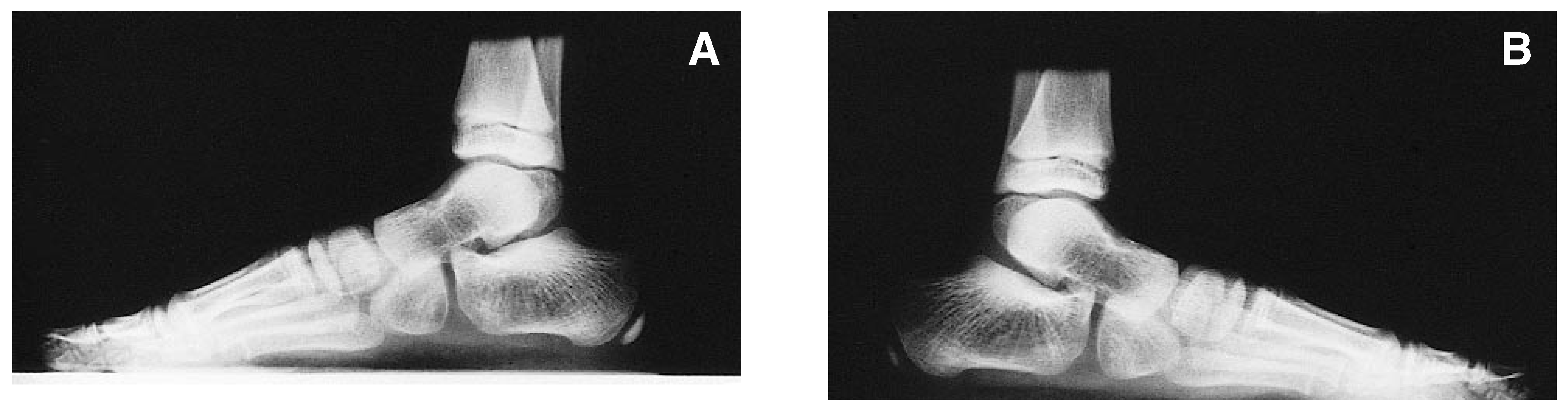
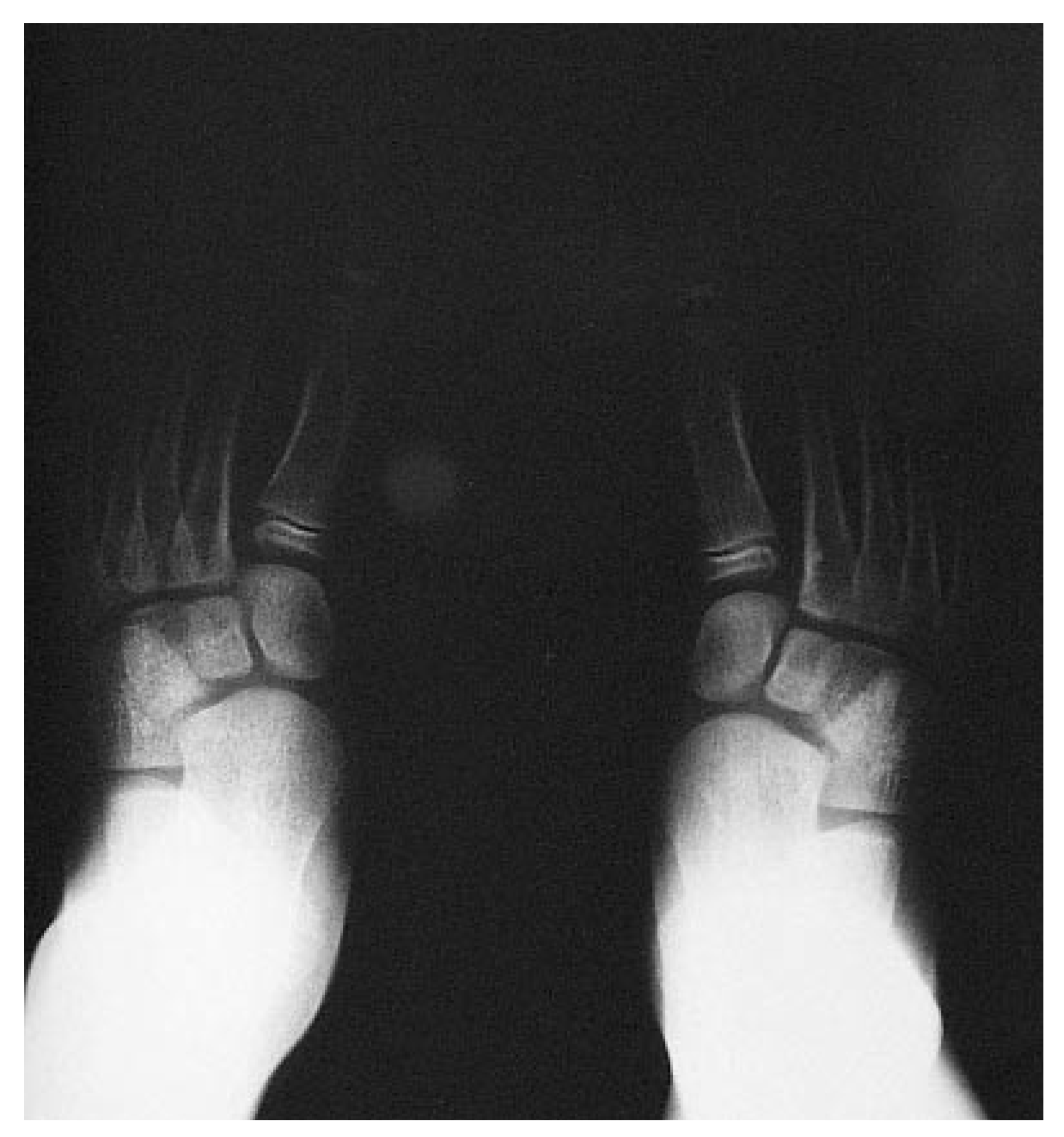
Plain radiographs revealed bilateral absence of the talonavicular joints, a low calcaneal inclination angle, and an increased talar declination angle. The only other distinguishing feature was an early appearance of the calcaneal apophysis (
Fig. 2 and
Fig. 3).
Treatment
At the follow-up visit the patient brought the conventional-type shoe that precipitated the discomfort. The patient was treated successfully with 1/4-inch U-shaped well-skived felt dispersion pads that fit around the prominent part of the navicular. These dispersion pads were placed in both of the patient’s shoes to alleviate the irritation and pressure. The patient was casted in the nonweightbearing neutral position bilaterally for functional foot orthoses. This type of orthosis was used to decrease the pronatory motion that was still available at the subtalar and midtarsal joints: This would help prevent the talonavicular unit from plantarflexing and adducting into the medial aspect of the orthosis and shoe during closed kinetic chain pronation.
The orthotic shell was made of polypropylene, a thermoplastic polymer (Thermoplast-I®
(Rohm Haas, Germany.) and Thermo-plast-II®
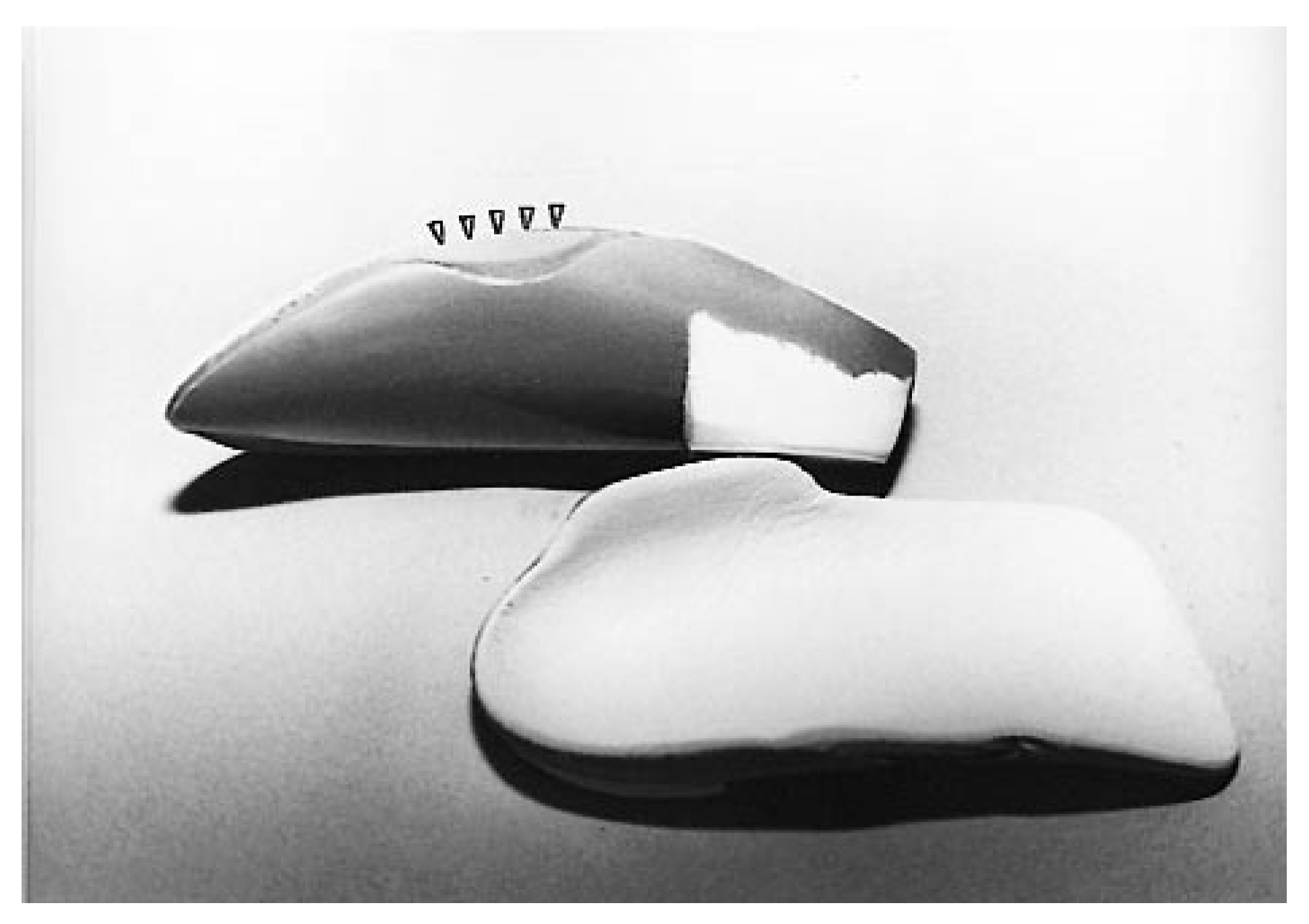
(Rohm Haas, Germany.)). The shell extended to the metatarsal heads and was 3 mm thick, providing moderate flexibility. The advantage of constructing a shell from this material is that it is both difficult to crack (because of its flexibility) and highly effective in controlling the foot during physical activities. The shell was designed with a high medial flange, a lateral clip, a deep heel seat, and a 3° rearfoot varus posting bilaterally. The orthosis was similar in appearance to a University of California Biomechanics Laboratory (UCBL) foot orthosis. The structure of this orthosis thus far is a fairly common one for a pediatric patient under the age of 6 years with a hypermobile flatfoot. However, what makes this orthosis specifically tailored to the pediatric patient presenting with a talonavicular fusion is the shell of the orthosis, which was cut to form a shallow U-shaped dispersion around the navicular (
Fig. 4). This area of dispersion as well as the entire orthosis was covered in 1/16-inch PPT® (Langer Biomechanics Group, Deer Park, NY.), an open-cell polyurethane foam that provides the patient with good shock attenuation and excellent dissipation of heat. Also, PPT is a pliable material should the physician need to make any modifications once the patient has begun wearing the device.15 Polyvinyl chloride (Biofoam® (Smithers Biomedical Systems, Kent, OH.)) was used as a top cover for cosmesis.
Plantarly, a dual-density heel post was used [
7]. The lateral side of the heel of the orthosis is softer, to provide shock absorption at heel strike, and the medial side is more rigid to provide more support as one rolls into pronation after heel contact.
The authors wanted to further investigate how the patient was adjusting to the new orthoses, and to make sure that there were no new defects or abnormalities in the orthotic material. When the child returned 3 weeks after receiving the orthoses, she was found to be completely asymptomatic. There were no abrasions or areas of irritation, and the patient’s orthoses were intact and in good condition. The patient’s mother related that she was now able to walk in her school shoes comfortably.
Discussion
During infancy, talonavicular coalitions are mostly cartilaginous or fibrous in nature rather than bony. These coalitions will eventually allow for progres-sively less motion at the joint. It is during this stage that symptoms frequently begin to appear [
9,
13]. Symp-toms and complications of untreated talonavicular coalitions can range from mild aching in the midfoot to harmful sequelae, such as osteophytic lipping of the navicular. Talonavicular fusions are often associated with biomechanical imbalances and conditions such as peroneal spastic flatfoot [
5,
6]. Radiographs, if taken at the time of birth, would most likely demonstrate no anomalies, because the navicular does not ossify until approximately 5 years of age [
16]. Therefore, if this type of fusion is present at birth, the child could still be expected to have some motion at the joint and thus be asymptomatic. However, one would expect symptoms to appear as the bones begin to ossify, resulting in increasingly restricted motion. Patients usually experience discomfort after initiation of a new physical activity, a change in shoes, or trauma to the affected area [
13]. The child’s mother had related that the bony protuberance had been present since birth. If the examination of the child’s feet had been performed at a younger age, then perhaps the talus and navicular would have been found to be ossified.
Most of the reports of cases of talonavicular coalition have indicated that standard weightbearing lateral, anteroposterior, and lateral oblique projections are needed to make a definitive diagnosis [
4,
13,
16,
17]. While other diagnostic modalities, such as tomography, may be used, it is believed by Berquist16 that computed tomography is the method of choice for diagnosing tarsal coalitions. However, in cases of talonavicular fusions, this is rarely the protocol, as routine radiographic views are more than sufficient [
4,
16]. It is important to consider primary and secondary radiographic findings in order to diagnose tarsal coalition correctly [
4].
According to Perlman and Wertheimer,4 the major radiographic changes seen with talonavicular coalitions are a decrease in joint space at the talonavicular articulation, a rounding of the naviculocuneiform joint due to limitation of motion at the talonavicular joint, and beaking of the navicular.
If the coalition becomes symptomatic, conservative treatment should be instituted, followed by surgical management if the symptoms persist. Treatment varies according to the type of tarsal coalition, the severity of the deformity, the extent of disability, the degree of pain, the patient’s age, and the types of symptoms (eg, peroneal muscle spasms). Most authors agree that conservative treatment consists of different types of accommodative and rigid orthoses [
5].
A common complaint in patients afflicted with talonavicular coalitions is the hard, bony prominence of the navicular rubbing against the inside of the shoe. A protocol that can be used in patients with this phenomenon or similar anomalies is the shallow U-shaped dispersion around the navicular within the shell of the orthosis. This dispersion was specifically tailored for the child’s presenting complaint. While patients may present under a wide range of circum-stances, easily performed examinations, such as gait analysis, passive range of motion of the joints in the lower extremity, and radiographic examination of the patient’s foot, are all that is needed to make an appropriate diagnosis and manage this condition.
Summary
The authors have presented a review of the literature, a case report, and a conservative treatment regimen for the pediatric patient afflicted with talonavicular coalitions. Although the orthoses described cannot be considered unique, their use in this case is. A full biomechanical examination, musculoskeletal evaluation, and gait analysis are essential. Early detection is often the key to successful management of congenital deformities or pathologic conditions in the podopediatric patient.