The literature is replete with references to peroneal spastic flatfoot in the presence of demonstrable tarsal coalitions, but little has been written on the condition as a separate entity. The purpose of this article is not to exhaustively discuss peroneal spastic flatfoot with tarsal coalition, but rather to emphasize that the condition can exist in the absence of tarsal coalition, in which case it may be followed differently. This article offers a suggested protocol for diagnosing and treating children presenting with peroneal spastic flatfoot in the absence of coalition. A salient feature of this protocol is the use of the common peroneal nerve block. With or without coalition, the common peroneal nerve block appears to be an effective diagnostic modality. If motion of the subtalar joint is increased after injection, the likelihood of a demonstrable coalition is decreased. Additionally, the injection may very well help relieve the symptomatology of peroneal spastic flatfoot with or without coalition.
A caveat is warranted with respect to the cases described in this article: This was not a formal study, but rather a retrospective reflection on five cases in which the protocol was followed. This makes the study anecdotal rather than scientific. It should be noted that one modality not utilized was magnetic resonance imaging (MRI), as will be discussed later.
Etiology
Although tarsal coalitions have been reported as early as 1750 [
1], Sir Robert Jones [
2] appears to have been the first author to recognize and clinically describe peroneal spastic flatfoot. Since then, many authors have attributed the condition to tarsal coalitions [
3,
4,
5,
6,
7]. Coalitions are the most likely cause of peroneal spastic flatfoot [
8], but not the only causative factor [
5,
9]. While most authors make only passing reference to the peroneal spasm that presents without coalition, some authors recognize that the problem may arise from other factors
de novo [
5,
7]. Johnson [
5] notes that any lesion capable of inflaming the peritalar joints may create a protective contraction of the peroneal (and other) muscles. Etiologies of peroneal spastic flatfoot cited by Johnson include tuberculosis, osteomyelitis, trauma, osteoarthritis, rheumatoid arthritis, Sudeck’s atrophy (reflex sympathetic dystrophy), nonspecific tarsal synovitis, and occupational strain. Others have offered the following as causes of the noncoalition peroneal spastic flatfoot: osteochondral fractures, osteoid osteoma, and fibrosarcoma [
10]; rheumatoid arthritis [
11]; gout, post-traumatic arthritis, acromegaly, osteitis deformans, and osteochondrodystrophy [
12]; dysplasia epiphysealis hemimelica (Trevor’s disease) [
13]; any pain surrounding the ankle or subtalar joint [
14]; any circumstances that might restrict movement and otherwise alter the biomechanics of the talocalcaneonavicular joints [
7]; and overzealous clubfoot casting, postoperative subtalar arthrodesis, and synovial irritation created by altered biomechanics of the foot [
15]. Lapidus [
16,
17] has postulated that stress on the interosseous and talocalcaneal ligaments is increased with inversion and relaxed upon eversion of the subtalar joint. Kyne and Mankin [
18] explored this concept further and found that there was an increase in intra-articular pressure in the talocalcaneal joint with inversion and a decrease with eversion. Thus a patient may develop a peroneal spastic flatfoot in “splinting” the subtalar joint into the reduced-pressure configuration. It should also be borne in mind that ankle sprains have been implicated in tarsal coalitions [
19,
20] and may play a role in the formation of spastic flatfoot. Doig and Menelaus [
21] note that there appears to be an association between subtalar arthritis and slipped capital femoral epiphysis, resulting in peroneal spastic flatfoot. They postulated that in cases with concurrent pathologies, an immunologic disorder might be an underlying cause.
Regardless of the precipitating factor, most authors agree that the peroneal muscles contract or shorten as a protective mechanism or “reflexive arc” to reduce or eradicate pain [
17,
18,
22,
23]. Overall, the musculature splints the subtalar and ankle joints against discomfort or pain, maintaining an everted attitude of the rearfoot. This splinting results in an adaptive, functional shortening, with tautness or contracture of the muscle(s) or the musculotendinous unit [
3,
7,
14,
22]. The peroneus brevis muscle is most often implicated, but the peroneus longus, peroneus tertius, and extensor digitorum longus muscles may also exhibit contracture in peroneal spastic flatfoot [
7,
15]. Most authors also maintain that the spasm is not a true muscle spasm but a tonic contracture resulting in increased tension [
3,
5,
8,
23]. In other words, it is an organic shortening of the muscle, not a neurologic clonus [
3,
14]. However, based on the use of electromyography, Blockey [
24] believed that while there was increased tension in the peroneus brevis, there was no shortening or contracture. He found no motor-unit activity in the peroneus brevis muscle in two cases but also noted that his results may be suspect owing to his lack of technical proficiency with the electromyograph. Kaplan et al [
25] believed that there was a true contracture of the peroneus brevis but only a functional shortening of the peroneus longus because of the increased distance from its origin to its insertion.
Clinical Presentation
Regardless of the etiology of peroneal spastic flatfoot, the presenting signs and symptoms are usually the same. Pediatric patients (or their parents) will relate either an insidious onset of symptoms or an abrupt onset related to an athletic or other strenuous event. Pain or stiffness or both may be localized to the subtalar joint, the sinus tarsi, the ankle joint laterally, or the subluxated talar head medially. A detailed medical history of the patient may reveal that the condition has been present for some time but has been increasing in severity. Symptomatology is often relieved by rest and aggravated by activity.
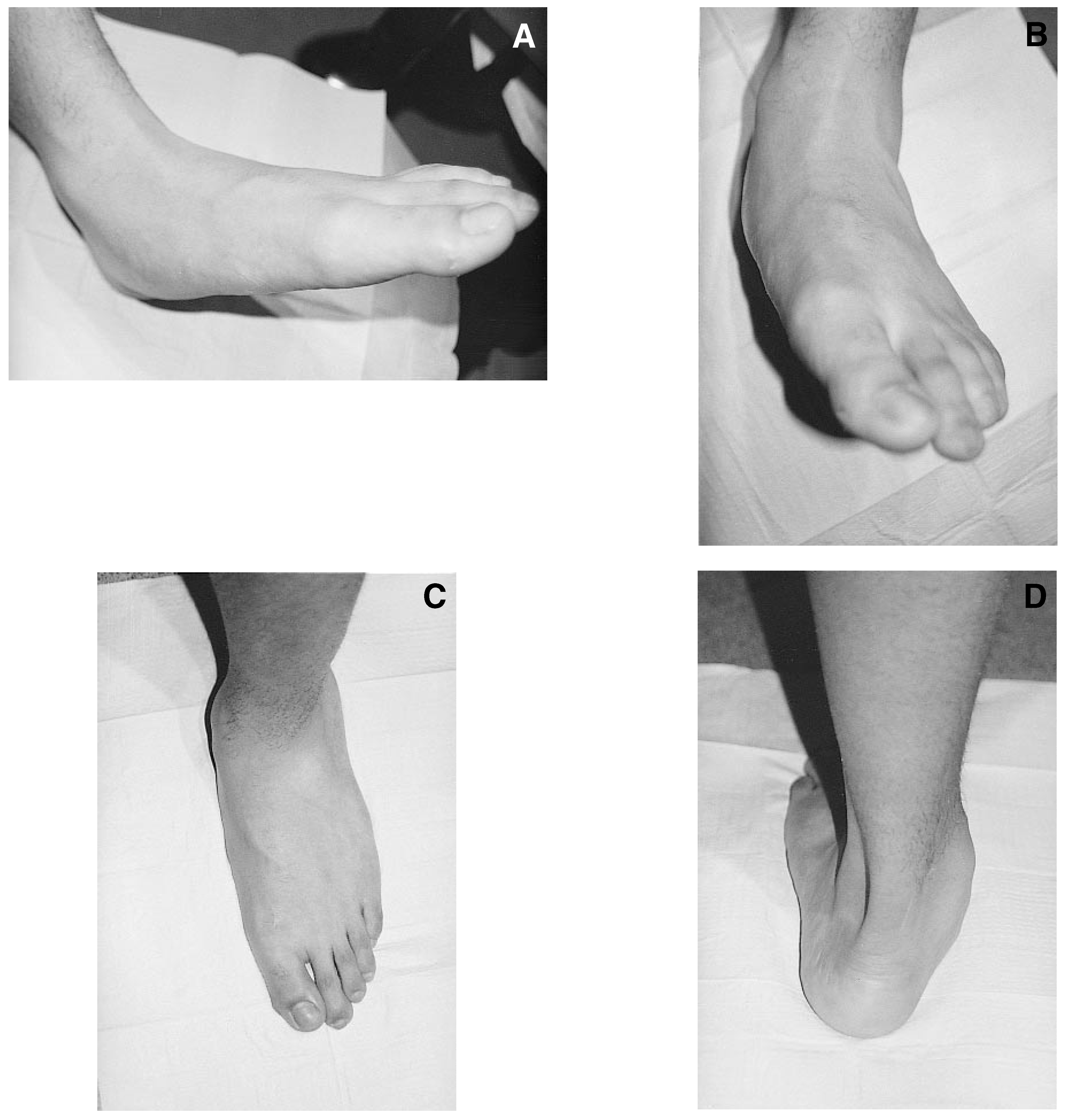
Examination will reveal a marked decrease in or an absence of motion in the subtalar joint. Forced inversion of the rearfoot will exacerbate the symptoms. It should be noted that movement of the forefoot or the heel fat pad should not be mistaken for subtalar motion. The calcaneus will generally be in valgus and the talus will be deviated medially and plantarly. The forefoot will be in abduction and frequently dorsiflexion as the peroneus brevis inserts into the base of the fifth metatarsal, distal to the midtarsal joint (
Fig. 1). Tautness of the peroneal muscles is usually apparent.
Diagnosis
Diagnosis of idiopathic pediatric peroneal spastic flatfoot must entail exclusion of a coalition and other apparent etiologies and exploration of other possible causes. Thus radiologic modalities remain the most beneficial diagnostic tools.
Plain film radiography should be the initial screening tool for any pediatric patient who presents with a rigid or semirigid foot, especially when tarsal coalition is suspected. Signs of coalition are usually present on standard radiographs [
8,
19,
26,
27]. With respect to subtalar coalition, on lateral views one may see talonavicular beaking, the “halo sign” of sclerosis surrounding the subtalar joint, subtalar joint-space narrowing or irregularity, or blunting of the posterior talar tubercle. Lateur et al [
28] maintain that the “C sign” is the most valuable indicator of subtalar joint coalitions as viewed on lateral radiograph. This sign represents the medial outline of the talar dome and the inferior aspect of the sustentaculum tali—essentially three-fourths of the “halo sign.” With Harris-Beath views (calcaneal axial), one may see partial or complete obliteration of the subtalar joint or unevenness or obliquity of the facets. Calcaneonavicular bars are best viewed in the 45° medial oblique radiograph: This may demonstrate the ossified or ossifying bar or the “anteater sign” representing an elongation of the anterior process of the calcaneus toward the navicular. This elongation is frequently seen on lateral radiographs as well. Of possible assistance in the visualization of tarsal coalitions are the Isherwood views [
29]; however, these are difficult to perform well because of rather awkward positioning of the patient and the need for perfect arrangement of the lower extremity.
Other less frequently seen coalitions to be aware of are talonavicular [
30], naviculocuneiform [
31], and cuboideonavicular [
32], all of which tend to be asymptomatic and obvious on x-ray. However, Williamson and Torode [
33] report a case of peroneal spastic flatfoot in which a cuboideonavicular coalition was the causative factor. Radiographs should also be scrutinized for other abnormalities that may have precipitated peroneal spastic flatfoot, such as fracture, evidence of old fracture, bone or soft-tissue tumors, arthritic changes, and possibly foreign bodies.
Because most pediatric patients, depending on their age and osseous maturity, will present with nonossification or incomplete ossification of the tarsal region, plain radiography may not accurately reflect coalitions. It is believed that clinical presentation of coalitions (not necessarily peroneal spastic flatfoot
per se) signifies beginning ossification of the impending block, but predates full ossification by an average of 3 to 4 years [
34]. Also to be considered are the ages at which the various osseous coalitions appear: talonavicular at 3 to 5 years, calcaneonavicular at 8 to 12 years, and talocalcaneal at 12 to 16 years [
23]. In cases in which suspicion is raised, especially of tarsal coalition, computed tomography (CT) becomes a helpful diagnostic modality when plain radiographs do not demonstrate pathology. Views necessary for adequate visualization are coronal planes for the subtalar joint and transverse cuts for the talonavicular and calcaneocuboid joints [
14]. Computed tomographic arthrography appears to have no distinct advantage over plain CT [
35]. The diagnosis of nonosseous subtalar bridges (fibrous and cartilaginous unions) can be made if one is careful in CT evaluation and looks for subtle changes, especially posterior to the sustentaculum tali [
36]. Computed tomography has proven useful in the diagnosis of soft-tissue coalitions as well as bony coalitions [
37]. Some maintain that while MRI has a definite place in the diagnosis of pediatric pathology, CT is still the standard imaging modality for evaluation of tarsal coalitions [
38].
Magnetic resonance imaging is being recognized by many as the
de facto standard for assessment of foot and ankle pathology. Earlier studies, cited previously, have extolled the strengths and advantages of CT, but with MRI becoming more available in medical facilities and its cost reduced somewhat, it may become the first choice for imaging tarsal coalitions and other rearfoot problems. Pachuda et al [
14] suggest that MRI ought to replace CT, as MRI is a better technique, capable of reflecting osseous fusion as well as nonosseous union. In cases of questionable radiographic evidence, their algorithm for diagnostic work-up suggests use of CT in cases of osseous maturity and MRI for patients who have not achieved osseous maturity. It has been demonstrated that tarsal coalitions can be easily seen, evaluated, and staged with MRI and that arthritides and synovial pathologies can be identified [
39]. Some authors maintain that fibrous coalitions are not well reflected in CT and are better seen with MRI [
40]. An increasing number of authors advocate MRI as the medium of choice for diagnostic imaging, especially with respect to pediatric pathology [
41]. The limitation of MRI is that it may not be able to distinguish tarsal synovitis from fibrous union [
40]. As with plain radiography, CT and MRI scans should be scrutinized for other factors that might have caused the peroneal spastic flatfoot.
In cases where imaging has not demonstrated a definite pathology, other causes should be investigated. If there is any suspicion that the child or adolescent is afflicted with any of the inflammatory arthropathies, such as juvenile rheumatoid arthritis, syphilitic or gonococcal arthritis, septic arthritis, Lyme disease, or tuberculous arthritis, he or she should receive appropriate blood testing. Note that in these cases, other presenting signs are likely to be apparent and will probably precede the spastic flatfoot.
Treatment
With particular reference to peroneal spastic flatfoot
per se, there are many modalities that may be used to relieve symptoms and possibly eliminate the condition altogether. For symptomatic relief in the pediatric patient, nonsteroidal anti-inflammatory drugs, muscle relaxants, paraffin baths, heat, warm soaks, and whirlpool have been cited [
9,
14,
26]. It should be kept in mind that ultrasound is not an option when growth plates are open. Tachdjian [
7] advocates treatment based on the severity of the problem, the degree of disability, and the age of the patient. During the growing years, 1/8- to 3/16-inch inner heel wedges and extended medial counters with medial longitudinal arch support can alleviate pain and improve function. If severe pes valgus is apparent, Tachdjian recommends the use of University of California Biomechanical Laboratory (UCBL) foot orthoses. Foot orthoses with various modifications, such as long rearfoot posts and no grind-off to restrict medial pronatory motion, have also been suggested [
9,
14,
26]. Ankle orthoses such as the supramalleolar orthosis and the ankle-foot orthosis can be of biomechanical benefit [
6,
23].
When symptoms are unabated by other methods, many advocate the use of below-the-knee casts for 3 to 6 weeks, with the patient weightbearing or nonweightbearing [
7,
12,
14,
19,
23,
26,
42]. The common peroneal nerve block (and sural nerve block) can frequently relieve pain [
6,
8,
9,
43] and may be helpful in assessing subtalar joint mobility, especially with respect to possible surgical intervention in cases of obvious coalition [
8]. Injections of steroid and anesthetic into the sinus tarsi have also been found effective [
6,
14,
19].
The above-noted conservative treatments are frequently cited as first-line approaches to spastic flatfoot when tarsal coalition is present or suspected. Therein lies a controversy in the overall approach to tarsal coalitions and, tangentially, peroneal spastic flatfoot. Many authors firmly believe in exhausting or at least trying conservative care before any surgical intervention, while others stress the importance of surgery as soon as possible. Some advocate conservative care initially if the peroneal spasm is acute, but surgery if it recurs or becomes severe or chronic [
7,
12,
23,
44,
45]. Others maintain that, because not all coalitions remain symptomatic, conservative care should be the first choice in most cases [
9,
26,
46].
Further controversy lies in the choice of surgical procedure for coalitions. Traditionally, triple arthrodesis was the procedure of choice for tarsal coalitions once the child achieved osseous maturity. It has also been reported that isolated subtalar arthrodeses may yield acceptable results in some cases [
47,
48]. Many surgeons now advocate resection of the offending bar, especially in pediatric patients with no signs of arthritic changes [
14,
48].
Few would deny the benefit and good long-term prognosis of calcaneonavicular bar resection, especially with interposition of muscle belly, adipose tissue, or silicone implant, but the overall advisability of resection in subtalar coalitions remains controversial. Still, many authors have reported success with talocalcaneal bony bridge resections with or without implanted materials [
7,
44,
49,
50,
51,
52,
53]. Downey [
48] highlights the fact that most of these studies and reports are based on small series of patients with little to no protocol as to approach. There appears to be a diversity of opinion as to indications, choice of procedures, and subsequent results.
Materials and Methods
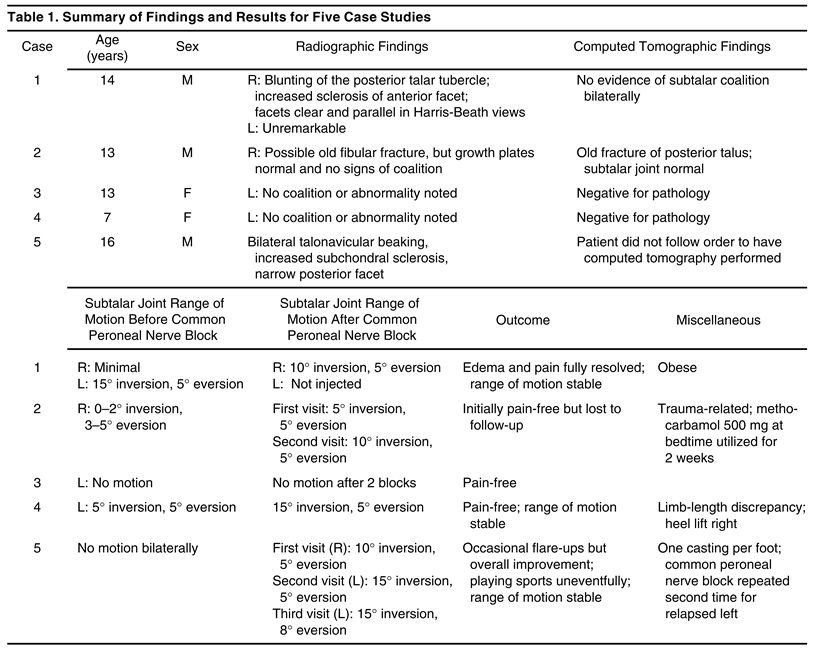
In the five case reports that follow, the same basic protocol was followed, with some variation. Each of the patients presented with the signs and symptoms of peroneal spastic flatfoot, and in four cases the condition was not associated with tarsal coalition. Two patients appeared to have signs of coalitions, but CT scans were negative for one patient, and both patients responded well to conservative treatment. All patients except one were between the ages of 13 and 16 years. Except where noted, all patients had unremarkable medical histories.
All patients received a common peroneal nerve block with 1 to 3 ml of lidocaine 2% without epinephrine, and motion was assessed with a Tractograph
® (Royce Medical Products, Culver City, CA). The common peroneal nerve block is an easy, safe, and effective diagnostic and therapeutic treatment [
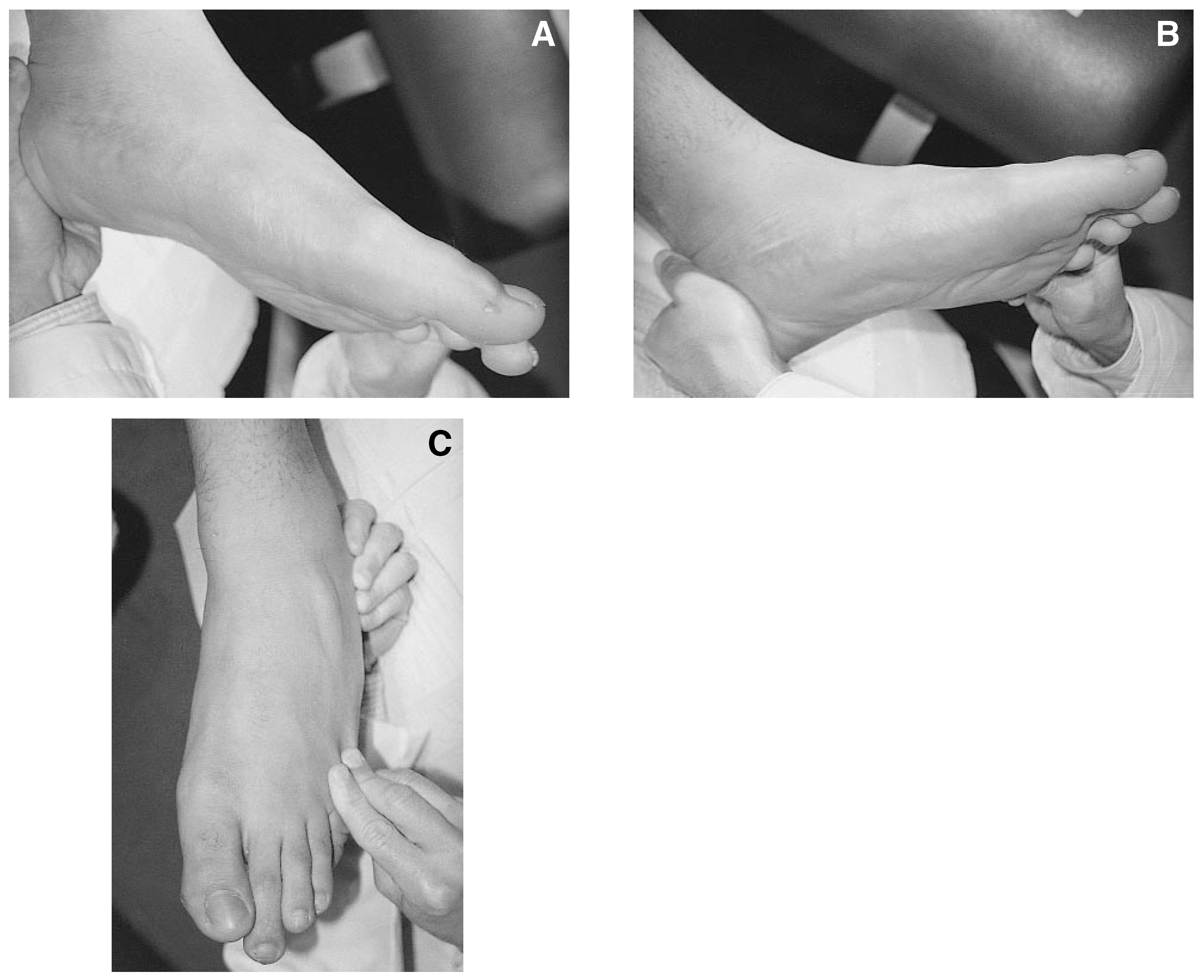
54]. The nerve can be easily palpated directly behind the head of the fibula, even in obese children. Once it has been located, only a small amount of anesthetic is necessary, usually 1 ml, to achieve full effect. With larger individuals, more anesthetic may be administered, but one should use as small a syringe as possible to reduce resistance, preventing a painful injection. A 25- to 27-gauge 5/8-inch needle on a 1-ml tuberculin syringe is ideal, and lidocaine or mepivacaine hydrochloride may be used. With the proximal epiphyseal growth plate of the fibula in the region, bupivacaine should be avoided, as earlier studies suggest premature physeal closure with its use. With the skin slightly pinched, the injection can be given with little to no discomfort, thus easing the patient’s anxiety over “getting a shot” and making subsequent injections possible without further apprehension. The practitioner should realize that the effect is not usually immediate. Sufficient time, which varies from individual to individual, should be allowed before forcefully inverting the foot. Doing so prematurely may increase the contracture and make further relaxation difficult. The foot and leg may be tested by lightly stroking the lateral border and determining if epicritic sensation is diminished. If anesthesia is achieved, the clinician should gently invert the foot at the subtalar joint, stopping if any symptomatology remains (
Fig. 2).
Regardless of outcome, the block was followed by a short-leg fiberglass cast applied in as inverted a position as possible and the patient was instructed to remain nonweightbearing on crutches. After 2 weeks the cast was removed and motion and symptomatology were again assessed. If movement was maintained or achieved, neutral position casting was performed with the affected foot or feet held in varus as much as possible, especially the rearfoot. If motion decreased or did not change, a second common peroneal nerve block was performed. Once full anesthesia was induced, the affected feet were again inverted maximally and neutral position casts were taken.
In the cases where more motion was achieved, a semifunctional orthotic device was prescribed, consisting of a 3- to 4-mm polyethylene shell (weight dependent), 1/8-inch PPT® (Langer Biomechanics Group, Deer Park, NY), and a polyvinyl chloride top cover. The rearfoot was posted the same number of degrees as the maximally inverted positive casts and appropriate varus extrinsic forefoot posting was applied to address the forefoot supinatus seen in all cases. A deep, wide-cut heel seat was fabricated, and in order to restrict pronatory motion, no medial grind-off was allowed.
In the cases in which no motion increase was perceived, essentially accommodative devices were fabricated, consisting of a 2- to 3-mm polyethylene shell (weight dependent), 1/8-inch PPT with a polyvinyl chloride cover, and a PPT longitudinal arch filler. The rearfoot was posted to cast, which was usually valgus owing to the everted attitude of the foot. Extrinsic forefoot posting was also ordered. A medial flange with a deep, wide heel seat and a long rearfoot post with no grind-off were also prescribed.
During the wait for the orthoses, if no symptoms were demonstrated by the patient, 3/16- to 1/2-inch cork heel varus wedges with extension to the metatarsal heads and 1/4-inch PPT longitudinal arch supports were fabricated and the patient instructed to wear them every day. If symptoms were present, a common peroneal nerve block was given and another fiberglass cast applied. This was removed 2 weeks later and the cork wedges with 1/4-inch PPT were fabricated and dispensed. If there was continued pain, the effectiveness of further injection and casting was considered dubious.
All patients were given tendo Achillis–stretching exercises, as a significant equinus is evident in most cases of peroneal spastic flatfoot.
Case Reports
The overall assessment, treatment, and outcomes are summarized in Table 1. History, work-up, and differences among the cases are summarized below.
Case 1
The patient had pain in the right lateral ankle and arch area of 2 months’ duration, which increased in severity over the previous week with activity. Pain was experienced at night, and there was no history of trauma. The patient had used an over-the-counter leather arch support, which provided some relief. Physical examination revealed severe tenderness with palpation and range of motion along the right lateral inferior aspect of the lateral malleolus and 1+ (1 plus) nonpitting edema locally. Tenderness was noted bilaterally along the medial band of the plantar fascia, especially at the calcaneal insertion.
Case 2
This patient had a history of a broken ankle 9 months previously. The patient’s mother stated that the patient was casted in an “out” position for 8 weeks. The foot became progressively painful. Tenderness was evident laterally, but there was no edema or erythema.
Case 3
The patient had pain in the left ankle laterally for 3 months, which gradually increased in severity during ambulation. The patient had no history of trauma. Examination revealed tenderness with inversion and plantarflexion at the ankle joint. Tenderness was noted also with palpation from the lateral malleolus to the styloid process of the fifth metatarsal.
Case 4
The patient had pain in the left ankle for approximately 1 year, with gradual onset. Tenderness was noted during range of motion of the left ankle. Limb-length discrepancy was noted, with the right being 1.5 cm shorter than the left. Gait angle revealed 5° abduction of the right foot, and 20° abduction of the left. A heel lift was incorporated into the right orthosis.
Case 5
The patient experienced burning pain on the inside of the feet (arches) for years, and stated that it was worsening. The patient played basketball frequently. The medical history was significant for attention-deficit disorder, for which clonidine hydrochloride and thioridazine hydrochloride were prescribed. The patient was 6 feet 7 inches tall and weighed 190 pounds. Examination revealed tenderness upon palpation of the navicular tuberosity.
Discussion
The pediatric patient with peroneal spastic flatfoot presents a diagnostic and treatment challenge to the practitioner. Coalition is a major underlying cause of the problem. If a coalition is found to be the underlying cause, the choices of conservative care, resection, isolated arthrodesis, and triple arthrodesis must be evaluated. It should be emphasized that those surgeons who currently advocate resection recognize that arthrodesing procedures may be necessary if failure is encountered. Arthrodesis is usually considered a salvage procedure of last resort, and it is probably best to first exhaust the conservative treatment plans outlined here. The prognosis of coalition resection is guarded owing to the prospect of secondary adaptive joint changes and should be carefully weighed against the possibility of arthrodesis [
48]. One also has to consider the psychological effects of surgery on the growing child or adolescent. During the formative years and especially during puberty, when most coalitions tend to become symptomatic, physical appearance and the need to be perceived as “normal” by one’s peers becomes an issue.
The use of imaging should be limited in accordance with the practitioner’s planned choice of treatment. Plain radiographs are always indicated. In instances when there is no demonstrable pathology, especially of coalition, the podiatric physician must assess whether the treatment plan would change appreciably if other imaging techniques yielded more information. If there is a need for definitive diagnosis, then CT seems most appropriate. When signs of coalition are apparent on radiographs, CT and MRI scans should be ordered only when surgery is strongly contemplated. Because they are more expensive, MRI scans should be reserved for those cases in which fibrous or cartilaginous union may exist and surgical resection is planned. If conservative care will be attempted and radiographs reveal unequivocal coalition, CT scans appear to be superfluous. Although CT will probably support the diagnosis, a positive CT finding will not change the outcome or treatment plan; thus their use should be discouraged owing to current concerns regarding radiation exposure of patients. It should be noted that CT and MRI, even with the use of extremity coils, are time-intensive, uncomfortable, noisy, and frightening modalities for the pediatric patient and should be used judiciously.
When considering surgical intervention for tarsal coalitions, the clinician is advised to use Downey’s Articular Classification System. This protocol appropriately takes into account the age of the patient, the degree of osseous maturity, the type of coalition, the articular involvement of the coalition, and secondary arthritic changes that may be present [
48]. Presence of secondary changes has a significant impact on surgical choice. In cases in which the changes are more apparent, arthrodesis is favored over resection.
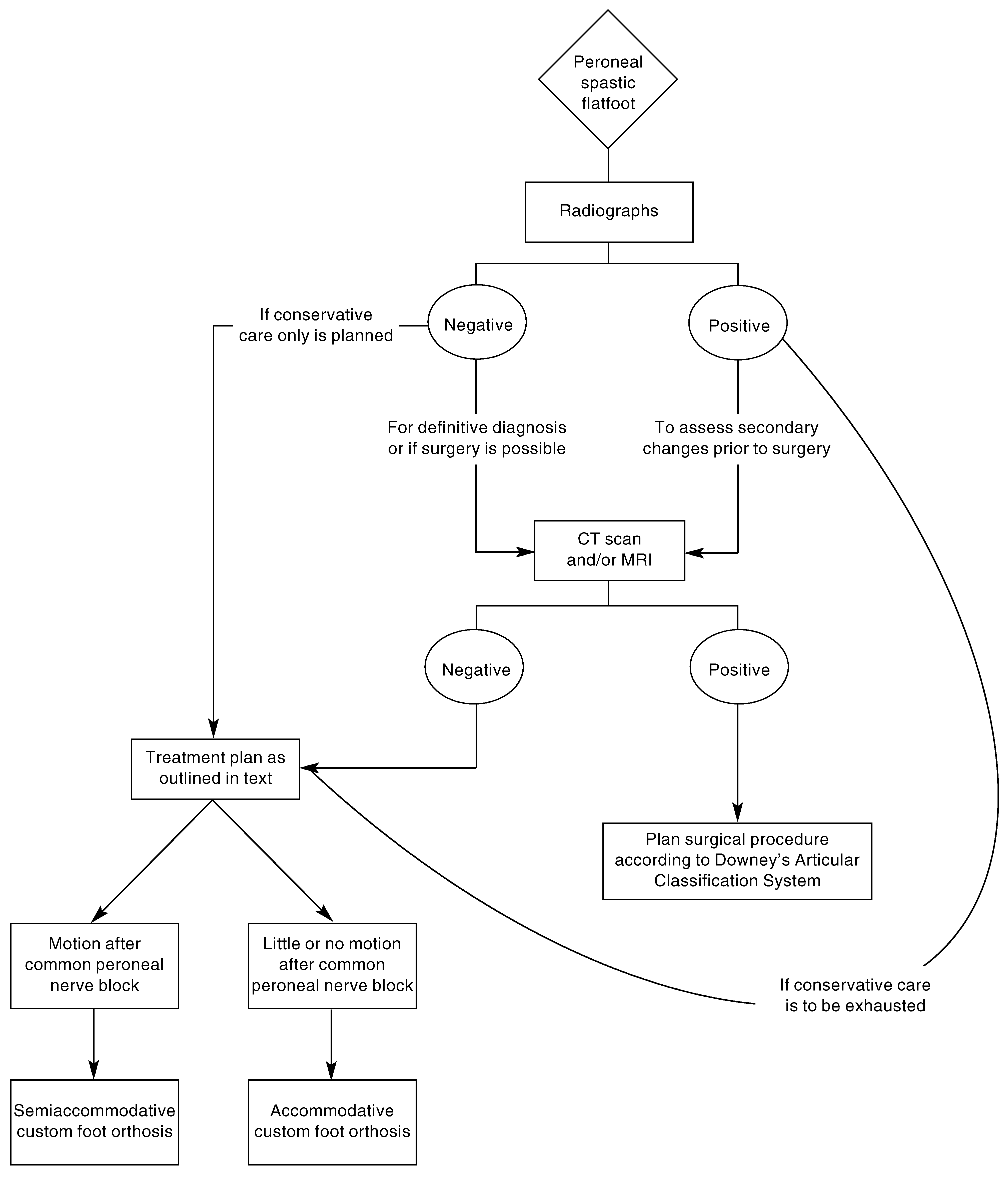
The protocol algorithm shown in
Figure 3 may be followed to facilitate treatment of the pediatric patient with peroneal spastic flatfoot, with or without tarsal coalition. The treatment regimen of common peroneal nerve block, nonweightbearing casting, appropriate assessment of results, palliative measures, and appropriate orthotic management should be adhered to in an effort to achieve the best possible prognosis.
Initial radiographs should be obtained, with CT imaging performed when further evaluation for possible coalition is needed or surgical intervention is considered an option. Given the increased cost and today’s managed-care environment, MRI scans should be reserved for the few cases in which fibrous or cartilaginous union cannot be ruled out using CT and surgical resection is planned.
Conclusion
The question remains: Should the surgeon presumptively operate in the absence of signs other than those of peroneal spastic flatfoot? This author believes in approaching surgery more cautiously in the case of the pediatric patient than in the case of the adult patient. The ramifications of surgery in the child or adolescent may be more far-reaching than in the adult. This is not to say that surgery should never be performed on a pediatric patient with peroneal spastic flatfoot. Rather, in most situations, all available nonsurgical methods should be exhausted. A step-by-step treatment protocol has been proposed, specifically with respect to peroneal spastic flatfoot in the absence of coalition. This protocol and the outlined treatment plan have been followed in five cases with success. While MRI scans were not ordered for any cases that did not demonstrate coalition, symptomatic relief and return to activity were achieved.
There is no “correct” solution to the conundrum addressed in this article. The protocol offered here was designed to help organize the practitioner’s approach and produce an effective course of treatment.