To the Editor:
Absence of the hallucal sesamoids is a rare condition. Rarer still is the presentation of congenital hallux varus with the absence of both hallucal sesamoids. There is very little information on either of these conditions in the literature.
Zinsmeister and Edelman [
1] reported on two cases of congenital absence of the tibial sesamoid. The two cases lacked radiographic evidence of an osseous tibial sesamoid; however, during surgery a cartilaginous precursor was revealed in one of the cases. Stanifer et al [
2] presented a case of congenital hallux varus in a 9-month-old child. The etiology of hallux varus was explored. Described below is a unique case of bilateral hallux varus with bilateral absence of the hallucal sesamoids in a teenager with no apparent congenital deformity.
Case Report
A 19-year-old Spanish-speaking woman presented to Sheehan Memorial Hospital in Buffalo, NY, with leftfoot discomfort and abnormal shoe wear. No history of trauma was reported by the patient. The patient reported that the discomfort was of 6 weeks’ duration. The patient also related residual hip discomfort. The entire history was related by the patient’s mother, who was fluent in both English and Spanish.
The mother’s report revealed that the prenatal and birth history were significant. The patient was born at approximately 7 months’ gestation. No history of gestational diabetes, hypertension, or gestational toxicity was reported by the mother. Anoxia was present at birth, and the patient was admitted to the intensivecare nursery for 1 month. Birthweight was 3 pounds 10 ounces. Apgar scores were not available. During the patient’s stay in the intensive-care nursery, a left-hip dysplasia was discovered, and a hip spica was used.
After discharge from the intensive-care nursery, the patient experienced developmental disabilities that continued throughout infancy and childhood. The mother reported that her daughter could not hold her head in midline until 7 months. Crawling and ambulation were delayed. The patient did not walk independently until 24 to 26 months of age. Speech and cognitive skills were also delayed. Congenital hallux varus was noted by the mother during the patient’s first few months of life.
At approximately 18 months of age, the patient was taken outside the US to live. According to the mother, no further treatment for the dislocated hip or foot deformity was provided until the daughter returned to the US 2 years ago. No genetic tests had been performed, and no history of surgery was reported. A history of asthma was related, but the disorder was described as under control. The patient is considered learning disabled and lives independently.
With palpation, discomfort was elicited over the course of the extensor digitorum longus tendon to the fifth metatarsal. No edema or erythema was present over the fifth metatarsal. Vascular, dermatologic, and neurologic assessments were normal. Bilateral hallux varus was noted. Palpation of the first metatarsal head was not painful and no crepitus was noted. Abnormal shoe wear was noted. Radiologic examination was ordered.
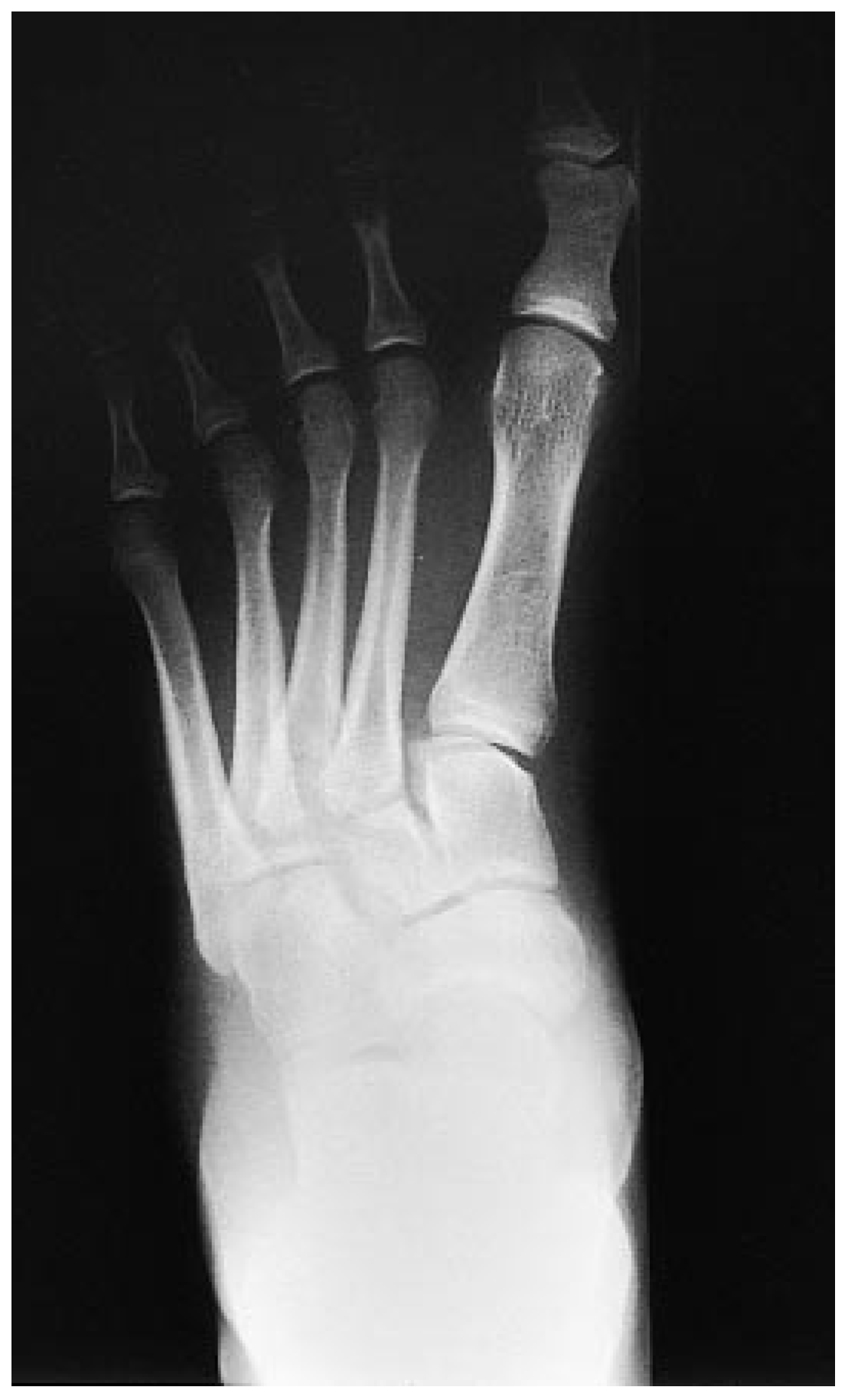
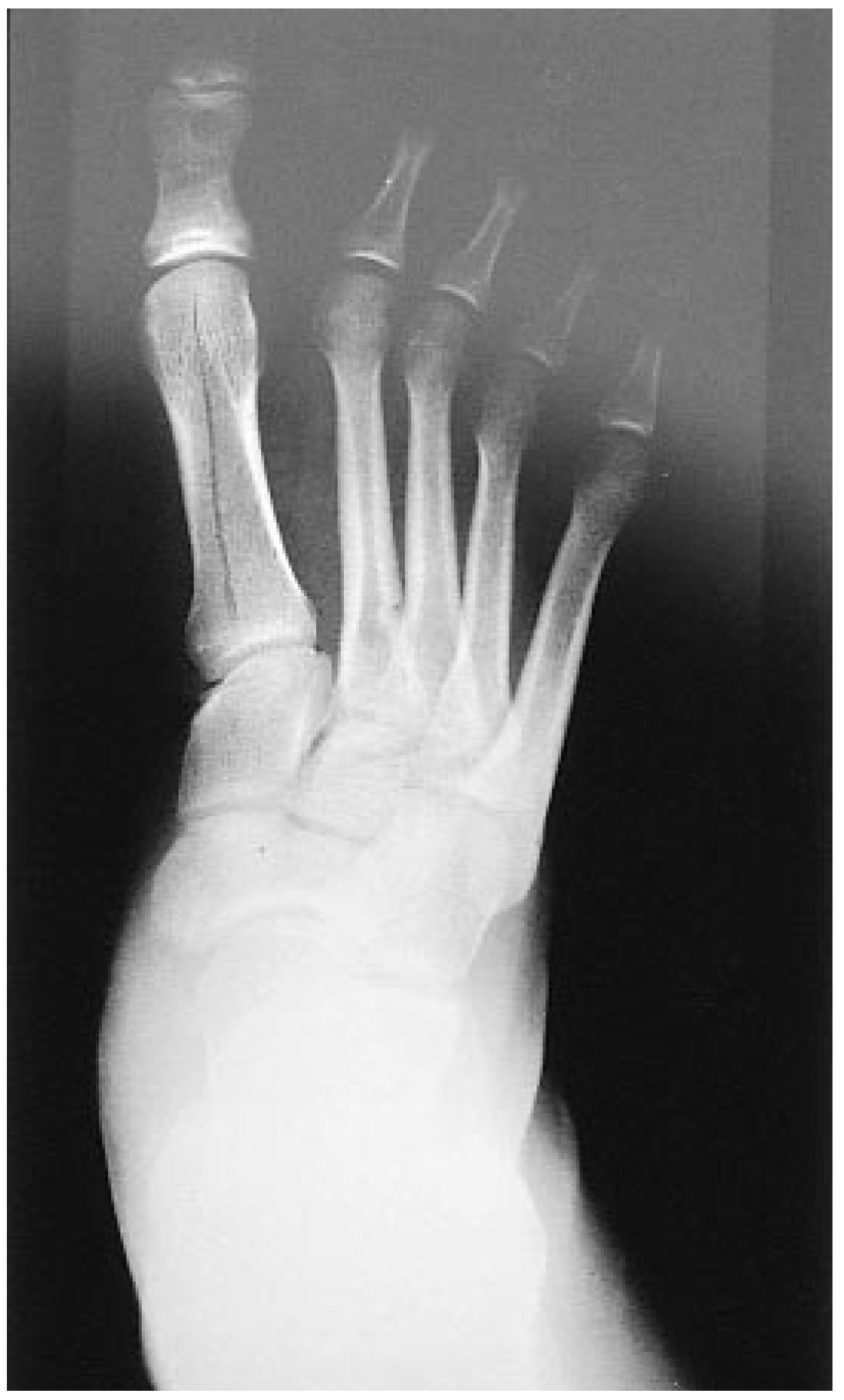
Anteroposterior, medial oblique, and lateral views of both feet revealed no evidence of acute fracture or destructive bony changes. Metatarsus primus varus with medial angulation of the first metatarsal was noted bilaterally. The remaining metatarsals were in proper alignment. Congenital absence of the sesamoids was noted. The joint spaces were well maintained. The radiographic impression was bilateral metatarsus primus varus (
Figure 1 and
Figure 2).
The results of the radiologic examination were discussed with the patient and her mother. Surgical intervention was discussed at this time as well as further radiologic studies, including a plantar axial radiograph and a computed tomographic scan. An orthopedic examination was ordered to further evaluate the hip pain.
Discussion
Tachdjian [
3](p2408) has stated that ossification of the medial and lateral sesamoids of the hallux occurs between 12 and 14 years of age. In the case presented above, neither the medial nor the lateral hallucal sesamoid was present radiologically. A computed tomographic scan may reveal cartilaginous precursor. As the patient presented with multiple congenital variants in her osseous structure, a genetic component must be ruled out. Hallux varus as reported by Tax [
4] and Tachdjian [
3](p2649) may occur in children with developmental disabilities. One of the most common inherited disabilities in which congenital hallux varus occurs is diastrophic dwarfism. This form of dwarfism may also involve adduction of the thumb, clubfoot, scoliosis, and hip dysplasia. Males and females are equally affected.
According to Tachdjian, [
3](p2649) congenital hallux varus may also have other etiologies. In the primary type, a taut fibrous band has been identified as bringing the hallux toward midline. The band extends on the medial side of the great toe to the base of the first metatarsal. A second type of congenital hallux varus is associated with congenital forefoot deformities. These may include a short first metatarsal, metatarsus varus, and accessory ossicles. Using Tachdjian’s classification, the patient may be categorized as type 2; however, without further genetic information, the patient may be diagnosed with an unidentified developmental disability. Diastrophic dwarfism can be ruled out according to the history. It is the author’s opinion that the uniqueness of this presentation may indicate involvement of another genetic component that has yet to be identified.
Summary
A case of congenital hallux varus with congenital absence of the sesamoids has been presented, and the causes of congenital hallux varus have been discussed.