Atherosclerotic occlusive disease (macrovascular disease) is enhanced in diabetes mellitus. Prior to the isolation of insulin, the life expectancy of a patient with diabetes was less than 5 years following diagnosis. As the life span of patients with diabetes was extended, it became apparent that they were more vulnerable to vascular disease [
1]. Peripheral vascular disease is four to six times more prevalent in the population with diabetes between the ages of 45 and 75 years than in those without and the male-to-female ratio approaches one [
2,
3]. Patients with diabetes mellitus are at increased risk of morbidity and mortality from coronary artery disease, stroke, and peripheral vascular disease. With diabetes and vascular disease, long-term survival is poorer at all ages, the 10-year mortality rate being 38% with diabetes and 11% without diabetes [
4].
Approximately 15% of patients with diabetes develop a foot ulcer at some stage during the course of their disease and foot problems are the most common cause of hospitalization of patients, costing more than a billion dollars in health care annually [
5,
6,
7]. Fifty percent of all nontraumatic lower extremity amputations in the US occur in patients with diabetes, the amputation rate being 15 to 40 times higher than in those without diabetes [
8]. An understanding of the accelerated macrovascular disease of diabetes is important in reducing the morbidity, mortality, disability, cost of amputations, and related complications.
Atherosclerosis in Diabetes
The histologic appearance of atherosclerotic occlusive disease is not altered in diabetes [
9]. While atherosclerosis is a systemic process, it has a predilection to cause occlusion at specific sites. For example, the bifurcation of the carotid artery or the aorta are common sites for atherosclerotic plaque. However, in diabetes these sites are not common except in patients with additional risk factors, especially cigarette smoking [
10,
11]. Lower extremity peripheral vascular disease is more common and progresses more rapidly than in the general population, the prevalence being four to six times greater in those with diabetes. The reason for the increased incidence of vascular disease is unknown, but it is clear that it occurs at an earlier age, tends to be more aggressive and extensive in distribution, and is more likely to result in amputation and premature death [
12].
The mechanisms contributing to this enhanced atherogenesis are manifold. Diabetes is associated with hypertriglyceridemia, decreased HDL, and an increased LDL/HDL ratio, as well as alterations in endothelium and platelet function. In turn, these phenomena have been related to hyperinsulinemia, hyperglycemia, or insulin resistance. In diabetes, insulin resistance or deficiency causes the liver to take over a major role in lipid synthesis, resulting in higher triglyceride levels in the blood. This, combined with the loss of lipolytic effects of insulin, leads to even higher blood lipid levels, thus probably contributing to the increased atherogenesis seen in diabetes [
13]. However, no data have emerged to provide a clear causal relationship between metabolism and atherosclerosis. Macrovascular disease does appear to be related to duration of diabetes and not its severity or degree of control.
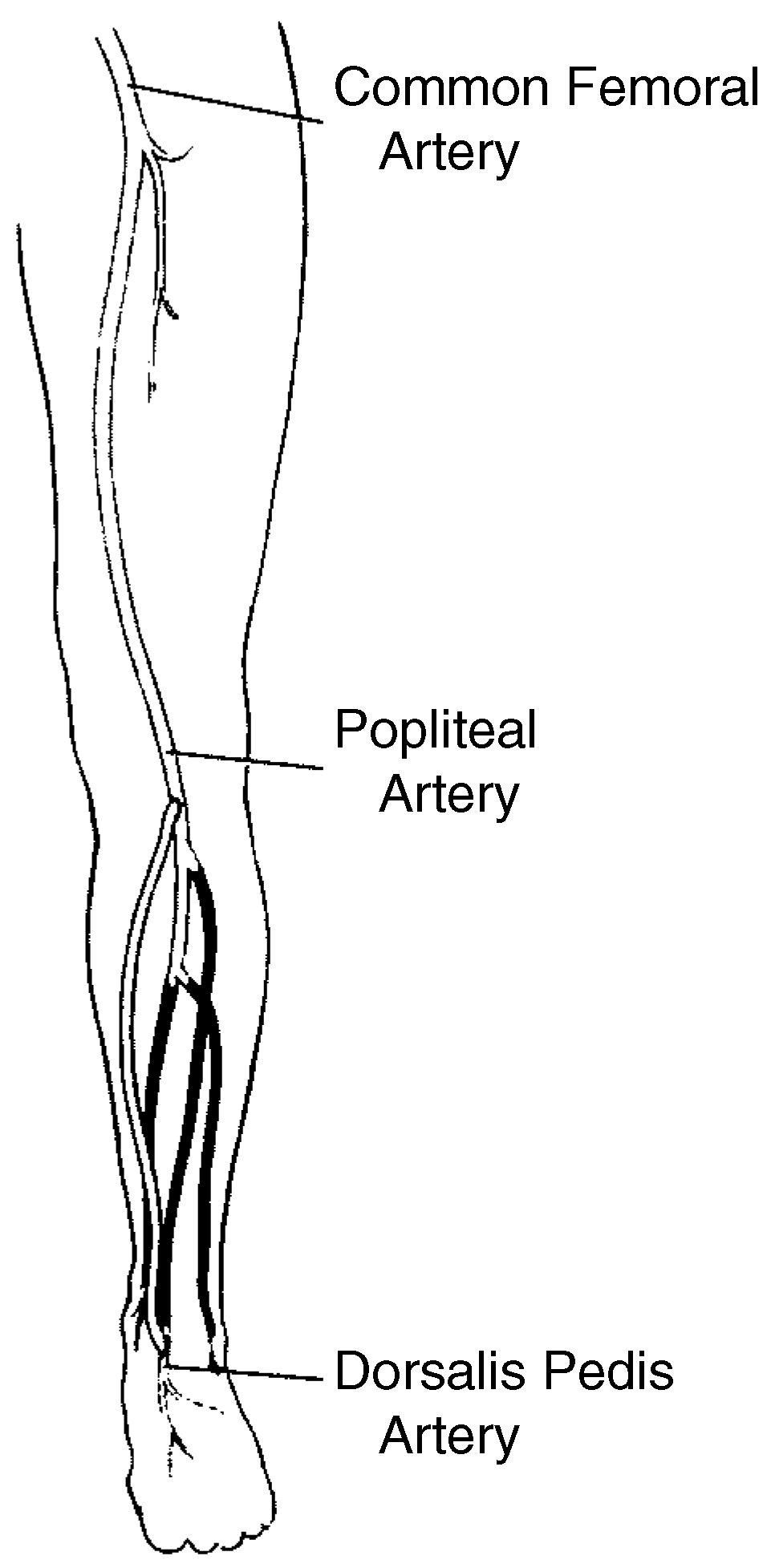
The pattern and distribution of macrovascular disease in diabetes is characteristic. Femoropopliteal disease in diabetes is no different from the nondiabetic’s but is frequently associated with more distal disease. Popliteal trifurcation and tibioperoneal disease are highly characteristic of diabetes (
Fig. 1). The peroneal artery is the most frequently spared artery. As far as the foot vessels are concerned, the dorsalis pedis artery is frequently spared. There are a few aspects of the microcirculatory physiology that deserve emphasis in relation to the etiology and treatment of atherosclerotic occlusive disease. One important observation is that the alterations in the microcirculation are not occlusive. This is in contrast to an early study indicating that there is a narrowing or occlusive lesion in the arterioles and microcirculation associated with diabetes [
14]. If this were true, there would be little place for treatment of large vessel disease, because the blood could still not pass through the microcirculation. Subsequent controlled studies have failed to demonstrate any small vessel occlusive disease associated with diabetes on the basis of histology, arterial casting, or vascular resistance [
9,
10,
15,
16]. Patients with diabetes mellitus do have a thickened muscle capillary basement membrane, but the capillary lumen is not narrowed. The basement membrane thickening is associated with an albumin lead, but does not impair diffusion of oxygen [
17,
18,
19]. However, the important point to remember is that there is no occlusive lesion in the microcirculation of patients with diabetes mellitus that precludes tissue perfusion.
Figure 1.
Distribution of infrapopliteal arterial disease (shaded area), with an example of a distal popliteal to dorsalis pedis artery bypass graft. From LoGerfo FW, Rosenblatt MS: “Clinical Features and Treatment of Peripheral Vascular Disease in Diabetes Mellitus,” in International Textbook of Diabetes Mellitus, ed by KGMM Alberti, RA DeFronzo, et al., John Wiley & Sons, New York, 1992. Reprinted with permission.
Figure 1.
Distribution of infrapopliteal arterial disease (shaded area), with an example of a distal popliteal to dorsalis pedis artery bypass graft. From LoGerfo FW, Rosenblatt MS: “Clinical Features and Treatment of Peripheral Vascular Disease in Diabetes Mellitus,” in International Textbook of Diabetes Mellitus, ed by KGMM Alberti, RA DeFronzo, et al., John Wiley & Sons, New York, 1992. Reprinted with permission.
The pattern of vascular disease as already mentioned is different in diabetes. For example, approximately 12% to 17% of patients undergoing aortoiliac reconstruction are diabetic as opposed to 65% to 75% of patients undergoing femorotibial bypasses. When diabetes is the only risk factor, the atherosclerosis tends to occlude the tibial arteries (anterior tibial, posterior tibial, and peroneal arteries) in the leg. Thus, it is not unusual for a diabetic patient to have no occlusive arterial disease down to the popliteal artery, with a strong popliteal pulse and still have an ischemic foot. At first, this may sound like a relatively hopeless circumstance for arterial reconstruction and restoration of perfusion. Two factors, however, have greatly improved the prognosis for the management of tibial artery occlusive disease. First is the observation that even though the tibial arteries are occluded, the arteries in the foot, especially the dorsalis pedis, are relatively spared. This pattern of occlusion of the arteries in the leg with sparing of the arteries in the foot has been documented in prospective studies using histology or arterial casting as the end points [
10,
15]. The second important factor in the management of tibial artery occlusions is the establishment of bypass grafts to the dorsalis pedis artery as effective in restoration of foot perfusion. At first, this may seem surprising, since the dorsalis pedis is a relatively small artery with a limited outflow bed. There is a growing understanding that vein bypass grafts to the distal tibial and pedal vessels have a success rate equal to, or better than, that of more proximal reconstructions [
20,
21]. The patency of dorsalis pedis bypass is just as good as that of femoropopliteal bypass. This somewhat unanticipated success rate has greatly enhanced the options for salvage of the diabetic foot.
Management of Occlusive Arterial Disease in Diabetes
The pattern of atherosclerotic occlusive disease seen in diabetes often presents several options with regard to arterial reconstruction. Peripheral vascular disease is the most common indication for surgery in the patient with diabetes, comprising 30% to 50% of all patients who are operated on for peripheral vascular disease and 60% to 75% of patients undergoing lower leg revascularization. A patient may have occlusion of the superficial femoral artery with reconstitution of the popliteal artery but with occlusion of the tibial arteries below. A bypass to the popliteal artery will improve foot perfusion somewhat, but bypass to the dorsalis pedis will restore maximum perfusion. Because of the associated neuropathy and compromised foot biology, it is generally preferable to bypass to the dorsalis pedis and provide the foot with maximum circulatory support. This, in turn, maximizes the opportunity for wound healing.
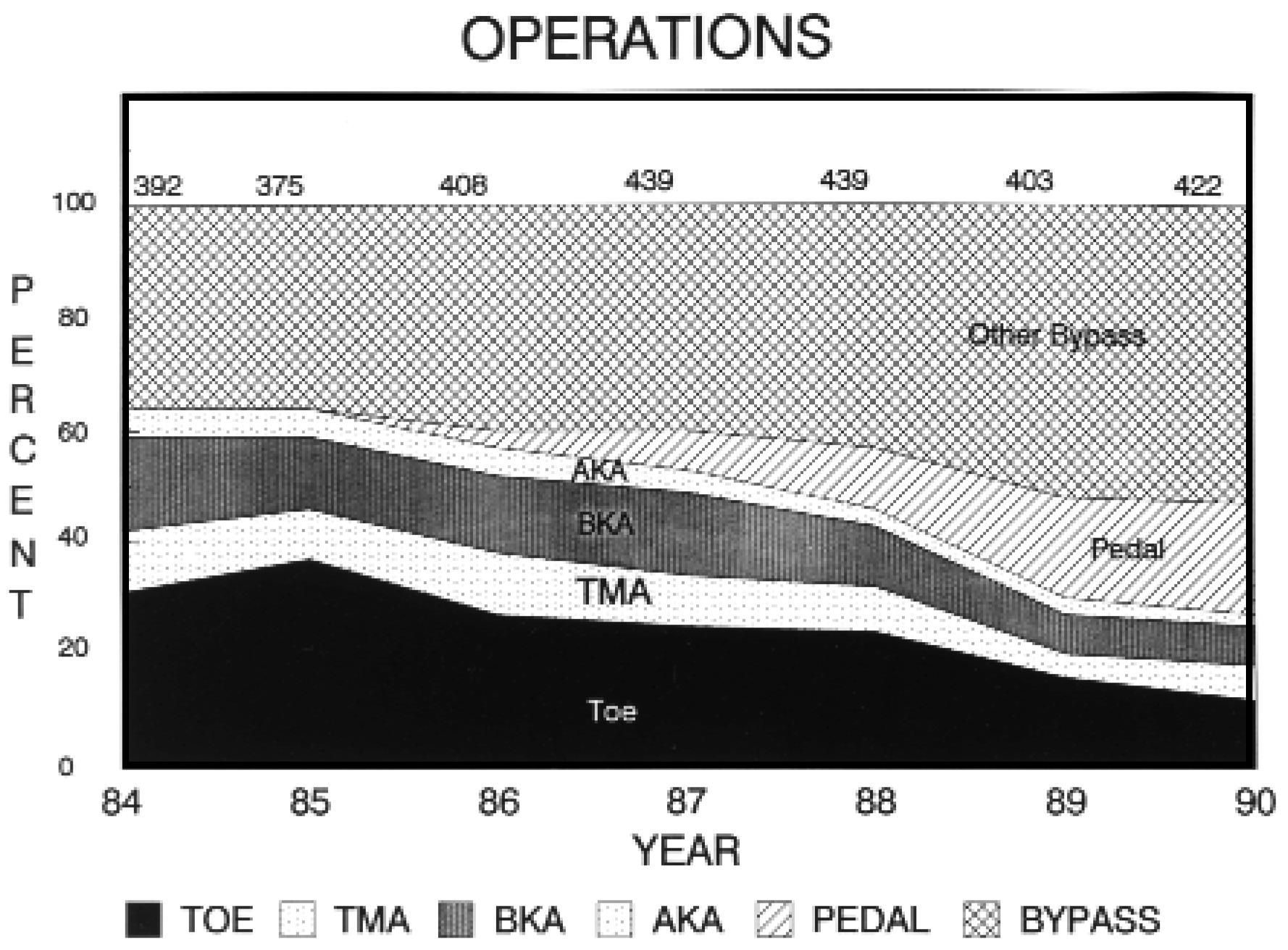
The importance of these considerations can be emphasized by the clinical problem of a patient with a toe ulcer. If the bypass to the popliteal artery is done (femoropopliteal bypass), the foot will be improved, but it may be necessary to perform a transmetatarsal amputation to obtain healing. If, in the same patient, the bypass is to the dorsalis pedis artery (femoropedal bypass), there will be sufficient recovery for the ulcer to heal or to respond to an arthroplasty or toe amputation. The bypass that restores maximum perfusion will maximize tissue salvage. Dorsalis pedis bypass achieves this goal and maximizes tissue salvage, resulting in a dramatic reduction in amputations (
Fig. 2). The distal infrageniculate distribution of the atherosclerotic process in diabetes also makes it possible to construct shorter grafts to the dorsalis pedis artery using the superficial femoral artery or the popliteal artery as the inflow source, which fare as well as the longer grafts from the common femoral artery [
22]. Thus, even though ischemia is only part of the complex pathogenic causative mechanism of diabetic foot problems, maximizing perfusion may overcome to some extent the other components of altered physiology that make the diabetic foot so vulnerable. In other words, it takes greater perfusion to maintain skin integrity in the patient with diabetes than in the nondiabetic patient. This is possible only by doing away with the myth that microvascular occlusive disease is present in diabetes and acceptance of the fact that there is sparing of distal vessels, especially the dorsalis pedis artery and the distal foot arteries. There are nonocclusive anatomical and physiologic abnormalities in the microcirculation associated with diabetes, notably capillary basement membrane thickening without narrowing of the lumen [
17]. This may impair nutritive and blood cell exchange but does not impede oxygen diffusion. This probably explains the increased TcPO2 seen in diabetic patients presenting with foot ulcers when compared with nondiabetic patients [
19]. Serum opsonic activity and cell-mediated immunity are depressed in diabetics, and the nonocclusive small vessel disease not only impairs the normal response to infection and trauma but may also make antibiotic therapy less effective [
23].
Figure 2.
Seven-year operative experience in the care of diabetic foot lesions. The numbers at the top represent the total number of operations for each year. Decreasing incidence of all amputations corresponds almost precisely with the increasing use of bypass to the dorsalis pedis artery. During this period, there was no increase in operative mortality or postbypass amputations. Abbrevations: AKA, above the knee amputation; BK, below the knee amputation; TMA, transmetatarsal amputation. From LoGerfo FW, Gibbons GW, Pomposelli FB Jr, et al.: Trends in the care of the diabetic foot: expanded role of arterial reconstruction. Arch Surg 127: 619, 1992. Data derived from Table 2 of source article (p 619), which was based on raw data retrieved from Massachusetts Health Data Center and vascular data base. Copyright 1992, American Medical Association, reprinted with permission.
Figure 2.
Seven-year operative experience in the care of diabetic foot lesions. The numbers at the top represent the total number of operations for each year. Decreasing incidence of all amputations corresponds almost precisely with the increasing use of bypass to the dorsalis pedis artery. During this period, there was no increase in operative mortality or postbypass amputations. Abbrevations: AKA, above the knee amputation; BK, below the knee amputation; TMA, transmetatarsal amputation. From LoGerfo FW, Gibbons GW, Pomposelli FB Jr, et al.: Trends in the care of the diabetic foot: expanded role of arterial reconstruction. Arch Surg 127: 619, 1992. Data derived from Table 2 of source article (p 619), which was based on raw data retrieved from Massachusetts Health Data Center and vascular data base. Copyright 1992, American Medical Association, reprinted with permission.