To the Editor:
Penetrating wounds from the spines of marine catfish can often result in a retained foreign-body reaction to the surrounding area. This can occur with or without the knowledge of the individual [
1]. The resultant soft tissue granuloma can be treated with simple removal of the foreign body and proper treatment of the site. A number of complications have been reported with catfish stings including: severe localized inflammation caused by the toxins released, a foreign-body reaction, infection, tissue necrosis, amputation, and even death [
2,
3].
Catfish contain hazardous dorsal and pectoral fins, each of which contains a cartilaginous barbed spine along with the leading edge that attaches to venom glands [
2]. The venom itself has also been shown to be dermatonecrotic and locally vasoconstrictive [
4]. A second toxin released has also been identified from the epidermal cells on the skin of the fish: the toxin causes intense throbbing pain, possible muscle fasciculations, and tissue necrosis, all of which are somewhat heat labile [
3]. The overall structure of the spine creates more extensive tissue injury than a simple penetration injury when the spines become embedded.
The diversity of the habitat of the catfish also contributes to the possible complications of the injury. Catfish are native to fresh and salt water environments, which increases the amount of water-borne bacterial organisms such as
Aeromonas or
Vibrio. Other possible sources of infection include
Erysipelothrix, Norcardia, Chromobacterium, Sporothrix, or
Actinomyces [
2].
There are numerous treatment options and recommendations cited in the literature relating to fishspine injuries. Many state that established principles of local wound care management should be followed. These include irrigation, debridement, topical antibiotics, and systemic antibiotics if required. Relief of pain is accomplished by immediate immersion of the involved extremity in water that is as hot as tolerated (up to 45° C or 120° F) for 30 min to several hours as needed [
5]. Hot water appears to denature the toxins within the wound [
6]. Local anesthetics (narcotic or otherwise) have been less effective for pain management [
5,
6]. The wound should be explored surgically and radiographically for any foreign material that should be removed. Prophylactic antibiotic therapy and tetanus immunization status should be ascertained. The site should then be allowed to heal by secondary intention [
5,
6].
Case Report
A 30-year-old male presented to the podiatry clinic with a chief complaint of pain in his right foot. Three months prior, the patient caught a large catfish in the Gulf of Mexico. After removing the hook, the catfish fell on his right foot. The spine from the pectoral fin apparently penetrated his shoe and was retained in the soft tissue around the first metatarsophalangeal joint unknowingly for 3 months. Two days prior to his visit, the patient stated that he was soaking his right foot and noticed a hard, white object jutting out from his skin. With a pair of tweezers, the patient removed a foreign body from his right foot. The patient’s medical history was unremarkable.
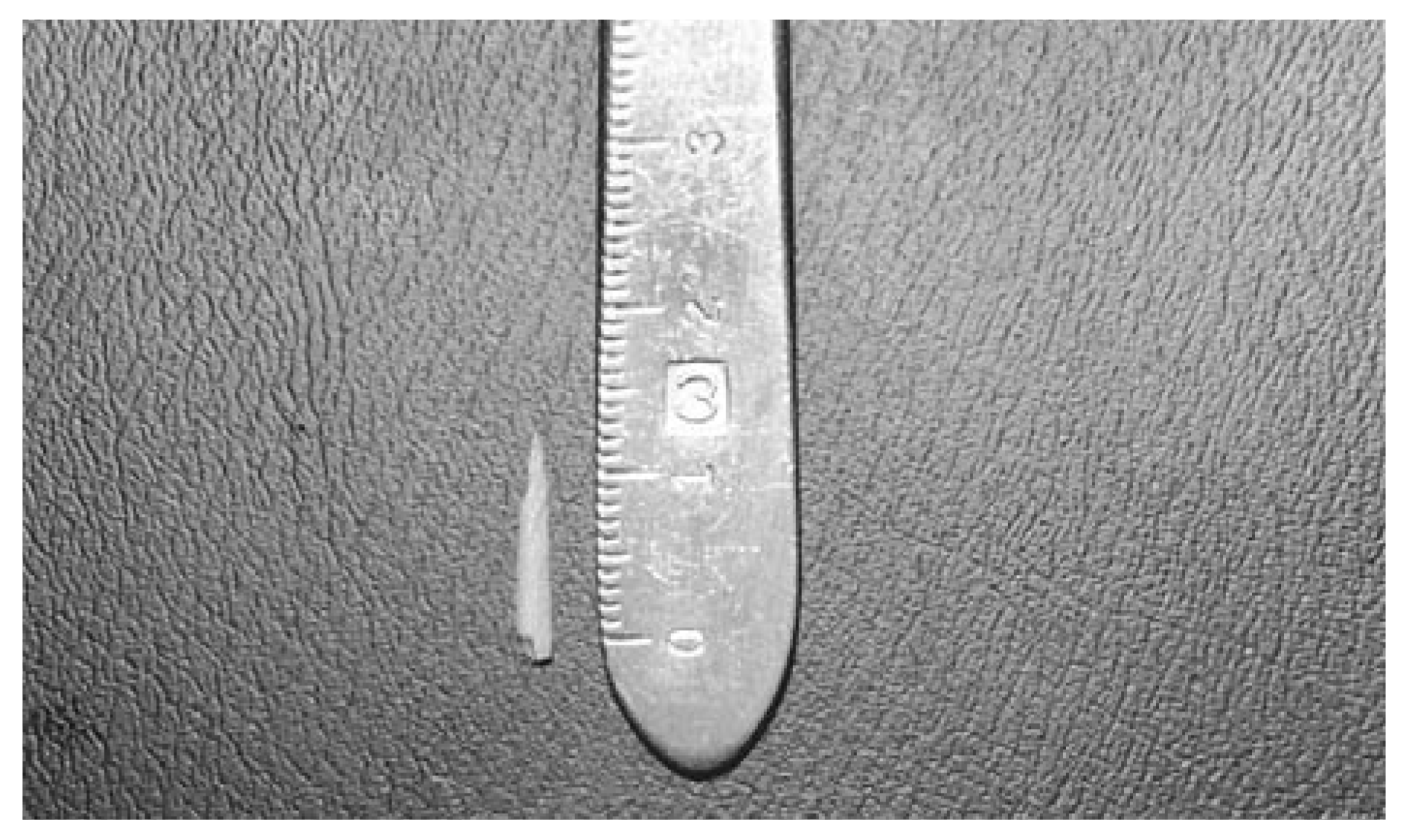
On clinical examination, the foreign body measured approximately 1.4 cm and was consistent with a catfish spine. The spine was hard, opaque, and presented with a very sharp serrated edge (
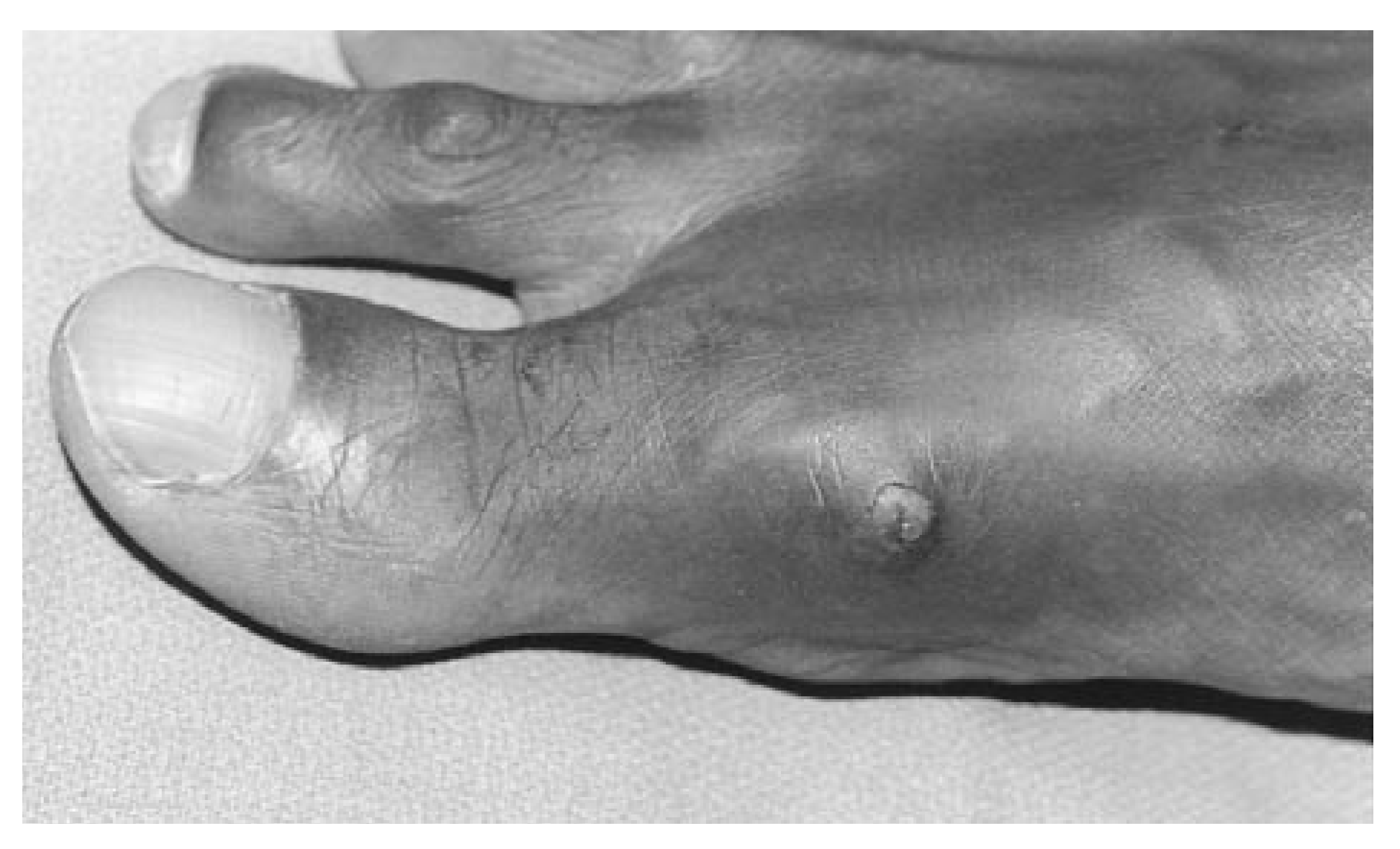
Figure 1). The dorsomedial aspect of the first metatarsophalangeal joint also presented with an elevated area of granulation tissue with a discharge of serosanguineous fluid (
Figure 2). A small sinus tract was noted that probed into the soft tissue adjacent to the joint. There was little erythema and no signs of infection. The radiographs were within normal limits. Culture and sensitivity were also taken and revealed no growth after 48 hr. A tetanus booster was given.
The wound was then copiously lavaged and irrigated with a mixture of povidone iodine, hydrogen peroxide, and normal saline. Antibiotic ointment was applied and the site was dressed with a sterile dressing. A postoperative shoe was also dispensed.
The patient returned in 1 week and the wound was probed as before, but only to approximately 1 cm. The focal area of reactive tissue had markedly reduced. The patient had no complaints and at 3 weeks, the wound was completely healed.
Conclusion
Marine envenomation injuries can be devastating and at times lethal. This case presentation, however, was uneventful and demonstrated complications associated with aquatic life. The treatment regimen was consistent with the literature and 1 year following the injury, the patient presented without complications or recurrences.