Literature Review
In 1895, Landerer and later in 1931, Gaenslen presented a surgical approach to the relatively uncommon entity of calcaneal osteomyelitis.[
1] A split-heel approach also known as the cloven heel method was suggested to treat osteomyelitis of the calcaneus. Gaenslen reviewed 11 cases that were mostly hematogenous in etiology with success in ten cases. He used midline posterior and plantar incision and bisected the calcaneus longitudinally. The soft tissue was reflected in a single thick flap including periosteum. The medullary canal was curetted and closure afforded a midline scar with good weightbearing surfaces.
In 1972, Horwitz[
2] described four patients with contiguous focus osteomyelitis. These patients had ulcerations that were deep enough to infect adjacent bone. He related good results with subtotal calcanectomy using an incision encompassing the posterior ulceration and extending laterally to the calcaneocuboid joint. He recommended suturing the heel cord to surrounding soft tissue, and high-shoes with conforming foam insert and 1/2-inch heel lift postoperatively.
In 1974, Martini et al[
3] reported on 20 cases with success in 85% using partial or total calcanectomy for chronic refractory osteomyelitis. In 1981, Crandall and Wagner[
4] reported on 31 cases. They related an increased failure rate in the diabetic population. Postoperatively, patients received a total contact cast, followed by a polypropylene ankle-foot orthosis with a custom heel-cup. They related that the procedure is a viable option because it can be converted to a Syme’s or below the knee amputation in the event of failure.[
4] In 1991, Giacolone et al[
5] reported a case with good results after a total calcanectomy in a patient with diabetes. They recommended performing the procedure with a vascular or orthopedic surgeon in case higher levels of amputation are required. Smith et al[
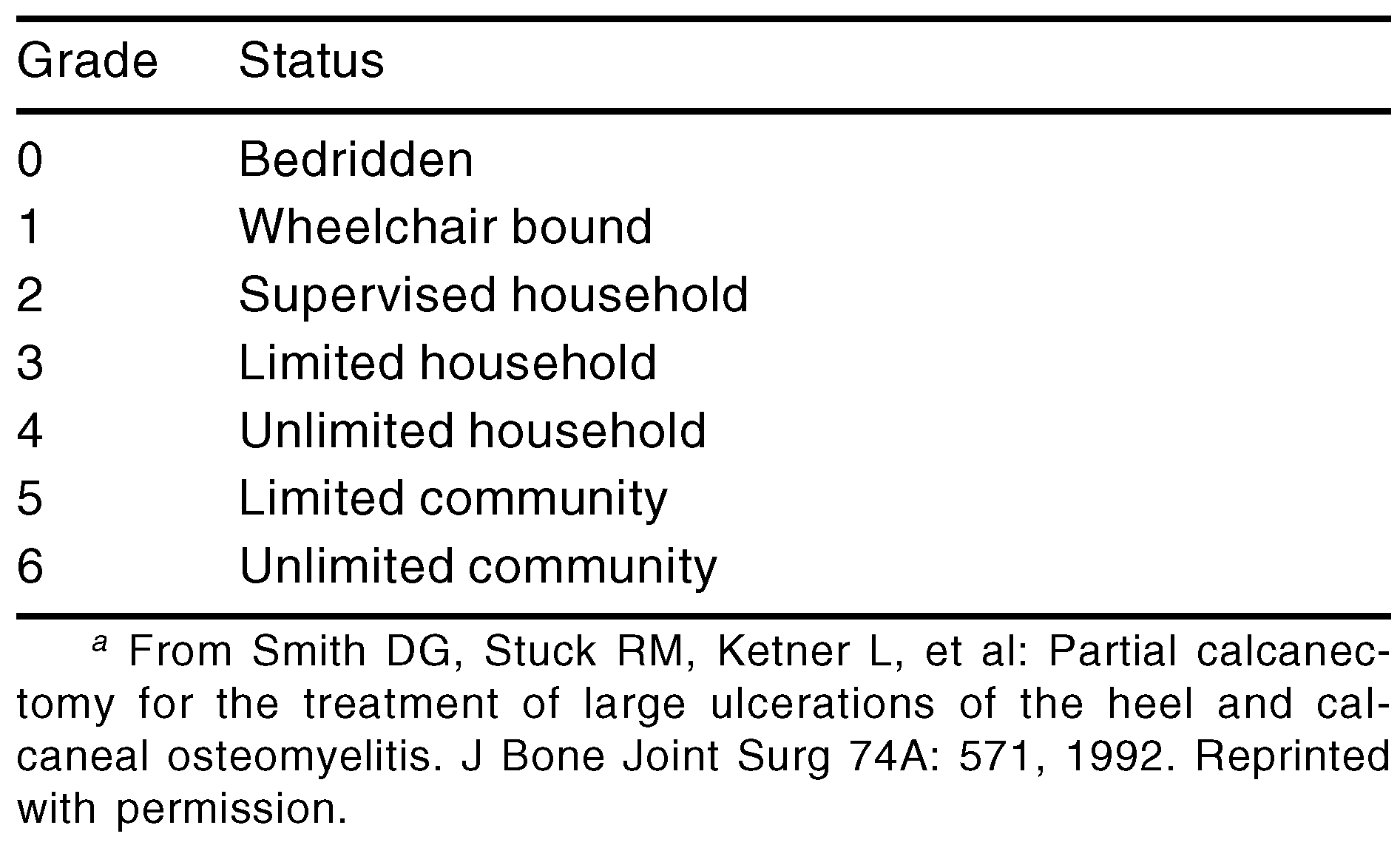
6] reported on 12 patients with an 85% success rate. They based their success on the Volpicelli Ambulation Grading Scale, and related no change in grading in most cases, and one case of improved function (
Table 1).
Case Study
A 62-year-old male presented with nonhealing ulcerations on both feet. The patient related that the ulcers had been present for many years and occasionally required oral antibiotics in addition to meticulous wound care to effect healing. More recently, however, the ulcerations had not responded to this care. His medical history reveals paraplegia for 40 years, noninsulin-dependent diabetes mellitus, and benign prostatic hypertrophy. The patient’s surgical history is significant for decubitus ulceration repair on the buttocks, and prostate surgery without complications. Medications include oral hypoglycemics only. The patient has no allergies. Social history includes no alcohol, tobacco, or illicit drug use. The patient’s religious beliefs precluded the use of any blood transfusions. The patient is self-employed, with frequent traveling and lecturing as part of his daily activities.
A physical examination reveals a massively obese male in no apparent distress who is confined to a wheelchair. The vascular examination reveals excellent perfusion to the level of the digits. There is no significant venous disease but severe pitting edema distal to the knees. Dermatologic evaluation reveals grade 3 ulcerations on the plantar aspect of both feet at the level of the calcanei. The ulcerations involve most of the heel pads. Laboratory evaluation revealed mildly elevated white blood cell count without left shift, and a moderately elevated sedimentation rate (35 mm/sec). The culture from tissue biopsy revealed
Enterococcus, Staphylococcus aureus, and
Klebsiella. Radiographs showed marked osteoporosis at both calcanei with the radiologist’s impression as “extensive neuropathic changes, although osteomyelitis could not be ruled out” (
Figure 1).
The initial treatment included compression pumps to control the massive edema, culture-specific antibiotics, and dressing changes twice a day using a wetto-wet regimen. Several months later, the wounds had not progressed satisfactorily and a magnetic resonance imaging scan was ordered and the podiatry department was consulted. A bone biopsy was performed and this revealed acute and chronic osteomyelitis. It was decided to perform a subtotal or total calcanectomy with proximal margins sent for culture including fungal, acid-fast bacillus, aerobic, anaerobic, and histopathologic evaluation.
Surgical Procedure
A posterior and plantar midline approach is used with excision of the plantar ulcerations. The incision is deepened through subcutaneous tissue with care to avoid neurovascular and tendinous structures. This is then deepened through the tendo Achillis, leaving it attached to any viable soft tissue structures. A large periosteal elevator is used to free the surrounding soft tissue of the calcaneus, with care to avoid and retract the medial and lateral neurovascular and tendinous structures. A large osteotome is then used to resect a plantar wedge of bone from the calcaneus at the level of the ulcerations. A moderate amount of purulence was noted to exude from the calcaneus at this time. An osteotome is then placed superior to the posterior facet of the calcaneus and the bone is resected in toto to the level of the cuboid. After copious power lavage, the wounds are packed with saline-soaked gauze and covered with gauze impregnated with petroleum jelly. No tourniquet is used throughout the procedure. Intraoperative biopsy revealed acute and chronic osteomyelitis and culture results were similar to the previous results.
Postoperatively, the patient was maintained in posterior splints and received culture-specific antibiotics, and wet-to-wet dressing changes twice daily. The wounds granulated quickly. The patient was discharged from the hospital with daily wound care and antibiotics administered by home health care providers. The wound was allowed to granulate completely and the patient was discharged from the podiatry service with an ankle-foot orthosis to prevent footdrop and facilitate wheelchair transfers and mobility.
Conclusion
Considering that the authors’ patient was paraplegic from a fall sustained more than 40 years prior, functional concerns were less important. However, the calcanectomy allowed healing of long-standing ulcerations and improved his quality of life. Constant dressing changes, wound care, and hospital admissions were no long necessary. In ambulatory patients, this procedure has proven to be an effective method of curing osteomyelitis with good functional outcomes. Surgical considerations include maintaining the tendo Achillis attachment to soft tissue structures to aid in plantarflexion, and care to avoid neurovascular and tendinous structures is imperative. In addition, subtotal calcanectomy has been shown to provide a more stable and functional foot in ambulatory patients than total calcanectomy because of preservation of articular surfaces, ligaments, and tendons [
4].