The first New York City Marathon was in 1970, when 126 men and one woman participated in the 26.2-mile race around New York City’s Central Park. Today, the marathon runs through all five New York City boroughs and attracts almost 30,000 participants from more than 100 countries. Thus, despite its modest beginnings, the New York City Marathon has become one of the world’s most popular and prestigious marathons. [
1]
The New York College of Podiatric Medicine has the privilege of providing podiatric medical care for the participants of the New York City Marathon. The marathon serves as a microcosm of world-class athletes from which the college is able to study podiatric sports injuries. In 1994, the college conducted a survey of marathon athletes who presented to the medical stations. That year, 29,735 athletes took part in the marathon.1 Although various long-term studies exist concerning the occurrence of running injuries in athletes, this study was conducted because of the apparent absence of data on acute podiatric injuries suffered during a large urban marathon.
Materials and Methods
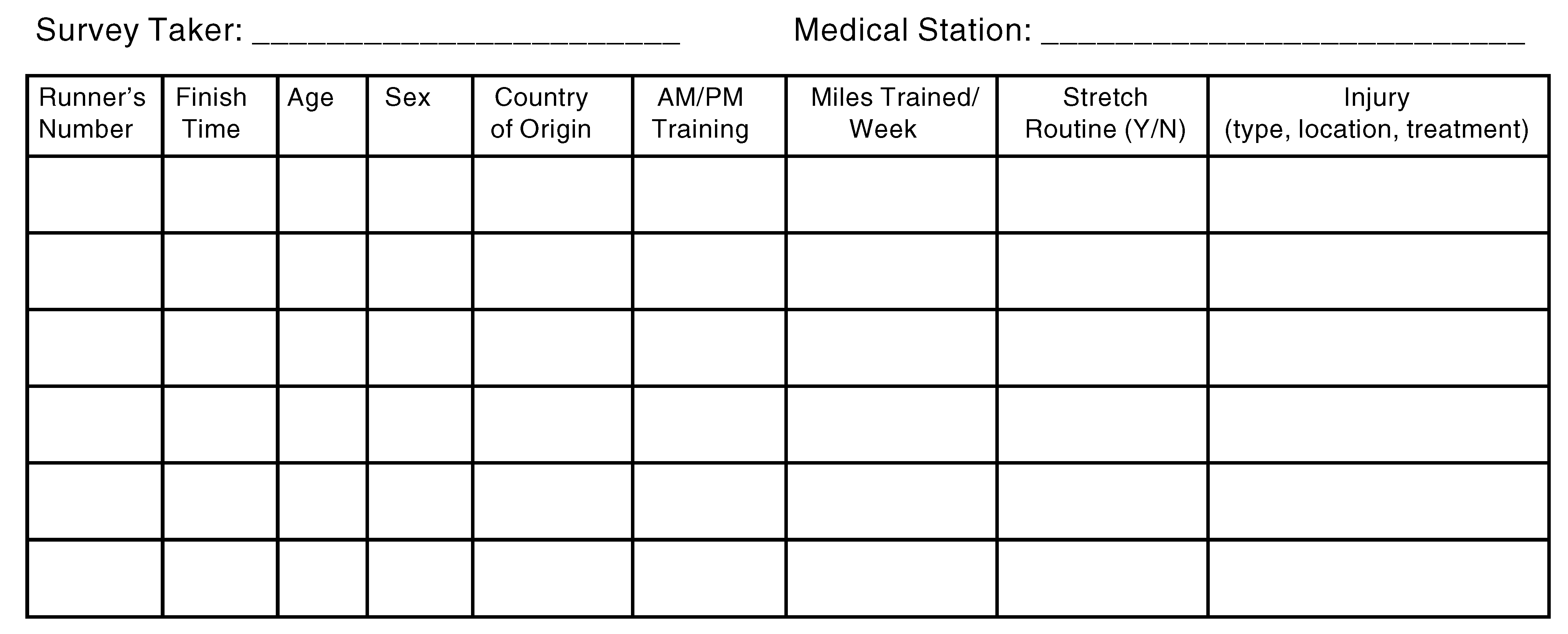
Survey forms were distributed to all of the podiatric medical stations at the 1994 New York City Marathon (
Fig. 1). Volunteers from the New York College of Podiatric Medicine were asked to complete the forms based on information they obtained from the athletes as they were being treated for various injuries. The following information was obtained: 1) age; 2) sex; 3) country of origin; 4) preferred time to train (morning or night); 5) miles trained per week in the month preceding the marathon; 6) participation in a stretching routine; 7) finish time (for those who were treated at the end of the race); and 8) type of injury (
Fig. 1).
Of the 278 participants surveyed, 13 were excluded from the statistical reporting because their injuries did not involve the lower extremity. Therefore, the final sample consisted of 265 runners. Two and onehalf percent had more than one type of injury.
Results
Of the 265 injured athletes surveyed here, three quarters were male. Twenty-two and one-half percent were younger than 30 years of age, 36.5% were between 30 and 40 years of age, and 29% were older than 40 years of age. A little more than half were of foreign origin. Ninety-eight percent of athletes took part in a regular stretching program. Athletes surveyed at the end of the race had an average finish time of 3 hr and 31 min (range 2 hr and 22 min to 5 hr and 53 min).
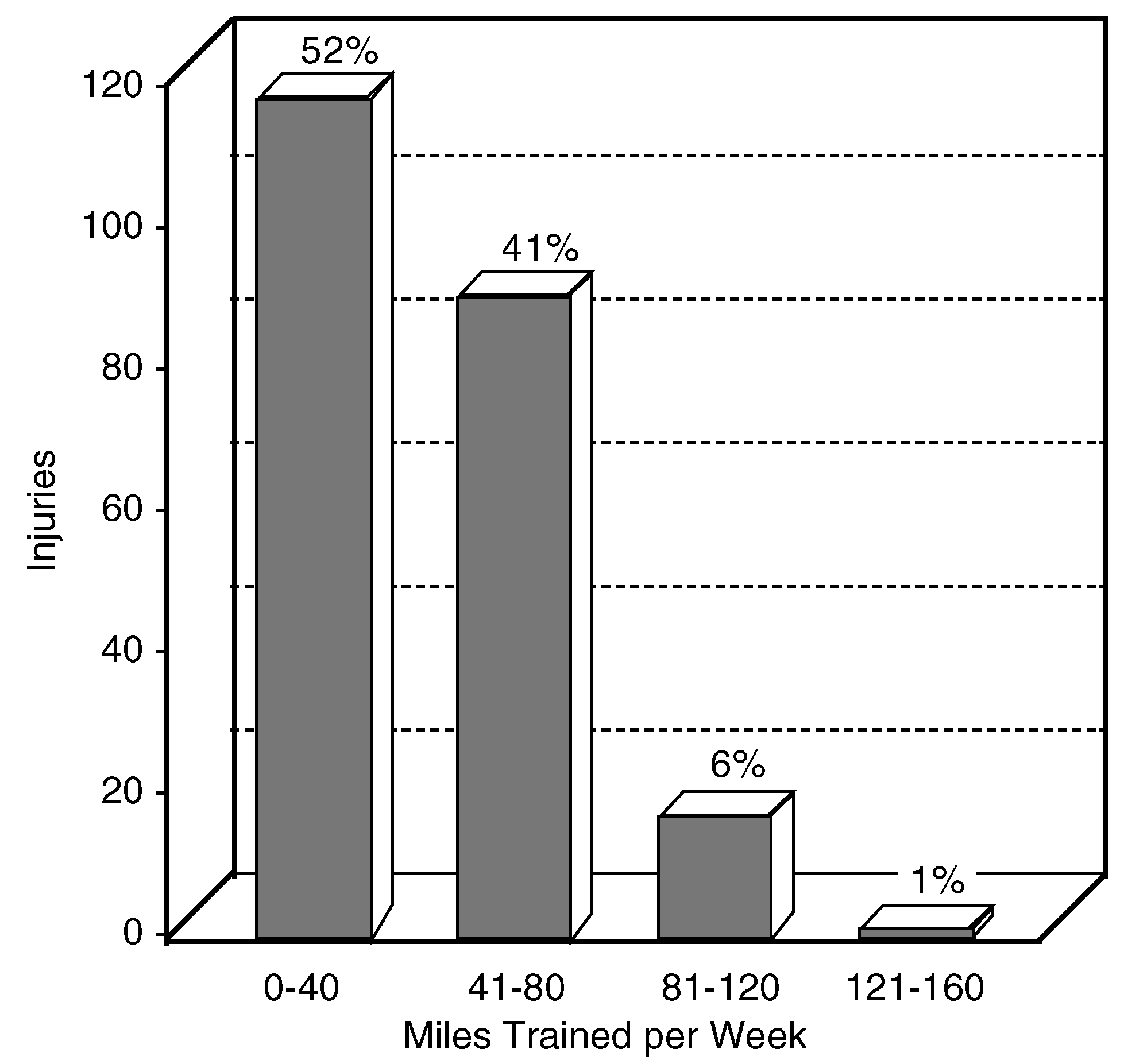
More than 50% of all injuries occurred in runners who trained between 0 to 40 miles per week. Less than 10% of all injuries occurred in those who ran more than 80 miles per week (
Fig. 2). A regression analysis confirmed that a relationship existed between the amount of miles trained per week and the number of athletes injured (r2 = 0.92; standard error of coefficient = 0.21) (
Fig. 2).
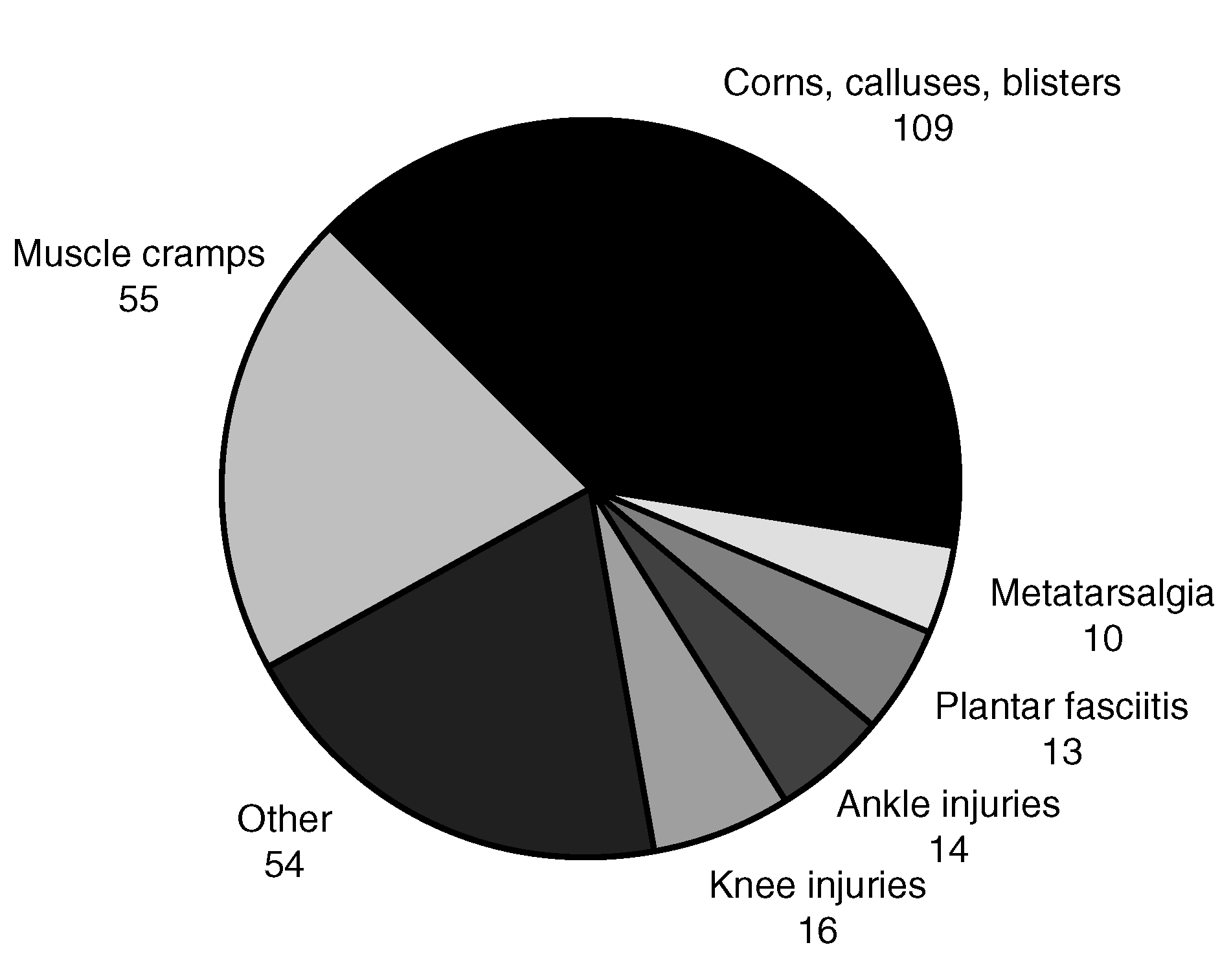
The most common podiatric injuries reported were acute shear and stress injuries (corns, calluses, blisters), acute muscle fatigue injuries (muscle cramps), knee and ankle injuries, plantar fasciitis, and metatarsalgia (
Fig. 3). Injuries reported less frequently included Achilles tendinitis, shin splints, iliotibial band syndrome, patella-femoral syndrome, and subungual hematoma.
Discussion
The gender and age of injured athletes surveyed here tended to reflect the general make-up of all New York City Marathon runners. According to the Road Runners Club, which sponsored the 1994 marathon, 74.8% of marathon runners were male and 25.2% female (73.8% male and 26.2% female in the present study). The majority of New York City Marathon runners were between 30 and 40 years of age (36% between age 30 and 40 in the present study). In agreement with this study, most studies have found no association between acute running injuries and gender, although one study found that female runners were more susceptible to chronic stress fractures because of lower bone mineral density as a result of hormone factors. [
2,
3,
4]
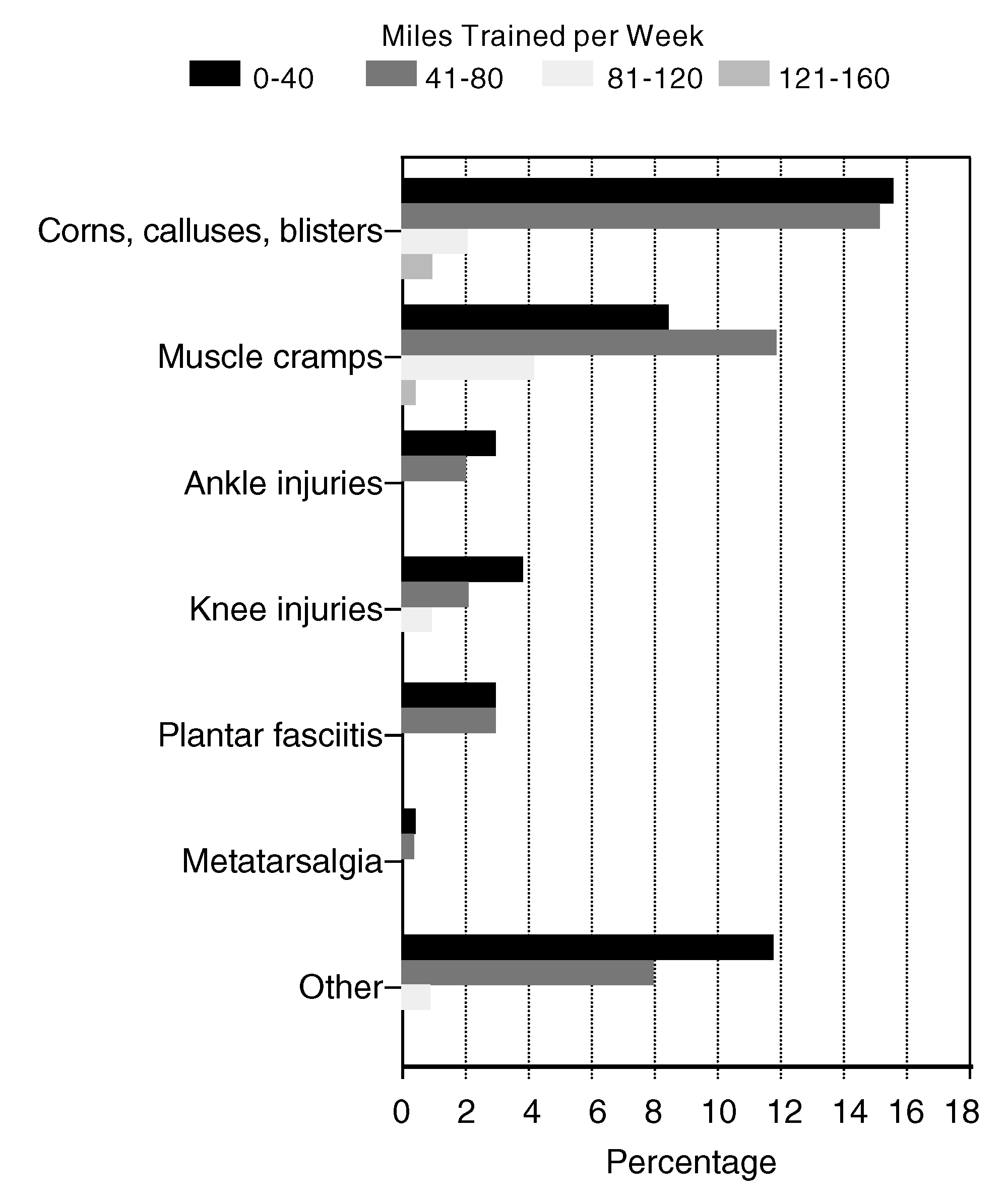
There was, however, a strong inverse relationship between the number of miles trained per week and the number of injuries (r2 = 0.92). Those athletes who trained the least suffered the most injuries. The relationship between increased training and reduced amount of injuries also held true when the injuries were considered individually (
Fig. 4). For example, callosities, muscle cramps, ankle and knee injuries, plantar fasciitis, and metatarsalgia were all more common in those who ran 0 to 40 hr per week. In contrast, the runners with the heaviest training schedule had zero incidence of ankle or knee injuries, plantar fasciitis, and metarsalgia.
The references in the literature concerning training and risk of injury are variable. Many studies have found that after a certain point, increased training leads to increased injuries. [
2,
3,
5] According to these studies, running injuries are mostly overuse injuries caused by constant repetition. Increased training, therefore, only heightens the risk of incurring injury.
In contrast, other studies found that inexperience may be associated with increased risk of injury in competitive athletes. [
3] A study of Navy Sea, Air, and Land (SEAL) recruits suggests that altering running routines before basic training to more closely resemble actual conditions in the service may help prevent injury in new recruits.6 This type of event-related running experience and course familiarity may be especially important in preventing injuries in marathon runners.
Increased training miles may also play a role in preparing athletes for the mental and physical hardships of a full marathon. Thus, the data appear to support the conclusion that marathon runners who train more have a reduced risk of injury.
Most long-term studies of running injury cite knee and ankle injuries as the two most frequent kinds of injuries occurring in runners. [
2,
3,
4,
7,
8,
9,
10] Estimates are that as many as 40% of runners will at one time suffer knee injuries and that almost all runners will suffer ankle injury because of the frequent occurrence of sprains. [
4,
9] In contrast, the present study found that corns, calluses, and blisters were the most common injuries in marathon runners. Knee and ankle injuries ranked second and third in incidence, respectively. In the authors’ opinion, the incidence of shearing injuries (corn, calluses, and blisters) may have been underreported by previous studies because of their relatively minor nature.
Conclusion
Athletes who participate in urban marathons put themselves at an especially high risk of incurring a wide variety of injuries. It was the purpose of this study to document the nature and relative frequency of these injuries and to determine if a relationship exists between injury and training.
The most common podiatric injuries reported were shear and stress injuries which include corns, calluses, and blisters, muscle cramps, acute knee and ankle injury, plantar fasciitis, and metatarsalgia. Shearing injuries (calluses, corns, blisters) have been overlooked by previous studies on running injuries.
Less frequently reported injuries included Achilles tendinitis, shin splints, iliotibial band syndrome, patella-femoral syndrome, and subungual hematoma. Gender and age appeared not to play a role in the risk of injury. Similarly, since virtually all runners participated in a stretching program, this variable was also not considered a factor in risk of injury; however, athletes with the least amount of training for the marathon had a greater incidence of injury.
Additional References
GROSS ML, DAVLIN LB, EVANSKI PM: Effectiveness of orthotic shoe inserts in the long-distance runner. Am J Sports Med 19: 409, 1991.
KALLINEN M, ALEN M: Sports-related injuries in elderly men still active in sports. Br J Sports Med 28: 52, 1994.
KANNUS VP: Evaluation of abnormal biomechanics of the foot and ankle in athletes. Br J Sports Med 26: 83, 1992.
KIBLER WB, GOLDBERG C, CHANDLER TJ: Functional biomechanical deficits in running athletes. Am J Sports Med 19: 66, 1991.
LIU NY, PLOWNAM SA, LOONEY MA: The reliability and validity of the 20-meter shuttle test in American students 12 to 15 years old. Res Q Exerc Sport 63: 360, 1992.
MASCARO TB, SWANSON LE: Rehabilitation of the foot and ankle. Orthop Clin North Am 25: 147, 1994.
RENSTROM AF: Mechanism, diagnosis, and treatment of running injuries. Instr Course Lect 42: 25, 1993.
REYNOLDS KL, HECKEL HA, WITT CE, ET AL: Cigarette smoking, physical fitness, and injuries in infantry soldiers. Am J Prev Med 10: 145, 1994.
STUSSI E, STACOFF A: Biomechanical and orthopedic problems of tennis and indoor sports. Sportverletz Sportschaden 7: 187, 1993.
TING AJ: Running and the older athlete. Clin Sports Med 10: 319, 1991.
UITENBROEK DG: Seasonal variation in leisure time physical activity. Med Sci Sports Exerc 25: 755, 1993.