The oblique closing wedge osteotomy, as described by Juvara [
1], has been advocated for the correction of metatarsus primus adductus. Advantages of this procedure include the ability to correct larger first intermetatarsal angles, compatibility with screw fixation, and consequent early mobilization of the first metatarsophalangeal joint. Complications with basilar procedures primarily involve malunion of the osteotomy with residual elevation of the distal segment of the first metatarsal or shortening of the first metatarsal [
2,
3,
4,
5,
6,
7,
8,
9,
10,
11]. This can result in abnormal loading of the foot associated with lesser metatarsalgia, stress fractures, painful hyperkeratotic lesions, and hallux limitus.
Previous studies have quantified the complications of elevation and shortening encountered with the oblique closing base wedge osteotomy [
2,
3,
5,
10,
11].
These studies are composed of complex multivariate problems and have been evaluated using single factor analysis. Only one of these used an analytic approach to support their conclusions [
11].
Zlotoff [
5] evaluated 156 feet and reported on the clinical significance of shortening and elevation of the first metatarsal in which the first metatarsal would no longer bear its original share of weight during stance and ambulation. The complications would then challenge the compensatory mechanisms leading to lesser metatarsal callosities and metatarsalgia.
Wanivenhaus and Feldner-Busztin [
9] reported elevation and shortening in their group. The first metatarsal elevation was not quantified, while shortening averaged 3.6 mm. Fixation constructs included both Kirschner wires and screws. Their patients were immobilized with a short-leg nonweightbearing cast for 5 weeks following 1 week of splint immobilization.
Haendel and Lindholm10 also addressed elevation of the first metatarsal and discussed some possible etiologies of the complications found in their study. Suggested causes included failure of coaptation of the plantar cortex, inadequate fixation, and lack of adequate immobilization. The authors reported only 2.66° of elevation, but acknowledged that 33% of all osteotomies resulted in 5° or greater decrease in first metatarsal declination. They noted that Kirschner wire and AO screw fixation resulted in less elevation when compared with monofilament wire, but this was not statistically supported. They also discussed the advantages of rigid internal AO fixation that can lead to primary bone healing and excellent anatomical apposition. Statistical analysis and control for factors such as age and postoperative course were absent from their study.
Schuberth et al [
11] evaluated 159 feet in 104 patients and reported 93% incidence of first metatarsal elevation, averaging 6.7°. Significantly more elevation was identified in patients who were not cast immobilized postoperatively, who underwent bilateral surgery or adjunctive procedures, in cases where fixation other than screws was used, and in older patients. They neglected to evaluate the effect of these factors simultaneously and did not take into account the effect of multiple variables. When viewed in isolation, neither type of fixation (screw
versus Kirschner wire) nor bilateral
versus unilateral proved more detrimental than the other when considering metatarsal elevation and shortening [
5].
The purpose of this article was to evaluate the differences in elevation and shortening of the first metatarsal in oblique closing base wedge osteotomies of the first metatarsal caused by differences in fixation methods.
Materials and Methods
A retrospective review of medical records and radiographs of patients who underwent 33 oblique closing base wedge osteotomies of the first metatarsal was performed. The records reviewed were from 1987 to 1993. These osteotomies were fixated either with a single AO screw or two convergent 0.062 Kirschner wires. Medical records were reviewed to identify age, gender, race, postoperative course, and significant medical history. Subjects in comparison groups were matched for gender and age.
All patients in the study received the same postoperative care plan. Patients were treated in a nonweightbearing short leg cast for 3 weeks, followed by 3 weeks nonweightbearing in a removable short leg rocker sole walker. The patients advanced to gradual full weightbearing for an additional 3 weeks in the rocker sole ankle-foot orthosis before weightbearing in the desired shoes.
All radiographs were standard weightbearing lateral and dorsoplantar views. Preoperative and postoperative films were evaluated with measurements of the intermetatarsal angle, metatarsal declination angle, tibial sesamoid position, metatarsal protrusion, and length of the first and second metatarsals. Measurements were performed by the same reviewer using the same goniometer for all measurements. Use of this approach has been validated and shown to be reliable [
12].
The intermetatarsal angle was measured on the dorsoplantar view by bisecting the distal portion of the first metatarsal at the anatomical neck and bisecting the base of the metatarsal just distal to the osteotomy. The second metatarsal was bisected at the distal and proximal diaphyseal flares. The intermetatarsal angle was then measured from the bisection of the two lines [
13]. The metatarsal declination angle was measured on the lateral view from the angle formed by the bisection of a line drawn from the plantar aspect of the first metatarsal head to the plantar aspect of the calcaneus, which represented the weightbearing surface, and the bisection of the base of the first metatarsal distal to the osteotomy site, and the distal portion of the metatarsal at the anatomical neck [
10]. Tibial sesamoid position was evaluated using the standard classification of one to seven [
14].
The lengths of the first and second metatarsals were determined by using the bisections of the metatarsals that had been established with previous measurements and measuring the distance between the point where the bisection crossed the proximal bone end and distal aspect of the metatarsal head [
1]. The metatarsal protrusion distance was measured by extending the bisections of the first and second metatarsals proximally to a point of bisection. The distance from the point of bisection to the distal end of the first metatarsal and the distal aspect of the second metatarsal was calculated. The measurement for the second metatarsal was subtracted from the measurement for the first metatarsal to identify the metatarsal protrusion distance. Measurements were obtained at the point of last radiographic follow-up examination which represents a stable clinical end point (
Table 1). Stable bone healing was determined by finding radiographic consolidation of the surgical fracture and resolution of symptoms at the osteotomy.
Table 1.
Follow-up Examinations in Days.
Table 1.
Follow-up Examinations in Days.
This study controlled for multiple variables by matching for age and type of fixation. The average age of the patients with the AO screws was 34.0 years ± 10.1. The unilateral Kirschner wire age was 40.9 years ± 17.1 and the bilateral Kirschner wire group was 30.2 years ± 9.9. The subjects were matched for age plus or minus 4 years. All procedures were standardized in that all were oblique closing base wedge osteotomies, a Reese guide was used to create each osteotomy, and the postoperative courses were identical.
Results
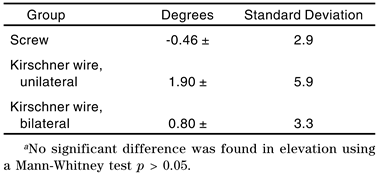
The fixation method represents the independent variable in this study, while elevation and shortening of the first metatarsal represent the dependent variables. Shortening is compared in
Table 2 while elevation is compared in
Table 3 and
Table 4. No statistical difference was found in either elevation or shortening using the Mann-Whitney test (
p > 0.05). The 14 cases that plantarflexed were attributed to intentional surgeon-mediated orientation of the osteotomy axis.
Table 2.
Comparison of Metatarsal Shortening a.
Table 2.
Comparison of Metatarsal Shortening a.
Table 3.
Comparison of Metatarsal Elevation a.
Table 3.
Comparison of Metatarsal Elevation a.
Table 4.
Millimeter Displacement With Each Fixation Type.
Table 4.
Millimeter Displacement With Each Fixation Type.
Discussion
This study found no difference in the amount of elevation or shortening when comparing screw with Kirschner wire fixation. The authors believe the common denominator of these comparable results correlates to matched osteotomy technique and consistent postoperative immobilization in all groups. Cadaver model structural analysis results support the hypothesis that matched technique will provide comparable stability for a variety of fixation configurations [
15,
16,
17]. Specific comparison of 3.5-mm screw and 0.062 Kirschner wire stability has shown no specific statistical difference [
18].
Conclusion
Finding less elevation in the bilaterally treated group may be related to complete nonweightbearing with a wheelchair in those patients serving a protective role against dorsiflexion over a longer postoperative time frame. This result supports the supposition that postoperative immobilization significantly reduces complications such as elevation.
When immobilization is comparable, various fixation techniques will lead to more predictable outcomes. While Schuberth et al [
11] found unilateral results to be superior, casting and nonweightbearing status were not consistent across their group. The authors believe that uniformity in this respect suggests that bilateral surgery may not contribute to adverse results. Nigro et al. [
2] used axis technique, and although an osteotomy guide was not used, uniformity of osteotomy architecture may be presumed in their group. Nonetheless, the substantial elevation in their group (34%) was probably linked to mixed immobilization technique. Regardless of fixation type, protective immobilization would appear to play a fundamental role in final first metatarsal position.