Standardization of foot x-rays for the purpose of assessing function is not a new concept. In their first text, Gamble and Yale[
1] stated “the natural weight supporting attitude gives more information concerning patho-mechanical conditions which may present in the foot than other postures which the patient may assume.” The authors believed that weightbearing produced its own standard as the foot is positioned at right angles to the leg and that the force of body weight immobilizes the foot without the need for artificial devices. It is also important that the positioning is easily accomplished by the patient.
In their second text, Gamble and Yale[
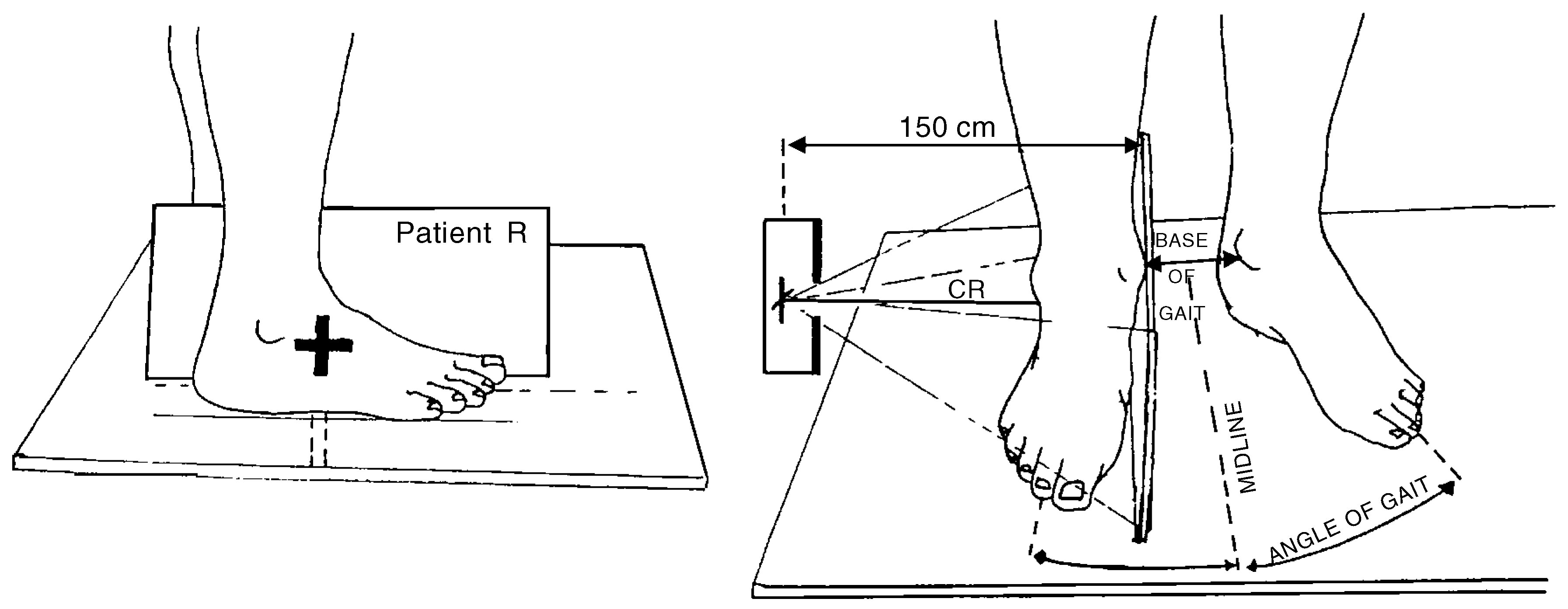
2] stressed the positioning process in stating “great care should be exercised on posing the patient in his natural base and angle of stance because this position coincides within acceptable limits with the foot position in the midstance phase (whole foot on ground)” of walking gait. The angle of gait is the line formed when both feet bisect relative to the line of progression. The base of gait is the estimated distance between the malleoli during walking.[
3]
Essentially, “the foot being x-rayed is placed on the film with the contralateral side of the film covered by a lead plate (
Figure 1). The contralateral foot is then positioned at the calculated angle to the first foot, and with the heels apart, corresponding to the base of gait. The patient’s body is placed in the direction of progression.”[
4]
These theories have yet to be tested. As a result, on a worldwide basis, foot x-rays are typically taken during nonweightbearing. The aim of this study is to validate the process of taking weightbearing angle and base of gait x-rays.
Previous studies have shown that change in angular value can be produced by internal and external rotation of the leg, and by alteration of the central ray.[
5,
6,
7,
8,
9,
10]
Other than an isolated videofluoroscopic study of four subjects, the authors know of no previous work that suggests that static films are in any way representative of dynamic gait.[
11]
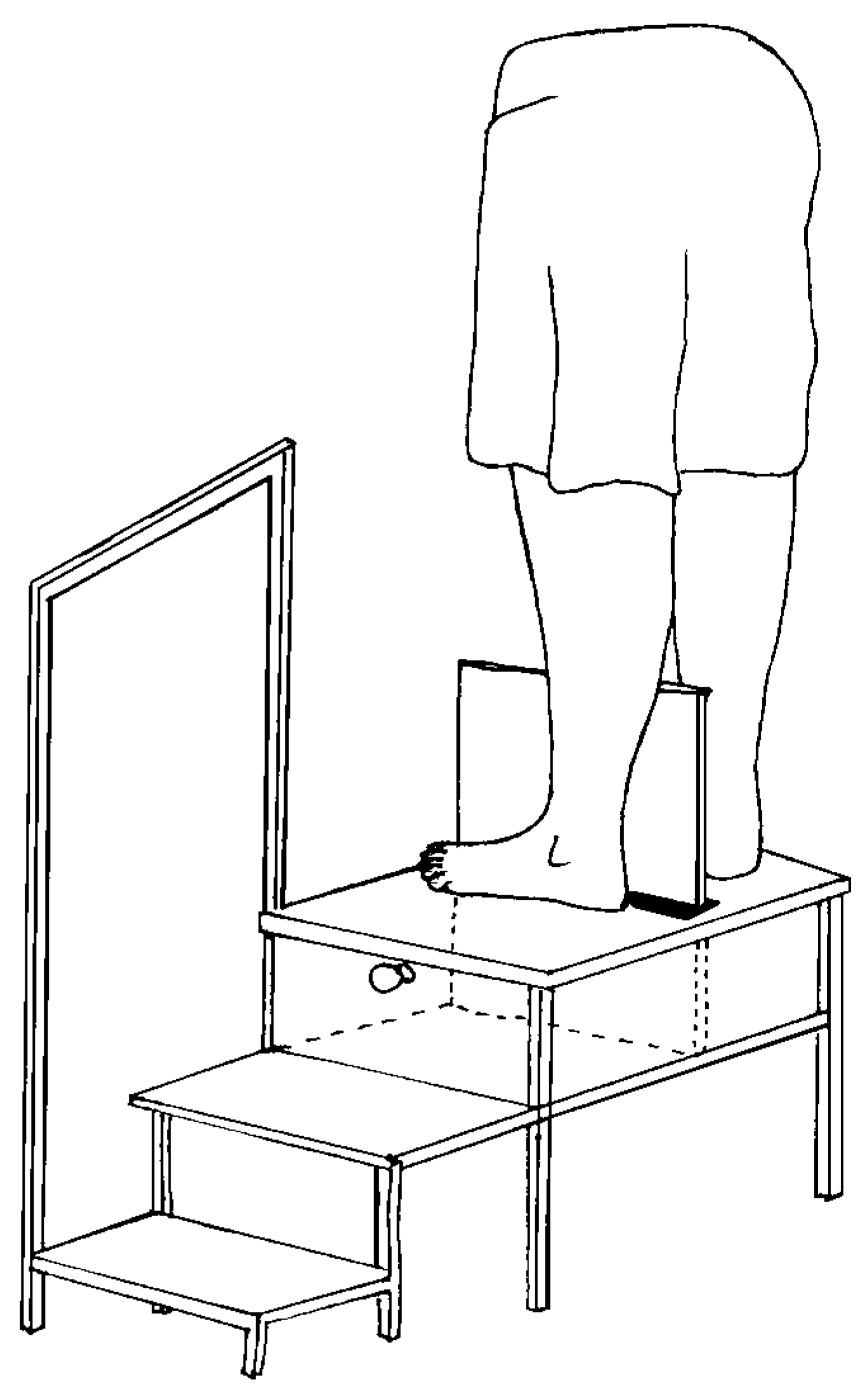
In the US, the recommended use of an orthoposer has made the taking of weightbearing laterals with “hospital” units possible by allowing the x-ray head to be positioned 30 cm from the floor (
Figure 2). The study apparatus, like the one proposed by Gamble and Yale in 1966, has an aperture for positioning a lateral x-ray. A knob-and-lever system is used to maintain the cassette in the cassette holder. Lead blocking within the platform makes it possible to take two weightbearing laterals on the same film.[
1]
In Australia, most x-rays are taken by trained radiographers in the hospital setting. The absence of an orthoposer, the liability of the patient falling off a standard (90 cm high) hospital x-ray examination table, and the lack of research validating weightbearing angle and base of gait x-rays have resulted in almost all foot studies being taken during nonweightbearing.
Methodology
Sixty female subjects, aged 12 to 68 years, with no associated findings of defensive gait (limp) requiring diagnostic right foot x-rays, were identified in Queensland University of Technology’s podiatry clinics. Subjects were asked to bring any previous foot x-rays to the hospital. Verbal and written explanation of study background, purpose, method, time involvement, and additional radiation (two fluoroscopic trials were determined to represent 13% of a single x-ray radiation dose) were presented to each participant. Subjects were asked to sign the study consent document consistent with requirements of the Queensland University of Technology ethics committee.
Females were chosen because they generally have smaller feet that are more likely to fit within the boundaries of the 9-inch fluoroscope field. The fluoroscopic equipment allowed only for study of the right foot. In addition, the lateral fluoroscope had to be taken with the central ray entering from the medial rather than lateral aspect (
Figure 3). Taking an x-ray of a “phantom” foot (foot model) with the central ray entering from the lateral and medial aspects showed no difference in the calcaneal pitch angle.
Initially, the subject’s angle and base of gait were assessed by the radiographer performing the study. Next, a weightbearing lateral x-ray of the right foot was taken at a focal film setting of 150 cm, 58 kilovolt, and 3.0 mA along with other diagnostic films that may have been ordered (
Figure 2).
The fluoroscopic unit was then set at a 150-cm focal film distance with the central ray positioned 3 cm above the level of the 30-cm-high walking platform. The phantom foot, which doubled as a subject identification marker, was “test”-screened at 3.0 mA and 58 kilovolt. This assured that the subject’s foot would fall within the fluoroscopic field. Last, the field was collimated to just short of end boundaries in order to visualize the maximum foot anatomy while reducing “scatter” radiation.
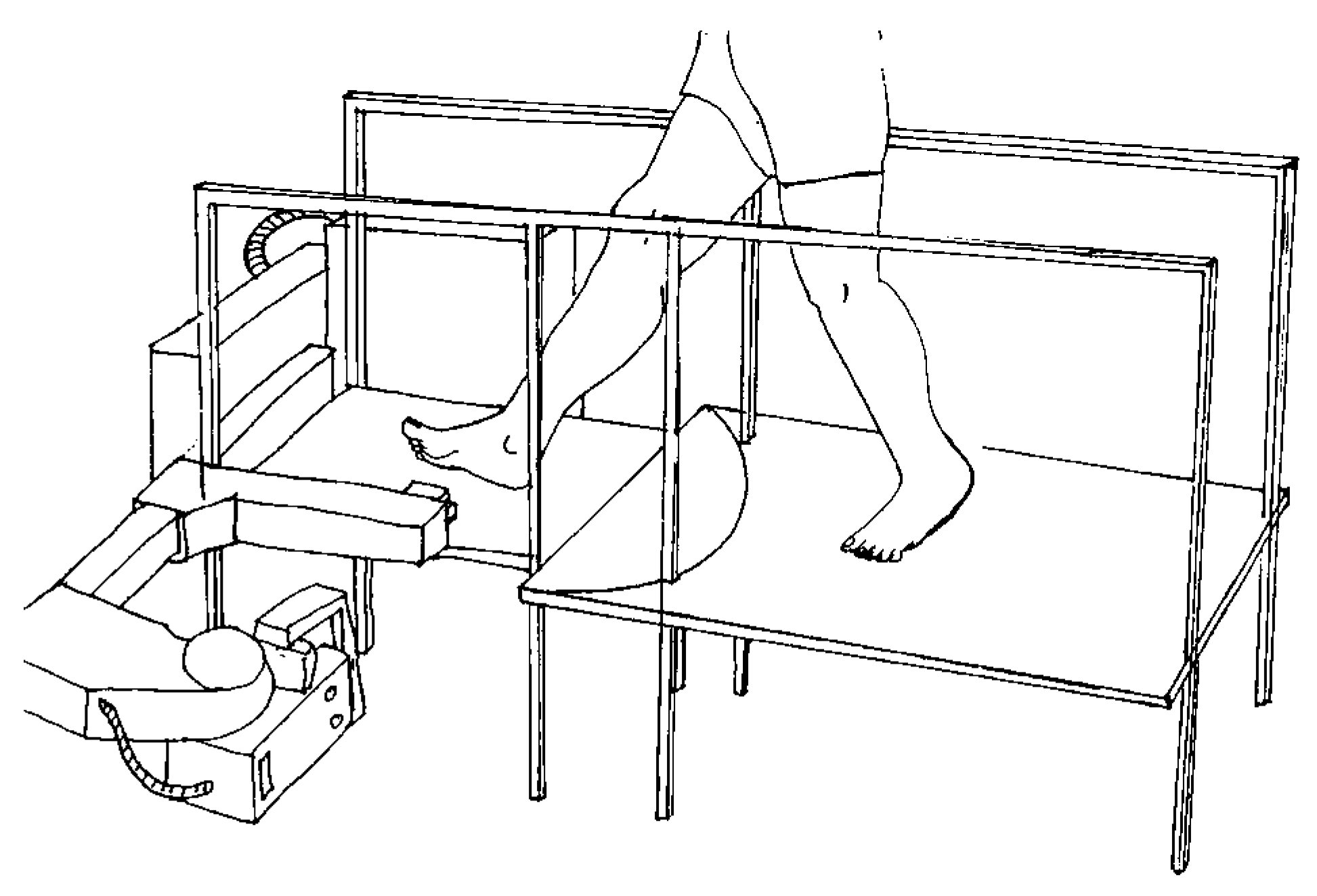
Next, the researcher showed the method of walking across the fluoroscopic apparatus (
Figure 3). The walking platform was made of a 20 × 20 × 3-mm steel angle that was assembled so that 15-mm plywood flooring could be fitted. Legs were constructed with square steel tubing (25 × 25 × 1.6 mm) with adjustable feet to ensure a level surface. The walkway was designed within a 0.5-cm tolerance of the boundaries of the fluoroscopic apparatus to ensure fluoroscopy was taken at the same angulation in each subject. A handrail was incorporated in the left side of the apparatus for safety and mobile steps were used to gain access to the platform.
In this “two-step” study, subjects were trained to have their right (study) heel contact a predetermined point (
Figure 3). The patients were allowed to look at the target. They were encouraged to take a final third step to the boundaries of the gait platform to simulate normal walking gait. After 15 to 20 min, subjects were sufficiently acclimated to consistently “hit” their predetermined “spot” while showing a consistent rhythm of gait. During the training period, the subject’s angulation of approach was adjusted by moving the front section of the platform to ensure the study foot struck perpendicular to the central ray.
Using nonverbal cues, the radiographer (who performed studies on all 60 subjects) was informed that the subject was ready. The fluoroscopic power button was pressed at left (nonstudy) foot heel contact.
In most cases, the target anatomy could be observed on at least one of the two study trials. However, a number of nonusable trials resulted from a flare, which is equivalent to a photographic flash, because too much time elapsed between the time the power was switched on and the time the study foot entered the field.
The same focal film distance and the same calibrated landing spot on the study apparatus were used to maintain a consistent study protocol.
The lateral x-rays were placed on a light box and recorded onto Beta video format. Laterals that overlapped one another had a cardboard extension placed to act as a horizontal reference point. The fluoroscope VHS tapes were also dubbed into Beta format, and each of the 25 frames per second were numbered. The fluoroscope tape was again dubbed into VHS format so information could be introduced into the computer. The fluoroscope frame that best represented the x-ray image was selected according to the tibial stance position on the talus. A single-frame, shuttle-advance videocassette recorder was used to identify the exact frame.
The video image was then transferred to a personal computer using a frame capture board. This digital image was then edited using photograph software to improve clarity.
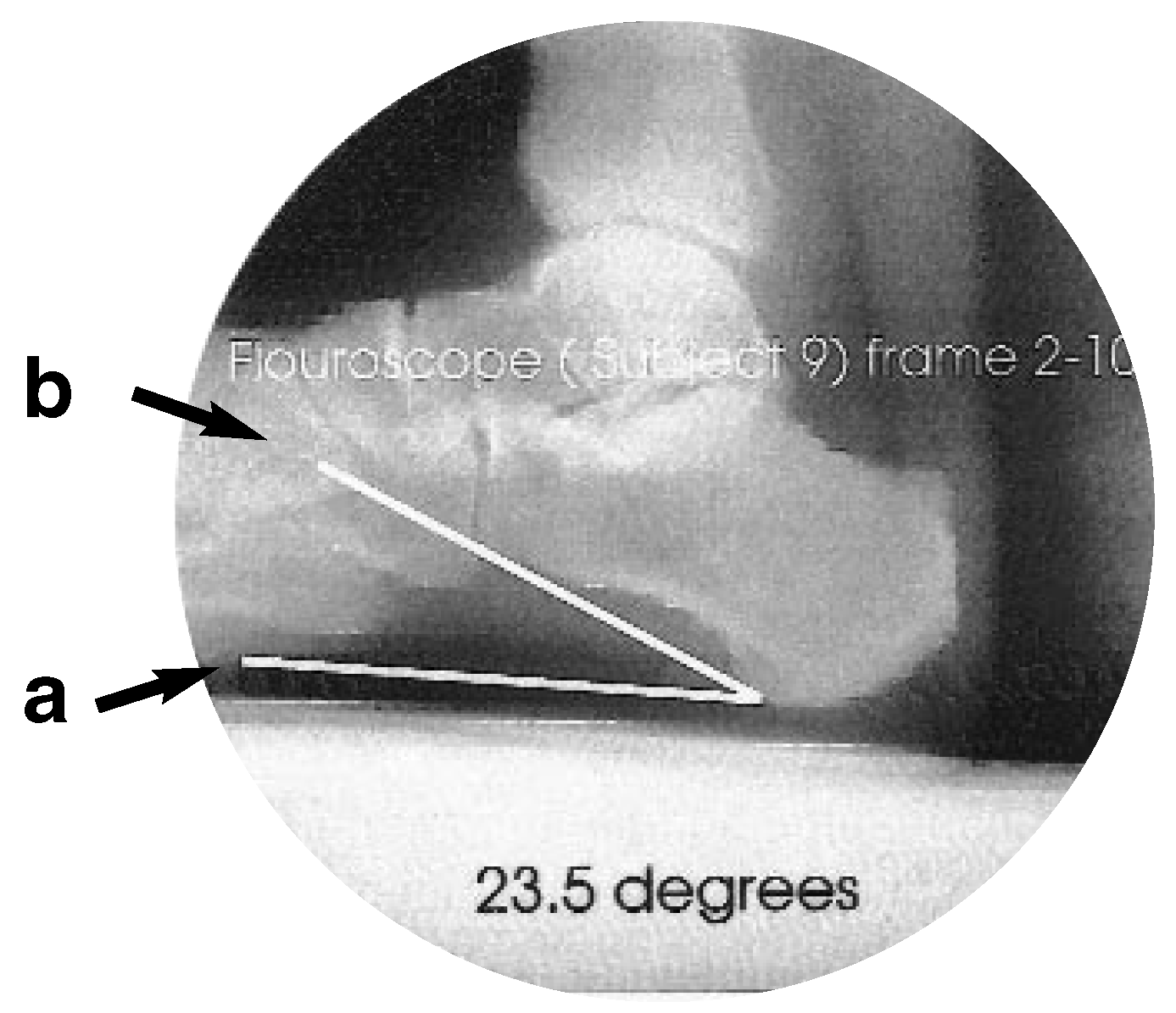
The angle produced between the plane of support and the calcaneal pitch was drawn and measured on the digitized image using the Corel-DRAW
® (CorelDRAW, Ottawa, Ontario, Canada.) program (
Figure 4). In the case of four subjects with previous nonweightbearing films, the plantar calcaneus-plantar fifth metatarsal line was used. All measurements of x-rays and fluoroscopic frames were performed in an identical fashion by two observers acting independently of one another.
Calcaneal pitch data were assumed to be normally distributed. Product-moment correlations between x-ray and fluoroscopy values were determined. Repeatability was assessed by the ratio of between-observer (within-subject) variability to between-subject variability in those patients who had at least two measurements on a frame.
For the 36 subjects where at least one x-ray measurement and one fluoroscopic measurement were obtained, a mean x-ray value and a mean fluoroscopic value were calculated. In addition, a “worst-case” pair of values was derived, based on the x-ray and fluoroscopic measurements that were farthest apart in absolute terms.
Results
Thirty-six x-rays were measured by both observers: the between-observer variance was 0.6% of the between-subject variance, equivalent to a product-moment correlation of 0.995 between observers. Among the 54 fluoroscopic images measured by both observers, the between-observer variance was 0.5% of the between-subject variance, equivalent to a product-moment correlation of 0.996 between observers. There was no evidence of a systematic bias in measurement between the two measurers.
The calcaneal inclination angle was 22.5° ± 5° using fluoroscopy and 22.9° ± 5.0° using x-rays. The ranges were 10° to 35° and 9° to 35° respectively. The difference was thus 0.4° with 95% confidence bounds 0.2° and 0.7°. There was no significant difference between the two means.
The product-moment correlation between x-ray and fluoroscopy means was 0.99. For the worstcase measurements, the correlation was 0.97 (p < 0.001 in both cases).
In reviewing the four subjects with previous nonweightbearing lateral x-rays, it can be seen that angular measurements were noticeably dissimilar (
Table 1). There were too few subjects from which to draw firm quantitative conclusions.
Discussion
The concept of the calcaneal inclination angle as a measurable, quantifiable, angular pitch of the calcaneus observed on a weightbearing lateral x-ray is universally accepted in orthopedic, physiotherapy, radiologic, and podiatric literature.[
1,
6,
12,
13,
14,
15,
16,
17,
18,
19,
20,
21]
Also generally accepted is the fact that calcaneal pitch is an indirect measure of arch height or foot pronation and supination.[
15,
18,
19,
20]
The calcaneal inclination angle is based on a horizontal reference line (a) that articulates with the plantar calcaneus and the calcaneal pitch line (b) (
Figure 4). This study used the universally accepted plantar calcaneus as the proximal aspect of the pitch line. The distal aspect of the pitch line generally involves the plantar (inferior) aspect of the calcaneocuboid joint.[
18]
Some authors, either pictorially or by text, use the anterior plantar calcaneal tubercle as the reference point (
Figure 4).[
13,
22] Christman[
23] suggested that this prominence can change because of the pull of the long plantar calcaneocuboid ligament. As a result, the plantar prominence would be a less reliable reference line than the plantar calcaneocuboid joint, which is more representative of joint function.
There are two commonly used methods of producing a horizontal reference line. One method involves drawing a line that connects the most plantar aspect of the calcaneus to the most plantar aspect of the fifth metatarsal. This line is superimposed onto a previously constructed horizontal line drawn on the x-ray viewbox.[
18]
It was not possible to use this method in the current study because of an inability to observe the fifth metatarsal head on fluoroscopy. As a result, an alternative “horizon line” method based on the supporting surface or weightbearing plane of the orthoposer apparatus was used. It is generally believed that using the equipment as the horizon line reduces measurement error.[
21]
Using the orthoposer to determine the horizon avoids the variable of soft tissue thickness. Pictorially, some authors show a soft tissue space beneath the calcaneus and not under the fifth metatarsal, while others more accurately depict soft tissue space beneath both the calcaneus and fifth metatarsal head.[
17,
21] Steel et al[
13] in assessing soft tissue found a 0.1- to 1.6-cm range plantar to the fifth metatarsal and a range of 0.7 to 2.5 cm plantar to the calcaneus. Subsequently incorporating the heel fat pad would result in a slightly higher mean calcaneal inclination angle.
With one exception, the authors’ calcaneal inclination angles fell within the limits of 11° to 38° cited in the literature.[
12,
13,
17] The authors’ average calcaneal inclination angle x-ray value of 22.9 is close to the adult average commonly quoted as being 18 to 21.[
4,
13,
18] DiGiovanni and Smith6 found slightly increased (24.5) median values. Again, a slightly higher calcaneal inclination angle mean value may be a reflection of incorporating the denser heel pad into the angular measurement.
The results from the repeatability study suggest a negligible component of error caused by measurement technique.
Last, and most significant, the high correlations between mean fluoroscopic and x-ray values of even the worst-case pair measurements suggest that the two methods yield clinically identical results.
Conclusion
Using the previous x-rays of four subjects, there appears to be a weak relationship between weightbearing and nonweightbearing x-rays.
The authors considered that the weightbearing angle and base of gait method used in this study is a close clinical reflection of dynamic gait. Considering the importance of function in foot problems, the use of an orthoposer device is strongly recommended.