Twenty-two subjects with a history of foot and leg problems were studied with a Musgrave Footprint System® (W.M. Automation, Newtonabby, Northern Ireland, United Kingdom.) and Electrodynogram® (Tekscan Inc, Boston.) in-shoe pressure sensor device. Subjects were tested barefoot, in standardized running shoes, and in the same shoes with prescription subortholene orthoses (with a 4° inverted ethylene vinyl acetate heel post) made from a balanced plaster cast. Peak pressure and time to peak pressure were evaluated in several key locations beneath the foot. Repeatability testing was undertaken to assess the reliability of the sensors.
Using a matched paired t-test, an important change in foot and leg biomechanical function was observed. The maximum pressure was loaded (5% to 7%) earlier on the lateral border of the foot during the gait cycle (P < 0.05). This finding suggests that forces through the foot may be changed by the use of orthoses. The “generic” effect of the custom-molded (4° inverted) subortholene foot orthoses has been quantitatively shown in this study.
Background
Biomechanically related problems of the lower extremity are frequently encountered by podiatric physicians. The “modus operandi” for the management of foot function is to use some form of motion-controlling orthosis. The development of modified shoes and orthoses is considered by some as more of an art than a science, and individual methods and opinions are largely the product of trial and error. Treatment is considered successful when a patient’s symptom is resolved. The patient and clinician may proceed through several cycles of prescription, trial, and retrial before a satisfactory treatment regimen is found.
With the advent of specialized computer systems, it is now possible to obtain quantitative information about pressure beneath the foot. Many investigators have observed the distribution of barefoot pressures on the plantar aspect in subjects, which has proven useful in identifying parameters of foot function. [
1,
2,
3] When attempts have been made to evaluate the effect of orthoses, video analysis is usually undertaken.[
4,
5,
6,
7] This method can identify only gross changes in function, and smaller (yet significant) changes of 5% to 10% cannot be readily or accurately identified. It has only been with the recent advent of high speed computers and the correct (reliable) testing protocol that such critical changes can now be identified.[
8]
Measurement of pressure beneath the foot has the potential to greatly reduce the time and difficulty associated with finding the suitable combination of treatments. It is believed that while this approach may be initially confined to the research laboratory, the application of this knowledge by practicing podiatric physicians will have a direct impact on patient management.
The specific aim of this study was to observe if any change occurred during the time at which maximum pressure occurs beneath the lateral (fifth metatarsal), middle (second to fourth metatarsal), or medial (first metatarsal) heads.
Methodology
Twenty-two volunteers were recruited into this project and all subjects had attended the Queensland University of Technology podiatry clinic for treatment of musculoskeletal pathology (ie, “normal” foot structure, but with symptoms). Subjects underwent a technique of pressure measurement in the shoe during walking. The Electrodynogram in-shoe pressure measurement system was used to evaluate foot pressures of the plantar aspect at the foot-orthosis-shoe interface.
Each subject walked 5 min with the system attached in all test situations. Data are then recorded while walking on a hard surface and the information was analyzed.
Subjects were provided with and tested in standardized shoes while wearing a custom-molded orthosis made from 4-mm subortholene with a high density ethylene vinyl acetate heel postinverted at 4°. Barefoot pressure on the plantar aspect was also measured using a floor-mounted Musgrave footprint analysis system in order to ensure that all participants have acceptable (within the normal range) foot pressures of the plantar aspect. The methodology for Musgrave data collection is reported elsewhere.[
8] The subject is given 10 to 15 min to acclimate to all test situations. Multiple pressure prints are obtained and an average of six individual steps are recorded. A summary of the testing protocol is provided in
Table 1.
All orthoses used in testing were manufactured by the same technician of the School of Public Health at the Queensland University of Technology podiatry department.
Data Analysis
Data from all trials were transferred to a floppy disk and stored in a personal computer for analysis using the Statistical Analysis Software® (SAS Institute Inc, Cary, NC.) program. The plantar aspect of the foot is divided into regions and included the hallux, metatarsal heads, medial and lateral midfoot, and the heel. A peak pressure value for each area was calculated and the time taken for this pressure to be reached (as a percentage of the stance phase) was also taken. A match-pair t-test was undertaken to compare the difference in mean peak regional pressures and the time taken to reach the peak pressure with and without the use of the standard Root orthosis inside the shoe. Barefoot match-pair testing was done before and after use of orthoses to check for any appreciable sensor degradation of the Electrodynogram system.
Results
A paired
t-test was used to assess the repeatability of time to maximum pressure. The results are reported in
Table 2.
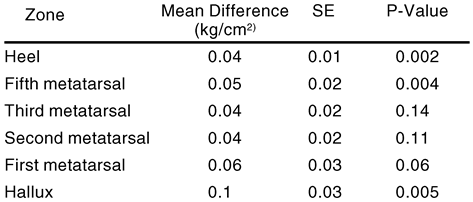
A different situation exists when the Electrodynogram is used to measure the absolute maximum peak pressure before and after testing. Several zones measured showed a significant difference in absolute pressure measurement. All after-test pressure measurements were lower (
Table 3). Because of the fact that some sensor degradation may be suspected, assessment of changes in absolute peak pressure with the Electrodynogram are not reported here.
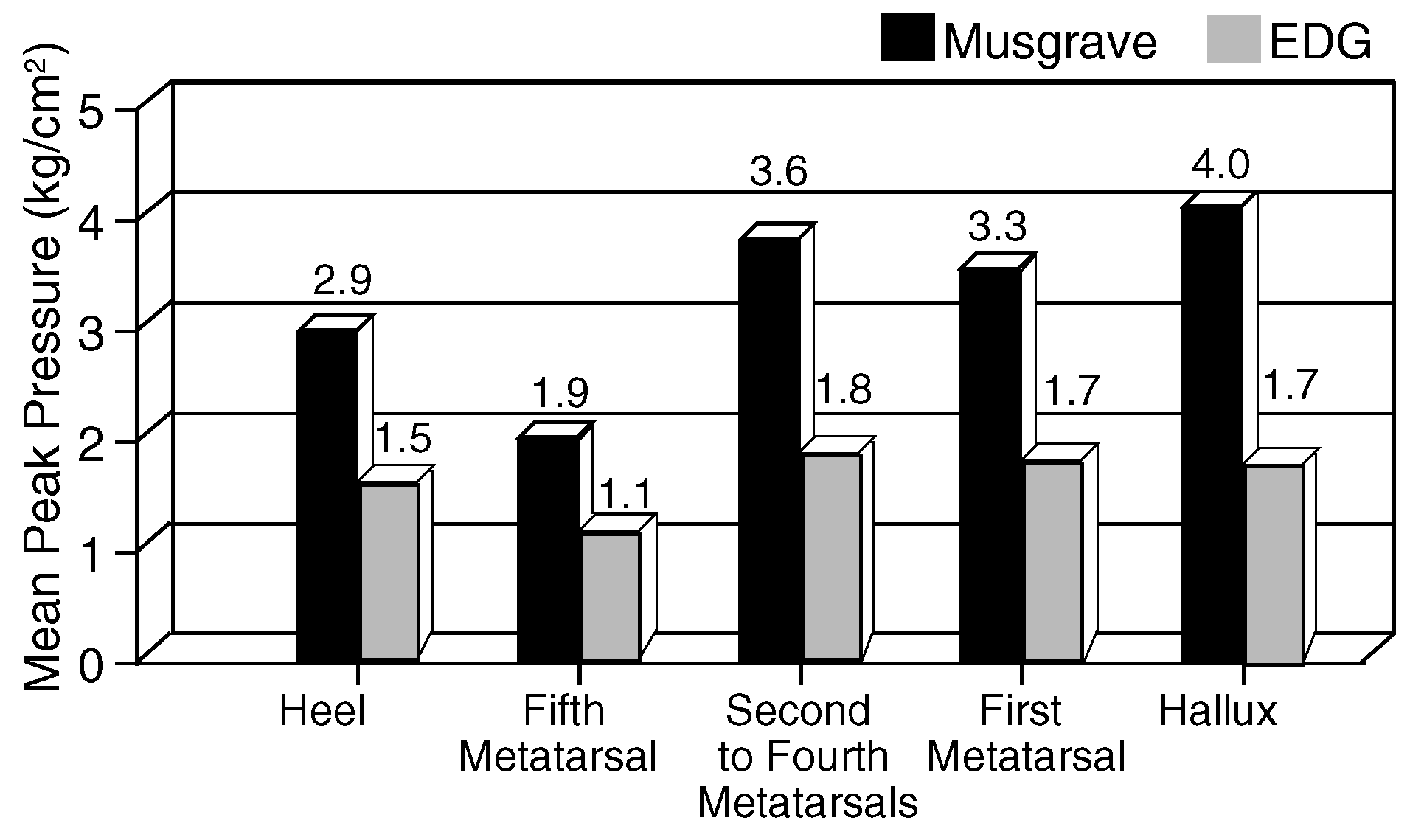
Figure 1 shows the mean differences between the Electrodynogram and Musgrave System in regard to mean peak pressure for the various locations beneath the foot. A paired
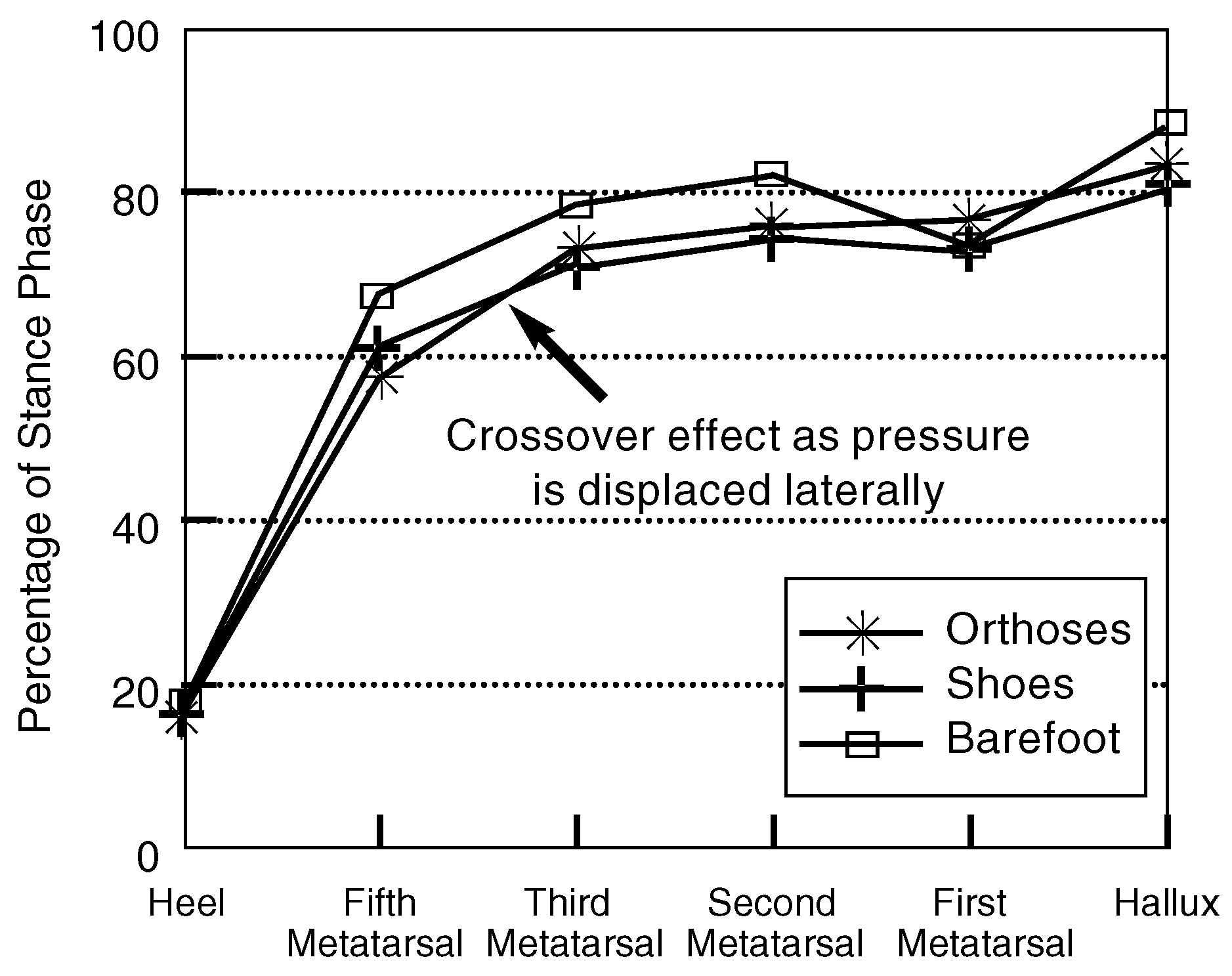
t-test was used to assess the temporal changes of pressure loading on various anatomical locations beneath the foot and are reported in
Figure 2.
Discussion
Repeatability analysis of the Electrodynogram’s measure of “time to” and maximum pressure beneath the foot yielded two points. First, the Electrodynogram system appears capable of accurately measuring the time to maximum pressure at specific points on the sole of the foot.
Table 2 shows P-values with no statistically significant difference between the before-test and after-test time measurement. Pressures were peaking between 60% and 80% of the gait cycle (Fig. 2).
On comparison of pressure recordings between the Musgrave system and Electrodynogram, pressures were consistently lower for the Electrodynogram testing.
Figure 1 shows the average pressure recordings for the two systems. This difference may be explained by 1) it is probable that when the Electrodynogram sensors were applied to the nonweightbearing foot (metatarsal heads), the location did not correspond to the actual location of the anatomical structures during dynamic gait (weightbearing) because of soft tissue movement and foot elongation. The Musgrave platform scans the entire foot and will always locate the maximum pressure points; 2) while both systems use forcesensitive resistors, there are technical differences in sensors (ie, size); and 3) the Electrodynogram sensors may undergo more rapid deterioration because of their physical characteristics (ie, they bend).
Using a matched paired
t-test, an important change in foot and leg biomechanical function was observed. Maximum pressure appears to be loaded (5% to 7%) earlier on the lateral border of the foot during the gait cycle (P < 0.05).
Figure 2 shows the changes that occur when the orthosis is used. It may be inferred from this observation that load is displaced toward the lateral border of the foot. Scherer[
9] showed a similar pattern when he used an EMED Insole System
® (Novel Gmbh, Munich, Germany.) sensor matrix to identify displacement of the center of load line laterally when an orthosis was used. While the loading of the fifth metatarsal appears to be accelerated by the shoe, the orthosis further shortens the time to peak loading and delays loading on the medial border of the foot.
This is one of the first studies that quantifies the generic effects of a molded orthosis on foot function using pressure sensors. This may be seen as an important step in understanding how subtle differences in kinetic function may be achieved. The fact that an orthosis can displace pressure laterally and theoretically increase the loading around the oblique axis of the midtarsal joint has two significant implications.
First, some effects of a neutral orthosis have been identified. This is important when the issue of efficacy arises and should be seen as supporting the idea that orthoses exert an effect on foot function. Clinicians, however, should not overlook other important factors contributing to problematic pronation such as overactivity, increase in weight, and poor muscle conditioning.
Second, it is likely that an orthosis is just one means of modifying normal foot function. Biomechanical function can be altered with the use of orthoses; however, it is reasonable to assume that this is only a transitory effect while the orthosis is being used. Factors such as material density, accuracy of plaster modifications, and variations in plaster application to the neutral cast are likely to impact on the orthoses’ ability to control foot and leg function.
Conclusion
The research work conducted at the Queensland University of Technology has shown that the neutral shell Root-type of orthosis produces changes in foot function when used by the patient. The lateral border of the foot reaches maximum peak pressure 5% to 7% earlier in the stance phase of gait. Conversely, the medial plantar surface of the forefoot has a delay in reaching its maximum pressure. These findings also suggest that in-shoe pressures of the plantar aspect of the foot vary from barefoot platform measurement and these differences may be readily explained.