Split hand and split foot deformity is typically an autosomal dominant disorder that affects the central rays of the hands and feet. Its incidence is approximately 1:10,000 [
1]. The gene responsible for the inheritance of split hand and split foot has been mapped to the long arm of chromosome 7 at q21.3-q22.1, an area now implicated as important in normal human limb development [
2]. Podiatric physicians are well aware of the foot malformation of split hand and split foot referred to by such terms as “lobster claw” and ectrodactyly [
3]. The genetic basis of split hand and split foot may not be as familiar. It is an unusual disorder in that it displays several genetic phenomena including variable expressivity, reduced penetrance, and segregation distortion [
4]. Because of this nonmendelian mode of transmission, proper referral for genetic counseling is imperative besides treatment of the obvious pedal malformation.
Variable expressivity is the phenomenon in which expression of a disease may differ considerably among individuals who carry the same gene mutation [
5]. The classic example exists in the phenotypic expression of the autosomal dominant genetic disease, neurofibromatosis. One affected family member may show no phenotypic expression except for hyperpigmented macules known as café-au-lait spots; it is possible, however, that his or her offspring show expression similar to that of the infamous “Elephant Man.” [
5] Recently, Jarvik et al [
4] described several new pedigrees, in particular a father who had severe deformity of his hands and feet. The characteristic median cleft of both hands, absence of his index and middle fingers, and significant foot deformity were present. His daughter also had significant deformity of the feet but only a mild deformity of her right hand, most notably a radially deviated index finger. Father and daughter both carried the split hand and split foot allele, but the daughter had no hand deformity [
4]. The daughter’s less severe expression of the disease was the typical presentation for an autosomal dominant disease with variable expressivity.
Penetrance, however, is the probability that a gene will have any phenotypic expression at all; hence, reduced penetrance is the case in which the individual carries the defective gene but fails to express any phenotypic abnormalities. Split hand and split foot is reported to be approximately 70% penetrant. Several pedigrees show evidence of obligate carriers of the split hand and split foot allele who fail to show any phenotypic expression [
5]. This further complicates effective counseling of the patient.
The third genetic phenomenon is that of segregation distortion. Typically, alleles segregate randomly and, therefore, there should be no excess of either sex becoming afflicted on transmission of a gene; however, in many cases, including those families studied by Czeizel et al [
6], there was an obvious excess of afflicted male offspring through paternal transmission.
In one such pedigree, the proband (a boy) was afflicted with bilateral cleft feet, an absence of the second and third toes on the right foot, and an absence of the second toe with hypoplasia of the third toe on the left. The proband’s brother also displayed bilateral cleft feet with similar malformations. The father displayed a bilateral absence of the middle and distal phalanges of the second through fifth toes. The father’s brother (proband’s uncle) and a maternal male cousin of the proband’s father also had bilateral cleft feet. All females were unaffected [
6].
In an additional pedigree in the study by Czeizel et al [
6], the proband (a male) had cleft feet bilaterally and a cleft left hand. His paternal uncle had bilateral cleft feet; specifically, a partial absence of the second and third toes with fusion of the third and fourth toes. His maternal uncle reportedly was missing one finger bilaterally with no foot deformity. Again, all females were unaffected.
Case Study
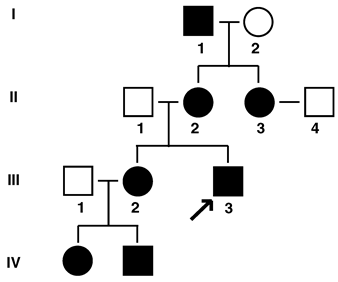
On May 15, 1995, a 59-year-old male presented to the Cleveland Foot and Ankle Clinic for primary podiatric care. At this time, the patient also requested information regarding his painless cleft foot deformity. On further questioning, the patient (III 3) revealed that his mother (II 2), maternal grandfather (I 1), sister (III 2), maternal aunt (II 3), niece (IV 1), and nephew (IV 2) were also afflicted with various degrees of hand and foot malformation. The patient had no children of his own (
Fig. 1).
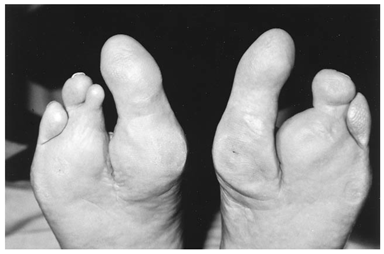
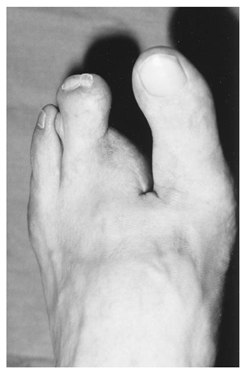
The physical examination revealed the typical median cleft noted on both feet (
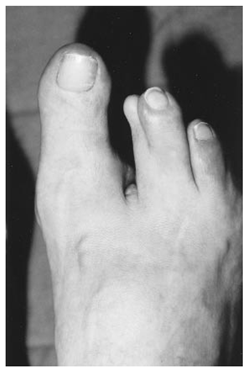
Fig. 2). There was complete absence of the second digit on the right foot and the third digit appeared hypoplastic with complete absence of nail (
Fig. 3). A complete absence of the second digit, and syndactyly of the third and fourth digits, were observed on the left foot (
Fig. 4).
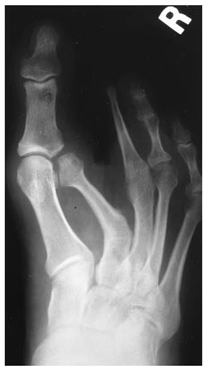
Radiographs were taken to evaluate the deformity further. Noted on the anterior posterior view of the right foot was the expected complete absence of the phalanges of the second digit; however, the second metatarsal shaft deviated at its midshaft to apparently articulate with the hypertrophic lateral base of the hallucal proximal phalanx and the fibular sesamoid. The third metatarsophalangeal joint appeared to be fused to what appeared to be an elongated proximal phalanx and was the sole bony architecture of the hypoplastic third digit (
Fig. 5).
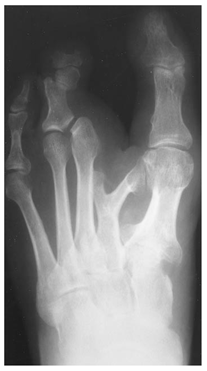
The anterior posterior view of the left foot revealed a hypoplastic bifid second metatarsal that appeared to articulate medially with the first metatarsal head. Again, the expected absence of the second digit phalanges was also seen. Syndactyly of the third and fourth proximal, intermediate, and distal phalanges was noted with only minimal articulation of the fused third proximal phalanx with the lateral third metatarsal head. Hypertrophy of the first metatarsal base could also be observed (
Fig. 6).
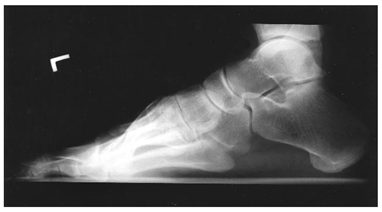
Most interesting on the lateral radiographs was the obvious nonarticulation and dorsal angulation of the lateral component of the bifid second metatarsal and the significant plantarflexed attitude of the first metatarsal with the hallucal proximal phalanx apparently articulating with only the dorsal surface of the first metatarsal head on the left foot (
Fig. 7).
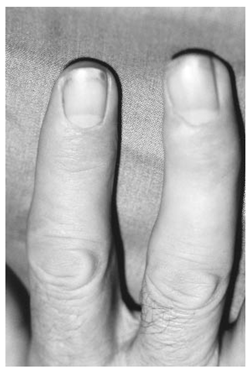
The patient’s mother was reportedly also afflicted with a similar cleft foot malformation, in addition to a hyperextension deformity of the third finger on her right hand. Interestingly, the same finger of the patient had a mild ulnar deviation (
Fig. 8).
The patient’s niece and nephew were both reported to be affected with cleft foot deformity. His nephew had no other malformation; however, his niece had severe deformity of the hands, including complete syndactyly of all fingers. Surgical reconstruction of her hands had been attempted several times, but this had proven unsuccessful.
The patient believed that his feet were several times stronger than other people’s feet and was uninterested in treatment. Since he had no plans to have children, counseling was unnecessary at that time but was recommended for other family members.
Discussion
As with other cases previously studied, an autosomal dominant mode of transmission with variable expressivity was observed in this family. The patient had clefting of both feet with practically no effect on his hands, as did his mother except for the greater consequence of her third finger; however, the greater affliction was observed in the patient’s niece. Even though all carry the same mutated gene, each had a phenotypic difference in presentation and severity. Similarly, phenotypic expression was variable as had been the case in the families studied by Jarvik et al [
4].
Although 70% penetrance has been reported for split hand and split foot, the gene appeared completely penetrant in this pedigree [
5]. Small sample populations do not accurately reflect mendelian ratios. If the inheritance of split hand and split foot in this family through several subsequent generations were followed, reduced penetrance may become apparent.
Effective counseling is more difficult because those disorders that have less than 100% penetrance may appear to skip generations. Under these circumstances, certain individuals will pass the gene onto their offspring, albeit they showed no sign of the disease.
In contrast to the families studied by Czeizel et al, segregation distortion did not appear to be valid in the presented case. In this pedigree, the split hand and split foot alleles appeared to segregate in a mendelian fashion. Males and females were affected equally and there was no transmission directly from father to son. The reason that some cases show this distortion of allele segregation and others do not is unknown. Molecular research should focus on answering these and other questions in the future.
Studies of split hand and split foot-associated translocations and deletions in the critical region of chromosome 7q have shown evidence that locus heterogeneity may also exist [
7]. That is, mutations at two or more distinct loci can produce the same or nearly similar phenotypes [
5].
In addition, split hand and split foot in a Pakistani kindred seemed to be transmitted as an X-linked trait; although apparent male-to-male transmission and three females with full expression created some doubt [
8]. It is possible that the apparent X-linked inheritance was actually a consequence of segregation distortion.
In other individuals, distal limb anomalies have been traced to interstitial deletions on chromosome 2 in one case and on chromosome 6 in another [
9,
10].
It appears that there are several candidate gene regions for the development of split hand and split foot. One possibility is that there may be genetic interplay between proteins encoded by genes on other chromosomes that act as enhancers or repressors of genes in the critical region of chromosome 7. Alternatively, all the potential candidate genes may be responsible for encoding proteins important in the sixth and seventh weeks of fetal development. This, however, remains speculative while awaiting elaboration at the molecular level.
Conclusion
It is important to understand the basics of split hand and split foot and offer referral for proper genetic counseling. Those individuals with split hands and split feet should understand the genetic inheritance of the disease. Many of these patients also have psychological issues to resolve; hence, they may need emotional support. Counseling can be challenging when dealing with phenomena such as reduced penetrance, variable expressivity, and segregation distortion.