Next Article in Journal
Pedal manifestations of meningococcal septicemia
Previous Article in Journal
Painful os cuboideum secundarium. Cross-sectional imaging findings
 
 
Journal of the American Podiatric Medical Association is published by MDPI from Volume 116 Issue 1 (2026). Previous articles were published by another publisher in Open Access under a CC-BY (or CC-BY-NC-ND) licence, and they are hosted by MDPI on mdpi.com as a courtesy and upon agreement with American Podiatric Medical Association.
Case Report

Dermatofibrosarcoma protuberans of the hallux

by
Kasra N. Behfar
,
Mark J. Mendeszoon
,
James S. Chrzan
and
Geoffrey M. Habershaw
New England Deaconess Hospital, Boston, USA
J. Am. Podiatr. Med. Assoc. 1996, 86(3), 126-128; https://doi.org/10.7547/87507315-86-3-126

Published: 1 March 1996
Dermatofibrosarcoma is a rare, slow growing, locally destructive, low grade malignancy that originates in the dermis.[1] This tumor has been reported more than 1,000 times in literature; however, in the authors’ literature search, only three cases were found involving the pedal digits and none involving the hallux. [2,3,4]
Dermatofibrosarcoma is most commonly seen in the second through fifth decades.1 The tumor occurs mostly on the trunk and proximal extremities.[5] This rare malignancy accounts for 0.06% to 0.1% of all neoplasms and 1.17% of all tissue sarcomas.[6,7] Metastasis to distant sites is rare and has been seen in approximately 6% of patients.[2,8,9,10,11]
Clinically, the tumor presents as a multilobulated, protuberant nodule that can enlarge over time and become intimate with the skin.[7] The lesion has a keloid type of appearance and can have a blue, red, tan, or purple hue to it. Typically, patients live with this lesion and it remains asymptomatic. Occasionally, the lesion may become complicated by bleeding, pain, infection, or significant enlargement.[2]
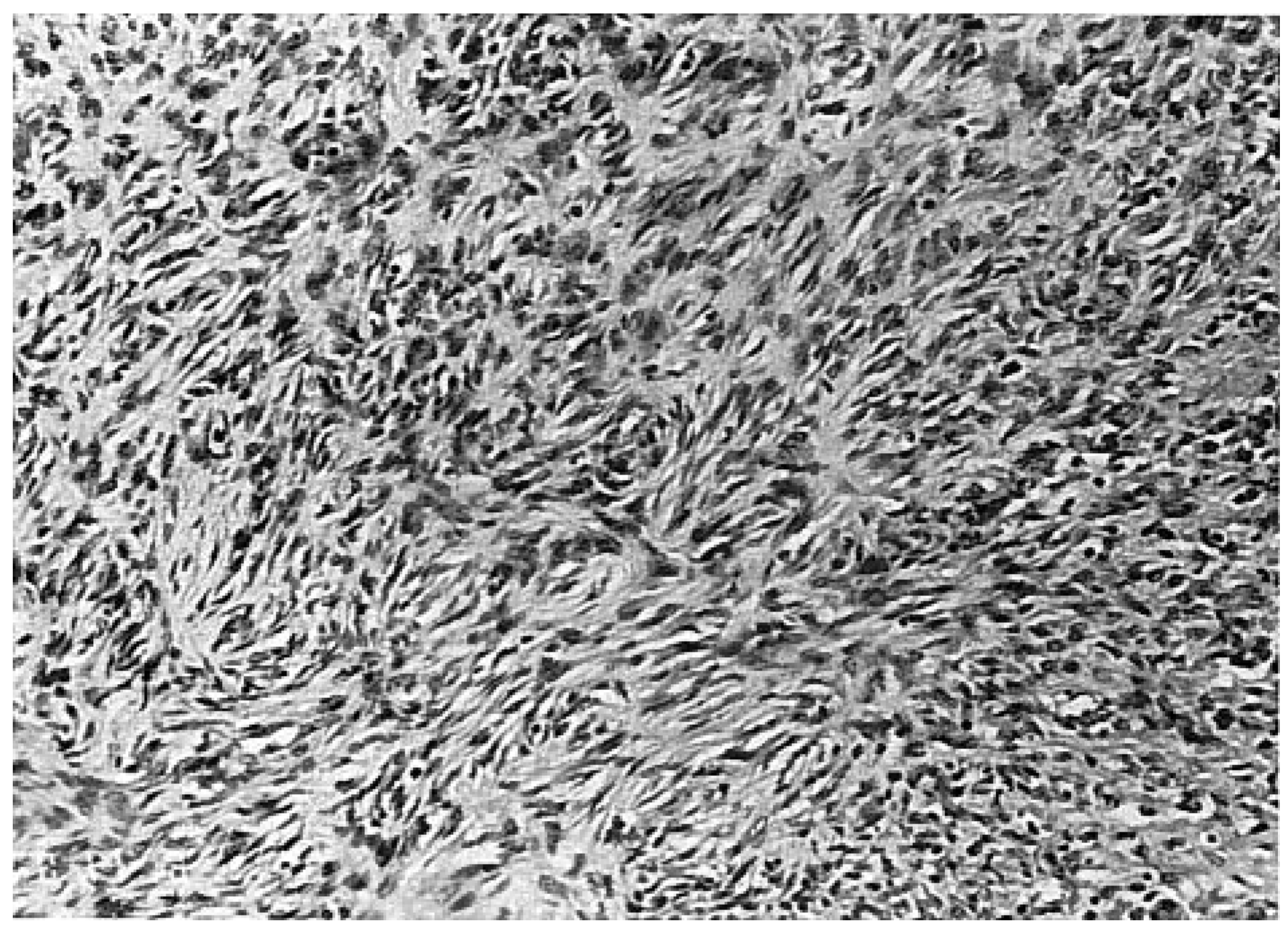
The most common differential diagnoses include the following: histiocytoma, localized scleroderma, keloid, fibromatosis, fibrosarcoma, Kaposi’s sarcoma, malignant melanoma, leiomyosarcoma, schwannoma, neurofibroma, and neurofibrosarcoma. Early diagnosis by biopsy is of utmost importance in prevention of progression and metastasis. Histologically, the tumor consists predominantly of uniform cells with large, spindle-shaped nuclei, arranged as irregular, intertwining bands resulting in a storiform appearance. This gives dermatofibrosarcoma protuberans its classic diagnostic “cartwheeling” appearance (Fig. 1).[10] The cells are highly pleomorphic with a high nucleus to cytoplasm ratio with prominent nucleoli that is classic for malignancy.
Dermatofibrosarcoma protuberans is an easily managed neoplastic entity, once the correct diagnosis is made. The treatment of choice is wide and deep excision of the tumor with preferable safety margins being at least 2.5 cm from the periphery of the tumor. This surgical approach is the best means of decreasing the rate of recurrence.[11,12,13,14] Adjunctive radiation therapy has not proven to significantly enhance the cure rate of dermatofibrosarcoma protuberans nor has chemotherapy proven effective. Recurrence rates have been reported to range from 20% to 55% and there is no relationship between the size of the tumor and recurrence.[15,16,17] Following surgical excision, extended follow-up examinations allow for the best clinical outcome for the patient.

Case Report

A 91-year-old male presented with a chief complaint of an enlarged mass on the distal aspect of his left great toe. The mass had been present for more than 30 years and had been asymptomatic until 1 year ago. Within the past year, the patient had begun experiencing pain and discomfort and was unable to wear shoes and walk. His past medical history was significant for chronic atrial fibrillation, colon cancer treated with resection, and right hip fracture treated with open reduction internal fixation. The patient’s medications included digoxin 0.25 mg, four times daily, and with no known drug allergies.
Figure 1. Histologic presentation with cartwheeling.
Japma 86 00126 g001
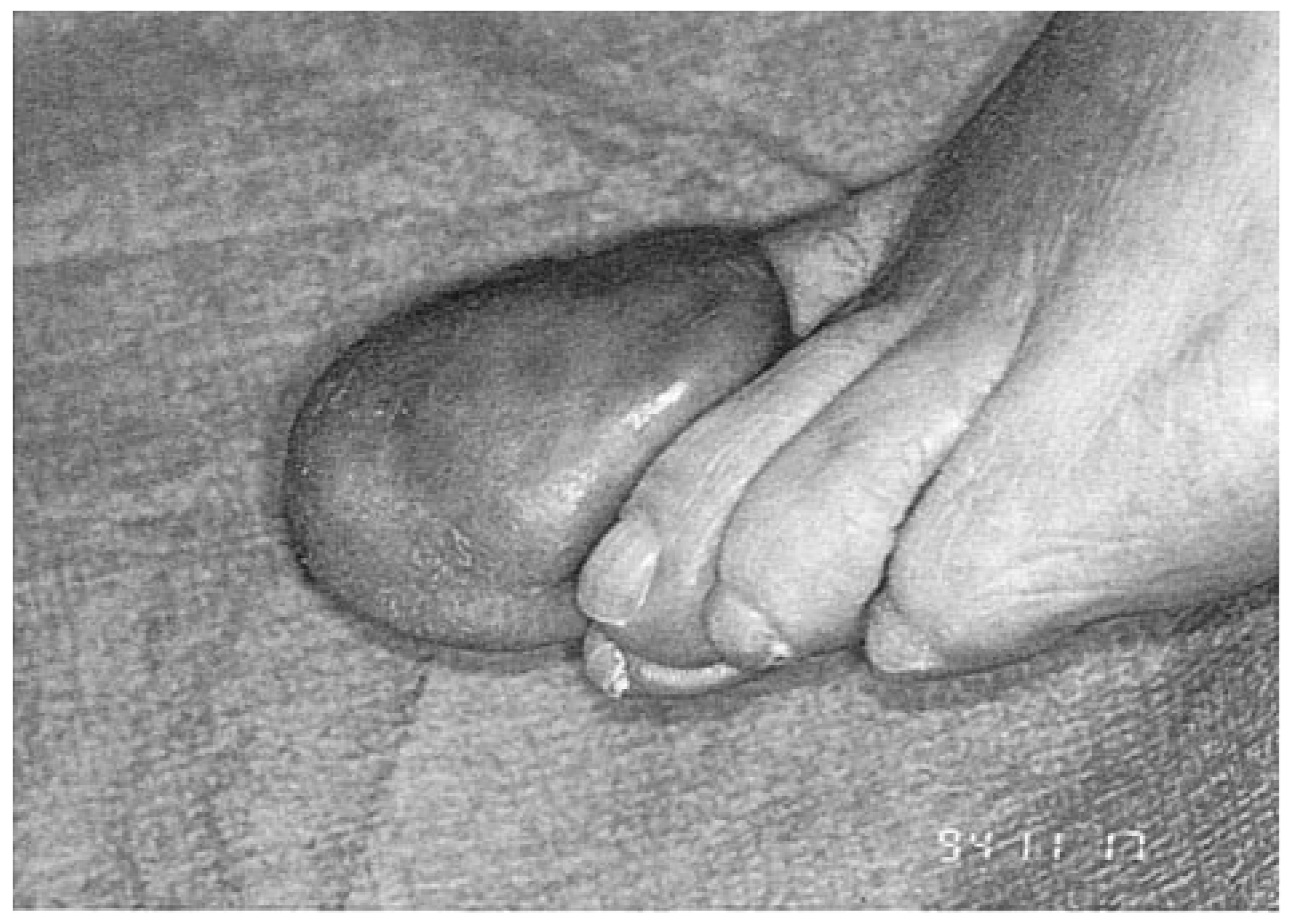
The patient was in remarkably good health with no other medical issues. Lower extremity vascular examination revealed bilateral +2/4 dorsalis pedis and posterior tibial pulses and immediate capillary filling time. The neurologic examination revealed intact sharp, dull, and vibratory sensations with +2/4 deep tendon reflex symmetrically. Extrinsic muscle strength was +5/5 of the anterior, lateral, and posterior compartments, bilateral and symmetrically. The dermatologic examination revealed a multilobular, nodular, firm lesion with areas of tan and bluish discoloration on the distal aspect of the left hallux. The lesion measured 5.5 × 5.0 cm (Fig. 2). There were no palpable inguinal or popliteal lymph nodes.
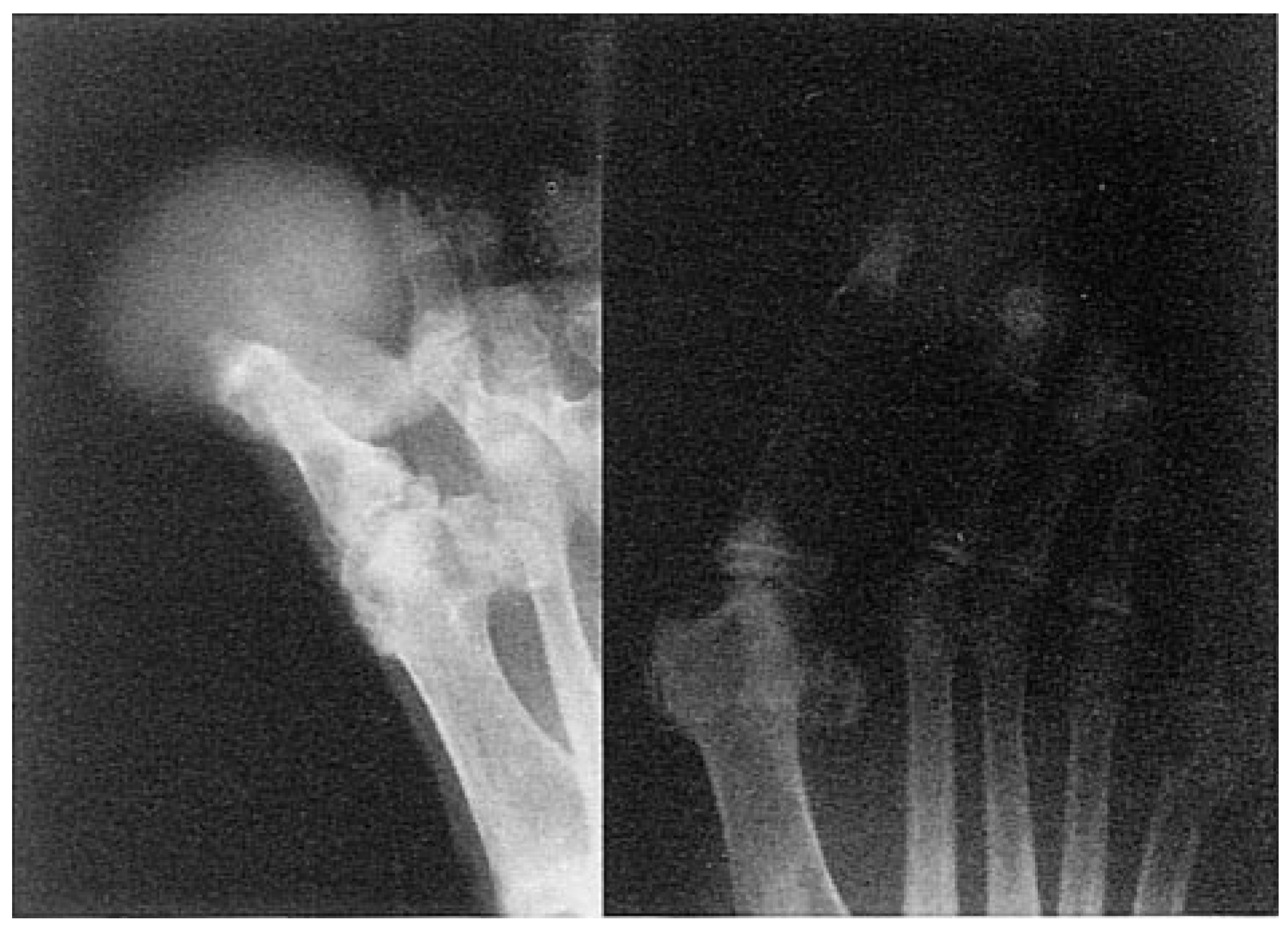
Radiographically, the lesion appeared as a soft tissue mass at the distal aspect of the left hallux. There was no evidence of calcification within the soft tissue; however, cystic changes were noted to be present within the proximal aspect of the distal phalanx of the left hallux. No cortical disruption of the distal phalanx was noted radiographically (Fig. 3).
The patient subsequently underwent an excisional biopsy (distal Syme’s amputation) of the lesion. He recovered uneventfully, with no complications, and returned to his normal activity levels in his usual shoes.
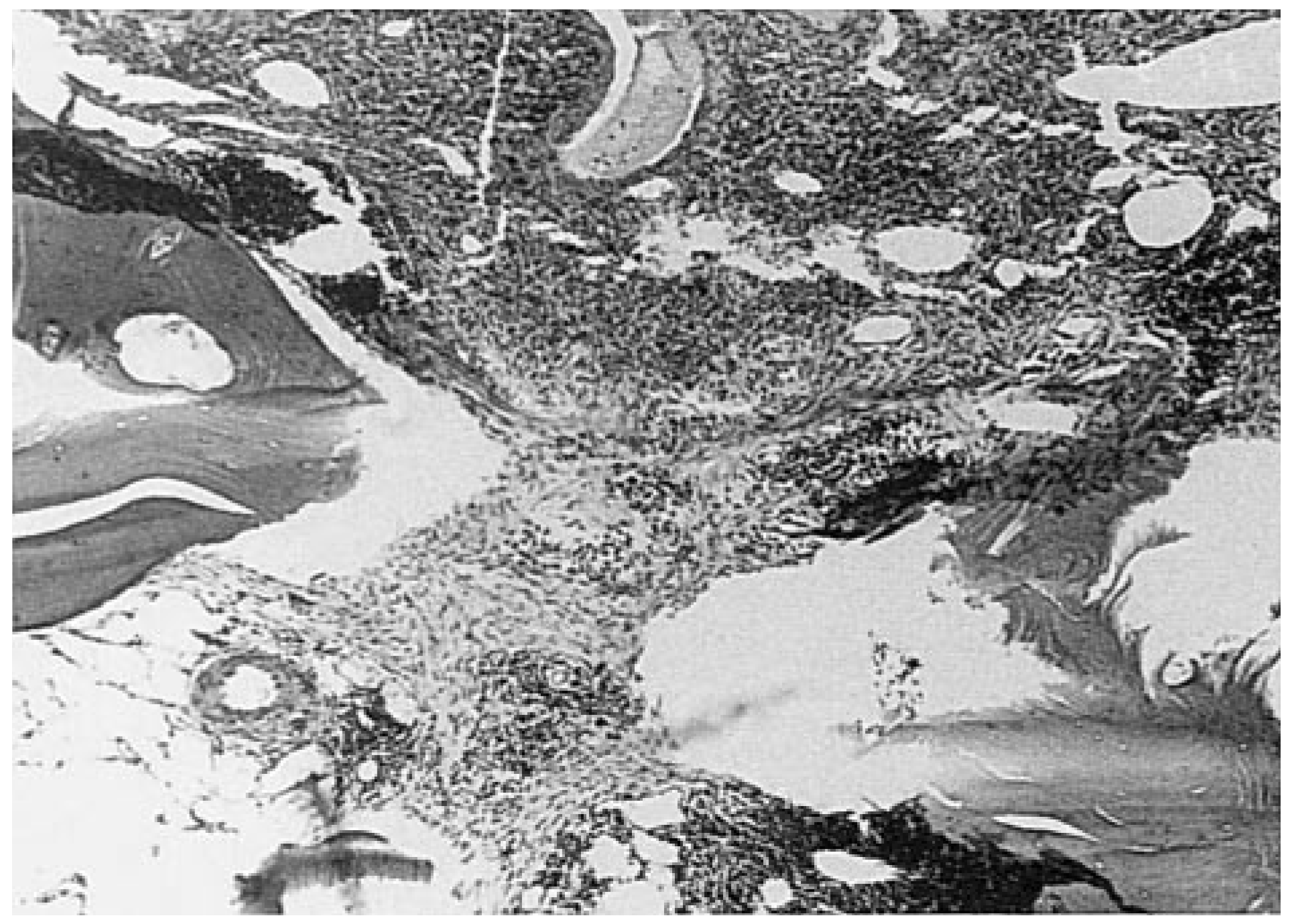
The pathology report revealed spindle-shaped cells with pleomorphism and a high nucleus to cytoplasm ratio. There was evidence of storiform pattern (cartwheeling) of the spindle cells (Fig. 1). The tumor was noted to invade the deep soft tissue and the central aspect of the distal phalanx (Fig. 4).
Figure 2. Left hallux showing lesion measuring 5.5 × 5.0 cm
Japma 86 00126 g002
Figure 3. Radiograph of left hallux with no cortical disruption.
Japma 86 00126 g003
Figure 4. Tumorous invasion of bone.
Japma 86 00126 g004

Conclusion

The authors present a unique case of dermatofibrosarcoma protuberans involving the hallux with invasion of the bone of the distal phalanx. This rare malignancy has infrequently been reported in the pedal digits, with no known cases of the hallux. This case also reveals the extent of local aggression of this tumor with bony invasion, which is a rare occurrence with dermatofibrosarcoma protuberans. A clinician should include dermatofibrosarcoma protuberans in a differential diagnosis of any soft tissue tumor in the foot, and once diagnosed as such, he or she must treat it aggressively with wide margin excision.

References

  1. LEVER, WF; SCHAUMBER, G; LEVER, G. Histopathology of the Skin, 7th ed; JB Lippincott: Philadelphia, 1990. [Google Scholar]
  2. KRAMER, BA; FREMLING, M. Dermatofibrosarcoma protuberans of the toe. Ann Plast Surg 1990, 25, 295. [Google Scholar] [CrossRef] [PubMed]
  3. ASSASSA, GS; SIEGEL, ME; CHEN, DC; ET, AL. Dermatofibrosarcoma protuberans of the toe: findings on multiple imaging modalities. Clinics Nuclear Med 1993, 18, 978. [Google Scholar] [CrossRef] [PubMed]
  4. BERLIN, SO. A review of 2,720 lesions of the foot. JAPA 1980, 70, 318. [Google Scholar] [CrossRef] [PubMed]
  5. SAUTER, LS; DEFEO, CP. Dermatofibrosarcoma protuberans of the face. Arch Dermatol 1971, 104, 671. [Google Scholar]
  6. GUTIERREZ, G; OSPINA, JE; DE BAEZ, NE; ET, AL. Dermatofibrosarcoma protuberans. Int J Dermatol 1984, 23, 396. [Google Scholar] [CrossRef]
  7. ASHACK, RJ; TEJUD, E; PARKER, C; ET, AL. A localized atrophic plaque on the back: dermatofibrosarcoma. J Derm Surg Oncol 1985, 11, 268. [Google Scholar]
  8. MCPEAK, LJ; CRUZ, T; NICASTRI, AD. Dermatofibrosarcoma protuberans: an analysis of 86 cases. 5 with metastasis. Ann Surg 1967, 166, 803. [Google Scholar] [CrossRef] [PubMed]
  9. MAVILI, ME; GURSU, KG; GOKOZ, A. Dermatofibrosarcoma protuberans with lymph node involvement. Ann Plast Surg 1991, 32, 438. [Google Scholar] [CrossRef] [PubMed]
  10. FREEMAN, RG. Dermtofibrosarcoma Protuberans. In Clinical Dermatology; Dobson, RL, McGuire, J, Eds.; Harper & Row: Philadelphia, 1982. [Google Scholar]
  11. BRENNER, W; SCHAEFLER, K; CHHABRA, H; ET, AL. Dermatofibrosarcoma protuberans metastatic to a regional lymph node: report of a case and review. Cancer 1975, 36, 1897. [Google Scholar] [CrossRef] [PubMed]
  12. HOFFERT, PW. Dermatofibrosarcoma protuberans. Surgery 1952, 31, 705. [Google Scholar]
  13. MCGREGOR, JK. Role of surgery in the management of dermatofibrosarcoma protuberans. Ann Surg 1961, 154, 255. [Google Scholar] [CrossRef] [PubMed]
  14. PHELAN, JT; JURADO, J. Dermatofibrosarcoma protuberans. Am J Surg 1963, 106, 943. [Google Scholar] [CrossRef] [PubMed]
  15. ROCKLEY, PF; ROBINSON, JK; MAGID, M; ET, AL. Dermatofibrosarcoma protuberans of the scalp: a series of cases. J Am Acad Derm 1989, 21, 278. [Google Scholar] [CrossRef] [PubMed]
  16. SHAPIRO, L; BROWNSTEIN, MH. “Dermatofibrosarcoma,” in Cancer of the Skin; Andrade, R, Gumport, SL, Popkin, GL, Eds.; WB Saunders: Philadelphia, 1976. [Google Scholar]
  17. ROSES, DF; VALENTI, Q; LATRENTA, G; et al. Surgical treatment of dermatofibrosarcoma protuberans. Surg Gynecol Obstet 1986, 162, 449. [Google Scholar] [PubMed]