Accessory ossicles in the foot are a common incidental finding. However, it is well known that accessory ossicles may be responsible for local pain and discomfort and symptomatic relief may be afforded by surgical removal.[
1,
2,
3,
4,
5] The main radiologic importance of accessory ossicles is their ability to mimic fractures on plain radiographs.1, 6 Symptomatic accessory ossicles often show increased uptake on nuclear medicine bone scintigraphy, and a bone marrow edema pattern on magnetic resonance imaging likely secondary to chronic stress or osteonecrosis in the ossicle.[
1,
6]
Os cuboideum secundarium is a rare accessory ossicle first described by Pfitzner [
7] in 1896, which occurs on the plantar aspect of the foot between cuboid and navicular. [
8] This ossicle is usually asymptomatic and difficult to visualize on plain radiographs, thus cross-sectional imaging techniques are preferable for depiction of this accessory ossicle. To the authors’ knowledge, this is the first description of a painful os cuboideum secundarium. The findings on computed tomography and magnetic re-sonance imaging are illustrated.
Case Report
A 23-year-old female presented with a 3-year history of increasing discomfort in the plantar aspect of the right foot and a 1-year history of numbness of the plantar aspect of her right great toe. Although her walking tolerance was unlimited, she was unable to participate comfortably in active sports. On physical examination, a 2.5-cm firm, immobile mass was palpable on the plantar aspect of the foot, inferior to the navicular. The overlying soft tissues were mobile. A positive Tinel’s sign of the medial plantar nerve directly over the mass was present with slightly reduced sensation on the plantar aspect of the great toe. The range of motion of both the ankle and subtalar joints was full and painless.
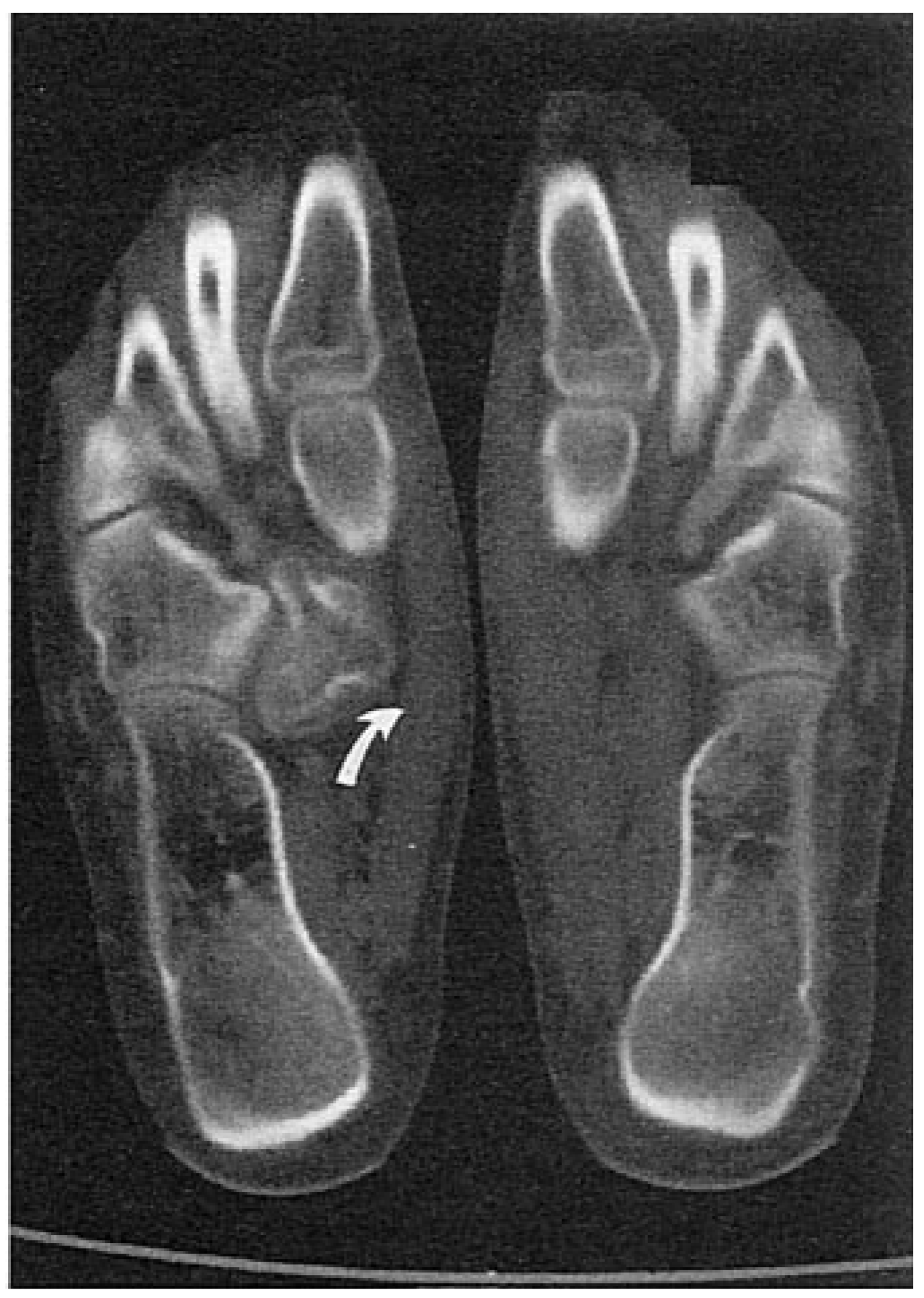
Contiguous 3-mm transverse and coronal computed tomography scans obtained through the right foot showed a well corticated bony mass on the plantar surface of the foot adjacent to the calcaneus proximally, to the cuboid laterally, and to the navicular medially (Fig. 1). No cortical fracture or erosion was visualized. Measuring 2 cm in width and height and 3 cm in length, this bony mass displaced the abductor hallucis muscle medially and elevated the plantar fascia. The remainder of the foot was unremarkable. A diagnosis of os cuboideum secundarium was made.
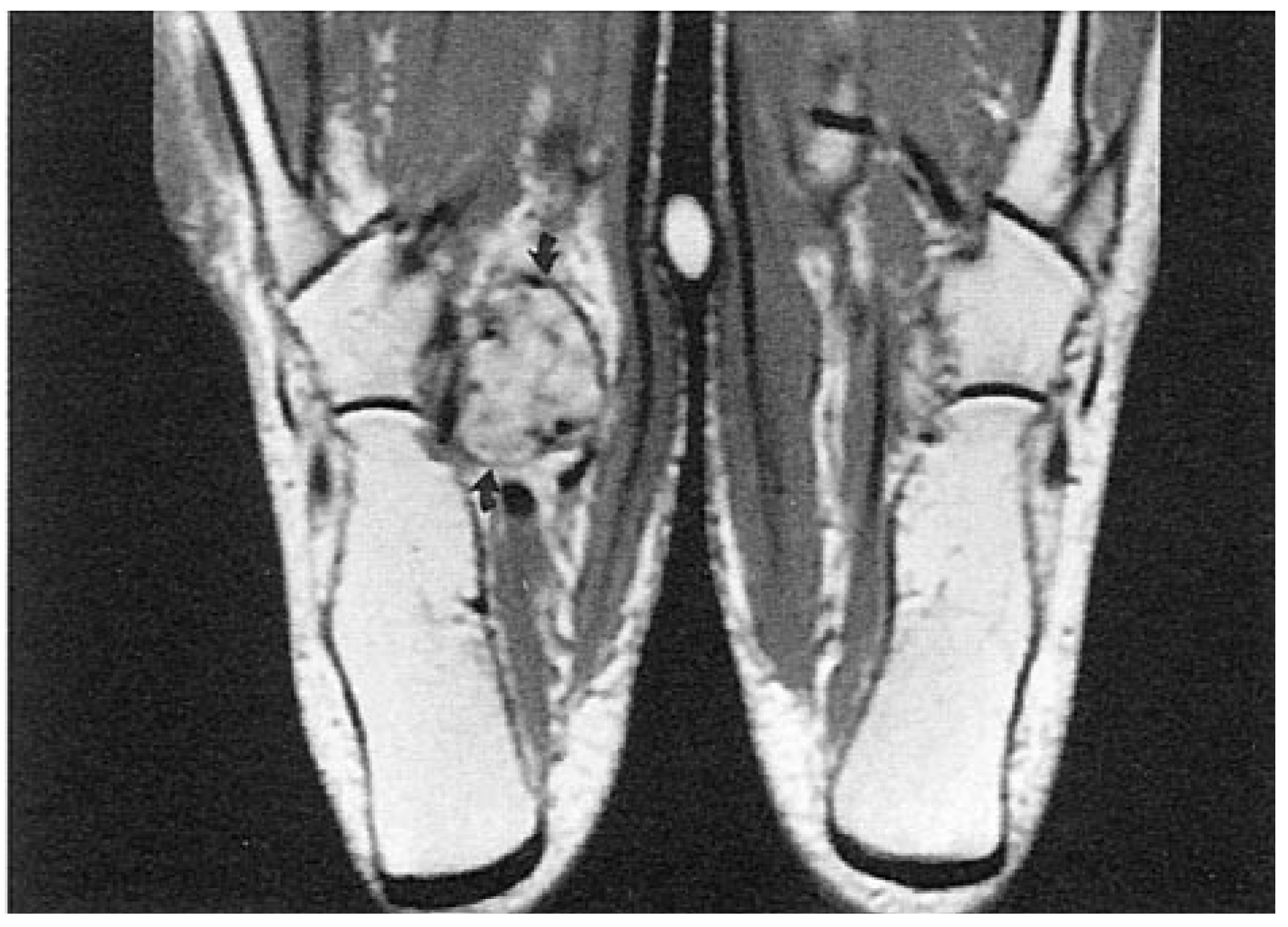
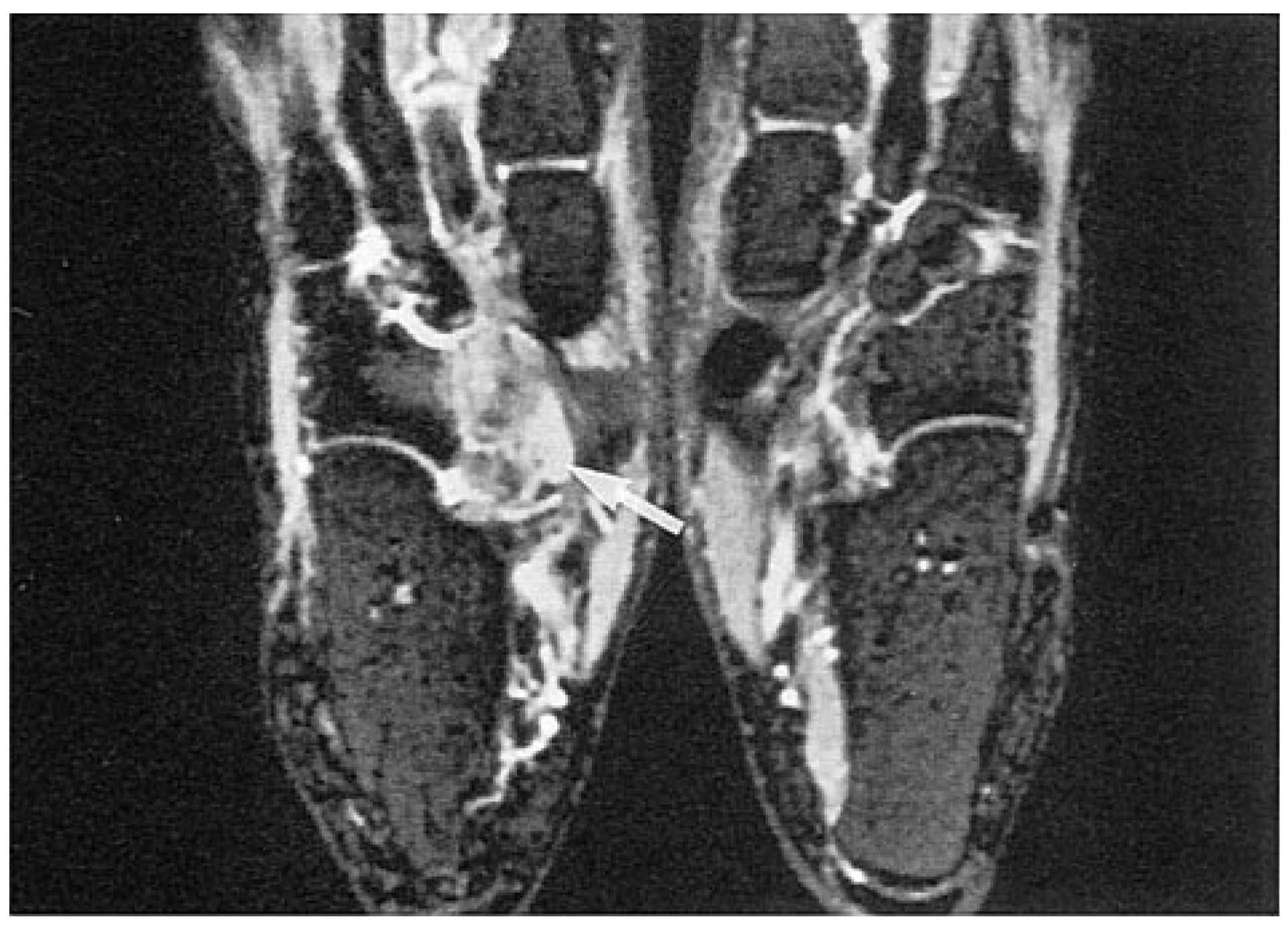
Because of the clinical impression of an enlarging soft tissue mass in association with the ossicle, magnetic resonance imaging of the foot was done. The bony mass was confirmed in the fossa between navicular, cuboid, and talus. The T1 and proton density-weighted magnetic resonance images showed normal marrow signal within the accessory ossicle indicating the presence of fatty marrow (Fig. 2). The short Tau inversion recovery images showed diffusely increased signal intensity in the marrow of the ossicle, indicating marrow edema (Fig. 3). There was displacement of the flexor hallucis longus and flexor digitorum tendons and abductor hallucis muscle. No associated soft tissue mass was identified.
Because of the likelihood that this ossicle accounted for some of the stability of the midfoot and the possibility of residual neuromuscular dysfunction if removed, the patient’s foot was treated with a cast, followed by orthoses. The orthoses provided symptomatic relief during 9 months of follow-up examinations.
Figure 1.
Transverse computed tomographic image of both feet viewed with standard bone windows shows a bony mass medial to the right calcaneocuboid joint that displaces the abductor hallucis muscle (arrow).
Figure 1.
Transverse computed tomographic image of both feet viewed with standard bone windows shows a bony mass medial to the right calcaneocuboid joint that displaces the abductor hallucis muscle (arrow).
Figure 2.
Transverse proton density magnetic resonance image confirms a well defined mass of inhomogeneous signal intensity bowing the adjacent muscles and tendons. The cortical margin of the ossicle appears as a low signal intensity line (arrows).
Figure 2.
Transverse proton density magnetic resonance image confirms a well defined mass of inhomogeneous signal intensity bowing the adjacent muscles and tendons. The cortical margin of the ossicle appears as a low signal intensity line (arrows).
Figure 3.
Transverse inversion recovery images show the central region of this mass (arrow) to be of high signal intensity, typical of marrow edema. The remainder of the tarsal bones show normal nonedematous marrow, which is of low signal intensity on this pulse sequence.
Figure 3.
Transverse inversion recovery images show the central region of this mass (arrow) to be of high signal intensity, typical of marrow edema. The remainder of the tarsal bones show normal nonedematous marrow, which is of low signal intensity on this pulse sequence.
Discussion
The foot is the most common location for accessory ossicles and skeletal elements in the body. [
9] More than 30 have been described, many having more than one accepted name. The true prevalence of many ossicles is unknown; however, as many as 18% of people are said to have an os peroneum and up to 25% have an os trigonum. [
9] Accessory elements are divided into sesamoid and accessory bones. Sesamoid bones reside within the substance of a tendon and move in unison with that tendon. They are usually found at sites where the tendon is under tension, either where they alter course or run over bony prominences. Accessory ossicles represent secondary centers of ossification which remain separate from the normal adjacent bone. Both accessory ossicles and sesamoid bones can be symptomatic. [
1,
2,
3,
4,
5]
The os cuboideum secondarium has been recognized as an accessory skeletal element for many years. [
7,
8] It is, however, one of the rarer accessory ossicles in the foot and descriptions of it are sporadic. Unlike many of the other accessory ossicles in the foot, the incidence of this particular ossicle is unknown.
The authors’ case shows an ossicle at the point of contact of the cuboid, navicular, and calcaneum. This is the classic described position for an os cuboideum secundarium. [
7,
8] Indeed, the computed tomographic appearance of the case closely resembles the anatomical specimen used to illustrated this entity in Kohler and Zimmer’s book on borderlands of normal and early pathologic findings in skeletal radiography. [
9]
Although it has been suggested that an os cuboideum secundarium may represent a form of cubonavicular coalition, computed tomography and magnetic resonance imaging examinations of the case presented show no fusion between cuboid, navicular, or the accessory ossicle.
It is well documented that, apart from mimicking fractures, accessory ossicles may themselves be symptomatic. [
1,
10,
11] Painful accessory skeletal elements frequently show increased uptake on nuclear medicine technetium-99m bone scintigraphy. The most frequently described symptomatic ossicles are the accessory navicular and the os trigonum, possibly as these are also the most common encountered ossicles. [
2] Pathologic examination of painful accessory navicular bones has revealed chondro-osseus inflammatory changes consistent with chronic, repetitive stress injury and repair, without evidence of fracture. [
2] In the authors’ case, the marrow edema on magnetic resonance imaging is likely to reflect a similar response to repeated stress. The failure of identification of a fracture on either computed tomography or magnetic resonance imaging supports this hypothesis. The absence of any other pathology on all imaging modalities and the symptomatic relief from orthoses confirm the accessory ossicle to be the source of pain and symptoms.
Summary
The authors presented the computed tomography and magnetic resonance imaging appearances of a painful os cuboideum secundarium. To the authors’ knowledge, this is the first report of the cross-sectional imaging appearance of this condition, and serves to underline the utility of computed tomography and magnetic resonance imaging in the investigation of foot pain.