Two prospective studies conducted by the US Army Research Institute of Environmental Medicine found that the risk of sustaining lower extremity injuries sufficiently severe to interfere significantly with training was 45% for females and 21% for males [
1,
2]. Of these, 11% of females and 2% of males sustained stress fractures. The second study showed that 129 trainees sustained injuries to their lower extremities that resulted in significant losses of training time. [
2] Nine of these were stress fractures. Traumatic events initiating the problems were rare.
Volpin et al [
3] reviewed 105 lower limb pain cases among recruits and found that 54% had stress fractures when diagnosed using technetium scans. Of the remaining recruits without evidence of stress fractures, 74% had anatomical deformities of the lower limb. Thus, lower extremity injury is common during basic training.
Only two studies reported the use of inner soles to prevent overuse injuries. One study used a type of inner sole that did not change vertical impact forces. [
4] No change in injury rate was reported. The second study used the same type of cushioning inserts used in this study.[
5] The inserts’ ability to alter vertical impact and their relative cushioning indices are discussed in the following section on choice of inserts. The authors of the second study found a decreased incidence of lower limb problems among army basic trainees. They compared injuries among 237 randomly selected new recruits who wore inserts with injuries in the records of 1,151 similar recruits who did not wear inserts. Twenty-one percent of the group wearing cushioned inserts experienced overuse injuries relative to 27% of the control group. This difference was significant at the 0.05 level.
Insert Choice
The Spenco Polysorb walker-runner ®(Spenco Inc, Waco, TX.) cushioning insert used was chosen because it seemed to work better than others used clinically with more than 700 soldiers reporting overuse related foot pain. It had the lowest peak acceleration and peak pressure scores (11.8 g and 73.8 kPa, respectively) but the highest energy return scores (43.4%) in simulated running of all 20 inserts reviewed. [
6] The insole cushioning index score was 84% for this insole while the most comparable was 66%. The vertical impact test data were gathered by “dropping a weighted and instrumented shaft at a des-ignated velocity onto the heel or forefoot of shoes into which the various test insoles were inserted.” [
6] This type of insert provides medial arch support with heel cupping. The insert was not supplied by nor chosen with formal consultation of the manufacturer.
Hypothesis
The use of shock absorbing inserts in army basic trainees’ boots and sneakers throughout training would result in less foot related problems during training than would occur among similar trainees who did not use the inserts.
Methods
Approval and Consent
The study was approved by an Institutional Review Committee and followed all of the relevant federal and international guidelines for use of human subjects. As trainees reported for basic training at a US Army post, they were asked to participate in the study. The study was carefully explained and consent forms were given to each trainee. Each had the opportunity to ask questions privately and understood that participation was voluntary. Only six of the trainees declined to participate.
Experimental Procedure
The US Army basic training units are formed sequentially as sufficient recruits arrive at the training post. Each unit called a battery or company, normally contains several hundred trainees. All units participating in this study underwent the same training program. The inserts were issued to every trainee in every other basic training unit as the units were filled by soldiers entering the army. Thus, half of the trainees entering the army at the participating training post received inserts. Sequentially formed units alternated between receiving or not receiving inserts.
Thus, whether or not a soldier received inserts was random depending on when he arrived for training and whether the unit filling at the time was or was not issued inserts. While the inserts do not require individualized fitting, they do come in shoe sizes. They were fitted to the trainees when they received their boots and sneakers during initial uniform distribution. The trainees were instructed to leave the inserts in their footwear for the entire training cycle and to wear the inserts at all times when on duty. Each trainee from a unit participating in the study was checked for use of the insert by training personnel as part of the normal uniform inspection procedure. This could not guarantee that trainees used their inserts as inspections were at infrequent, random intervals but did increase the likelihood that trainees would remember to use them. Each soldier completed a short questionnaire before and after training. They were validated by having several soldiers who had completed basic training answer the questions. The soldiers were asked what they thought each question meant, if any other questions should be asked, and whether it was likely that soldiers would answer the questions honestly.
The pretraining questionnaires asked about previous lower limb pain problems including presence of lower limb pain, history of serious injuries, and surgical procedures to the lower limbs. They asked also about physical conditioning attempted prior to entering the military and changes in regular level of exercise during the 6 months preceding training. The post-training questionnaire asked about overall frequency of use of inserts, use during physical training, use during road marches, use during class time, lower limb pain during basic training, and injuries during training. The results from these questionnaires were incorporated into the analysis reported in the results section. Analysis of the postparticipation questionnaires showed that, after about one third of the subjects had been enrolled, word about the study spread to the training units not issued inserts as the study progressed. Numerous soldiers in these control units purchased the same kind of inserts that were given to soldiers in the trial units. The inserts were readily available for purchase at post exchange stores scattered through the training area. Thus, the data were analyzed for three groups rather than two. There were no differences in results from before and after soldiers began purchasing their own inserts.
The data on 1) raw physical fitness test scores, 2) number of trainees graduating on time, 3) number of visits to the clinic for lower limb pain, and 4) severity of lower limb injuries were compared for the three groups.
Physical fitness tests in the US Army are given at least semiannually and consist of a 2-mile run, push-ups, and sit-ups. They are given at the beginning, approximately the middle, and at the end of basic training. The raw score is based on how fast the run is performed and by the number of push-ups and sit-ups performed in 2 min. The actual score is computed by adjusting the raw score by an age factor.
For purposes of this protocol, minor lower limb pain injuries were rated as 1) pain with no change in activities, 2) pain with decreased activities, and 3) pain with rest.
Subjects rated their pain on a colored visual analog scale that showed a continuous gradation of colors from white, indicating no pain, to bright red, indicating the most pain that could be tolerated for second without fainting. The continuous scale was marked with zero through ten with zero associated with no pain and ten associated with maximal pain. Most subjects tended to point at a spot along the continuum that the questioner interpreted as a number so most of the numbers were decimals rather than integers.
Results
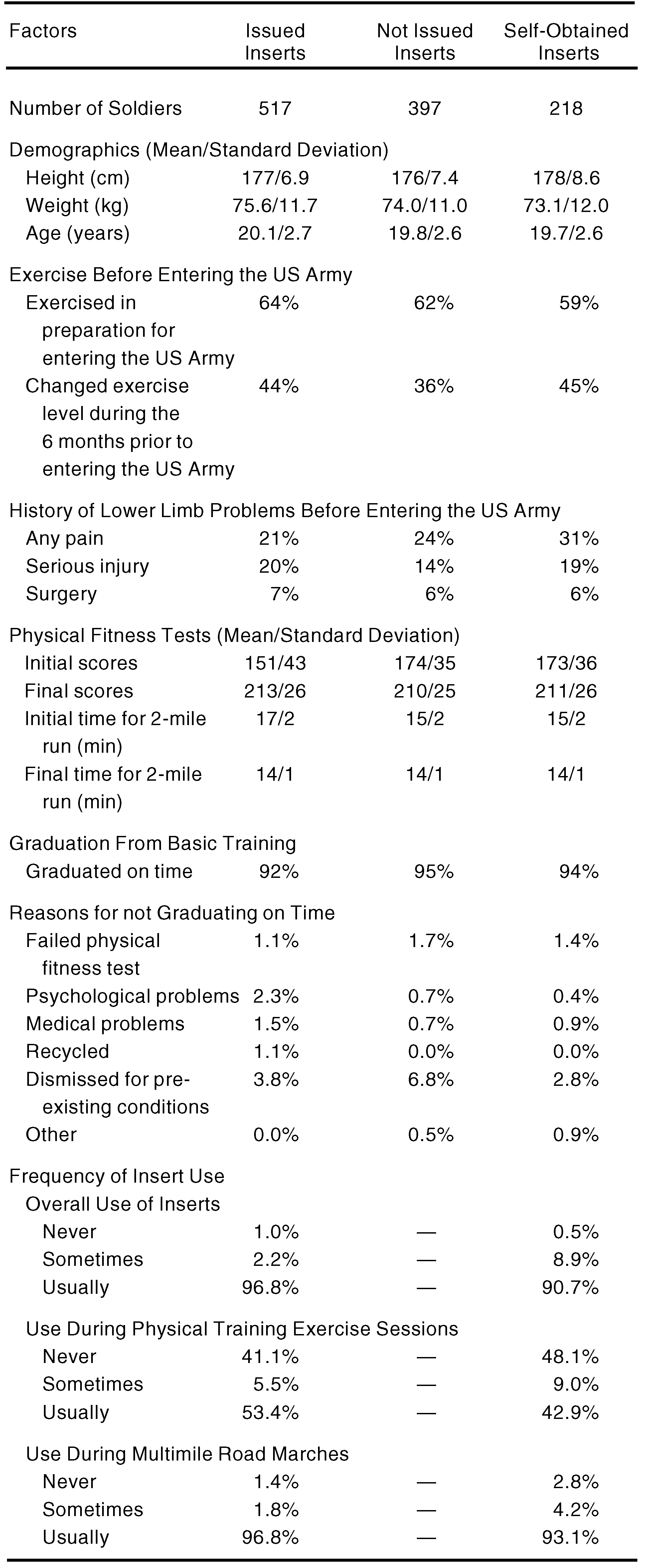
The demographics of the 1,132 male trainees who participated in the study are detailed in
Table 1. Only males participated in the study because females were not trained at the participating post.
There were no practical differences between the three groups with factors that might have affected their performance. These factors, including age, height, weight, scores on physical fitness tests, pre-entry exercise, and prior health problems are summarized in
Table 1. The initial scores on the physical fitness tests were slightly lower for the group issued inserts than for the other two groups. This was statistically significant but not of a great enough extent to be meaningful in actual physical performance. The difference disappeared by the first practice tests and was probably a statistical anomaly.
Table 1.
Comparison of Background Factors.
Table 1.
Comparison of Background Factors.
Six percent of trainees starting the study failed to finish basic training on time. However, 53 of those were lost because of pre-existing problems. An additional 16 did not graduate because of psychological problems and 16 failed the physical fitness test. Only 13 failed to graduate because of medical problems. Thus, less than 5% (55 trainees) of the trainees who were not dismissed because of preexisting problems failed to graduate on time.
Almost all of the trainees issued inserts reported using them most of the time. The members of the group not issued inserts were divided into those who did not purchase their own (and reported never using inserts) and those who did purchase their own (
Table 1).
Use of inserts did not have any preventive effect on occurrence of lower limb problems during training. Physical fitness test scores and graduation rates were not affected. Five hundred seventeen trainees were issued inserts, 397 were followed but not issued inserts, and 218 were not issued inserts but purchased them on their own. The inserts purchased were identical to those supplied to the other trainees.
Thirty-eight percent of those issued inserts were seen for lower limb pain problems, as opposed to 29% of those not issued inserts and 38% of those who bought their own. These frequencies are not significantly different (chi square test of independent frequencies = 0.719, p = 0.698), so the hypothesis that inserts prevent training injuries is rejected.
Although one third of the soldiers were treated for lower limb pain problems, less than 1% failed to graduate on time because of medical problems. Stress fractures occurred among only 12 trainees and did not prevent most from graduating.
Table 2 summarizes the problems for which these trainees were seen and the amounts of pain they reported. There were no clinically important differences among the groups in problems.
The proportions of each variable for the three groups were compared using chi square and
t-tests for proportions. None of the groups were different for any of the proportional variables (
Table 1 and
Table 2). A one-way, independent measures, analysis of variance was used to look for differences among the three groups for the continuous variables of height, weight, age, running time on the physical fitness test, and physical fitness test scores. Prior to training, the group issued inserts had slightly lower physical fitness test scores of 151 relative to 174 and 173 (F = 44.06, p = 0.0001) and run times longer by an average of 2 sec (F = 63.96, p = 0.0001). However, all scores were statistically and practically similar by the end of training. Power analyses for both dichotomous and continuous variables showed that sufficient number of subjects participated to have a 95% chance of detecting a difference of 10% between the groups. [
7]
The authors did not use a multiple repeated measures analysis of variance to compare changes between the three groups over the course of training because the only measure available to test was the physical fitness test score. The physical fitness test had an initial intergroup difference that disappeared by the time training had begun. Thus, it would have been misleading to use the results of a multigroup repeated measures test. Changes over time within a group were evaluated using single group repeated measures designs.
Table 2.
Comparison of Medical Problems.
Table 2.
Comparison of Medical Problems.
Discussion
The results were surprising because the authors routinely provide inserts of the type used in the study to soldiers who experience similar types of lower limb pain caused by similar training. The authors frequently provided inserts to two types of patients not involved in this study. One type was patients treated at an army medical center, who were relatively seasoned soldiers not training as intensely as the trainees who participated in this study. The problems of these relatively seasoned soldiers were corrected among approximately 80% of those who used the inserts regularly. This was based on a sample of 300 soldiers seen over the last 3 years with follow-up examinations of 250 of the soldiers ranging from 3 to 24 months.
The other type of patients to whom inserts were regularly provided consisted of trainees from the same post at which this study took place but who were treated before the study began. None of them participated in the study. When these trainees were evaluated for lower limb pain caused by such problems as stress reactions, pes planus (flat feet), and patellofemoral joint syndrome, they were issued inserts. The problems were corrected among approximately 55% of the trainees who used the inserts regularly. This was based on a sample of 400 trainees who were issued inserts over the last 2 years. As these trainees could get care only from the issuing clinic, any trainee who required further medical care would have been noted and their data recorded.
As detailed in the Methods section, this study was initially designed to have only two groups: one that received inserts and one that did not. Many of the trainees in the group that was not supposed to have inserts purchased their own. Thus, an unexpected third group formed halfway through the study. It would not have been appropriate to eliminate the subjects from the study as “contaminated controls” because they were a large, selfselected group. The validity of the study would have been destroyed if they were different from the remaining controls in any significant way.
For example, it is possible that those trainees from the control group who purchased their own inserts were those who believed that they were likely to have lower limb pain problems during basic training. If that assumption was correct, and if the inserts helped them avoid developing problems, then the selfformed group had the same rate of problems as the other two groups because the inserts helped.
If they had been prohibited from purchasing inserts, they might have had more injuries and, thus, the control group would have had a higher incidence of injuries than the group supplied with inserts. This scenario is possible, but unlikely, because examination of the postparticipation questionnaire data from the training units that participated before soldiers began purchasing their own inserts shows no trend toward a difference. The relative numbers are approximately the same as those finally achieved.
Another possibility is that the inserts actually caused some injuries. This is suggested because the insert group had a slightly higher rate of several problems.
However, the differences are likely to be random as the overall statistical analysis shows that the amount of variation across problems indicates that the amount of differences for these individual problems is well within the likelihood of chance. However, the scenario is possible but unlikely to have happened to a great extent because none of the groups differed from each other. According to the logic presented in the above scenario, the self-formed group that purchased their own inserts should have been more likely to injure themselves than the group that was randomly issued inserts. If the inserts caused significant numbers of injuries, this group should have had more injuries than any other.
A likely possibility accounting for the lack of a difference between the groups is related to the sensitivity of the participating school to the need for prevention of lower limb injuries and early intervention when initial, relatively minor symptoms occur. The training school had recently participated in a study intended to identify ways to predict which soldiers were most likely to develop lower limb pain during training. Thus, the training personnel were acutely aware of which symptoms reported by trainees were likely to lead to significant lower limb pain problems in the near future. Most of the trainees reporting such symptoms were referred for care far earlier than they had been prior to initiation of the predictive study and the incidence of serious problems was substantially less than it had been prior to the predictive study.
Possibly, no difference was found between groups because the overall level of problems was very low relative to the levels before the study. Most of the serious problems were never permitted to occur and minor ones were rectified more quickly than they might have been in units not previously sensitive to symptoms likely to lead to significant debilitation.
The results might have been different if the study had been done with a “naive” school. This may have been the case among the participants in the study of Schwellnus et al [
5]. The only other reason there might have been a difference in the studies’ results is that Schwellnus et al used soldiers from the South African Army this study used soldiers from the US Army. Differences in training procedures may have been overwhelmingly important.
Summary
This relatively large study showed that consistent use of orthotic inserts did not prevent lower limb pain among healthy soldiers in basic training. The authors’ clinical work indicates that the same inserts were effective in helping to reduce foot pain.