Article

Clinical Value of Technetium Tc 99m Monomer Methoxy Isobutyl Isonitrile Scintigraphy for the Level of Lower-Limb Amputation in Patients with Diabetic Foot Ulcers

1
Orthopedics and Traumatology Clinic, Yozgat City Hospital, Yozgat 66100, Türkiye
2
Orthopedics and Traumatology Clinic, Private Erciyes Hospital, Kayseri 38040, Türkiye
3
Nuclear Medicine Clinic, Kayseri City Education and Research Hospital, Kayseri 38080, Türkiye
4
Orthopedics and Traumatology Clinic, Kayseri City Education and Research Hospital, Kayseri 38080, Türkiye
*
Author to whom correspondence should be addressed.
J. Am. Podiatr. Med. Assoc. 2026, 116(3), 34; https://doi.org/10.3390/japma116030034
Submission received: 15 May 2024 / Revised: 10 June 2024 / Accepted: 7 October 2024 / Published: 21 May 2026

Abstract

Background: There is a positive relationship between mitochondrial damage in the cell and uptake in technetium Tc 99m monomer methoxy isobutyl isonitrile (99mTc-MIBI) scintigraphy. Severe mitochondrial dysfunction with cell death occurs in patients with diabetic foot ulcers (DFUs). To decide on the level of amputation, 99mTc-MIBI scintigraphy should be considered. Methods: Prospectively, 24 patients with DFUs were included in the study. Based on treatment that started with the hospitalization, patients were divided into two groups: those whose DFUs healed and did not need surgical intervention (healed group) and those whose DFUs did not regress despite surgical and medical treatment and who required further surgical intervention (reoperation group). Before surgery, 99mTc-MIBI scintigraphy was performed. The 99mTc-MIBI uptake rates of the injured foot relative to the healthy foot were recorded. Deep-tissue culture was taken at surgery. Erythrocyte sedimentation rate, white blood cell count, and C-reactive protein (CRP) and albumin levels were measured. Results: The 99mTc-MIBI uptake rates of patients with poor prognosis were higher at all times than those of patients who did not require revision surgery. A significant difference was found between these values in the 10 and 30 s rates. The mean ± SD CRP level was 86.04 ± 21.87 mg/dL in the healed group and 144.43 ± 27.54 mg/dL in the reoperation group (p = 0.040). There was a positive correlation between ulcerated foot and healthy foot 99mTc-MIBI involvement rates at 10 and 30 s and CRP values, and a negative correlation between albumin values. Conclusions: There was a significant relationship between 99mTc-MIBI involvement rates and poor prognosis and reamputation. The correlation between CRP and albumin levels, which are among the predictive values, and 99mTc-MIBI uptake confirmed this relationship in DFUs, which are difficult to manage and treat.

1. Introduction

Diabetes mellitus (DM) is an important public health problem with an increasing incidence worldwide [1]. Even a small diabetic foot ulcer (DFU) can compromise the viability of the entire foot [1,2]. The risk of death within 5 years for a patient with DFU is 2.5 times higher than that for a patient with DM without a foot ulcer [1,3]. Diabetic foot lesions are a very important health problem because of their high morbidity and mortality rates [1,2,3,4,5,6]. The mean annual incidence and prevalence of foot ulcers in patients with DM vary from 1% to 4% and from 5% to 10%, respectively [5]. The major microvascular complications of DM include nephropathy, retinopathy, neuropathy, and angiopathy [2,4]. Given the microvascular changes, it can disrupt tissue nutrition and cause organ damage through disorders in coagulation, contractility, permeability, and regeneration mechanisms [7].
The worst possible potential outcome of DFU, other than death, is lower-extremity amputation [1,4]. Approximately 20% of patients with DFU require lower-extremity amputation [1,2,3,5], and DFU-related amputations constitute 40% to 85% of nontraumatic amputations [1,3,4,5,6]. Once amputated, the incidence of a second amputation in the contralateral limb reaches 50% within 2 years [3,5,6]. Amputation negatively affects the quality of life of patients with DFU. Predicting the level of DFU-related amputation can reduce amputation rates by observation and prophylactic action for high-risk groups [1,2,3,4]. Many studies have explored efforts to prevent foot amputation and determine risk factors associated with amputation [1,2,3,4,5,6,8]. Failure to determine the appropriate level of primary amputation is one of the main causes of reamputation, and reamputation rates of 15% to 40% have been reported [3,5,6,9].
Clinical history and physical examination, transcutaneous oxygen pressure measurement, Doppler ultrasonography, computed tomography (CT), contrasted CT angiography, venography, magnetic resonance imaging (MRI), MRI angiography, carbon dioxide angiography, and lower-extremity duplex scanning are the methods frequently used in the evaluation of peripheral vascular disease [2,3,4,5,6,7,8,10].
In addition, various nuclear medicine agents have been used in the diagnosis of diabetic foot and osteomyelitis [5,7,8,10,11,12,13,14,15,16]. In the absence of radiologic findings in diabetic foot wounds, three-phase bone scintigraphy and leukocyte-marked bone scintigraphy are used to determine tissue perfusion and diagnosis of osteomyelitis [5]. In a study conducted to determine the amputation level of diabetic foot, the three-phase bone scintigraphy method was deemed to be a useful method in determining the level [5]. Similarly, [18F]fluoro-2-deoxyglucose positron emission tomography has been used to distinguish nonviable from salvaged tissues in patients with peripheral vascular disease [10,17]. Although positron emission tomography uniquely evaluates viability noninvasively, it is expensive and has only limited availability [10]. The sensitivity of technetium Tc 99m (99mTc) hexamethyl-propylene-aminoxime-labeled leukocyte scintigraphy for the diagnosis of osteomyelitis was 88.4% [16]. Three-phase bone scintigraphy is the most widely used radionuclide imaging modality for the diagnosis of musculoskeletal infections. It is performed with 99mTc-labeled diphosphonates (hydroxymethylene diphosphonate/hydroxy diphosphonate). The mechanism of uptake is the physicochemical adsorption of diphosphonates to hydroxyapatite crystals that form the amorphous bone mineral matrix. The amount of uptake of the radiopharmaceutical agent in the bone structure depends on new bone formation in relation to regional blood flow and osteoblastic activity [18]. The false-negative rate of these methods can, therefore, be high.
Also known as 99mTc sestamibi, 99mTc monomer methoxy isobutyl isonitrile (99mTc-MIBI) is a radiopharmaceutical agent used to evaluate pathology in the heart, breast, and parathyroid [7,8,13,14,15,19,20]. 99mTc-MIBI is part of a class of radioactive diagnostic agents characterized as lipophilic cationic radiotracers [13,14,15]. It is localized to intramitochondrial anionic proteins in cells [7,13,14,15]. Cellular uptake is proportional to regional blood flow, mitochondrial activity, and cellular viability [7]. 99mTc-MIBI is not organ-specific and is inversely correlated with mitochondrial function [7,13].
Uptake of 99mTc-MIBI in cells depends on perfusion, viability, and mitochondrial activity [7,8,13,19]. Because of these properties, 99mTc-MIBI is a radiopharmaceutical agent used in studies of tissue perfusion and viability and in evaluation of peripheral vascular diseases [7,8,15,19,20,21,22]. In the literature, 99mTc-MIBI has been used for perfusion imaging, particularly in lower-extremity peripheral vascular diseases [7,8,13,19,20,21,22]. No study has evaluated the level of amputation using 99mTc-MIBI, particularly in patients with DFU, and studies evaluating the perfusion and viability of the musculoskeletal system in patients with DM are also limited [7,8,13,19,20,21]. There are studies evaluating musculoskeletal system perfusion and viability using 99mTc-MIBI in patients with DM [8,19] and both with and without DM [7,15,20,21].
In this study, we aimed to determine the predictability of the amputation level to reduce the risk of amputation and develop better treatment strategies in patients with DFU. For this purpose, we evaluated the perfusion and viability of skeletal muscles using 99mTc-MIBI in patients with DFU and tried to determine the relationship between the uptake rates recorded with 99mTc-MIBI scintigraphy and amputation level and reamputation.

2. Methods

2.1. Patients

Thirty-five patients hospitalized for DFU between 20 January 2020, and 31 March 2020, in the Kayseri City Hospital Orthopedics and Traumatology Clinic Diabetic Foot and Wound Care Unit (Kayseri, Turkiye) were included in the study and evaluated prospectively. At the end of the first year, 11 patients who were lost to follow-up because of the COVID-19 pandemic were excluded from the study, and the study was completed with 24 feet of 24 patients (19 men, five women; 12 right sides, 12 left sides; mean ± SD age, 63.4 ± 11.3 years; age range, 42–86 years).

2.2. Study Design

Based on treatment that started with the hospitalization, patients were divided into two groups: those whose DFUs healed and did not need surgical intervention (healed group) and those whose DFUs did not regress despite surgical and medical treatment and who required further surgical intervention (reoperation group). The reoperation group consisted of patients who received antibiotherapy for the isolated agent; received anticoagulant therapy; did not recover despite repeated debridements, daily dressings, and supportive treatments (such as hyperbaric oxygen); and needed high-level amputation.
The inclusion criteria were as follows: DFU, no previous surgical procedure, a diagnosis of type 2 DM, and age 18 years or older. The exclusion criteria were as follows: type 1 DM, DFU in both lower extremities, pregnancy, lactation, a history of malignancy, a history of sepsis, non-DM ischemic peripheral artery disease, and a known history of allergy or a history of hypersensitivity to proteins.

2.3. Data Measurement

Patient age, sex, smoking history, DM duration, DFU side, Wagner classification, amputation history, peripheral artery disease history, laboratory values, microbiologic culture results, and medical comorbidities were collected. In the laboratory evaluation, hemoglobin level, white blood cell (WBC) count, plasma albumin level, hemoglobin A1c level, erythrocyte sedimentation rate, C-reactive protein (CRP) level, estimated glomerular filtration rate, creatinine level, ankle–brachial index, and peak systolic velocities were measured.
The Doppler ultrasound results for the arteria femoralis, arteria poplitealis, arteria tibialis posterior, arteria dorsalis pedis, and arteria tibialis anterior were recorded as triphasic, biphasic, and monophasic.
Lower-extremity radiography and MRI were used to evaluate the presence of neuropathic arthropathy (Charcot’s arthropathy) or osteomyelitis. Lower-extremity ultrasonography was used to evaluate peripheral artery disease.
The Society for Vascular Surgery (SVS) classification system, which emerged in 2013 and was formally introduced in an SVS publication in 2014, addresses three critical factors contributing to the risk of limb amputation: wound, ischemia, and foot infection. The SVS WIfI (Wound, Ischemia, and foot Infection) classification assigns a 4-grade scale to each parameter, ranging from 0 to 3, with 0 indicating absence; 1, mild; 2, moderate; and 3, severe [23].

2.4. 99mTc-MIBI Scintigraphy

Double-headed single-photon emission CT (SPECT)/CT (AnyScan SC; Mediso, Budapest, Hungary) was used for imaging. Tetrakis (2-methoxyisobutyl isonitrile) copper (I) tetrafluoroborate (1.0 mg, MON.MIBI KIT; Eczacıbaşı Monrol, Istanbul, Turkey) was labeled with 99mTc radionuclide obtained by daily milking from the Mo-Tc generator.
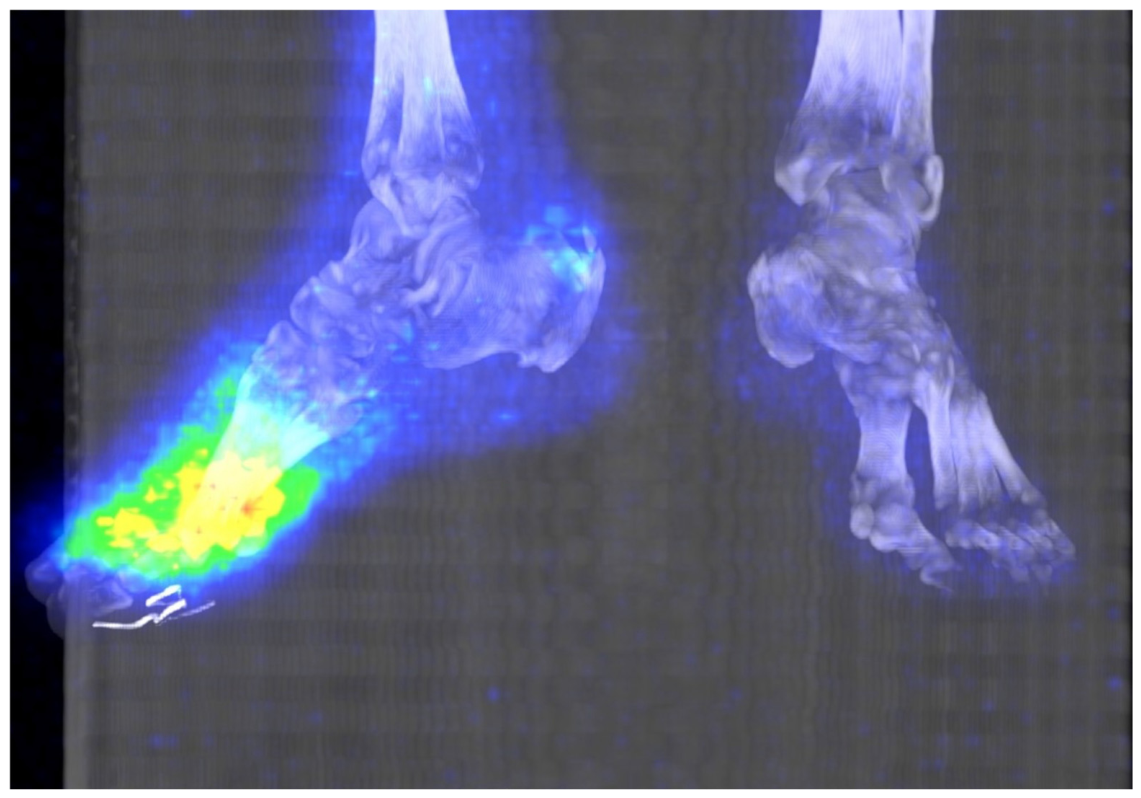
After the patients were placed in the appropriate position, the detectors were positioned at 180° using the low-energy high-resolution collimator, and the foot area was focused in the anteroposterior position. After the parenteral administration of 20 mCi of 99mTc-MIBI, dynamic imaging was started. Data were collected from the anterior and posterior projections in a 15 s, 30-frame, 128 × 128 matrix, without using a zoom factor. After dynamic imaging, 300 s of static imaging was performed in anteroposterior positions. Subsequently, SPECT/CT images were acquired without changing the patient’s position (Figure 1).
The obtained images were analyzed using the Interview 2.0 program on the workstation connected to the Mediso AnyScan SC gamma camera. An intact extremity was taken as a reference for evaluation. Relevant areas of the extremity with DFU and the contralateral healthy extremity were taken and proportioned. The peak activity values at 10 and 30 s were taken as a basis. This process was performed separately for anterior and posterior imaging, and the arithmetic mean of the values was calculated. Time–activity curves were obtained for all of the analyses.
With 99mTc-MIBI scintigraphy, the 99mTc-MIBI uptake rates of the foot of the diabetic ulcerated extremity side/foot of healthy extremity side, distal ankle of diabetic ulcerated extremity side/proximal ankle of diabetic ulcerated extremity side, and extremity of the diabetic ulcerated side/extremity of healthy side were measured at 10 and 30 s, respectively. Two nuclear medicine consultants (SK, HG) unaware of the data evaluated the scintigraphic studies and reached the final impression by consensus.
The uptake rates of 99mTc-MIBI scintigraphy at 10 and 30 s were compared between the healed and reoperation groups. The relationship between these rates and the need for upper-level amputation was demonstrated with 99mTc-MIBI.

2.5. Ethical Issues

The study protocol was approved by the Erciyes University Ethics Committee and was conducted in accordance with the principles of the Declaration of Helsinki.

2.6. Statistical Analysis

Data analyses were conducted with IBM SPSS Statistics for Windows, Version 22.0 (IBM Corp., Armonk, NY, USA). Percentages and standard deviations were determined for categorical data and continuous variables, and the Shapiro–Wilk test and histograms were used to evaluate data distribution. The Pearson χ2 test was used to compare categorical data between groups. After the difference between repeated measurements was analyzed with the Friedman test, pairwise comparisons were made with the Dunn test. The Mann–Whitney U test was used to examine the difference between nondependent groups. The relationship between laboratory results and 99mTc-MIBI uptake results was evaluated by the Spearman correlation analysis. A p < 0.05 was considered statistically significant.

3. Results

The mean ± SD hospital stay was 14.6 ± 2.1 days (range, 3–45 days). Table 1 summarizes the baseline characteristics of the patients. Before the patients’ clinical admissions, the mean ± SD wound duration was calculated to be 3.04 ± 1.03 months. Moreover, six patients (25%) required a repeated surgical procedure.
The patients’ baseline WBC count, erythrocyte sedimentation rate, and CRP level decreased over time, and the albumin level increased. Laboratory values at the end of follow-up were significantly different from the initial values (Table 2).
When the mean ± SD CRP and albumin levels of the groups were compared before treatment, the CRP level was significantly higher in the reoperation group versus the healed group (144.43 ± 27.54 mg/dL [range, 107–281 mg/dL] versus 86.04 ± 21.87 mg/dL [range, 2–232 mg/dL]; p = 0.04) and the albumin level was lower (32.4 ± 1.53 g/L [range, 27–37 g/L] versus 35.81 ± 1.32 g/L [range, 28–44 g/L]; p = 0.224).
The mean ± SD estimated glomerular filtration rate during clinical admissions was calculated to be 53.12 ± 13.53 mL/min. The mean ± SD creatinine level was 1.15 ± 0.35 mg/dL. The mean ± SD hemoglobin level was measured at 11.06 ± 1.73 g/dL.
In the deep-tissue cultures of the patients, Gram-negative bacteria (Escherichia coli, Pseudomonas aeruginosa, etc.) were detected in seven patients (29.2%) and Gram-positive bacteria (Staphylococcus aureus, Staphylococcus epidermidis, etc.) in eight patients (33.3%). Although yeast growth was observed in one patient, no growth in the culture was found in eight patients (33.3%).
In Doppler ultrasound results for the femoral artery, one patient was evaluated as monophasic, one as biphasic, and 22 as triphasic. For the popliteal artery, four patients were assessed as monophasic and 20 as triphasic. For the tibialis anterior artery, four patients were monophasic, two were biphasic, fifteen were triphasic, and three had no flow; and for the tibialis posterior artery, five patients were monophasic, two were biphasic, fourteen were triphasic, and three had no flow. For the dorsalis pedis artery, five patients were monophasic, one was biphasic, fourteen were triphasic, and four had no flow.
The patients’ mean ± SD ankle–brachial index was 0.67 ± 0.08. Ankle–brachial index values ranging from 0.40 to 0.59 were observed in three patients, and according to the WIfi classification, ischemia was evaluated as grade 2 for these patients. The wound status was classified as grade 3 in one patient and as grade 2 in 23 patients.
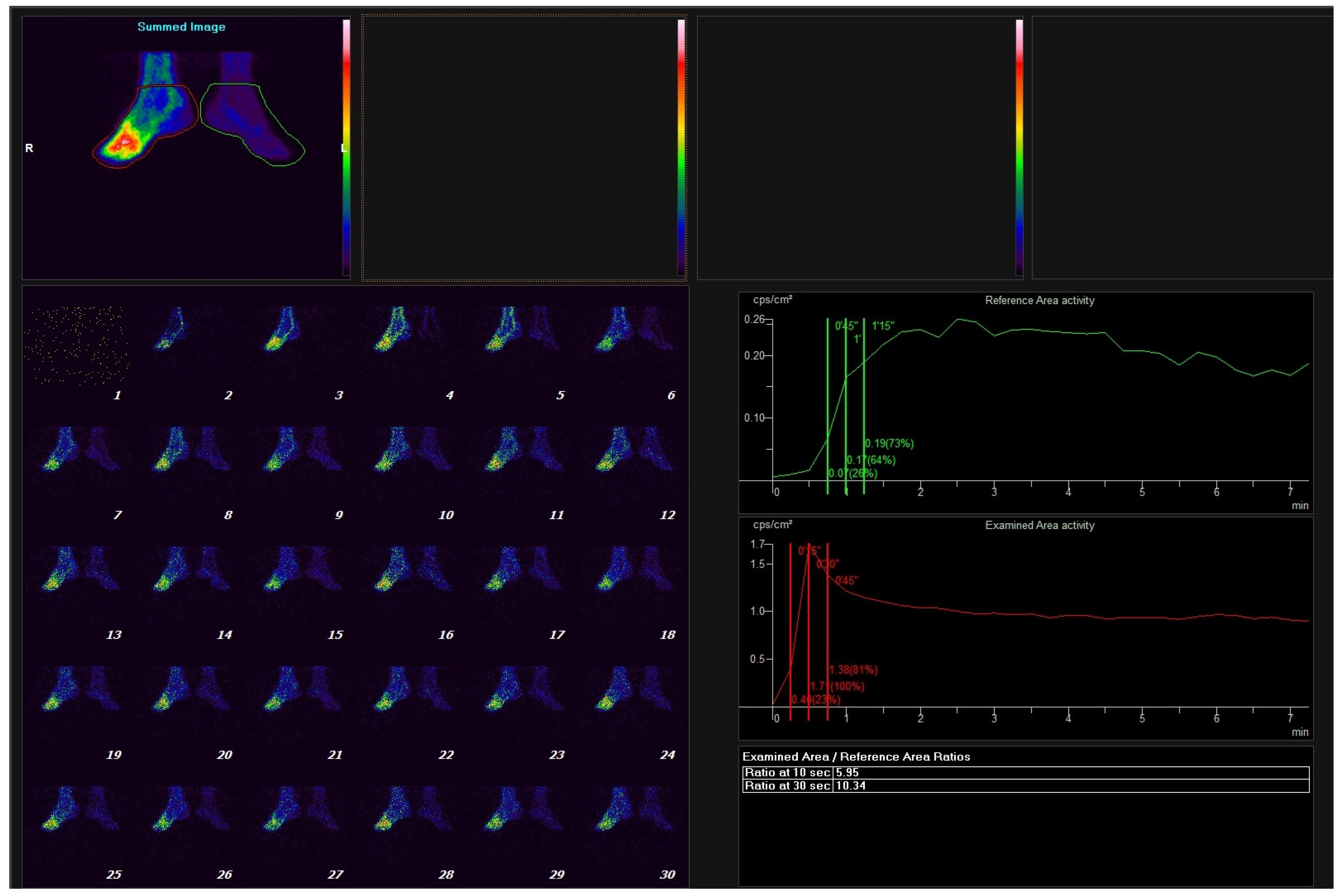
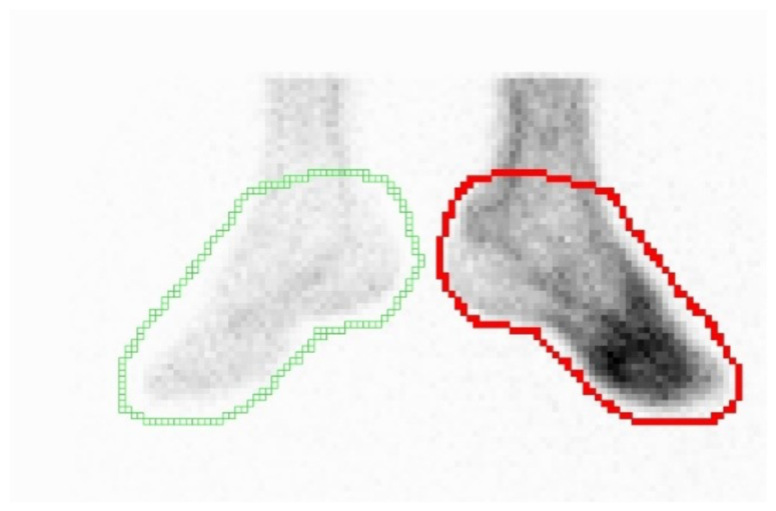
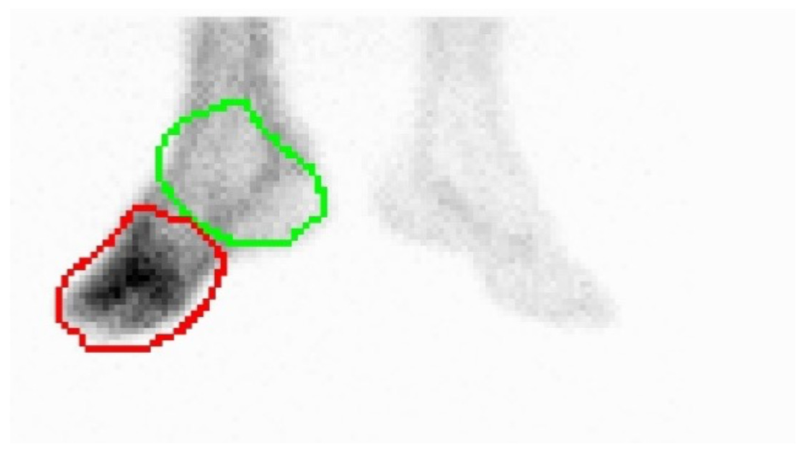
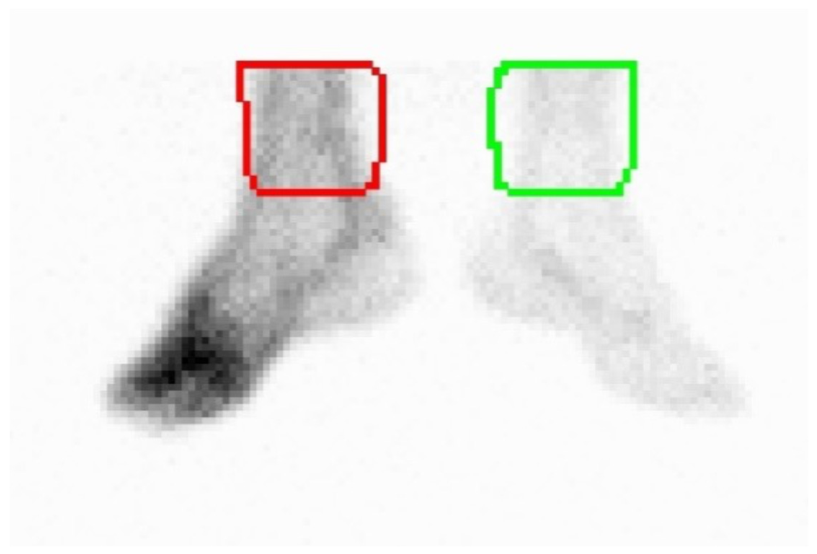
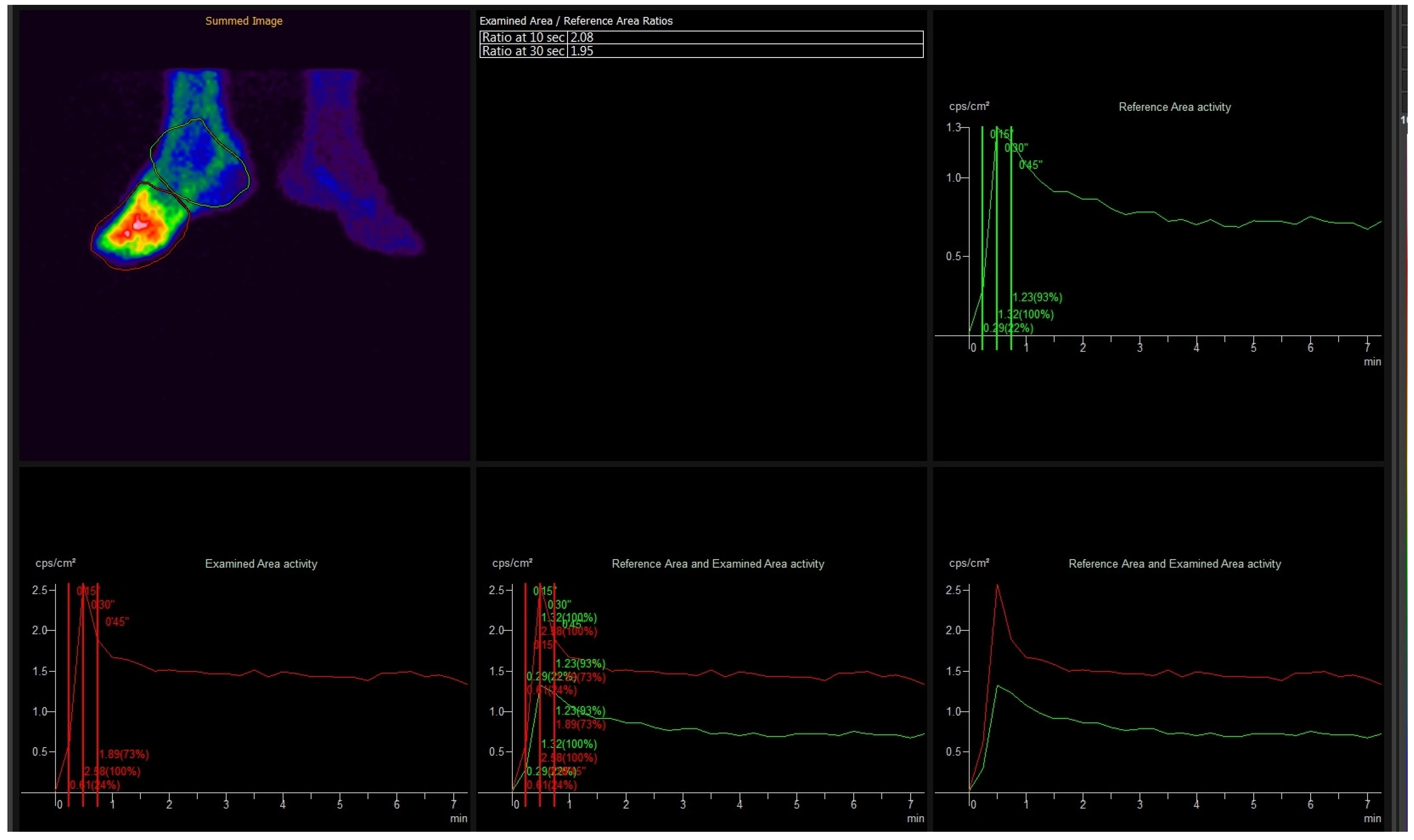
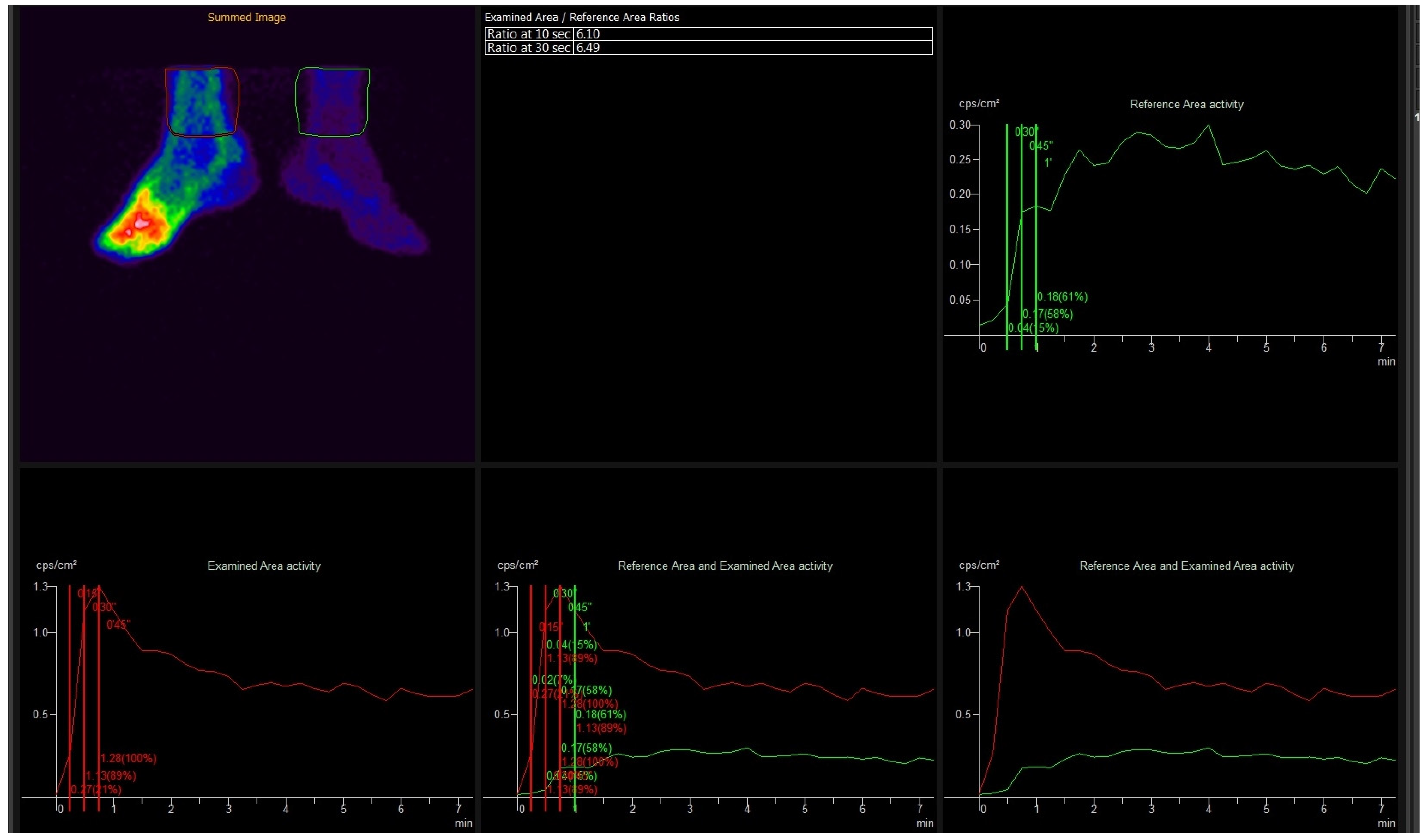
The 99mTc-MIBI uptake rates of the feet (Figure 2), distal ankle/proximal ankle (Figure 3), and all of the extremity parts (Figure 4) of the DFU and healthy extremities of the patients were measured separately at 10 and 30 s. The 99mTc-MIBI uptake rates of the patients included in the study compared with the healthy extremity over time are summarized in Table 3. The 99mTc-MIBI uptake images are shown in Figure 5, Figure 6 and Figure 7. In this study, the 99mTc-MIBI uptake rates of patients with a poor prognosis were higher at all times than in patients who did not require revision surgery. A significant difference was found between these values in the 10 and 30 s rates (Table 4). This was found to be directly related to the failure of lower-level amputations and the need for repeated surgery from the upper level in the patient group with high 99mTc-MIBI uptake rates. Of the three patients who underwent toe amputation, two underwent transmetatarsal amputation and one underwent below-the-knee amputation. One patient who underwent transmetatarsal amputation underwent below-the-knee amputation. Two patients underwent below-the-knee amputation.
A moderate positive relationship was found between the foot section in the 30 s 99mTc-MIBI uptake rates and pretreatment CRP levels of patients in the reoperation group. Also, a weak negative relationship was observed between the extremity section in the 10 and 30 s 99mTc-MIBI uptake rates and albumin levels (CRP level: foot section—10 s, r = 0.354, p = 0.089; 30 s, r = 0.552, p = 0.005; extremity section—10 s, r = 0.349, p = 0.094; 30 s, r = 0.461, p = 0.023; albumin level: foot section—10 s, r = −0.182, p = 0.395; 30 s, r = −0.241, p = 0.256; extremity section—10 s, r = −0.407, p = 0.048; 30 s, r = −0.497, p = 0.013). On the contrary, no significant relationship was found between pretreatment erythrocyte sedimentation rate, WBC count, and 99mTc-MIBI uptake rates (WBC count: foot section—10 s, r = 0.086, p = 0.690; 30 s, r = 0.399, p = 0.054; extremity section—10 s, r = 0.239, p = 0.261; 30 s, r = 0.343, p = 0.101; erythrocyte sedimentation rate: foot section—10 s, r = −0.340, p = 0.104; 30 s, r = −0.382, p = 0.066; extremity section—10 s, r = −0.251, p = 0.237; 30 s, r = −0.310, p = 0.140).

4. Discussion

In this study, we tried to determine the amputation level by evaluating the perfusion and vitality of the extremities of patients with DFUs using the 99mTc-MIBI technique, a nuclear imaging method. In this study, the 99mTc-MIBI uptake rates of patients with poor prognosis were higher at all time points than in patients who did not require revision surgery. A significant difference was found between these values in the 10 and 30 s rates. A moderate positive relationship was found between foot section in the 30 s 99mTc-MIBI uptake rate and pretreatment CRP level of the reoperation group. A weak negative relationship was observed between the extremity section in the 10 and 30 s 99mTc-MIBI uptake rates and albumin level.
Accurately determining the amputation level in patients scheduled for amputation because of DFU is a clinical challenge [2,3,4,5,6,8,10]. No consistent criteria can definitively determine the amputation level before surgery [8,10]. Clinical evaluation, when used alone, is not a reliable indicator of successful recovery of the amputation level [8,10]. The actual amputation level is usually determined by the surgeon during surgery [8]. The level is determined according to intraoperative observations of tissue bleeding and viability of soft tissues and bones [8]. In the present study, it was observed that amputations performed at levels with high 99mTc-MIBI uptake led to higher-level amputations. Because 99mTc-MIBI is directly associated with muscle dysfunction and decreased vitality, we believe it can be used as an imaging modality to determine the level of amputation.
Various clinical risk factors for amputation have been identified, and different radiologic methods are needed depending on the amputation level [2,5,6,7,8,9,10,24,25]. Although each method has advantages and disadvantages, determining the exact amputation level is very difficult [5,8,9,10,24,25]. On the contrary, imaging methods are not consistent enough in routine use in choosing the amputation level [5,8,9,10,24,25]. In the present study, it is a radiologic technique that provides a great convenience for surgeons because tissue viability is clearly demonstrated visually to determine the level of amputation, and it is superior to all of the other techniques in this respect.
Conversely, scintigraphy can be helpful in the diagnosis of inflammation and infection because it is both sensitive and specific [5]. Studies using various radionuclide techniques have provided valuable data for selection of the optimum amputation level [5,8,10,11,12,17,26]. Scintigraphy is more likely to determine the most distal amputation level with healthy circulation [8,10,26]. However, not every scintigraphic technique fully reflects deep-tissue perfusion and does not show the lesion extent or distribution [5,7,8,11]. The results of blood flow measurements of the radionuclide may not always be reproducible or reliable [7,8,13,14]. Determination of the viability at the cellular level by these methods is questionable [5,7,8,11,14]. Most radionuclides accumulate in the extracellular fluid and provide only indirect evidence of tissue viability [7,8,13,14,26]. In addition, these tests are time-consuming [5,7,8,13,14]. In the present study, 99mTc-MIBI, which provides direct intracellular uptake, provided direct information about tissue viability.
However, 99mTc-MIBI is advantageous with a short half-life and allows intravenous injection at higher doses [7,8,13,14,15,19,20]. Given its high energy, its image quality and resolution are superior to those of other radionuclides [12,13,14,15,16]. 99mTc-MIBI, a lipophilic cation, enters cells through the negative electric potential difference in the cell membranes and accumulates in the cytoplasm and mitochondria [8,13,14,27]. Cellular uptake and capture of 99mTc-MIBI are associated not only with regional blood flow but also with mitochondrial metabolic conditions and viability [8,13,14,26]. With 99mTc-MIBI, infarcted and ischemic tissues in a risky extremity can be detected [7,8,13,14,22,28].
99mTc-MIBI is an advantageous agent because of its long-term tissue retention, slow removal from tissues, blood-flow-dependent involvement, and better quality imaging [7,8,13,14]. The effective half-life of 99mTc-MIBI is approximately 5 h, and its physical half-life is approximately 6 h [7,8,13,14]. The fundamental photon energy of gamma emission is 140 keV [8,14]. Also, 99mTc-MIBI is superior in terms of toxicity profile because of its low radiation dose [13]. This very low risk of toxicity makes it a suitable tracer for perfusion imaging [13].
Because of these advantages and its high-quality image, many researchers prefer 99mTc-MIBI in the investigation of peripheral ischemia and perfusion abnormalities in the lower extremities [7,8,13,14,15,19,20,21,22]. In an experimental study, a clear dividing line between necrotic and normal tissues was demonstrated using 99mTc-MIBI scan, and these findings were confirmed pathologically [28]. Another study used 99mTc-MIBI scan to predict surgical outcomes of amputation [8] and reported that 99mTc-MIBI screening supports its use in selecting the optimal amputation level consistent with subsequent stump healing [8].
Studies using 99mTc-MIBI in the lower extremities of patients with DM aimed to show a decrease in perfusion reserve in the early period before the development of symptoms and clinical findings in patients with DM [7,8,15,19,20,21]. Çelen et al. [7] reported that the mean perfusion reserve of the calf muscles in the DM group was significantly lower than that in the control group. Arteriolar dilatation, capillary permeability, and neuropathy are important factors in the perfusion reserve [7,8,15,19,20,21]. To determine the amputation level in the present study, while evaluating the extremity perfusion of patients with DFUs, the healthy contralateral lower extremities of the patients were examined under the same conditions and used as the control group.
The most important adverse effect of 99mTc-MIBI is postinjection allergic reactions; however, they are rarely seen [29]. Overall, 99mTc-MIBI is less radiotoxic than other radiopharmaceutical agents because of its lower degree of nuclear localization and unrepaired double-stranded DNA breakage [30]. Most adverse effects are very temporary and rarely require intervention [13]. In the present study, no complications were observed during follow-up.
This study has some limitations. First, a relatively small number of patients was evaluated. Because this study was conducted during the COVID-19 pandemic, some patients were lost during follow-up and were excluded from the study. Second, we had problems with the supply of radionuclides, which affected the number of patients. Finally, the follow-up period was relatively short. Further prospective studies may be planned to evaluate this technique in larger patient populations with longer follow-up.

5. Conclusions

Radionuclide angiography has not yet been accepted as a routine method for determining the appropriate amputation level. Given its costs, its routine use is limited. However, the 99mTc-MIBI technique may contribute to determining the amputation level and reducing the number of additional amputation attempts, considering the condition of the patients. With 99mTc-MIBI, physicians’ awareness about the amputation level in patients with DFU must be improved. Information gathered from 99mTc-MIBI is likely to guide the method, course, and duration of treatment.

Author Contributions

Methodology, M.E. and F.O.; software, M.E., A.E.G. and F.O.; validation, M.E., S.K. and H.G.; formal analysis, M.E., A.E.G., S.K., H.G. and F.O.; investigation, M.E. and A.E.G.; resources, M.E., S.K. and H.G.; data curation, M.E., S.K. and H.G.; writing—original draft preparation, M.E.; writing—review and editing, A.E.G. and F.O.; visualization, M.E. and H.G.; supervision, S.K. and F.O.; project administration, M.E.; funding acquisition, M.E. and F.O. All authors have read and agreed to the published version of the manuscript.

Funding

This research received no external funding.

Institutional Review Board Statement

The study was conducted in accordance with the Declaration of Helsinki and was approved by the Erciyes University Clinical Research Ethics Committee (protocol code: 2020/30; approval date: 15 January 2020).

Informed Consent Statement

Informed consent was obtained from all subjects involved in the study.

Data Availability Statement

The datasets generated and/or analyzed during the current study are not publicly available due to patient privacy and ethical restrictions but are available from the corresponding author on reasonable request.

Conflicts of Interest

The authors declare no conflicts of interest.

References

  1. Hoogeveen, R.C.; Dorresteijn, J.A.; Kriegsman, D.M.; Valk, G.D. Complex interventions for preventing diabetic foot ulceration. Cochrane Database Syst. Rev. 2015, 2015, CD007610. [Google Scholar] [CrossRef]
  2. Lee, D.W.; Kwak, S.H.; Kim, J.H.; Choi, H.J. Prediction of diabetic foot amputation using newly revised DIRECT coding system: Comparison of accuracy with that of five existing classification systems. Int. Wound J. 2023, 20, 359–371. [Google Scholar] [CrossRef]
  3. Gazzaruso, C.; Gallotti, P.; Pujia, A.; Montalcini, T.; Giustina, A.; Coppola, A. Predictors of healing, ulcer recurrence and persistence, amputation and mortality in type 2 diabetic patients with diabetic foot: A 10-year retrospective cohort study. Endocrine 2021, 71, 59–68. [Google Scholar] [CrossRef]
  4. Jeon, B.; Choi, H.J.; Kang, J.S.; Tak, M.S.; Park, E.S. Comparison of five systems of classification of diabetic foot ulcers and predictive factors for amputation. Int. Wound J. 2017, 14, 537–545. [Google Scholar] [CrossRef]
  5. Baykal, Y.B.; Yaman, E.; Burc, H.; Yorgancigil, H.; Atay, T.; Yıldız, M. Is scintigraphy a guideline method in determining amputation levels in diabetic foot? J. Am. Podiatr. Med. Assoc. 2014, 104, 227–232. [Google Scholar] [CrossRef]
  6. Ozan, F.; Gürbüz, K.; Çelik, I.; Dursun, Z.B.; Uzun, E. Evaluation of major and minor lower extremity amputation in diabetic foot patients. Turk. J. Med. Sci. 2017, 47, 1109–1116. [Google Scholar] [CrossRef] [PubMed]
  7. Çelen, Y.Z.; Zincirkeser, S.; Akdemir, I.; Yilmaz, M. Investigation of perfusion reserve using 99Tcm-MIBI in the lower limbs of diabetic patients. Nucl. Med. Commun. 2000, 21, 817–822. [Google Scholar] [CrossRef] [PubMed]
  8. Sarikaya, A.; Top, H.; Aygit, A.C.; Benlier, E.; Unal, Y. Predictive value of 99mTc-sestamibi scintigraphy for healing of extremity amputation. Eur. J. Nucl. Med. Mol. Imaging 2006, 33, 1500–1507. [Google Scholar] [CrossRef] [PubMed]
  9. Adiyeke, L.; Karagoz, B. Analysis of Doppler ultrasonography and computed tomography angiography for predicting amputa-tion level and re-amputation rate. North. Clin. Istanb. 2022, 9, 401. [Google Scholar]
  10. Lauri, C.; Leone, A.; Cavallini, M.; Signore, A.; Giurato, L.; Uccioli, L. Diabetic foot ınfections: The diagnostic challenges. J. Clin. Med. 2020, 9, 1779. [Google Scholar] [CrossRef]
  11. Asli, I.N.; Javadi, H.; Seddigh, H.; Mogharrabi, M.; Hooman, A.; Ansari, M.; Jalallat, S.; Assadi, M. The diagnostic value of 99mTc-IgG scintigraphy in the diabetic foot and comparison with 99mTc-MDP scintigraphy. J. Nucl. Med. Technol. 2011, 39, 226–230. [Google Scholar] [CrossRef]
  12. Malone, J.; Leal, J.; Moore, W.; Henry, R.; Daly, M.; Patton, D.; Childers, S. The “gold standard” for amputation level selection: Xenon-133 clearance. J. Surg. Res. 1981, 30, 449–455. [Google Scholar] [CrossRef]
  13. Rizk, T.H.; Nagalli, S. Technetium 99m Sestamibi. In StatPearls; StatPearls Publishing: Treasure Island, FL, USA, 2024; Available online: http://www.ncbi.nlm.nih.gov/books/NBK553148/ (accessed on 1 January 2024).
  14. Top, H.; Sarikaya, A.; Aygit, A.C.; Benlier, E.; Kiyak, M. Review of monitoring free muscle flap transfers in reconstructive surgery: Role of 99mTc sestamibi scintigraphy. Nucl. Med. Commun. 2006, 27, 91–98. [Google Scholar] [CrossRef] [PubMed]
  15. Manevska, N.; Stojanoski, S.; Gjorceva, D.P.; Todorovska, L.; Vavlukis, M.; Majstorov, V. Tissue-muscle perfusion assessed by one day 99mTc-MIBI rest-dipyridamol scintigraphy in non-diabetic and diabetic patients. Rev. Esp. Med. Nucl. Imagen Mol. 2018, 37, 141–145. [Google Scholar] [CrossRef]
  16. Devillers, A.; Moisan, A.; Hennion, F.; Garin, E.; Poirier, J.Y.; Bourguet, P. Contribution of technetium-99m hexamethylpropylene amine oxime labelled leucocyte scintigraphy to the diagnosis of diabetic foot infection. Eur. J. Nucl. Med. 1998, 25, 132–138. [Google Scholar] [CrossRef]
  17. Smith, G.T.; Wilson, T.S.; Hunter, K.; Besozzi, M.C.; Hubner, K.F.; Reath, D.B.; Goldman, M.H.; Buonocore, E. Assessment of skeletal muscle viability by PET. J. Nucl. Med. 1995, 36, 1408–1414. [Google Scholar]
  18. Şahin, Ö.; Serdengeçti, M.; Uğur, Ö. Nuclear medicine and imaging in musculoskeletal infections. TOTBID Derg. 2020, 19, 712. (In Turkish) [Google Scholar]
  19. Nemcova, A.; Jirkovska, A.; Dubsky, M.; Bem, R.; Fejfarova, V.; Woskova, V.; Pysna, A.; Buncova, M. Perfusion scintigraphy in the assessment of autologous cell therapy in diabetic patients with critical limb ischemia. Physiol. Res. 2018, 67, 583–589. [Google Scholar] [CrossRef]
  20. Li, Y.; Li, Q.; Liang, S.; Liang, X.; Zhou, W.; He, H.; Jin, R.; Wang, K.; Zhu, Z.; Yan, Z. A novel use of hill function and utility of 99mTc-MIBI scintigraphy to detect earlier lower extremity microvascular perfusion in patients with type 2 diabetes. Medicine 2017, 96, e8038. [Google Scholar] [CrossRef] [PubMed]
  21. Zhang, Q.; Liu, X.; Li, Q.; Liu, Y.; He, H.; Wang, K.; Yan, Z. Quantitative model for assessment of lower-extremity perfusion in patients with diabetes. Med. Phys. 2023, 50, 3019–3026. [Google Scholar] [CrossRef] [PubMed]
  22. Aygit, A.C.; Sarikaya, A. Imaging of frostbite injury by technetium-99m-sestamibi scintigraphy: A case report. Foot Ankle Int. 2002, 23, 56. [Google Scholar] [CrossRef] [PubMed]
  23. de Oliveira Cerqueira, L.; Duarte, E.G.; de Souza Barros, A.L.; Cerqueira, J.R.; Araújo, W.J.B.D. WIfI classification: The Society for Vascular Surgery lower extremity threatened limb classification system, a literature review. J. Vasc. Bras. 2020, 19, e20190070. [Google Scholar]
  24. Jbara, M.; Gokli, A.; Beshai, S.; Lesser, M.L.; Hanna, S.; Lin, C.; Zeb, A. Does obtaining an initial magnetic resonance imaging decrease the reamputation rates in the diabetic foot? Diabet. Foot Ankle 2016, 7, 31240. [Google Scholar] [CrossRef][Green Version]
  25. Chou, Y.; Hou, C.; Wu, C.; Huang, D.; Tsai, S.; Liu, T.; Ding, L.; Chang, C.; Ou, K.; Chiu, Y.; et al. Risk factors that predict major amputations and amputation time intervals for hospitalised diabetic patients with foot complications. Int. Wound J. 2022, 19, 1329–1338. [Google Scholar] [CrossRef] [PubMed]
  26. Bhatnagar, A.; Sarker, B.; Sawroop, K.; Chopra, M.; Sinha, N.; Kashyap, R. Diagnosis, characterisation and evaluation of treatment response of frostbite using pertechnetate scintigraphy: A prospective study. Eur. J. Nucl. Med. Mol. Imaging 2002, 29, 170–175. [Google Scholar] [CrossRef]
  27. Piwnica-Worms, D.; Kronauge, J.F.; Chiu, M.L. Uptake and retention of hexakis (2-methoxyisobutyl isonitrile) technetium(I) in cultured chick myocardial cells. Mitochondrial and plasma membrane potential dependence. Circulation 1990, 82, 1826–1838. [Google Scholar] [CrossRef]
  28. Sarikaya, I.; Aygit, A.C.; Candan, L.; Sarikaya, A.; Türkyilmaz, M.; Berkarda, Ş. Assessment of tissue viability after frostbite injury by technetium-99m-sestamibi scintigraphy in an experimental rabbit model. Eur. J. Nucl. Med. 2000, 27, 41–45. [Google Scholar] [CrossRef]
  29. Hesse, B.; Vinberg, N.; Mosbech, H. Exanthema after a stress Tc-99m sestamibi study: Continue with a rest sestamibi study? Clin. Physiol. Funct. Imaging 2011, 31, 246–248. [Google Scholar] [CrossRef]
  30. Maucksch, U.; Runge, R.; Wunderlich, G.; Freudenberg, R.; Naumann, A.; Kotzerke, J. Comparison of the radiotoxicity of the 99mTc-labeled compounds 99mTc-pertechnetate, 99mTc-HMPAO and 99mTc-MIBI. Int. J. Radiat. Biol. 2016, 92, 698–706. [Google Scholar] [CrossRef]
Figure 1. Single-photon emission computed tomography/computed tomography image. The right foot is the diabetic foot ulcer side and the left foot is the healthy foot side.
Japma 116 00034 g001
Figure 2. Technetium Tc 99m monomer methoxy isobutyl isonitrile uptake rates of the feet. Green indicates the healthy foot side; red, diabetic foot ulcer side.
Japma 116 00034 g002
Figure 3. Technetium Tc 99m monomer methoxy isobutyl isonitrile uptake rates of the distal ankle/proximal ankle. Green indicates the healthy foot area; red, diabetic foot ulcer area.
Japma 116 00034 g003
Figure 4. Technetium Tc 99m monomer methoxy isobutyl isonitrile uptake rates of the legs. Green indicates the healthy foot side; red, diabetic foot ulcer side.
Japma 116 00034 g004
Figure 5. Second-by-second technetium Tc 99m monomer methoxy isobutyl isonitrile uptake and its graphs for the feet. Green indicates the healthy foot side; red, diabetic foot ulcer side.
Japma 116 00034 g005
Figure 6. Second-by-second technetium Tc 99m monomer methoxy isobutyl isonitrile uptake and its graphs for the distal ankle/proximal ankle. Green indicates the healthy foot side; red, diabetic foot ulcer side.
Japma 116 00034 g006
Figure 7. Second-by-second technetium Tc 99m monomer methoxy isobutyl isonitrile uptake and its graphs for the legs. Green indicates the healthy foot side; red, diabetic foot ulcer side.
Japma 116 00034 g007
Table 1. Baseline characteristics of the 24 study patients.
CharacteristicHealed Group (n = 18)Reoperation Group (n = 6)Total (N = 24)p Value
Age (mean ± SD [years])61.6 ± 2.569.2 ± 3.963.4 ± 11.30.060 a
Sex (No.)
Women
Men

4
14

1
5

5
19


0.634 b
Smoking history (No.)
Present
Absent

9
9

2
4

11
13


0.649 b
Duration of DM (mean ± SD [years])10.8 ± 1.815.9 ± 5.212.1 ± 9.20.494 a
No. of comorbidities (No.)
1
2
≥3

7
8
3

1
2
3

8
10
6
0.353 b
Side of involvement (No.)
Right
Left

6
12

60

12
12

0.014 b
Hemoglobin A1c (mean ± SD [%])8.9 ± 0.57.7 ± 0.68.6 ± 2.10.280 a
Abbreviations: DM, diabetes mellitus. a Mann–Whitney U test. b χ test.
Table 2. Laboratory results for the 24 study patients during follow-up.
VariableBefore TreatmentAfter Treatmentp Value a
Month 1Month 3Month 6
WBC count (median [range] [103/µL])9.6 (4.3–30)7.7 (3.9–18.4)7.5 (4–17.7)8.5 (4.1–22) b0.044
ESR (median [range] [mm/h])58.5 (4–140)31 (4–138)19 (2–198) b15 (2.8–140) b0.001
CRP (median [range] [mg/L])79.35 (2–322)14.4 (0.7–170)8.85 (1.1–154) b6.95 (0.9–267) b0.001
Albumin (median [range] [g/L])34.2 (27–44)35 (25–45)39 (23–45)38.5 (18–47) b0.036
Abbreviations: CRP, C-reactive protein; ESR, erythrocyte sedimentation rate; WBC, white blood cell. a Friedman test. b The difference compared with before treatment was statistically significant.
Table 3. 99mTc-MIBI uptake rates of patients’ extremities by time.
VariableAnatomical AreaTime (s)Mean ± SDMedian (Range)
DFUS/HFSFoot1012.49 ± 0.481.80 (1.06–12.72)
DFUS/HFSFoot302.70 ± 0.412.00 (1.08–7.50)
DFUS/HFSDistal ankle/proximal ankle101.10 ± 0.120.97 (0.25–2.31)
DFUS/HFSDistal ankle/proximal ankle301.16 ± 0.120.91 (0.39–2.76)
DFUS/HFSExtremity102.26 ± 0.381.41 (0.51–7.47)
DFUS/HFSExtremity302.01 ± 0.271.33 (0.54–4.59)
Abbreviations: DFUS, diabetic foot ulcer side; HFS, healthy foot side; 99mTc-MIBI, technetium Tc 99m monomer methoxy isobutyl isonitrile.
Table 4. Comparison of 99mTc-MIBI uptake rates between patient groups.
VariableAnatomical AreaTime (s)Healed Group (n = 18)Reoperation Group (n = 6)p Value a
Mean ± SDMedian (Range)Mean ± SDMedian (Range)
DFUS/HFSFoot101.85 ± 0.191.56 (1.06–3.51)4.42 ± 1.703.06 (1.80–12.70)0.012
DFUS/HFSFoot302.11 ± 0.351.74 (1.08–7.50)4.45 ± 1.044.54 (1.52–7.46)0.033
DFUSDistal ankle/proximal ankle101.06 ± 0.130.91 (0.40–2.31)1.23 ± 0.291.05 (0.25–2.17)0.537
DFUSDistal ankle/proximal ankle301.11 ± 0.140.88 (0.49–2.76)1.31 ± 0.241.38 (0.39–2.04)0.454
DFUS/HFSExtremity102.13 ± 0.431.41 (0.51–7.47)2.66 ± 0.831.61 (1.11–5.98)0.378
DFUS/HFSExtremity301.76 ± 0.281.29 (0.54–4.59)2.74 ± 0.632.92 (0.82–4.54)0.310
Abbreviations: DFUS, diabetic foot ulcer side; HFS, healthy foot side; 99mTc-MIBI, technetium Tc 99m monomer methoxy isobutyl isonitrile. a Mann–Whitney U test.
Disclaimer/Publisher’s Note: The statements, opinions and data contained in all publications are solely those of the individual author(s) and contributor(s) and not of MDPI and/or the editor(s). MDPI and/or the editor(s) disclaim responsibility for any injury to people or property resulting from any ideas, methods, instructions or products referred to in the content.