Healthcare Provider Knowledge and Utilization of the Medicare Therapeutic Shoe Benefit

Abstract
1. Introduction
2. Materials and Methods
3. Results
Secondary Findings
4. Discussion
4.1. Implications of Findings
4.2. Limitations
4.3. Further Research
5. Conclusions
Author Contributions
Funding
Institutional Review Board Statement
Informed Consent Statement
Data Availability Statement
Acknowledgments
Conflicts of Interest
Abbreviations
| TSB | Therapeutic Shoe Benefit |
| DM | Diabetes Mellitus |
| DPM | Doctor of Podiatric Medicine |
| PCP | Primary Care Provider |
| DFU | Diabetic Foot Ulcer |
Appendix A. Survey Questions
- Do you treat patients with diabetes?
- a.
- Yes (Respondent continues to Section 2)
- b.
- No (Respondent directed to end of survey)
- Which of the following most accurately defines your area of practice? (If you are an NP/PA please identify which practice you work in your career.)
- a.
- Vascular specialist (Respondent continues to Section 3.a)
- b.
- Physical Therapist (Respondent continues to Section 3.b)
- c.
- Certified diabetes educator (Respondent continues to Section 3.b)
- d.
- Primary care provider (Respondent continues to Section 3.a)
- e.
- Endocrinologist (Respondent continues to Section 3.a)
- f.
- Nephrologist (Respondent continues to Section 3.b)
- g.
- Wound care specialist—Non DPM (Respondent continues to Section 3.b)
- h.
- Doctor of Podiatric Medicine (Respondent continues to Section 3.c)
- i.
- Orthotist/prosthetist (Respondent continues to Section 3.d)
- In which state do you currently practice?
- a.
- State drop down selection
- Which of the following best describes your practice facility?
- a.
- Hospital
- b.
- Private clinic
- c.
- Community clinic
- What types of insurance do your patients most commonly carry?
- a.
- Private PPO
- b.
- Private HMO
- c.
- Medicare
- d.
- Medicaid
- e.
- Private payer
- How many patients with diabetes do you see in a week?
- a.
- 0–25
- b.
- 25–50
- c.
- 50–75
- d.
- 75–100
- e.
- 100 or more
- How many patients with diabetes do you encounter weekly with wounds or history of wounds?
- a.
- 0%
- b.
- 25%
- c.
- 50%
- d.
- 75%
- e.
- 100%
- Do you recommend supportive or protective footwear to patients with diabetes?
- a.
- Yes
- b.
- No
- At what point do you believe a person with diabetes would benefit from therapeutic shoe gear?
- a.
- Before wounds develop for prevention
- b.
- After wounds to help them heal
- c.
- After amputation or significant deformity to accommodate the shape of the foot
- How frequently do patients mention finances as a barrier to protective shoe gear?
- a.
- 100% of the time
- b.
- 75% of the time
- c.
- 50% of the time
- d.
- 25% of the time
- e.
- 0% of the time
- f.
- N/A do not discuss shoe gear
- Are you familiar with Medicare’s Therapeutic Shoes for Persons with Diabetes benefit?
- a.
- Yes (Respondent continues to Section 4.a)
- b.
- No (Respondent directed to end of survey)
- In which state do you currently practice?
- a.
- State drop down selection
- Which of the following best describes your practice facility?
- a.
- Hospital
- b.
- Private clinic
- c.
- Community clinic
- What types of insurance do your patients most commonly carry?
- a.
- Private PPO
- b.
- Private HMO
- c.
- Medicare
- d.
- Medicaid
- e.
- Private payer
- How many patients with diabetes do you see in a week?
- a.
- 0–25
- b.
- 25–50
- c.
- 50–75
- d.
- 75–100
- e.
- 100 or more
- How many patients with diabetes do you encounter weekly with wounds or history of wounds?
- a.
- 0%
- b.
- 25%
- c.
- 50%
- d.
- 75%
- e.
- 100%
- Do you recommend supportive or protective footwear to patients with diabetes?
- a.
- Yes
- b.
- No
- At what point do you believe a person with diabetes would benefit from therapeutic shoe gear?
- a.
- Before wounds develop for prevention
- b.
- After wounds to help them heal
- c.
- After amputation or significant deformity to accommodate the shape of the foot
- How frequently do patients mention finances as a barrier to protective shoe gear?
- a.
- 100% of the time
- b.
- 75% of the time
- c.
- 50% of the time
- d.
- 25% of the time
- e.
- 0% of the time
- f.
- N/A do not discuss shoe gear
- Are you familiar with Medicare’s Therapeutic Shoes for Persons with Diabetes benefit?
- a.
- Yes (Respondent continues to Section 4.b)
- b.
- No (Respondent directed to end of survey)
- In which state do you currently practice?
- a.
- State drop down selection
- Which of the following best describes your practice facility?
- a.
- Hospital
- b.
- Private clinic
- c.
- Community clinic
- What types of insurance do your patients most commonly carry?
- a.
- Private PPO
- b.
- Private HMO
- c.
- Medicare
- d.
- Medicaid
- e.
- Private payer
- How many patients with diabetes do you see in a week?
- a.
- 0–25
- b.
- 25–50
- c.
- 50–75
- d.
- 75–100
- e.
- 100 or more
- How many patients with diabetes do you encounter weekly with wounds or history of wounds?
- a.
- 0%
- b.
- 25%
- c.
- 50%
- d.
- 75%
- e.
- 100%
- Do you recommend supportive or protective footwear to patients with diabetes?
- a.
- Yes
- b.
- No
- How frequently do patients mention finances as a barrier to protective shoe gear?
- a.
- 100% of the time
- b.
- 75% of the time
- c.
- 50% of the time
- d.
- 25% of the time
- e.
- 0% of the time
- f.
- N/A do not discuss shoe gear
- Are you familiar with Medicare’s Therapeutic Shoes for Persons with Diabetes benefit?
- a.
- Yes (Respondent continues to Section 4.c)
- b.
- No (Respondent directed to end of survey)
- In which state do you currently practice?
- a.
- State drop down selection
- Which of the following best describes your practice facility?
- a.
- Hospital
- b.
- Private clinic
- c.
- Community clinic
- d.
- Large commercial shoe supply store
- e.
- Privately owned shoe supply store
- What types of insurance do your patients most commonly carry?
- a.
- Private PPO
- b.
- Private HMO
- c.
- Medicare
- d.
- Medicaid
- e.
- Private payer
- How many patients with diabetes do you see in a week?
- a.
- 0–25
- b.
- 25–50
- c.
- 50–75
- d.
- 75–100
- e.
- 100 or more
- What percentage of your patients getting therapeutic shoes are replacing previous therapeutic shoes?
- a.
- 100% of the time
- b.
- 75% of the time
- c.
- 50% of the time
- d.
- 25% of the time
- e.
- <25% of the time
- How frequently do patients mention finances as a barrier to protective shoe gear?
- a.
- 100% of the time
- b.
- 75% of the time
- c.
- 50% of the time
- d.
- 25% of the time
- e.
- 0% of the time
- f.
- N/A do not discuss shoe gear
- Are you familiar with Medicare’s Therapeutic Shoes for Persons with Diabetes benefit?
- a.
- Yes (Respondent continues to Section 4.d)
- b.
- No (Respondent directed to end of survey)
- Which of the following roles do/would you most likely fill under Medicare’s Therapeutic Shoes for Persons with Diabetes benefit?
- a.
- Certifying provider
- b.
- Prescribing provider
- c.
- Supplying provider
- If you serve as a certifying provider, for what proportion of your likely eligible patients is the prescription process initiated?
- a.
- Offered to 100% of patients that qualify
- b.
- Offered to 75% of patients that qualify
- c.
- Offered to 50% of patients that qualify
- d.
- Offered to 25% of patients that qualify
- e.
- Offered to 0% of patients that qualify
- How often do you discuss or refer patients to use Medicare’s Therapeutic Shoes for Persons with Diabetes benefit to help them access protective shoe gear?
- a.
- 100% of patients
- b.
- 75% of patients
- c.
- 50% of patients
- d.
- 25% of patients
- e.
- <25% of patients
- f.
- Not applicable (do not serve as certifying provider)
- What barriers prevent you from utilizing or recommending services under Medicare’s Therapeutic Shoes for Persons with Diabetes benefit?
- a.
- Lack of awareness
- b.
- Unclear who qualifies
- c.
- Complexity of documentation
- d.
- Financial reasons-labor-to-reimbursement ratio
- e.
- Financial reasons-risk of non-reimbursement
- f.
- Patient resistance
- g.
- Challenges communicating with other providers
- Which of the following roles do/would you most likely fill under Medicare’s Therapeutic Shoes for Persons with Diabetes benefit?
- a.
- Certifying provider
- b.
- Prescribing provider
- c.
- Supplying provider
- How often do you discuss or refer patients to use Medicare’s Therapeutic Shoes for Persons with Diabetes benefit to help them access protective shoe gear?
- a.
- 100% of patients
- b.
- 75% of patients
- c.
- 50% of patients
- d.
- 25% of patients
- e.
- <25% of patients
- f.
- Not applicable (do not serve as certifying provider)
- What barriers prevent you from utilizing or recommending services under Medicare’s Therapeutic Shoes for Persons with Diabetes benefit?
- a.
- Lack of awareness
- b.
- Unclear who qualifies
- c.
- Complexity of documentation
- d.
- Financial reasons-labor-to-reimbursement ratio
- e.
- Financial reasons-risk of non-reimbursement
- f.
- Patient resistance
- g.
- Challenges communicating with other providers
- Which of the following roles do/would you most likely fill under Medicare’s Therapeutic Shoes for Persons with Diabetes benefit?
- a.
- Certifying provider
- b.
- Prescribing provider
- c.
- Supplying provider
- How often do you discuss or refer patients to use Medicare’s Therapeutic Shoes for Persons with Diabetes benefit to help them access protective shoe gear?
- a.
- 100% of patients
- b.
- 75% of patients
- c.
- 50% of patients
- d.
- 25% of patients
- e.
- <25% of patients
- f.
- Not applicable (do not serve as certifying provider)
- If you serve as a prescribing practitioner, for what proportion of your likely eligible patients is the prescription process initiated?
- a.
- 100% of patients
- b.
- 75% of patients
- c.
- 50% of patients
- d.
- 25% of patients
- e.
- <25% of patients
- f.
- Not applicable (do not serve as prescribing practitioner)
- What barriers prevent you from utilizing or recommending services under Medicare’s Therapeutic Shoes for Persons with Diabetes benefit?
- a.
- Lack of awareness
- b.
- Unclear who qualifies
- c.
- Complexity of documentation
- d.
- Financial reasons-labor-to-reimbursement ratio
- e.
- Financial reasons-risk of non-reimbursement
- f.
- Patient resistance
- g.
- Challenges communicating with other providers
- What barriers prevent you from utilizing or recommending services under Medicare’s Therapeutic Shoes for Persons with Diabetes benefit?
- a.
- Lack of awareness
- b.
- Unclear who qualifies
- c.
- Complexity of documentation
- d.
- Financial reasons-labor-to-reimbursement ratio
- e.
- Financial reasons-risk of non-reimbursement
- f.
- Patient resistance
- g.
- Challenges communicating with other providers
Appendix B. Additional Survey Responses

| Profession | Number of Responses | 0–25 n/N (%) | 26–50 n/N (%) | 51–75 n/N (%) | 76–100 n/N (%) | Over 100 n/N (%) |
|---|---|---|---|---|---|---|
| Doctor of Podiatric Medicine (DPM) (Prescriber) | 296 | 63/296 (21.3) | 116/296 (39.2) | 72/296 (24.3) | 29/296 (9.8) | 15/296 (5.1) |
| Orthotist/Prosthetist/Pedorthist (Supplier) | 238 | 152/238 (63.9) | 69/238 (29.0) | 14/238 (5.9) | 4/238 (1.7) | 0/238 (0.0) |
| Primary Care Provider (PCP) | 3 | 2/3 (66.7) | 0/3 (0.0) | 1/3 (33.3) | 0/3 (0.0) | 0/3 (0.0) |
| Vascular Specialist | 7 | 3/7 (42.9) | 3/7 (42.9) | 0/7 (0.0) | 0/7 (0.0) | 1/7 (14.3) |
| Endocrinologist | 3 | 1/3 (33.3) | 2/3 (66.7) | 0/3 (0.0) | 0/3 (0.0) | 0/3 (0.0) |
| Certified Diabetes Educator | 10 | 2/10 (20.0) | 2/10 (20.0) | 4/10 (40.0) | 2/10 (20.0) | 0/10 (0.0) |
| Physical Therapist | 14 | 11/14 (78.6 | 0/14 (0.0) | 2/14 (14.3) | 1/14 (7.1) | 0/14 (0.0) |
| Wound Care Specialist (Non-DPM) | 9 | 5/9 (55.6) | 2/9 (22.2) | 1/9 (11.1) | 0/9 (0.0) | 1/9 (11.1) |
| Total Survey Responses | 580 | 239/580 (41.2) | 194/580 (33.4) | 94/580 (16.2) | 36/580 (6.2) | 17/580 (2.9) |
| Profession | Number of Responses | 0–20 n/N (%) | 21–40 n/N (%) | 41–60 n/N (%) | 61–80 n/N (%) | Over 81 n/N (%) |
|---|---|---|---|---|---|---|
| Doctor of Podiatric Medicine (DPM) (Prescriber) | 296 | 190/296 (64.2) | 75/296 (25.3) | 26/296 (8.7) | 2/296 (0.7) | 3/296 (1.0) |
| Orthotist/Prosthetist/Pedorthist (Supplier) | 238 * | 204/238 (85.7) | 33/238 (13.9) | 0/238 (0.0) | 0/238 (0.0) | 0/238 (0.0) |
| Primary Care Provider (PCP) | 3 | 3/3 (100.0) | 0/3 (0.0) | 0/3 (0.0) | 0/3 (0.0) | 0/3 (0.0) |
| Vascular Specialist | 7 | 4/7 (57.1) | 1/7 (14.3) | 1/7 (14.3) | 0/7 (0.0) | 1/7 (14.3) |
| Endocrinologist | 3 | 3/3 (100.0) | 0/3 (0.0) | 0/3 (0.0) | 0/3 (0.0) | 0/3 (0.0) |
| Certified Diabetes Educator | 10 | 2/10 (20.0) | 1/10 (10.0) | 5/10 (50.0) | 2/10 (20.0) | 0/10 (0.0) |
| Physical Therapist | 14 | 11/14 (78.6) | 1/14 (7.1) | 2/14 (14.3) | 0/11 (0.0) | 0/11 (0.0) |
| Wound Care Specialist (Non-DPM) | 9 | 6/9 (66.7) | 0/9 (0.0) | 1/9 (11.1) | 0/9 (0.0) | 2/9 (22.2) |
| Total Survey Responses | 580 | 423/580 (72.9) | 110/580 (19.0) | 35/580 (6.0) | 4/580 (0.7) | 6/580 (1.0) |
References
- Armstrong, D.G.; Boulton, A.J.M.; Bus, S.A. Diabetic foot ulcers and their recurrence. N. Engl. J. Med. 2017, 376, 2367–2375. [Google Scholar] [CrossRef] [PubMed]
- Saelee, R.; Bullard, K.M.; Hora, I.A.; Pavkov, M.E.; Pasquel, F.J.; Holliday, C.S.; Benoit, S.R. Trends and inequalities in diabetes-related complications among U.S. adults, 2000–2020. Diabetes Care 2024, 48, 18–28. [Google Scholar] [CrossRef] [PubMed]
- Zhou, X.; Andes, L.J.; Rolka, D.B.; Imperatore, G.; Benoit, S.R. Trends in nontraumatic lower-extremity amputation among privately insured adults with diabetes in the U.S., 2004–2018. Diabetes Care 2021, 44, e93–e94. [Google Scholar] [CrossRef] [PubMed]
- Bus, S.A.; van Netten, J.J. A shift in priority in diabetic foot care and research: 75% of foot ulcers are preventable. Diabetes/Metab. Res. Rev. 2016, 32, 195–200. [Google Scholar] [CrossRef] [PubMed]
- Wu, S.C.; Crews, R.T.; Armstrong, D.G. The pivotal role of offloading in the management of neuropathic foot ulceration. Curr. Diabetes Rep. 2005, 5, 423–429. [Google Scholar] [CrossRef] [PubMed]
- Bus, S.A.; Sacco, I.C.N.; Monteiro-Soares, M.; Raspovic, A.; Paton, J.; Rasmussen, A.; Lavery, L.A.; van Netten, J.J. Guidelines on the prevention of foot ulcers in persons with diabetes (IWGDF 2023 update). Diabetes/Metab. Res. Rev. 2024, 40, e3651. [Google Scholar] [CrossRef] [PubMed]
- Janisse, D.J. The Therapeutic Shoe Bill: Medicare coverage for prescription footwear for diabetic patients. Foot Ankle Int. 2005, 26, 42–45. [Google Scholar] [CrossRef] [PubMed]
- Hingorani, A.; LaMuraglia, G.M.; Henke, P.; Meissner, M.H.; Loretz, L.; Zinszer, K.M.; Driver, V.R.; Frykberg, R.; Carman, T.L.; Marston, W.; et al. The management of diabetic foot: A clinical practice guideline by the Society for Vascular Surgery in collaboration with the American Podiatric Medical Association and the Society for Vascular Medicine. J. Vasc. Surg. 2016, 63, 3S–21S. [Google Scholar] [CrossRef] [PubMed]
- American Diabetes Association Professional Practice Committee. Retinopathy, neuropathy, and foot care: Standards of care in diabetes—2024. Diabetes Care 2024, 47, S231–S243. [Google Scholar] [CrossRef] [PubMed]
- van Netten, J.J.; Raspovic, A.; Lavery, L.A.; Monteiro-Soares, M.; Paton, J.; Rasmussen, A.; Sacco, I.C.N.; Bus, S.A. Prevention of foot ulcers in persons with diabetes at risk of ulceration: A systematic review and meta-analysis. Diabetes/Metab. Res. Rev. 2024, 40, e3652. [Google Scholar] [CrossRef] [PubMed]
- McDermott, K.; Fang, M.; Boulton, A.J.; Selvin, E.; Hicks, C.W. Etiology, epidemiology, and disparities in the burden of diabetic foot ulcers. Diabetes Care 2023, 46, 209–221. [Google Scholar] [CrossRef] [PubMed]
- Brunner, J.E. Does your patient need diabetic therapeutic footwear? Where benefit, evidence, and bureaucracy collide. Clin. Diabetes 2015, 33, 51–53. [Google Scholar] [CrossRef] [PubMed][Green Version]
- Pinzur, M.S.; Shields, N.N.; Goelitz, B.; Slovenkai, M.; Kaye, R.; Ross, S.D.; Suri, M. American Orthopaedic Foot and Ankle Society shoe survey of diabetic patients. Foot Ankle Int. 1999, 20, 703–707. [Google Scholar] [CrossRef] [PubMed]
- White, J. Therapeutic shoes for diabetics are proven to be helpful: So why aren’t they prescribed more? Here’s how to tackle the barriers to patient usage. Podiatry Manag. 2022, 41, 73–81. [Google Scholar]
- Anderson, M.; Arvidson, C. Nurse practitioners and barriers to diabetic foot treatment. J. Am. Assoc. Nurse Pract. 2020, 32, 795–799. [Google Scholar] [CrossRef] [PubMed]
- Tang, W.; Zhao, Y.; Cheng, Z.; Xu, J.; Zhang, Y.; Liu, X. Risk factors for diabetic foot ulcers: A systematic review and meta-analysis. Vascular 2023, 32, 661–669. [Google Scholar] [CrossRef] [PubMed]

| Specialty | Total Responses | Not in USA n/N (%) | Incomplete Survey n/N (%) | Final Included Responses n/N (%) |
|---|---|---|---|---|
| Doctor of Podiatric Medicine (DPM) (Prescriber) | 304 | 6/304 (2.0) | 2/304 (0.7) | 296/304 (96.7) |
| Orthotist/Prosthetist/Pedorthist (Supplier) | 258 | 7/258 (2.7) | 13/258 (5.0) | 238/258 (92.2) |
| Certifying Health Professional (Certifier) (Total †) | 29 | 3/29 (10.3) | 13/29 (44.8) | 13/29 (44.8) |
| Primary Care Provider (PCP) | 14 | 2/14 (14.3) | 9/14 (64.3) | 3/14 (21.4) |
| Vascular Specialist | 8 | 0/8 (0.0) | 1 /8 (12.5) | 7/8 (87.5) |
| Endocrinologist | 7 | 1/7 (14.3) | 3/7 (42.9) | 3/7 (42.9) |
| Other Medical Professions (Total ‡) | 39 | 0/39 (0.0) | 6/39 (15.4) | 33/39 (84.6) |
| Certified Diabetes Educator | 14 | 0/14 (0.0) | 4/14 (28.6) | 10/14 (71.4) |
| Physical Therapist | 14 | 0/14 (0.0) | 0/14 (0.0) | 14/14 (100.0) |
| Wound Care Specialist (Non-DPM) | 10 | 0/10 (0.0) | 1/10 (10.0) | 9/10 (90.0) |
| Nephrologist | 1 | 0/1 (0.0) | 1/1 (100.0) | 0/1 (0.0) |
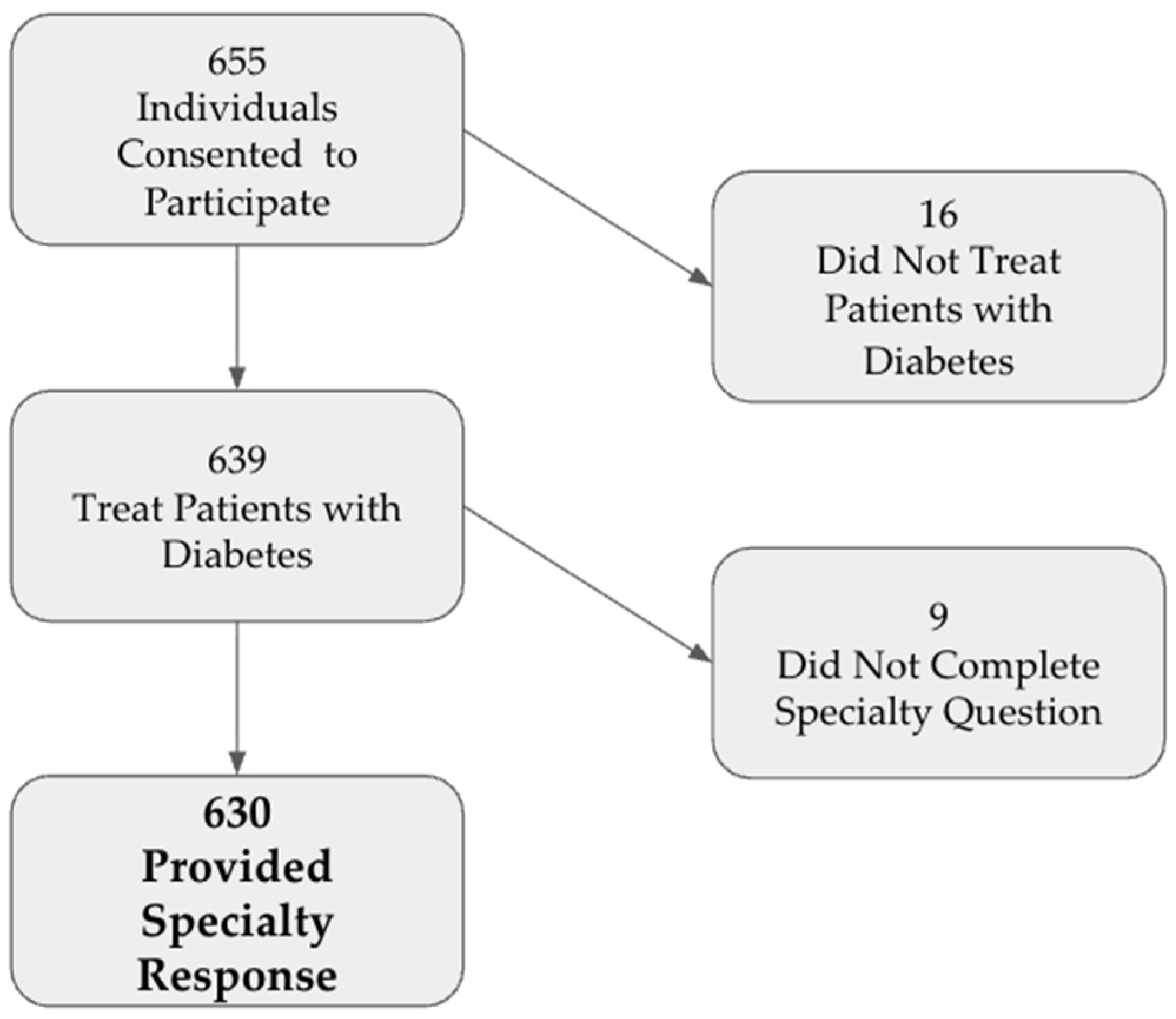
| Overall Total Responses | 630 | 16/630 (2.5) | 34/630 (5.4) | 580/630 (92.1) |
| Profession | Number of Responses | Respondents Recommending Footwear, n/N (%) | Knowledge of TSB, n/N (%) |
|---|---|---|---|
| Doctor of Podiatric Medicine (DPM) (Prescriber) | 296 | 293/296 (99.0) | 274/296 (92.6) |
| Orthotist/Prosthetist/Pedorthist (Supplier) | 238 | N/A * | 220/238 (92.4) |
| Certifying Health Professional (Certifier) (Total †) | 13 | 13/13 (100.0) | 5/13 (38.5) |
| Primary Care Provider (PCP) | 3 | 3/3 (100.0) ** | 1/3 (33.3) |
| Vascular Specialist | 7 | 7/7 (100.0) | 3/7 (42.9) |
| Endocrinologist | 3 | 3/3 (100.0) *** | 1/3 (33.3) |
| TSB Documentation Subgroup (Total ‡) | 547 | 306/309 (99.0) | 499/547 (91.2) |
| Other Medical Professions (Total ‡‡) | 33 | 30/33 (91.0) | 23/33 (69.7) |
| Certified Diabetes Educator | 10 | 10/10 (100) | 10/10 (100.0) |
| Physical Therapist | 14 | 11/14 (78.6) | 8/14 (57.1) |
| Wound Care Specialist (Non-DPM) | 9 | 9/9 (100.0) | 5/9(55.6) |
| Overall Total | 580 | 336/342 (98.2) | 522/580 (90.0) |
| Profession | N | Communication | Financial— Labor | Financial— Risk | Documentation | Lack of Qualifying Providers | Lack of Prescribing Providers | Patient Resistance | Unclear Eligibility | Unclear Role | Lack of Awareness |
|---|---|---|---|---|---|---|---|---|---|---|---|
| DPM (Prescriber) | 261 | 143 (54.8%) | 76 (29.1%) | 86 (33.0%) | 139 (53.3%) | 0 (0%) | 0 (0%) | 97 (37.2%) | 25 (9.6%) | 0 (0%) | 18 (6.9%) |
| Orthotist/Prosthetist/Pedorthist | 216 | 122 (56.5%) | 105 (48.6%) | 86 (39.8%) | 190 (88.0%) | 81 (37.5%) | 25 (11.6%) | 29 (13.4%) | 0 (0%) | 0 (0%) | 0 (0%) |
| Certifying Health Professionals | 5 | 1 (20.0%) | 1 (20.0%) | 1 (20.0%) | 2 (40.0%) | 0 (0%) | 0 (0%) | 2 (40.0%) | 1 (20.0%) | 1 (20.0%) | 2 (40.0%) |
| Other Medical Professions | 18 | 9 (50.0%) | 10 (55.6%) | 9 (50.0%) | 8 (44.4%) | 0 (0%) | 0 (0%) | 5 (27.8%) | 6 (33.3%) | 2 (11.1%) | 4 (22.2%) |
| Total | 500 | 275 (55.0%) | 192 (38.4%) | 182 (36.4%) | 339 (67.8%) | 81 (16.2%) | 25 (5.0%) | 133 (26.6%) | 32 (6.4%) | 3 (0.6%) | 24 (4.8%) |
| Respondents’ Self-Reported Proportion of Patients Treated with Financial Barriers | Knowledge of TSB | Total | |||
|---|---|---|---|---|---|
| No | No % | Yes | Yes % | ||
| 0% of the time | 6 | 8.7 | 63 | 91.3 | 69 |
| 25% of the time | 8 | 4.6 | 166 | 95.4 | 174 |
| 50% of the time | 14 | 7.8 | 165 | 92.2 | 179 |
| 75% of the time | 20 | 15.6 | 107 | 84.4 | 127 |
| 100% of the time | 6 | 25.0 | 18 | 75.0 | 24 |
| Total | 54 | 9.4 | 519 | 90.6 | 573 |
Disclaimer/Publisher’s Note: The statements, opinions and data contained in all publications are solely those of the individual author(s) and contributor(s) and not of MDPI and/or the editor(s). MDPI and/or the editor(s) disclaim responsibility for any injury to people or property resulting from any ideas, methods, instructions or products referred to in the content. |
© 2026 by the authors. Published by MDPI on behalf of the American Podiatric Medical Association (APMA). Licensee MDPI, Basel, Switzerland. This article is an open access article distributed under the terms and conditions of the Creative Commons Attribution (CC BY) license.
Share and Cite
Kurth, C.S.; Crews, R.T. Healthcare Provider Knowledge and Utilization of the Medicare Therapeutic Shoe Benefit. J. Am. Podiatr. Med. Assoc. 2026, 116, 32. https://doi.org/10.3390/japma116030032
Kurth CS, Crews RT. Healthcare Provider Knowledge and Utilization of the Medicare Therapeutic Shoe Benefit. Journal of the American Podiatric Medical Association. 2026; 116(3):32. https://doi.org/10.3390/japma116030032
Chicago/Turabian StyleKurth, Carol Szmuilowicz, and Ryan Thomas Crews. 2026. "Healthcare Provider Knowledge and Utilization of the Medicare Therapeutic Shoe Benefit" Journal of the American Podiatric Medical Association 116, no. 3: 32. https://doi.org/10.3390/japma116030032
APA StyleKurth, C. S., & Crews, R. T. (2026). Healthcare Provider Knowledge and Utilization of the Medicare Therapeutic Shoe Benefit. Journal of the American Podiatric Medical Association, 116(3), 32. https://doi.org/10.3390/japma116030032