The prevalence of diabetes mellitus (DM) continues to increase. Data from 2021 estimates a global prevalence of 536 million [
1]. with projections suggesting increases to 642 million by 2040 [
2]. and 783 million by 2045 [
1]. A 2017 study estimates the global prevalence rate to be 6,059 cases per 100,000, with several regions, such as Switzerland, Sweden, the Netherlands, and Taiwan, surpassing 10,000 cases per 100,000 [
3]. The greatest numbers of individuals with DM are in China, India, and the United States. Incidence rates range from approximately 1 per 1,000 person-years in Russia to 22 per 1,000 person-years in the US Medicare population [
4].
Diabetic foot ulcers (DFUs) are typically a late-stage manifestation of DM. Among patients with DM, the lifetime risk of developing a DFU is 19% to 34% [
5]. The global prevalence of DFUs is estimated to range from 15 million to 22.9 million [
6,
7] with an annual incidence of 1.6 million in the United States [
6]. One study of Seattle veterans with DM found an annual incidence rate of 5.0% [
8]. with a similarly demonstrated 6.0% in a study of Medicare beneficiaries with DM [
9]. Given the rising prevalence of DM, the total incidence of DFU is likely to follow a similar trend. Early recognition and treatment of DFUs is crucial; approximately half of all DFUs become infected [
10]. and individuals with DM who experience a DFU are 2.5 times more likely to die within the next 5 years compared with those without a DFU [
11]. An estimated 30% to 40% of DFUs heal by 12 weeks [
12]. and 67% by 1 year [
13] but recurrence remains high at 42% by 1 year and 65% by 5 years [
12]. The most-feared proximal outcome of DFUs is amputation, which can range in severity from removing a localized ulcer at the toe to requiring removal above the knee. The 5-year postamputation mortality rate for patients with DM is greater than 70%; rates are even higher and earlier for those requiring hemodialysis [
14].
Several factors increase the likelihood of a DFU eventually progressing to amputation, including older age, previous ulcer history, peripheral vascular disease, hypertension (both presence and duration), chronic kidney disease, stroke, transient ischemic attack, or myocardial infarction [
1516,
17]. Socioeconomic risk factors for post-DFU amputation include residing in a nonurban area and being a Medicaid beneficiary compared with a Medicare beneficiary [
18]. Patients who are black/African American, Hispanic, or Native American are also more predisposed to post-DFU amputation compared with non-Hispanic white patients [
17]. In addition, the laboratory values of patients who underwent amputation tend to show higher rates of an abnormal/absent ankle brachial index, albuminuria, decreased hemoglobin level, decreased glomerular filtration rate, or increased C-reactive protein level compared with those in patients with DFUs that healed [
16,
17].
Less studied is how the presence of infection in ulcers increases the likelihood of amputation, although it is accepted that it does increase the rate and shorten timing. Given the large disease burden caused by diabetic foot infections, it would be useful to have concrete information in this regard. Worldwide, the incidence of hospital admissions for diabetic foot infections is estimated to be 5.6 per 1,000 person-years [
19]. In the United States, the readmission rate for foot infection approaches 40% within 6 years [
20]. A literature review revealed few, if any, articles concerning the reduction in time from ulceration to amputation caused by infection. A Finnish study evaluated outcomes downstream of this process by measuring time from amputation to death in patients with diabetic foot infections, finding that the 1- and 5-year survival rates were 41.7% and 8.3%, respectively, versus 81.2% and 49.7% for those who did not require an amputation [
21]. However, no mention of ulceration was included in the analysis. The present study aimed to measure the progression of DFU to amputation and the associations between post-DFU infection and amputation across a continuous chronological course.
Methods
This study used patient records from The University of Texas Medical Branch (Galveston, Texas) through the TriNetX research platform (TriNetX LLC, Cambridge, Massachusetts). The data set is longitudinal, containing claims for procedures, diagnoses, pharmacy, and others from 1996 to 2023. TriNetX data are Health Insurance Portability and Accountability Act compliant and publicly available. Absent identifiable data, or data collection, this study was exempt from institutional review board approval.
Inclusion criteria were presence of DM and ulcer. Diagnoses of type 2 DM, DFUs, and foot infections were identified using International Classification of Diseases, Tenth Revision codes (Supplemental Table 1). We also collected data on patient age at ulceration, sex, race, ethnicity, and occurrence of amputation or infection before the first identified ulcer. Analysis, described later herein, focused on timing from the first identified ulcer to amputation.
All of the variables are described as mean ± SD or frequency (proportion) for continuous and categorical variables, respectively. We compared those with and without infection using t tests and χ2 (Fisher exact) tests for continuous and categorical variables, respectively. The same analysis was performed for those with and without amputation.
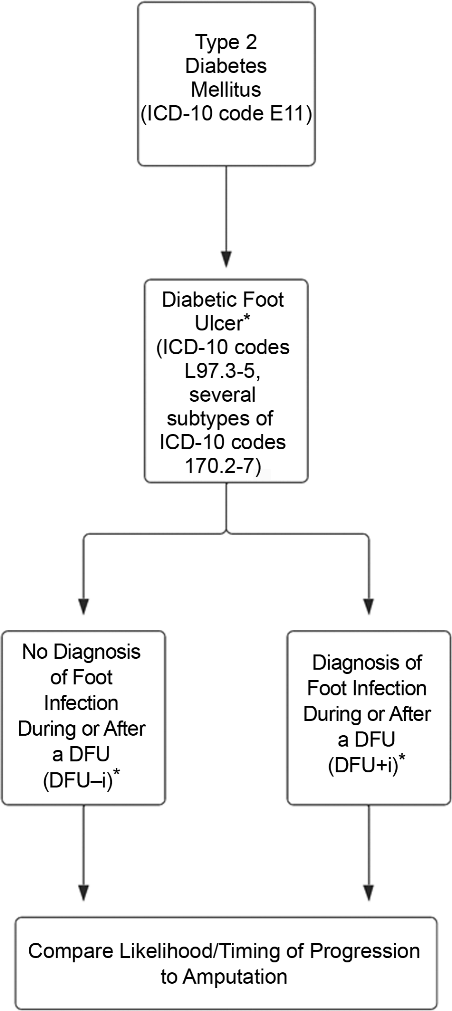
Several survival analyses were performed to understand the impact of infection on rates of and timing to amputation. First, we built Kaplan-Meier curves and performed Cox regression analysis to compare patients with and without infection. Next, we repeated this analysis with age at ulceration, sex, race, ethnicity, occurrence of infection before ulceration, and occurrence of amputation before ulceration as covariates. These analyses were then repeated using infection after ulceration as a time-varying covariate. In time-varying analysis, patients are counted as part of the noninfected group until an infection arises, at which time they are reclassified. This method ensures that each patient contributes to the time-to-event analysis in either the uninfected (DFU−i) or infected (DFU+i) arm, depending on their disease status (
Fig. 1).
Figure 1.
Method for classifying patients as having either noninfected (DFU−i) or infected (DFU+i) diabetic foot ulcer (DFU). *A full list of International Classification of Diseases, Tenth Revision (ICD-10) codes is provided in Supplemental Table 1.
Figure 1.
Method for classifying patients as having either noninfected (DFU−i) or infected (DFU+i) diabetic foot ulcer (DFU). *A full list of International Classification of Diseases, Tenth Revision (ICD-10) codes is provided in Supplemental Table 1.
Results
Of the 3,156 patients included in this study, 1,965 (62.3%) were men and 1,191 (37.7%) were women. Most of the patients were white race (76.1%) and not Hispanic or Latino (75.5%). Before a diagnosis of DFU, 41.1% of patients had already been diagnosed as having a foot infection and 1.1% of patients had already undergone a lower-extremity amputation. Either at the time of DFU diagnosis or afterward, 51.1% of patients developed a new diagnosis of comorbid foot infection and 8.7% eventually underwent lower-extremity amputation (
Table 1).
Table 1.
Demographic Data of Included Patients
Table 1.
Demographic Data of Included Patients
The mean ± SD age at first DFU diagnosis was 60.9 ± 13.3 years. Of the 3,156 patients included, 276 (8.7%) required an amputation at a mean ± SD of 1,532.0 ± 1,143.7 days after DFU. Among those who developed a subsequent foot infection after DFU diagnosis, the mean ± SD time to infection was 475.7 ± 828.7 days. Two hundred fifty-one of these patients (16.3%) underwent an eventual amputation at a mean ± SD of 717.2 ± 953.8 days after infection (
Table 2).
Table 2.
Chronological Data of Patients Within Inclusion Criteria
Table 2.
Chronological Data of Patients Within Inclusion Criteria
The likelihood of developing a subsequent infection after a DFU hovered around 50% regardless of sex, race, or ethnicity. Women were slightly, but significantly, more likely to develop a foot infection than men (51.5% versus 44.7%;
P < .001). Likewise, white patients were slightly more likely to develop an infection than black/African American patients (51.0% versus 44.4%;
P = .004). Having a history of foot infection before DFU diagnosis, however, presented a more noticeable risk of developing a foot infection after DFU diagnosis compared with having no history of pre-DFU foot infection (72.2% versus 32.7%;
P < .001). History of pre-DFU lower-extremity amputation also demonstrated considerable risk of post-DFU infection (67.6% versus 48.7%,
P = .028). See
Table 3 for full details.
Table 3.
Patients with Noninfected Diabetic Foot Ulcers versus Those with Infected Foot Ulcers
Table 3.
Patients with Noninfected Diabetic Foot Ulcers versus Those with Infected Foot Ulcers
The mean ± SD age at first DFU diagnosis was similar in the groups with and without infection (60.3 ± 13.0 and 61.6 ± 13.6 years, respectively), although the difference was statistically significant. Time-independent analysis calculated that the DFU+i group was 8.5 times more likely to undergo an amputation after a DFU (
P < .001). When using time-varying regression, the hazard ratio increased to 9.24 (
P < .001). After adjusting for sex, race, age at first ulcer, and history of infection or amputation before DFU, the hazard ratio in the time-varying analysis increased to 12.0 (
P < .001). Furthermore, in this analysis, white race and history of foot infection before DFU diagnosis were protective factors against amputation. White patients were 26% less likely to undergo amputation than black/African American patients (
P = .034), and patients diagnosed as having a pre-DFU infection were 51% less likely to undergo amputation than patients with no pre-DFU infection history (
P < .001). No other significant differences in patient composition were found, including race, sex, and age at onset of DFU (
Table 4).
Table 4.
Time-to-Event Analysis of Post–Diabetic Foot Ulcer Amputation Risk
Table 4.
Time-to-Event Analysis of Post–Diabetic Foot Ulcer Amputation Risk
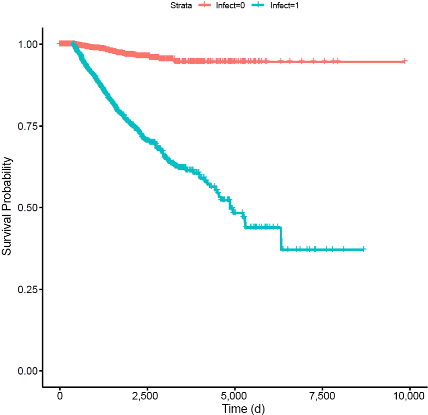
The furthest data available for the DFU+i group was 8,672 days after ulceration, and the median time to amputation was 4,857 days. No median time exists for the DFU−i group because the population never reached a 50% amputation rate. By day 8,672 in the DFU−i group, the amputation rate reached 5.4% (
Fig. 2).
Figure 2.
Time-varying survival probability of patients stratified by post–diabetic foot ulcer infection. Survival probability is defined as the likelihood of not receiving a lower-limb amputation after diabetic foot ulcer.
Figure 2.
Time-varying survival probability of patients stratified by post–diabetic foot ulcer infection. Survival probability is defined as the likelihood of not receiving a lower-limb amputation after diabetic foot ulcer.
Discussion
Compared with patients with noninfected DFUs, those with infected DFUs were more likely to have a history of severe foot disease before and after the onset of a DFU. In particular, most of the DFU+i group had a history of foot infection before DFU, whereas most of the DFU−i group did not. The odds of having a pre-DFU foot infection were five times greater in the DFU+i group than in the DFU−i group. Although pre-DFU lower-extremity amputations were rare (1.1%) in the entire population studied, the odds of having undergone a pre-DFU amputation were more than two times higher in the DFU+i group than in the DFU−i group. After a diagnosis of DFU, those who developed a subsequent foot infection were 12 times more likely to undergo an amputation when controlling for age at DFU onset, sex, race, ethnicity, and pre-DFU foot disease in time-varying analysis. The timing of amputation was also substantially earlier for patients with infected DFUs compared with noninfected DFUs. In other words, even when controlling for the higher burden of disease, those with infection were more likely to undergo amputation.
Most patients in the DFU-i group did not undergo amputation in the timeline of available records in the TriNetX database, which span out to a maximum of almost 10,000 days. Meanwhile, by approximately 9,000 days, the probability in the DFU+i group of avoiding amputation dropped below 50%.
We conducted this study because although the chronological associations and progress of DFU and subsequent foot infection with lower-extremity amputation are generally understood, they have mainly been studied by examining specified time points and have not always been performed with time-to-event analysis. Much fewer data exist that predict the exact time interval from DFU to eventual amputation. For example, Miller et al [
17]. analyzed rates of post-DFU amputation up to 5 years after DFU diagnosis; of 643,287 Medicare beneficiaries, 37,442 (5.8%) underwent amputation within 1 year; 17,172 (2.7%) underwent amputation between 1 and 3 years; and 14,019 (2.2%) underwent amputation between 3 and 5 years. A diabetic foot clinic in Liverpool, England, found that the 5-year amputation rate varied depending on ulcer classification as ischemic (29%), neuroischemic (25%), or neuropathic (11%) [
14]. It is not always clear in such studies whether survival analysis has been used.
Similar to the data on ulcer-to-amputation progression, data on infection-to-amputation progression is usually collected at discrete intervals. One longitudinal study from the United Kingdom found that 17.4% of patients with an infected DFU underwent at least a partial amputation by 1 year after DFU [
22]. Another study from 14 different European foot centers followed newly presenting patients with DFU from 2003 to 2004 for an unclear amount of time and found the below-the-ankle and above-the-ankle amputation rates to be 18% and 0%, respectively, among patients with infected DFUs with no peripheral artery disease [
23]. When looking at patients with infected DFUs and comorbid peripheral artery disease, the below-the-ankle and above-the-ankle amputation rates increased to 40% and 8%, respectively. Comparisons between those with and without amputation have not been performed, to our knowledge.
One notable limitation of this retrospective study is that we cannot determine whether the analyzed patients received standard care for DM, foot ulcer, or infection management. The TriNetX database that we used provides only abstracted information about the timing of International Classification of Diseases–coded diagnoses and procedures. Although standard of care is incredibly important from a patient-centered perspective, this is perhaps of less significance from an epidemiologic perspective. The intentions of this study revolve around understanding general historical trends, regardless of standard of care. We suggest that a prospective study may be useful, leaving this point open to discussion.
The results of this study confirm our hypothesis and the general consensus that subsequent or concurrent foot infections lead to worse outcomes for patients with DFUs in terms of both risk of and time to eventual amputation. However, they add precision to the subjective impressions. The likelihood of developing a foot infection after DFU onset is high at approximately 50%, similar to results in other studies [
6,
10,
24]. Great care and consistent follow-up is required to ensure not only that patients with infected ulcers minimize their risk of amputation but also that patients with noninfected ulcers minimize their risk of developing an infection. Further research should examine causes of subsequent infection after ulceration to aid clinicians in the overall goal of preventing infection and, ultimately, amputation.