During the past 2 years, there has been a steady decrease in the number of individuals applying to podiatric medical school [
1]. This decline in applicants brings less competition to the field. Having more yearly applicants will allow for an increase in both the quantity and quality of podiatric medical students. The American Podiatric Medical Association found that most student prospects were not likely to consider a career in podiatric medicine unless given proper information about the field [
2]. They reported that 68% of student prospects were familiar with a podiatric physician compared with 96% of prospects who were familiar with an MD [
2]. Donai et al [
3] found that only 55% of their survey respondents were familiar with podiatric medicine. Previous research indicated that a lack of familiarity led to a lower rate of applications. Therefore, the present study focused on assessing the level of familiarity with the profession in a region of the country with a podiatric medical school situated nearby.
As the population ages, the prevalence of conditions such as diabetes and osteoarthritis will increase. These conditions, and others, are commonly treated by podiatric physicians and, therefore, drive the need for increased podiatric medical care. Baby boomers as a group have also been heavily involved in fitness activities, and their continued endeavors will additionally boost the demand for podiatric medical care [
4]. Yet, minimal evidence exists about the evaluation of awareness of the field of podiatric medicine.
Whitham et al [
5] reported that training for a career in podiatric medicine ultimately provided graduates excellent employability, but there is still a decline in the number of those applying to podiatric medical colleges. Findings from their United Kingdom study resulted in four main themes surrounding exploring podiatric medicine as a career option: lack of awareness, inaccessible courses, unknown career status, and low positive role modeling in mainstream and popular media. Their study design involved a qualitative approach using informal group discussions led by an independent facilitator. The main limitation of their study design is that some members of the research team were podiatric physicians or members of the university, which may have influenced the interpretation of results. The present research method is grounded in a quantitative approach. This allows for finding statistical associations of trends and interpretation of numerical data to assist in drawing conclusions about a population, whereas a qualitative study cannot.
The purpose of this study was to establish levels of perceived awareness of the podiatric medicine profession. It is hoped that results of the study will upgrade knowledge among pre-health students and provide data that can aid in the recruitment efforts of the podiatric medicine profession. It is hypothesized that a significant percentage of high school and college students are unaware of the breadth and scope of practice of the podiatric medicine profession. Students’ perceived knowledge of the profession is hypothesized to be greater than their actual knowledge.
Methods
Institutional review board approval for this study was obtained from Midwestern University (Glendale, Arizona) on January 17, 2022. Surveys were collected consecutively between January 18, 2022, and February 28, 2023, and stored anonymously using a Web-based survey program (Research Electronic Data Capture [REDCap]; Vanderbilt University, Nashville, Tennessee).
Survey
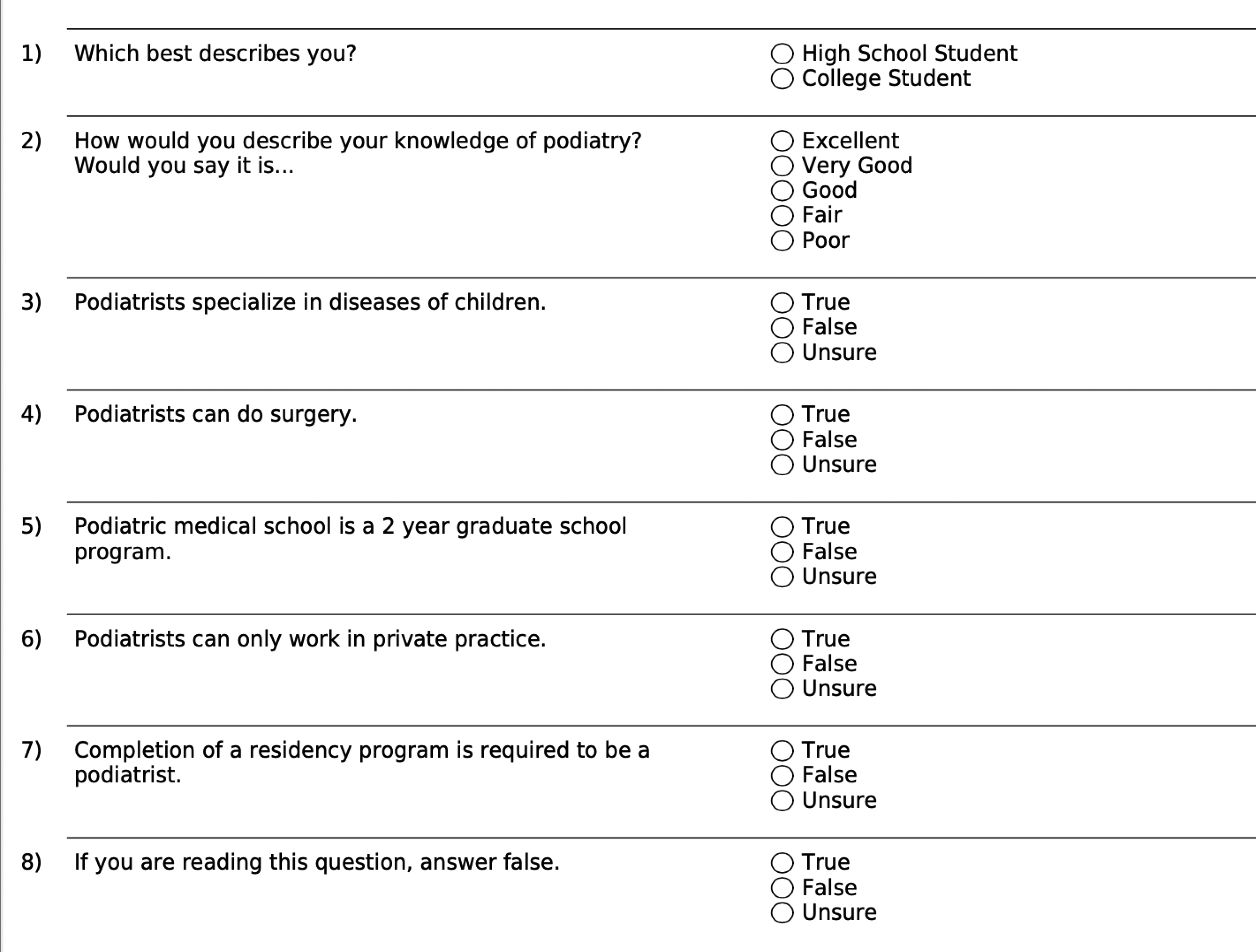
The survey was designed as a descriptive quantitative research analysis that included an eight-question self-completion questionnaire on REDCap. The questions were structured as true or false in the theme of gathering information related to the respondents’ knowledge of podiatric medicine (
Fig. 1). The questions were created by the research team, a biostatistician, and an expert in the field of podiatric medicine based on common misconceptions frequently heard about the profession. The survey was not based on any previous survey. The questionnaire was piloted among four podiatric medical students and staff at Midwestern University before being distributed as a convenience sample. The survey was taken online electronically, and the piloting process helped ensure that the questionnaire was relevant to podiatric medicine and its common misconceptions. The purpose of piloting among podiatric medical students was to help uncover any unclear or ambiguous wording in the survey questions. Piloting also allowed the researchers to assess the length and complexity of the survey. If the survey is too long, participants may easily become disengaged. Last, the survey was piloted to allow researchers to identify any technical difficulties with the survey platform or administration process. This included checking for compatibility across different devices and browsers, ensuring that skip logic and branching instructions worked correctly. The study was cross-sectional in design.
Study participants included students enrolled in a high school or college program in Arizona. High school students were localized to school districts within Maricopa County, and college students were recruited from Glendale Community College, Grand Canyon University, Arizona Christian University, Arizona State University, and Northern Arizona University. There was no preference for sex, race, or ethnicity. This research population was chosen as the target population to better understand the level of familiarity with the profession in a region of the country with a podiatric medical school situated nearby.
The survey was distributed via e-mail or in person by having participants scan a QR code. In-person distribution was performed by the authors of the paper and another podiatric medical student by randomly asking college students on or near a college campus. In addition, a limited subset of high school participants was administered the survey in person at the annual high school day event that Midwestern University hosts. The surveys taken in person were distributed via a tablet computer (iPad; Apple Inc, Cupertino, California) after the distributor pulled up the survey online. All of the information was gathered in REDCap at a live response rate. No data were input manually.
Survey administrators were explicitly directed not to let students take the survey multiple times and not to address any inquiries regarding the survey until submission was confirmed. The survey was administered between January 18, 2022, and February 28, 2023. The totality of how many students encountered the survey is unknown. The survey should be taken only once per individual. This was laid out in the instructions, and teachers administering the survey to high school students were instructed to allow only one survey per individual.
Data were collected from 171 students ranging from 14 to 18 years old at participating high schools and from 147 college students currently attending an accredited undergraduate university in Arizona. They were presented with all eight questions on one page, and all survey responses were handled confidentially. All of the data stored in REDCap were accessible by only the research team and the biostatistician.
Self-perceived awareness was measured as poor to excellent using question 2; actual awareness was assessed using questions 3 through 7 (
Fig. 1). Each actual awareness question answered correctly scored the participant 1 point in this category. A numerical comparison of the participants' perceived awareness score with their actual awareness score was analyzed using R (Version 4.0.2; The R Foundation, Vienna, Austria), and
P < .05 was considered statistically significant.
Informed consent was embedded into the survey document, where it required completion before the survey became available. Twenty-four surveys were excluded because no parental consent was given, the survey was not completed in its entirety, or the last question on the survey was answered incorrectly. If surveys were not complete and data were missing, then the survey was not included in the final data analysis.
Statistical Analysis
A total of 318 students responded to the survey. After exclusions, 294 responses were used in the analysis. Summary statistics (counts and percentages) were calculated for all of the survey questions for college and high school students separately (
Table 1). Comparisons of the responses between college and high school students were conducted using a χ
2 test, which assessed whether there was a difference in the distribution of responses between the student groups. A
P < .05 indicates that the academic level was associated with their knowledge level.
Table 1.
Comparisons for Survey Questions Overall
Table 1.
Comparisons for Survey Questions Overall
A similar analysis was conducted for the association between the knowledge of podiatric medicine questions (true/false/unsure response options) compared with the student’s perceived knowledge of podiatric medicine (single Likert scale questions of Good/Very Good/Excellent, Fair, and Poor) (
Table 2). The perceived knowledge of podiatric medicine question responses were combined for some categories (Good/Very Good/Excellent) due to low numbers in a few of those categories. All of the analyses were conducted in R, Version 4.2.2. Questions answered “unsure” were marked incorrect and used as such in the statistical analysis.
Table 2.
Comparisons of Perceived versus Actual Questions
Table 2.
Comparisons of Perceived versus Actual Questions
Results
A total of 294 survey responses were used in the final evaluation of data. In total, 57.1% of high school students and 47.9% of college students described their knowledge level of podiatric medicine as “poor,” with a relative difference of 10% between the two cohorts. Four of the five true/false questions were answered incorrectly more than 50% of the time (
Table 1). Fifty-four of 294 students described their self-perceived knowledge of podiatric medicine as good and higher, but 27.8% of those respondents answered the first knowledge question, “Podiatrists specialize in diseases of children,” incorrectly (
Table 2). Comparing students' self-perceived awareness with their actual awareness, all five actual awareness questions had a
P < .001, signifying that there was discordance between students' perceived and actual awareness of the podiatric medicine profession (
P < .01). For example, students who said that podiatric physicians can perform surgery reported a higher self-perceived knowledge level (68.5%) compared with students who were unsure and reported fair (34.1%) or poor (63.2%) as their self-perceived knowledge level (
Table 2). Percentages were also obtained from the following questions that were answered incorrectly among the students who classified their knowledge of podiatric medicine as good and higher: 31.5% answered false/unsure to podiatric physicians having surgical privileges, 42.6% answered true/unsure to 2 years of graduate education, 44.4% answered true/unsure to only being able to practice in private practice, and 40.8% answered false/unsure to the requirement of residency training.
Discussion
There has been a substantial decline in the number of applicants to podiatric medical school despite the essential need for national foot health [
6]. Evidence supports that many high school and undergraduate students are unaware of the breadth and scope of practice of the podiatric medicine profession.
We hypothesized that high school and college students overestimate their awareness of podiatric medicine and that a significant percentage of students have low actual awareness of the profession. It is presumed that this shortfall is greater in high school students, which was proved to be true based on data interpretation. As was noted in the American Podiatric Medical Association report, efforts at marketing the profession must be directed at a younger audience than previously thought [
2]. It was interesting that the data reflected that high school students reported only a 10% higher self-awareness level of “poor” compared with their collegiate counterparts (
Table 2).
We collected responses from 294 people for this survey; more than half of the high school students (57.1%) and nearly half of the college students (47.9%) thought they had poor knowledge about podiatric medicine. Also, of the 294 students, 54 believed that they had good or higher knowledge of podiatric medicine. However, surprisingly 27.8% of them incorrectly answered the knowledge question, “Podiatrists specialize in diseases of children” (
Table 2). This finding suggests that even some who felt confident about their knowledge had misconceptions about podiatric medicine. A statistically significant percentage of high school and college students’ self-perceived knowledge of the profession obtained from the study proved to be greater than their actual knowledge, concluding that there are many misconceptions that are believed about the podiatric medicine profession.
This finding is impactful because identification of a statistically significant disparity between students' perceived knowledge and their actual knowledge of a profession suggests the need of broader implications for education, career guidance, professional image, policy, and further research. Misconceptions about podiatric medicine could be one of the causes of the decline in applications during the past few years; however, note that the decline in podiatric medicine applications is likely a multifactorial issue. Other factors include negative health-care media, the rising costs of graduate college programs, and the increasing number of DO schools could also be contributing to declining podiatric medicine applicants [
7]. Previous literature suggests that further educating admission counselors, impactful media marketing, and engaged podiatric medicine practitioners could potentially help promote the field of podiatric medicine and further influence podiatric medicine awareness among high school and college students [
6].
To our knowledge, this is the first questionnaire with a research method revolving around quantitative methods. The main limitations of the study include a relatively small proportion of students who participated and that there was no validity or reliability testing performed on the survey. In addition, although steps were taken to avoid duplicate responses, the authors were unable to fully guarantee that surveys were not taken twice by the same student due to anonymity in data storage. The totality of how many students encountered the survey is also unknown. The survey design may also be prone to bias because it was not tested on the target population through a pilot phase before distribution. Questions were tested only by current podiatric medical students before distribution, so although we attempted to keep the questions about the profession based on basic common misconceptions, we had an inherent knowledge bias when forming the questions. Demographic data and response rate were also unable to be obtained. Furthermore, the surveys were not conducted nationwide, not necessarily affecting reliability but affecting generalizability of the survey results. Therefore, the findings cannot be seen to represent the wider student population. Finally, owing to proximity, a higher proportion of college surveys were completed by students attending Arizona State University compared with the other participating colleges.
Conclusions
These results suggests that awareness of podiatric medicine among high school and college students is poor. Further research is required to explore the reasons podiatric medicine is overlooked as a career and how to maximize recruitment in future generations. Larger sample sizes and nationwide questionnaires may also be implemented to elicit statistically significant findings that better represent the general population.