Historically, peripheral artery disease—specifically, lower-extremity arterial disease (LEAD)—has been defined by abnormal ankle-brachial index (ABI) testing (abnormal <0.9 or >1.4). Several studies have shown that LEAD is associated with coronary artery disease (CAD) and a higher incidence of major adverse cardiovascular events and cardiovascular mortality [
1–
4]. Based on abnormal ABI, LEAD has been associated with elevated cardiovascular disease risk in individuals free of known cardiovascular disease and independent of standard and novel risk factors [
2]. Screening for CAD in the form of stress testing or computed tomography (CT) angiogram is recommended for patients diagnosed with LEAD [
5].
With improvements in imaging quality, LEAD can often be visualized on radiographs in the form of infrapopliteal arterial calcifications (IPACs). The clinical significance of IPACs on radiographs is not fully understood, and this finding may not even be mentioned on standard radiology reports. Patients with this finding have varying degrees of vascular disease; this may be present in patients with symptomatic peripheral artery disease (claudication, rest pain, ischemic ulcers) or may be completely asymptomatic with subclinical disease developing. Patients may have risk factors, including diabetes, renal disease, smoking history, hyperlipidemia, or family history of atherosclerotic disease. These same conditions may also put patients at higher risk of CAD, but again, they may be clinically asymptomatic with no chest pain or exertional symptoms. Because of this, a clinical question has arisen: Knowing that LEAD and CAD are strongly associated, should patients with LEAD in the form of IPACs on radiographs be screened for CAD even if they are asymptomatic for both LEAD and CAD? The current study aimed to investigate the association between IPACs on radiographs and coronary artery calcification (CAC), as these patients may be at risk of future adverse cardiac events and further screening and preventive treatment may be indicated.
Other studies have found that peripheral arterial calcifications such as breast arterial calcifications on mammograms and hand arterial calcifications on radiographs are associated with CAD [
6,
7]. The connection between calcifications of the lower-extremity arteries on CT scan and CAC has been established [
8,
9]. The finding of peripheral artery calcifications on radiographs has been identified as a potential risk stratification tool for cardiovascular disease, but further research and validation are needed [
7,
10]. Specific populations of patients with LEAD and CAD, such as those with diabetes, have been studied; however, no studies have specifically explored the connection between IPACs on radiographs and CAC based on heart scan Agatston scores among the general population.
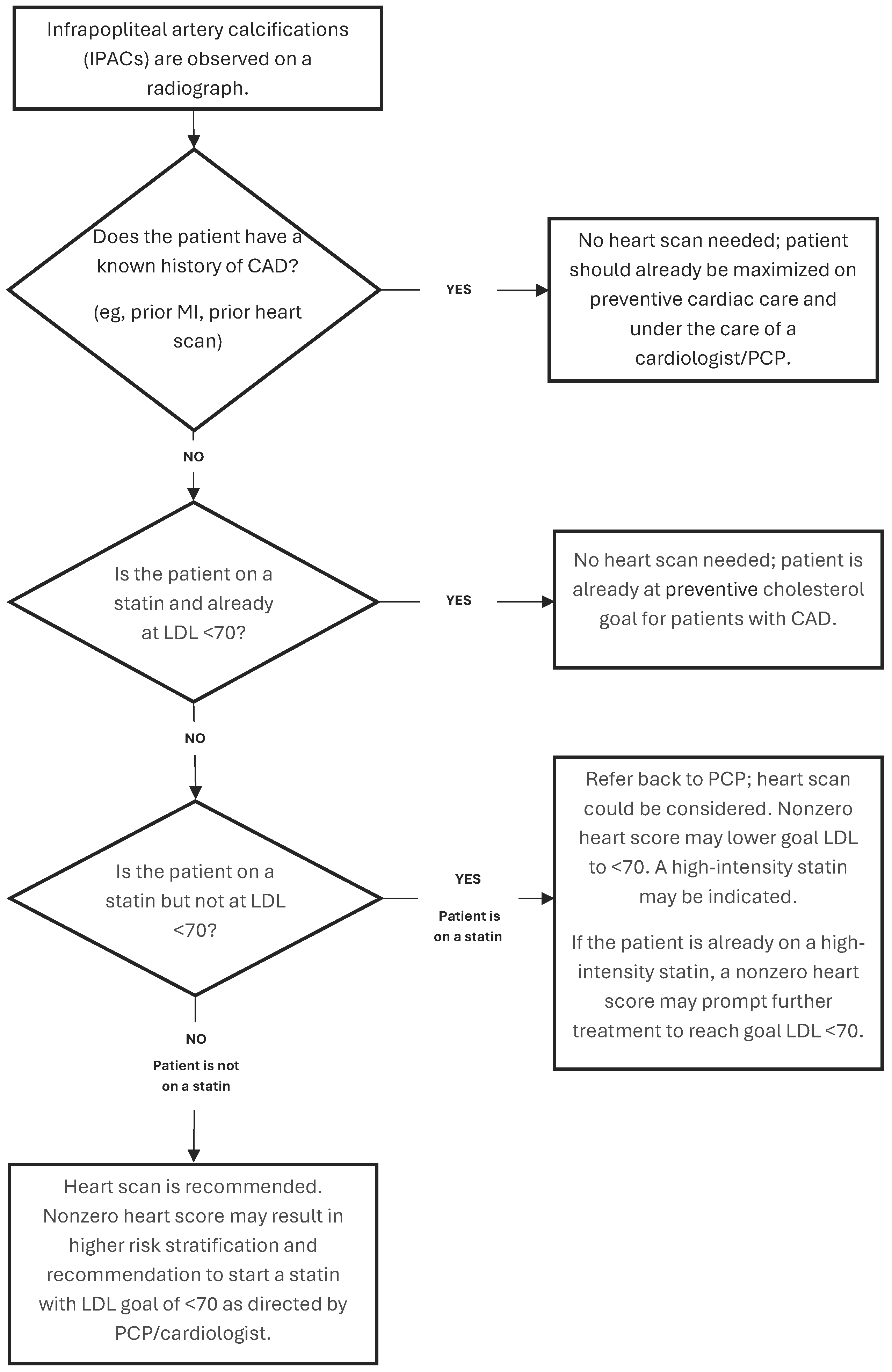
The current study aimed to investigate the association between IPACs and CAC by examining a general population of patients who had foot, ankle, heel, or tibia/fibula radiographs and a coronary artery CT scan for calcium scoring (heart scan). Heart scans were chosen as the measure of CAC, as they are performed as a screening examination for patients who are asymptomatic and do not have a known history of heart disease. Our primary hypothesis was that the presence of IPACs on radiographs would be strongly associated with nonzero heart scan calcium scores. Our secondary hypotheses were that IPACs would be reliably identified on radiographs and would not often be mentioned on standard radiology reports. Additionally, an algorithm for CAD screening recommendations is suggested to aid decision making when IPACs are identified on radiographs (
Fig. 1).
Figure 1.
Suggested flowchart for aiding decision making when infrapopliteal arterial calcifications are identified on radiographs. CAD, coronary artery disease; LDL, low-density lipoprotein; MI, myocardial infarction; PCP, primary care physician.
Figure 1.
Suggested flowchart for aiding decision making when infrapopliteal arterial calcifications are identified on radiographs. CAD, coronary artery disease; LDL, low-density lipoprotein; MI, myocardial infarction; PCP, primary care physician.
Materials and Methods
The institutional review board review at Ascension Wisconsin granted exempt status for this retrospective cohort study. This study included patients cared for between October 2008 and April 2021. The cohort was limited to patients who had both a heart scan (CT scan without contrast for cardiac scoring) and at least one plain radiograph of the lower extremity below the knee (foot, ankle, heel, tibia/fibula) within 12 months of each other. Patient charts were reviewed and the following information was recorded: sex, age, race, diagnosis of diabetes mellitus (at the time of the heart scan), CT coronary calcium Agatston score, radiograph type (foot, ankle, heel, tibia/fibula), and whether vascular calcifications were mentioned on the radiology report.
Five independent reviewers (three board-certified podiatrists and two board-certified radiologists comprising one vascular interventionalist and one musculoskeletal radiologist), including three of the authors (E.G., Z.B., and J.Z.), examined the radiographs looking for the presence or absence of vascular calcifications. They received no extra training in identifying IPACs other than their experience in their own specialty. Reviewers were blinded to the CT heart score results and radiology reports. They were asked to review images in their standard working environments using their specialty-specific equipment. The Merge RadSuite program (Merge Healthcare (Merative) Chicago, Illinois) was used for radiographic review; podiatrists used laptop computers and radiologists used desktop monitors in a dark-room setting.
After all radiographs were independently reviewed by each of the reviewers, all five came together to review and discuss any images for which there was not unanimous consensus. This was done to determine if arterial calcifications were present (yes) or absent (no) on any disputed images; discussion continued until there was unanimous agreement on the binary outcome. Five independent blind reviewers with different backgrounds and a consensus review were used to try to limit bias during the review process. Once a complete binary result was documented for each patient on the presence or absence of calcifications on the radiographs, it was used as a comparison with each reviewer’s individual blind review results to determine interrater reliability.
A heart scan is intended to quantify CAC in asymptomatic patients; it is not indicated for patients with CAD symptoms such as angina or shortness of breath. A heart scan is also not indicated for patients with a known history of CAD, as the findings likely would not change preventive cardiac care recommendations. Heart scan calcium scores, which are objective measures of CAC, were taken from the original heart scan result report and recorded in our master data spreadsheet. Heart scores were categorized according to standard categories as follows:
Category 0: no identifiable atherosclerotic plaque, very low cardiovascular disease risk, less than 5% chance of presence of CAD.
Category 1: 1 to 10, minimal plaque burden, significant CAD unlikely.
Category 2: 11 to 100, mild plaque burden, likely mild or minimal CAD.
Category 3: 101 to 400, moderate plaque burden, moderate nonobstructive CAD highly likely.
Category 4: over 400, extensive plaque burden, high likelihood of at least one significant coronary stenosis.
Statistical Methods
Exploratory analysis was done to summarize continuous variables (mean ± SD) and categorical variables (frequency). A χ2 analysis was used to compare the rates of heart calcifications (none versus any) among patients with and without IPACs. The Mantel-Haenszel χ2 analysis for trend was used to determine if the rate of IPACs increased with increasing heart score category (0–4). Logistic regression modeling was used to control for potential confounders (eg, age and diabetes) of the relationship between IPACs and heart score category. Significance was set at P < .05 for all statistical analyses. Odds ratios and 95% confidence intervals were determined where appropriate. All statistical analyses were performed using SAS 9.4 of the SAS System for Windows (SAS Institute Inc, Cary, North Carolina).
We estimated that we would be able to identify approximately 240 to 280 patients meeting the study entry criteria. We assumed that 17% of patients would have IPACs and approximately 50% of patients would have nonzero category heart scans [
11,
12]. Using these assumptions, the study would have 80% power (α = 0.05) to show a 50% increase in nonzero category heart scans among patients with IPACs, assuming at least 248 patients met the enrollment criteria.
The method for comparing interrater reliability was addressed in two ways. Individual reviewers were compared by specialty with one another as well as individually according to the consensus results. A comparison with the consensus result was done as the review of any radiograph is subject to the interpretation of the reviewer. We believe that the agreed upon consensus result is the best representation of the objective truth of the presence or absence of IPACs on these images.
Results
A total of 287 patients met the study criteria. Three patients were excluded because radiographs were not available and one patient was excluded because only fluoroscopy images were available for review. A total of 283 patients (165 female) were included in the final review. The age of the cohort was 57.4 ± 9.8 years (range, 23–82 years). There were 258 white, 21 black, one Asian, and three Hispanic patients, and 27 patients were diabetic.
Unanimous blind consensus regarding the presence or absence of IPACs was achieved among all five reviewers for 211 of 283 radiographs (74.5%). A total of 202 were blind consensus absent (no) and nine were blind consensus present (yes). Seventy-two had at least one reviewer differ on the presence of IPACs, and a secondary review and discussion of each of these radiographs were completed to determine a consensus opinion among all five reviewers.
Of the 72 patients, 25 were determined to have arterial calcifications and 47 were deemed to not have calcifications. After the complete review, a total of 12% (34 of 283) of the study population were classified as having IPACs. For the 34 with calcifications, 79% were initially identified as positive by at least a majority (three of five) of the blind reviewers prior to the group discussion. Only 21% (seven of 34) were flagged by two or fewer reviewers and later deemed to have calcifications present as determined by the group discussion. For the 47 of 72 radiographs that underwent secondary review that were determined by the group to not have calcifications present, 100% were initially identified by only two or fewer reviewers and 91% (43 of 47) were identified by only a single reviewer.
For the entire study population of 283 patients, 168 (59.36%) had a nonzero heart scan Agatston score. Patients with IPACs on radiographs were more likely to have a nonzero heart scan score compared with those without IPACs on radiographs (91% [31 of 34] versus 54.6% [136 of 249]; odds ratio, 8.6; 95% confidence interval, 2.6–28.8;
P < .0001) (
Table 1). The median Agatston score was significantly greater among patients with IPACs compared with those without IPACs (213 [interquartile range, 48–606] versus 2 [interquartile range, 0–73];
P < .0001).
Table 1.
Comparison of Demographic and Clinical Variables Among Patients With and Without Calcifications Seen on Radiographs
Table 1.
Comparison of Demographic and Clinical Variables Among Patients With and Without Calcifications Seen on Radiographs
Patients with IPACs were also more likely to have category 3 or 4 heart scores compared with those without arterial calcifications. Approximately 62% (21 of 34) of patients with IPACs had category 3 or 4 heart scores, whereas only 20.8% (52 of 249) of those without IPACs had category 3 or 4 heart scores (
P < .0001) (
Table 1).
Twenty-seven of 283 patients had diabetes at the time of their heart scan, 12 of whom were found to have IPACs. Because diabetic patients were more likely than nondiabetic patients to have IPACs (44% versus 9%;
P < .0001) (
Table 1) as well as category 3 or 4 heart scores (44% versus 24%;
P = .02) (
Table 2), this is a potential confounder of the association between IPACs and a severe (category 3 or 4 heart score) scan. Similarly, patient age is also a potential confounder of the association, as older patients were more likely to have IPACs (
P < .0001) (
Table 1) and category 3 or 4 heart scores (
P < .0001) (
Table 2). We controlled for potential confounding through logistic regression modeling, and IPACs remained significantly associated with category 3 or 4 heart scores (odds ratio, 4.4; 95% confidence interval, 2.0–9.7;
P = .0003) even after controlling for age and diabetes (
Table 3).
Table 2.
Comparison of Demographic and Clinical Variables Among Patients With and Without Severe Heart Scan
Table 2.
Comparison of Demographic and Clinical Variables Among Patients With and Without Severe Heart Scan
Table 3.
Regression Analysis of Association Between Presence of Calcifications on Foot Radiographs and Severe Heart Scan (Category 3, 4) While Controlling for Potential Confounders
Table 3.
Regression Analysis of Association Between Presence of Calcifications on Foot Radiographs and Severe Heart Scan (Category 3, 4) While Controlling for Potential Confounders
Additionally, each heart scan score report included a percentile rank for the individual’s age, race, and sex based on data from the Multi-Ethnic Study of Atherosclerosis [
13]. For example, a white male aged 54 with a total Agatston heart score of 48 ranks in the 73rd percentile compared with other males of the same age, race, and sex. The percentile rank was recorded for each patient and compared for those with and without IPACs on radiographs. Multi-Ethnic Study of Atherosclerosis data for percentile score rank are available only for patients aged 45 to 84; therefore, patients outside of this age range were excluded for this portion. This left 257 patients, 33 with IPACs on radiographs and 224 without IPACs on radiographs. For patients with IPACs, 29 of 33 (87.8%) had heart scores that ranked at or above the 50th percentile for their age, race, and sex; only 104 of 224 (46%) of those without IPACs ranked at or above the 50th percentile. This finding was significant (χ
2 = 19.79;
P < .0001). It was also more likely for patients with IPACs to rank at or above the 75th percentile for their age, race, and sex (15 of 33 [45%] versus 74 of 224 [33%]), but this finding was not significant (χ
2 = 1.96;
P = .16).
Radiology Report Review
Original radiology reports created at the time the radiographs were taken were reviewed for all study patients. Four of 283 patients had vascular calcifications mentioned on their report; these patients were also identified by our reviewers as having vascular calcifications. This means that of the 34 total patients identified as having IPACs, only four (11.7%) had this finding mentioned on their original radiology report.
Reviewer Comparison
Among the two specialties (radiology and podiatry), the two radiologists had independent agreement regarding IPACs on 83.5% of the images and the three podiatrists had independent agreement on 90.5% of the images. Compared with the consensus results, each of the five reviewers demonstrated a high score (89.7%, 99.6%, 91.5%, 92.9%, and 89.3%, respectively).
Discussion
The pathophysiologic process of lower-extremity arterial calcification may differ because calcification in the lower extremities is most prominent in the tunica media, which is distinct from the intimal pattern found in the coronary arteries [
14–
16]. The current study examined whether there was a clinical association between the presence of IPACs on radiographs and CAC on heart CT scans regardless of specific pathophysiology. Results from our study add to the evidence that there is an association between IPACs and CAC even though the specific location of calcification within the artery (medial versus intimal) may be different. This is similar to breast artery calcifications, as they also have a medial pattern but are still strongly correlated with CAD [
17]. Patients with arterial calcification tend to have this finding present in multiple areas throughout the body; this can be associated not just with diabetes and chronic kidney disease but other hormonal, medical, age-related, and genetic factors as well [
16,
18]. Medial peripheral arterial calcifications in dialysis patients have been shown to be a strong prognostic marker of all-cause and cardiovascular mortality [
19]. Additionally, it is known that polyvascular patients demonstrate higher risk than those without polyvascular disease; every effort should be made to identify these patients. The finding of vascular calcifications on a radiograph should be a red flag for cardiovascular risk.
A 2016 study by Shin et al [
9] established the association between lower-extremity arterial calcifications on CT and CAC. Although it was important to establish this relationship, a lower-extremity CT is a far less common examination than plain film radiographs. A foot, ankle, or lower-leg radiograph is a very common diagnostic examination, and establishing the association between IPACs on radiographs and CAC is extremely useful in daily practice. Shin et al also noted that IPACs, as visualized on CT, were only weakly associated with coronary calcium scores. Our study suggests that if calcification is severe enough to be visualized on a plain film radiograph, the IPAC is actually associated with high coronary calcium scores and likely multivessel CAD.
Based on the results of our study, the presence of IPACs on plain film radiographs is strongly associated with nonzero heart scan scores and severe (category 3 and 4) heart scores. With respect to patients with IPACs, 91% had nonzero heart scores, which was higher than the 81% noted for diabetic patients. Not only did 91% of the study population with IPACs have nonzero heart scan scores, but their heart scores were also more likely to rank in the upper percentiles for their age, race, and sex, and they were also more likely to have category 3 or 4 heart scores (62%) even after controlling for age and diabetes. The grouping of patients with category 3 and 4 scores (CAC >100) is important, as this threshold carries an increased 10-year risk of major adverse cardiovascular events [
12,
20]. Additionally, only IPACs and age (not diabetes) were significantly associated with severe heart scan scores. This finding is notable, as diabetes has historically been considered a heart disease equivalent [
21–
23]. In our study, we noted only the presence or absence of diabetes. We did not record the duration of diabetes and how well the disease was controlled, factors that may be important in the development of vascular changes among diabetic patients.
There is likely clinical usefulness in using IPACs to identify asymptomatic patients with nonzero heart scores and potentially severe CAC. Current American Heart Association/American College of Cardiology lipid guidelines list low ABI (<0.9) as a risk enhancer to be considered for lipid-lowering therapy [
24]. It is possible that with more research IPACs on radiographs could be considered similarly to low ABI. For now, a heart scan remains a better tool for risk stratification than IPACs alone. Heart scan results can change the preventive care needed for polyvascular patients, as high-intensity statin medication may be indicated [
20,
25,
26]. Although statin medications may not alter the process by which medial calcification develops,[
27] their cardioprotective benefits are well documented and may be beneficial for patients with CAC [
20].
Infrapopliteal arterial calcifications are often omitted from standard radiology reports; only 11.7% of our 34 patients had this finding mentioned on their original radiology report. Based on our study findings, we suggest that this radiographic finding may be clinically relevant and should be mentioned on radiology reports when it is clearly visualized. Reporting of incidental coronary, abdominal, and pelvic calcifications on CT is currently recommended [
28,
29]. Additionally, current evidence supports the reporting of breast artery calcifications on mammograms as a way to identify and treat cardiac risk factors in women [
17].
A previous study looking at peripheral artery calcifications found poor interrater reliability, ranging from 47% to 65%, when assessing both hand and foot images [
10]. A more recent study showed improved interrater reliability (as high as 76%) when looking specifically at foot radiographs of diabetic patients [
30]. Our results found high interrater reliability (74.5%) among five independent, blinded radiograph reviewers. Additionally, all of the individual reviewers were able to achieve greater than 89% accuracy with the consensus, and when calcifications were present, they were identified by the majority of reviewers nearly 80% of the time. Our findings suggest that identifying arterial calcification on radiographs is reliably achievable even among professionals with different expertise and training. Additionally, radiologists and podiatrists used different image viewing equipment in this study. This may have contributed to the trend that radiologists were generally more sensitive to this finding on higher-quality monitors, whereas podiatrists were generally less sensitive on lower-quality equipment. Different equipment may have decreased our overall interrater reliability. However, it is important to establish that reliability is still high even considering the different daily practice settings of radiologists and other clinicians.
Unfortunately, when calcifications were present, they were missed by the majority of reviewers more than 20% of the time. Although this number may be better than previous studies, it could still be improved. Reviewers for this study did not receive any specific training, and it is possible that specific training and experience in identifying IPACs on radiographs may help to improve reliability among professionals.
Limitations of this study include the retrospective design, small size (which resulted in wider confidence intervals for odds ratios in the regression analysis), short-term follow-up, and the fact that IPACs were not measured quantitatively or categorically. Given the retrospective design, our review was limited by the quality and quantity of available radiographs, and more complete lower-extremity radiographs may have led to more accurate patient categorization. Our review of the radiographs identified three patients whom we collectively identified as having IPACs but zero Agatston scores. These patients had subtle calcifications that were seen on only one view. Costacou et al [
8] reported that lower-extremity arterial calcifications on plain film radiographs in patients with type 1 diabetes were associated with an increased risk of CAC 6 years later. Our study looked at radiographs and heart scan results within 1 year of each other, so we can only speculate that with longer-term follow-up we may have been able to confirm the findings of Costacou et al in our study population. Additionally, specificity of this method may be increased by quantifying IPACs on radiographs, requiring that this finding be considered relevant only when seen on two or more views, or attempting to identify and document the morphology of the calcification pattern. According to some, patterns of arterial calcification (medial versus intimal) can be categorized on radiographs; however, our study noted only the presence or absence of calcifications [
31–
33]. Additional research could examine whether the morphology of calcification (medial versus intimal) relates to varying degrees of CAC and heart score categories. Further data on the incidence of chronic kidney disease and warfarin therapy among the population could also have provided further insight, but this information was not included in the study.
Additional limitations of the study include the patient population and demographics. The cohort of patients selected for this study comprised those who had willingly self-paid to have a heart scan. They may have been patients with risk factors, the heart scan may have been recommended by their doctor, or they may have had a personal concern and desire to evaluate their risk of heart disease. Even though our patient population was not a true random sample, based on the sample size calculations and percentage of zero scores, our cohort was not unlike the general population. Additionally, based on the regional economics and demographics, the patient population was heavily skewed toward a white population. Although these findings are likely relevant for all populations, further research on this topic would be beneficial to ensure accuracy and inclusion of all demographics.
Conclusions
We have shown that IPACs can be reliably identified on radiographs, and we suggest that, when visualized, they should be reported on standard radiology reports. Additionally, a heart scan should be considered for patients who do not have a known history of heart disease. A subsequent positive heart scan can significantly influence preventive cardiac care for asymptomatic patients.