Modifiable risk factors play a key role in appropriate perioperative patient management. Tobacco use continues to be a major modifiable risk factor in orthopedic procedures. Cigarette smoke exposure is one of the leading preventable risk factors affecting human health [
1,
2]. The exact mechanism that leads to the negative effect nicotine has on bone health is still not fully understood [
1,
3]. Much of today’s literature continues to assess the effect of nicotine on long bones, the spine, osteogenic cells, and microorganisms [
4]. Unquestionably, it can be agreed that persistent exposure induces oxidative stress and inflammation, leading to cellular and tissue damage [
5].
Since their introduction in 2009, electronic cigarettes (e-cigarettes) have seen an increase in popularity. Much of the desire to vape appears related to its advertisement as a cleaner/healthier option for those who are actively trying to quit smoking [
6]. As recently as 2015, McNeill et al [
7] reported that e-cigarettes are safer than traditional cigarettes. Additionally, data from the National Youth Tobacco Survey statistical model showed that exclusive cigarette use declined between 1999 and 2018, whereas dual use increased [
8]. Other sources have reported that e-cigarette use has increased from 1.5% to 20.8% and is the most prevalent form of nicotine consumption among adolescents [
4]. Although believed to be cleaner than typical cigarette use, e-liquids still pose potential risks to the orthopedic patient because of associated toxins. Vapor typically includes nicotine, flavoring, heavy metals, and formaldehyde, which affect cardiovascular and pulmonary health, wound healing, and musculoskeletal healing.
Most of our understanding of the pathophysiology of cigarette use in orthopedics comes from a combination of laboratory and spine research [
5,
9–
13]. There are some clinical studies that have revealed the negative effects of smoking on foot surgery [
3,
14–
18]. Krannitz et al [
16] are among the few who specifically investigated the effects of cigarette smoking on bone healing after elective bunionectomies with screw fixation and concluded that smokers displayed delayed healing time. Similarly, Cobb et al [
17] evaluated the effect on ankle arthrodesis and found a 3.75 times greater risk of nonunion in active smokers. Moreover, Chahal et al [
18] investigated subtalar joint fusion and found smokers to be 3.8 times more prone to nonunion. Our limited understanding of e-cigarettes likely lies in the difficulty in tracking and verifying tobacco and e-cigarette use in patients. If the current trends continue, a better understanding of this recreational activity could prove to be important for foot and ankle surgeons in the perioperative period. The primary aim of our study was to explore whether a difference in complications existed between our patients who smoked and our patients who used e-cigarettes.
Materials and Methods
This study was approved by the institutional review board of the University of Pittsburgh Medical Center February 1, 2023 (22080087). A patient list was generated from individuals who underwent foot and ankle surgery by two board-certified surgeons (J.M. and P.B.) with over 10 years of experience from May 1, 2020, to February 25, 2021. Patients were included if they were 18 years or older, had a minimum 3-month follow-up, underwent a foot and ankle procedure by the two primary surgeons, and were within the listed time frame. Patients were excluded if they were not reachable during the initial search or were unwilling to respond to the questionnaire.
Each patient was called directly and went through a standardized list of questions with podiatry residents (C.M. and N.O.) within the first 3 years of their training. Patients were asked if they would like to be included in the study; what surgery had been completed; what complications they experienced during their surgery; if they used traditional cigarettes or tobacco products or vaped; and, if they did vape, what they vaped and if they did so perioperatively. Patient informed consent was obtained during the phone call and used for data collection. The information was then recorded, de-identified, and compiled into a spreadsheet.
A thorough chart review was performed to further evaluate medical history, anatomical location of surgery, and postoperative complications. Medical history was recorded to assess involvement of diabetes, hypertension, hyperlipidemia, peripheral vascular disease, and neuropathy. The anatomical location was categorized based on forefoot, hindfoot, and other (multiple locations and soft tissue only). Complications included delayed wound healing, infection, delayed union, and nonunion. Four groups were then compiled based on tobacco smoking only, vaping only, smoking and vaping, and nonsmoking and nonvaping. The Fisher exact test was performed for univariate analysis of categorical variables among the respective groups using the statistical package SAS 9.4 (SAS Institute Inc, Cary, North Carolina). Statistical significance was set at P < .05.
Results
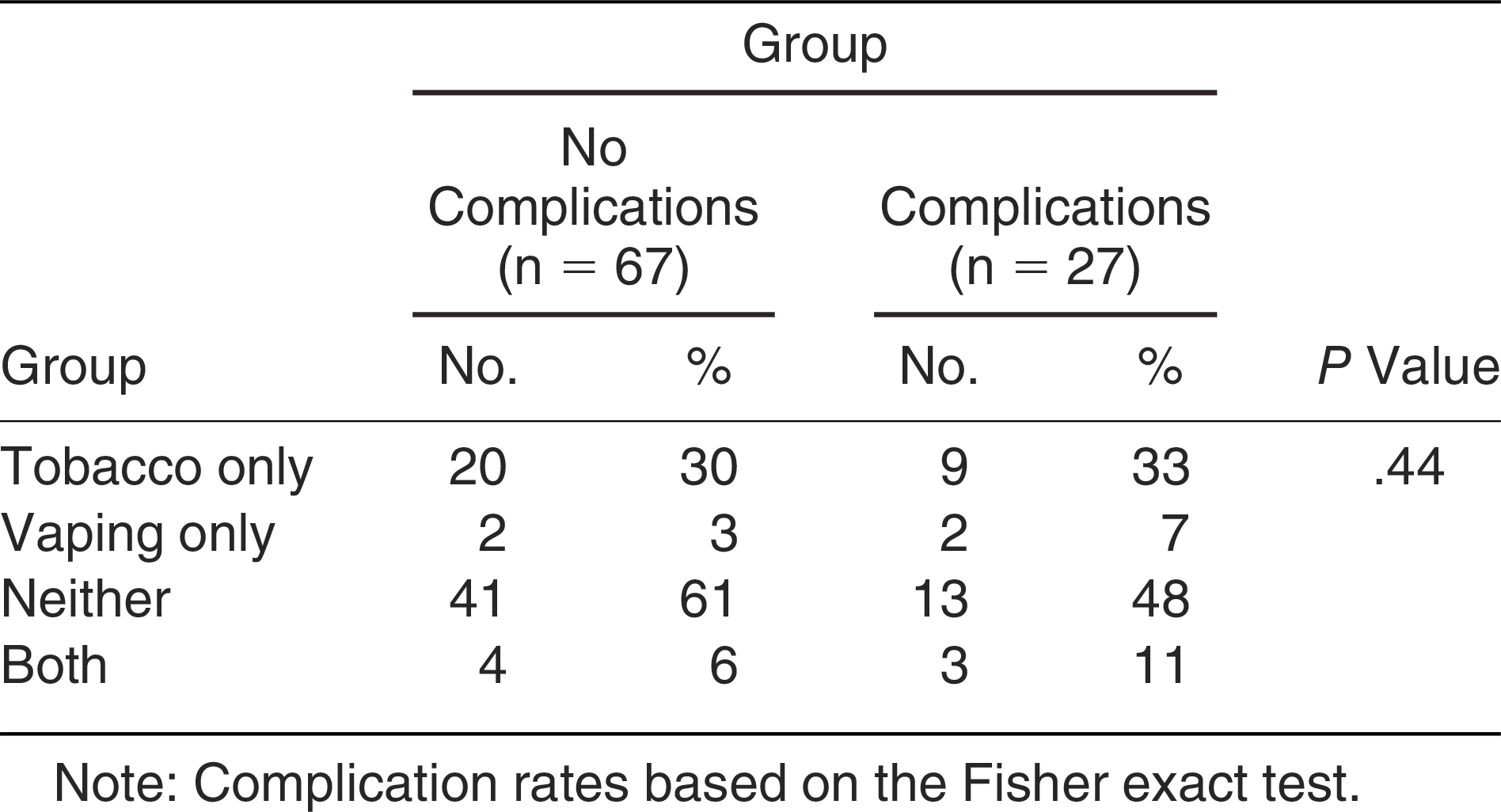
At our tertiary care facilities, only four participants within our patient pool admitted to vaping only. Seven individuals admitted to vaping and smoking, 29 smoked tobacco exclusively, and 54 neither smoked tobacco nor vaped. The surgeries were additionally categorized based on anatomical location. Thirty procedures involved the forefoot, 32 the hindfoot, and 22 other (multiple locations and soft tissue only). The Fisher exact test was used to compare each of the four groups, and no significant differences in the presence of complications were found (
P = .44) (
Table 1). Similarly, the location of surgery did not reveal a significant difference when assessing for complication rate (
P = .99) (
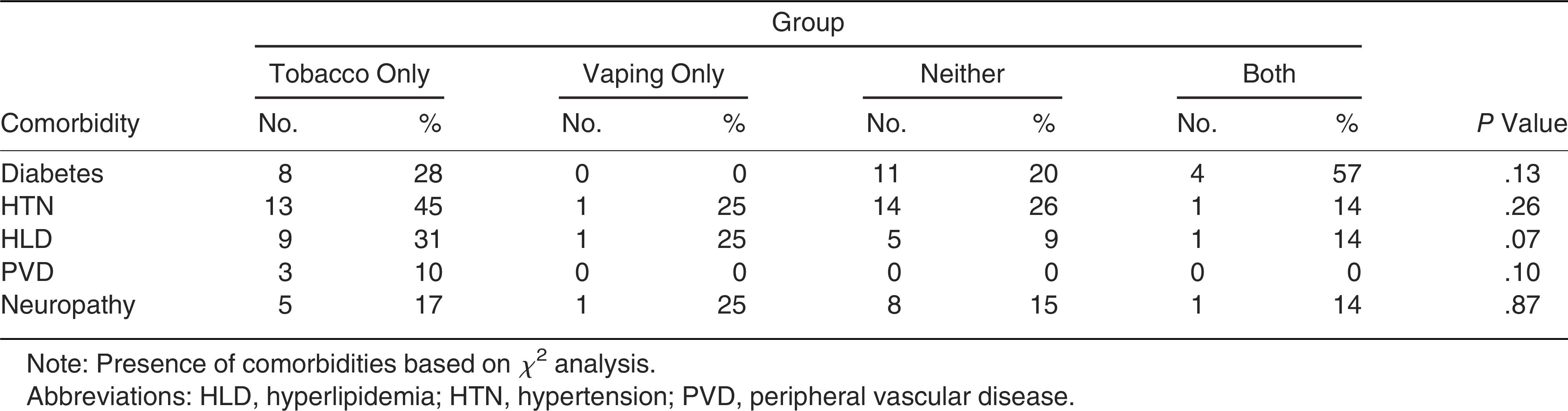
Table 2). Among the patient population, 23 had diabetes (11 of whom had a diagnosis of diabetic neuropathy), 29 had hypertension, 16 had hyperlipidemia, 15 had a diagnosis of neuropathy irrespective of diabetes, and three were diagnosed with peripheral vascular disease. Of these comorbidities, hyperlipidemia was the greatest risk factor for complications (
P = .07) (
Table 3).
Table 1.
Complications Among Groups
Table 1.
Complications Among Groups
Table 2.
Complications Among Locations
Table 2.
Complications Among Locations
Table 3.
Comorbidities Related to Complications
Table 3.
Comorbidities Related to Complications
Discussion
Most studies have concluded that smoking has an overall negative effect on the body, including bone healing [
11,
13,
17,
19,
20]. These complications will be seen clinically and radiographically in the form of delayed healing, pain, or nonunion. Less is known about the effects of e-cigarette use. Certainly, the two are similar in that they contain nicotine; however, different chemicals, flavorings, and mechanisms of transmission make each unique. The fewer chemicals involved in vaping offer a perceived benefit, especially for those who are in the process of attempting to quit smoking. However, as a recent study has shown, there is a growing concern regarding the potential side effects of e-cigarette use [
11]. These concerns have far-reaching implications, including in the foot and ankle community.
The complexity of e-cigarette vapor has yet to be fully vetted. A vast number of biochemical reactions are altered with persistent external chemical exposure. Additionally, variability in nicotine use by patients makes it difficult to standardize across all individuals. Daffner et al [
9] evaluated nicotine use in rabbit models to assess posterolateral spinal fusions and found that there was in fact a difference depending on the dose of nicotine involved. Certainly, this suggests that the quantity of nicotine in the vapor may be proportional to the propensity to cause a nonunion.
Although we tend to ask foot and ankle surgeons to focus on bone healing, vaping also affects the rest of the body. Certainly, these chemicals are not natural. An increase in inflammation and oxidative stress will affect the body systemically, but medical optimization specific to vaping is not known and the question remains as to whether it should be treated the same as traditional cigarette use. Some anesthesiologists are currently recommending avoiding e-cigarette use on only the day of surgery. A pilot study assessing cutaneous circulation in human hands found a reduction in blood flow after 5 min of e-cigarette use and variable recovery after cessation [
3].
Similarly, there is not a full understanding of the degree of soft-tissue involvement. Kennedy et al [
10] evaluated the histologic effects of inhaled combustible tobacco versus nicotine exposure with e-cigarettes on Achilles tendon repair in a small animal model and found that nicotine exposure via e-cigarettes significantly impeded the biomechanical healing properties of the Achilles tendon. The Centers for Disease Control and Prevention issued a statement citing increased lung injury and death with the use of e-cigarettes [
21]. It is possible that e-cigarettes pose the same—or greater—risk as traditional nicotine use. In an in vivo study on flap viability, Trojano et al [
22] found no difference in flap necrosis between vaping and smoking groups. Similarly, Rau et al [
13] showed no difference between these groups when evaluating flap necrosis and hypoxia.
To our knowledge, this pilot study is the first to assess the complication rate of foot and ankle surgery attributable to vaping. There are limitations to this study, including the retrospective design, variability of elective and limb salvage procedures, limited sample size, low recording of patients who admitted to only vaping, underpowered design, and the fact that we did not consider the quantity of vapor used or the duration of use in our questioning. Similarly, the quantity/pack-years smoked per patient and the duration of tobacco/nicotine use were not recorded. Another limitation is our reliance on the patients’ being forthcoming about the use of stigmatized products as well as their recall in quantifying the use of such products. It is conceivable that the surveyed nonsmoking and nonvaping group contained patients who were using these products. Understanding how e-cigarette vapor components may affect the perioperative period of foot and ankle surgery is crucial for optimizing patient care. It is important to accurately assess the effects of acute and chronic e-cigarette use on human bone and soft tissue and to inform health-care providers of the potential surgical and healing risks.
We were unable to determine if the inclusion of vaping affected the complication rate of foot and ankle surgery as originally anticipated. The width of the confidence interval demonstrates the amount of uncertainty in the estimate. We were also unable to find a significant change in the complication rate specific to those who exclusively smoked tobacco. Little is currently known about the effects of vaping on foot and ankle surgery. As more people engage in this recreational activity, more studies are warranted to fully evaluate the effects of e-cigarette use on foot and ankle surgery. Moreover, more prospective studies are necessary to appropriately assess the risk involved in operating on or treating individuals who are vaping within the perioperative period so that surgeons can give accurate advice to their patients. Future research should include prospective studies evaluating the rate of nonunion and soft-tissue compromise with e-cigarette use compared with traditional cigarettes.