Racial disparity among diabetic communities has been debated since the late 1990s [
1]. Most of the literature acknowledges higher rates of diabetes-related complications in minority communities. Databases in California found Hispanics to have a higher association with diabetes-related amputation [
1]. However, African Americans have also had a higher age-adjusted incidence rate of amputation irrespective of diabetic history compared with non-Hispanic whites [
1].
Geographic areas also seem to maintain different epidemiology regarding their diabetic distribution. Studies in metropolitan South Texas recorded higher minority populations and proportionately more diabetes-related amputations [
2]. Complication rates generally seem to parallel the total population. Even among different hospital institutions, minority groups have more poorly controlled diabetes and increased risk of amputation [
3]. Similarly, minority Americans are nearly four times more likely to have additional medical complications resulting in amputation [
4]. Diabetes-related amputations are documented to be two times more likely in African American individuals [
1]. These communities continue to have higher adjusted odds of major foot amputations despite longer hospitalization [
5]. Understanding the relationship between higher complication rates and minority groups could have a profound effect on cost of care, management, and hospital length of stay [
6].
Although there seems to be racial disparity among diabetic communities, this has yet to be definitively evaluated in patients with Charcot’s neuroarthropathy. Charcot’s neuroarthropathy has been secondarily documented as being more common in non-Hispanic white individuals without any definitive justification [
4,
7]. The purpose of this study was to retrospectively review geographic and racial disparities associated with the Charcot foot.
Materials and Methods
This study was approved by the institutional review board at the University of Pittsburgh (Pittsburgh, Pennsylvania). We retrospectively analyzed a database of patients from two hospitals in the greater Pittsburgh area: a city-centered tertiary care facility and a suburban community facility. Patients were assessed between January 1, 2013, and December 31, 2022. Patients were included if they presented to the main attending physician (J.M.) as either a referral or an initial evaluation with a diagnosis of Charcot’s neuroarthropathy of the foot or ankle. Initial patient selection was performed via International Classification of Diseases, 10th Revision codes associated with Charcot's joint of the foot: M14.60, M14.671, M14.672, M14.679, E11.610, and E10.610. Patients were required to be 18 years or older and have accessible electronic medical records through the University of Pittsburgh Medical Center. Patients were excluded if they were not evaluated by the main surgeon (J.M.), did not have accessible electronic medical records, or were not found to have an operative report, consultation, or follow-up progress note that included a true diagnosis of Charcot’s neuroarthropathy. Incidence rates for race, geographic location, and mortality were recorded. We also recorded whether primary evaluation consisted of operative or nonoperative management. In the operative consultation we additionally accounted for the incidence of local procedures (incision and drainage), reconstructions, and staged reconstructions. Secondarily, we monitored patient demographics, including age at onset, sex, comorbidity of diabetes, peripheral vascular disease, end-stage renal disease, heart failure, presence of a wound, osteomyelitis, and hemoglobin A1c level to monitor for possible confounding variables.
Results
We recorded 120 patients who met the inclusion and exclusion criteria. After medical record review, we recorded 105 patients who identified as white and 15 who identified as a minority (
Table 1). Those who identified as nonminority white had an older average age compared with minority groups (61.1 years versus 52.6 years) (
Table 1). We found similar values for body mass index (calculated as the weight in kilograms divided by the square of the height in meters) and hemoglobin A
1c (approximately 36 and 8.0%, respectively) (
Table 1). There were numerous comorbidities in the minority cohort for vascular disease, renal disease, heart failure, smoking, presence of an ulceration, and bone infection (
Table 1).
Table 1.
Patient Comorbidities by Racial Population.
Table 1.
Patient Comorbidities by Racial Population.
When accounting for differences in management, both the white and minority groups were treated surgically (47.3% and 46.7%, respectively). Conservative management was elected by 52.7% and 53.3%, respectively (
Table 2). The frequency of mortality seen was nearly equal at 21.9% in the white group and 20.0% in the African American group (
Table 2). When breaking down the type of operation undergone, the groups displayed similar amounts of reconstruction at 58.5% and 57.1%, respectively, and similar findings for localized irrigation and debridement or amputation at 34.0% and 28.6%, respectively (
Table 2). The minority group had a two times increased frequency of staged intervention (14.3% versus 7.6%) (
Table 2).
Table 2.
Treatment and Mortality by Racial Population.
Table 2.
Treatment and Mortality by Racial Population.
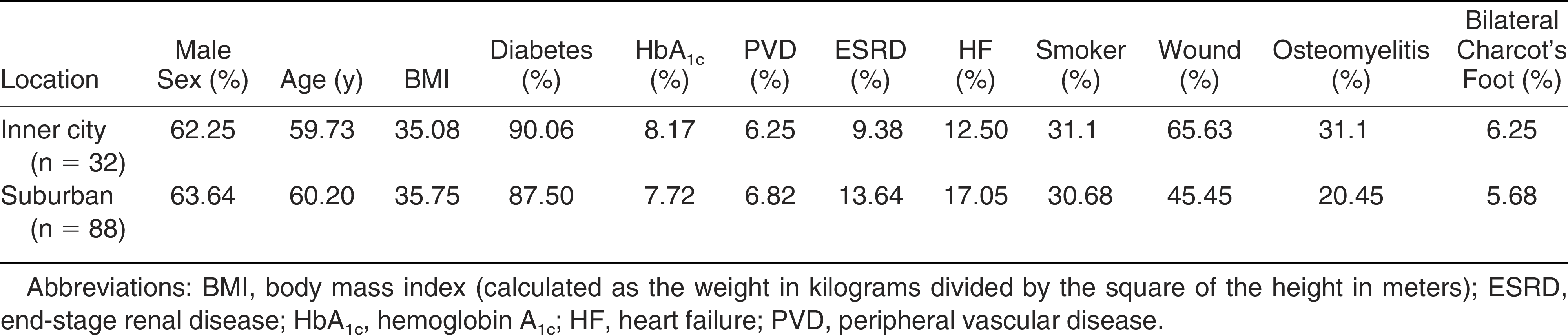
When accounting for population differences between the inner-city and suburban hospitals, we identified 32 patients who were initially treated at the inner-city hospital and 88 at the suburban hospital. Sex, age, body mass index, incidence of diabetes, vascular disease, and smoking were all similar between groups (
Table 3). Those seen in the inner-city hospital had a worse hemoglobin A
1c level (8.17% versus 7.72%, respectively) (
Table 3). There was an increased incidence of ulceration and documented osteomyelitis in the inner-city group (
Table 3).
Table 3.
Patient Comorbidities by Geographic Location.
Table 3.
Patient Comorbidities by Geographic Location.
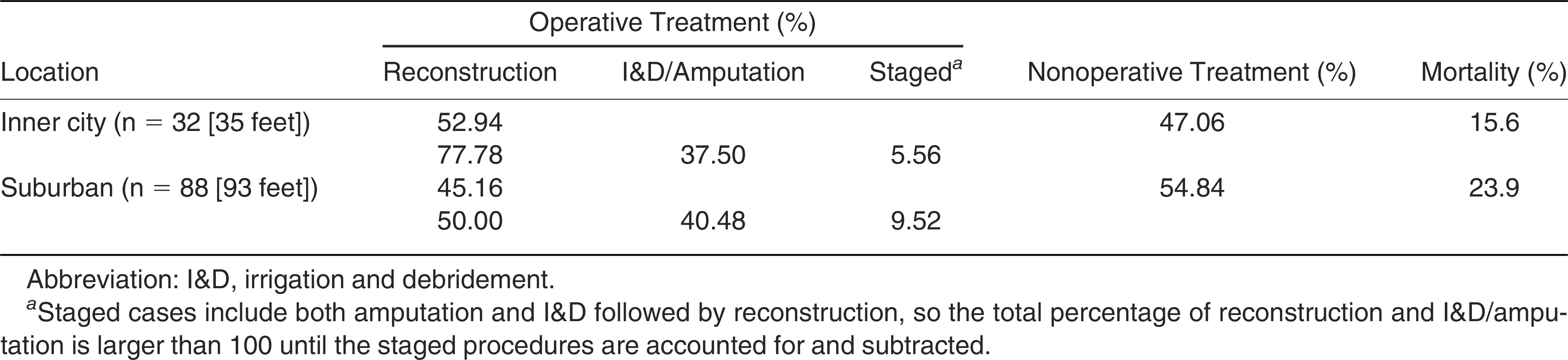
When accounting for differences in management between inner-city and suburban hospital settings, we identified operative intervention in 52.9% and 45.2%, respectively (
Table 4). There were more patients at the inner-city hospital who elected reconstruction (77.8% versus 50.0%, respectively) and a similar incidence of irrigation and debridement or amputation (37.5% versus 40.5%, respectively) (
Table 4). There was a higher incidence of mortality in the suburban communities (23.9%) versus the inner-city cohort (15.6%) (
Table 4).
Table 4.
Treatment and Mortality by Geographic Location.
Table 4.
Treatment and Mortality by Geographic Location.
Discussion
This study is the first of its kind to specifically record racial and geographic disparity among those with Charcot’s neuroarthropathy in the Pittsburgh area. The patient cohort was heavily composed of non-Hispanic white individuals (87.5%) who presented with a diagnosis of Charcot’s neuroarthropathy. This was an unexpected finding considering that most of the literature has discussed the increased incidence of minority communities with diabetes; however, it also seems to match those of similar secondary accounts by Lavery and McEwen et al [
4,
7]. Some literature has discussed the influence of bone mineral density as a plausible explanation for the higher incidence among white individuals. Although there may be an argument for foot microarchitecture and higher failure load trends, this literature is also somewhat scarce and more reliant on hip, spine, and distal tibia data [
8].
We reported greater incidences of comorbidities in the minority population group while accounting for vascular disease, renal failure, heart failure, and osteomyelitis. This finding seems to parallel that of other literature with increased rates of minority medical complications resulting in amputation as well as increased frequency of amputation in minority diabetic communities [
9]. When assessing population differences among urban inner-city and suburban communities, subtle differences were seen in hemoglobin A
1c level, known ulceration, and bone infection. This was somewhat expected because the inner-city hospital is a tertiary care facility with level I trauma access and tends to pool patients from a broad geographic range with an expected referral system for more complex pathology. Juxtaposed to the study by Lavery et al in 1999 [
2], we did not identify notable differences when assessing operative intervention or amputation outcomes on primary evaluation and management.
Management based on racial orientation was uniform for minority, nonminority, inner-city, and suburban communities. This was to be expected in part because we monitored a constant, sole provider who happens to work in two very different environments. Although inner-city patients more often underwent a reconstructive operation, there was a decreased incidence of how many of these were staged and revealed a lower mortality rate. Suburban areas seemed to have a slightly higher incidence of nonoperative management and a higher mortality rate. There seems to be a balance between access to care and time to diagnosis and management. Brennan et al. [
10] noted that rural minorities are at a 10% increased risk for major amputation or death, suggesting that race and geographic location may be additive. Although we did not specifically isolate which persons lived in which community, the lack of minorities suggests that suburban and rural communities may play a larger role when assessing Charcot’s foot.
We acknowledge similar mortality rates among minority and nonminority white participants despite the large difference in cohort size. Most of the literature has documented the degree of diabetic complication and the amputation rate among minorities; however, this is more difficult to account for given the small number of minorities included. This may revolve around absence or lack of education in the community [
11]. This would coincide with previous studies, and similarly we would encourage community health programs to stress educating the community about the phenomenon of Charcot’s neuroarthropathy [
11]. The little change that has been seen despite change in policy very well may be a result of delayed presentation, progression of deformity, and a primary diagnosis revolving around infection, sepsis, and major amputation [
12].
The strengths of this study included continuity of care by a sole provider; monitoring racial, geographic, and medical history; and possible confounding variables. The limitations of this study include its small population size and its geographic location specific to Pittsburgh. Although we believe that having reviewed one key attending physician will bring consistency and continuity of care, we do recognize that this also has the potential for bias. We also used International Classification of Diseases, 10th Revision diagnosis codes; however, this was unique to each visitation and did not always correlate with the specific diagnosis of Charcot’s neuroarthropathy, especially in the setting of a wound. This had the potential to not specifically be an initial consult visit as well as reduce the true number of patients who may be missed outside of this specific code.
Based on these findings, most patients who present to our facilities with a diagnosis of Charcot’s neuroarthropathy or Charcot-related complication are of non-Hispanic white origin. The minority community had an increased frequency of medical comorbidities in total. Minorities were also two times more likely to undergo a staged reconstruction. When assessing the influence of geography, inner-city patients, on average, had higher hemoglobin A1c levels, as well as the presence of wound and osteomyelitis. Similarly, this cohort was more apt to undergo reconstructive surgery, and they recorded a reduced mortality rate. Although there may be a correlation with medical comorbidities in minority communities, there does not seem to be a difference in the management of Charcot’s neuroarthropathy. Location has the potential to play a role in diagnosis, management, and potential outcomes. This may be due to a lack of education with emphasis to support a larger public health initiative prioritizing diabetes screening and understanding of the Charcot foot. More prospective and systematic studies are needed to identify a greater understanding of Charcot’s presentation in different communities.