Flatfoot is a very common deformity, characterized by the medial longitudinal arch flattening that causes the ground reaction force (GRF) to shift medially during the stance phase of gait [
1]. The medial shift of the GRF in flatfoot has been reported to be associated with the development of first metatarsophalangeal joint osteoarthritis [
2,
3] and hallux valgus [
4,
5], causing forefoot pain [
6], especially in females. Therefore, it is important for the prevention of these foot disorders to control the medial shift of the GRF in flatfoot. To develop an effective intervention for preventing the medial shift of the GRF in flatfoot, it is necessary to understand the characteristics of the loading pattern during the stance phase of gait in individuals with flatfoot.
The center of pressure (COP), defined as an instantaneous point of application of the GRF, has been used to assess the characteristics of the loading pattern during the stance phase of gait in flatfoot [
1,
7,
8,
9]. In those studies, the Center of Pressure Excursion Index (CPEI) was used for analysis of the COP trajectory during the stance phase of gait [
1,
7,
8,
9]. The COP usually moves laterally from almost the initial contact to the terminal stance, and then moves medially toward the preswing, thus forming an arc. The CPEI evaluates a concavity of the COP trajectory, and flatfoot has been shown to be associated with a lower CPEI, that is, a less concave COP trajectory, which is often interpreted as the medial shift of the COP trajectory [
10]. However, the CPEI evaluates the COP trajectory in relation to the line connecting the first and last point of the COP and cannot indicate the COP position relative to the plantar surface. In other words, a lower CPEI does not necessarily mean that the COP passes the medial side of the plantar surface. To understand in detail the characteristics of the loading pattern during gait in individuals with flatfoot, it is necessary to assess where the COP passes within the plantar surface based on position coordinate data of the plantar surface.
Moreover, it also remains unclear what influences the medial shift of the COP trajectory in individuals with flatfoot. Although researchers have focused on the relationship between static foot postures and the COP trajectory during gait [
7,
11], it has been indicated that static foot characteristics are not necessarily reflected in dynamic foot motion [
12], and the relationship between dynamic foot motion and the COP trajectory during gait remains uncertain. The foot can be subdivided into the rearfoot, midfoot, and forefoot by the Chopart and Lisfranc joints, respectively, each of which is reported to be connected during gait [
13]. A systematic review reported an association between flatfoot and increased frontal plane motion of the rearfoot during the stance phase of gait [
14]. Inversion-eversion is defined as rotational movements about the longitudinal axis of the foot, and tilts the plantar surface medially and laterally. Therefore, the medial shift of the COP trajectory in individuals with flatfoot is likely to be influenced by the frontal plane motion of the rearfoot. In addition, the frontal plane motion of the rearfoot in individuals with flatfoot has been reported to increase throughout the stance phase [
14], and the COP positions are likely to shift medially throughout the stance phase. Therefore, this study hypothesized that the COP displaces medially throughout the stance phase in individuals with flatfoot compared with normal foot, and the frontal plane motion of the rearfoot had a great effect on the COP position during the stance phase of gait. Clarifying at which phase of gait the COP shifts medial and what foot joint kinematics influence the COP positions in individuals with flatfoot could contribute to understanding the characteristics of loading pattern in individuals with flatfoot, which could be useful for the development of effective interventions for preventing medial shift of the GRF in individuals with flatfoot, such as foot orthoses. The aim of this study was to understand the characteristics of medial shift of the COP trajectory in individuals with flatfoot and what foot joint kinematics influence the COP positions.
Materials and Methods
Participants
Participant enrollment was conducted from September 8, 2016, to November 2, 2017. The inclusion criteria in this study were healthy young females. The exclusion criteria included the presence of any disease or current illness that would affect walking. Participants were recruited from among students at Hiroshima University (Hiroshima, Japan) by convenient sampling. Fifty healthy females participated in this study. All of the measurements were conducted on either the right or the left foot, randomly selected. Normal foot or flatfoot was determined by a single examiner (W.K.) using the normalized navicular height truncated (NNHt) [
15]. Based on the NNHt score, 27 participants were classified as having normal foot (0.24 ≤ NNHt ≤ 0.30) and 23 participants were classified as having flatfoot (NNHt < 0.24). There were no participants having a high-arched foot type. Participant demographics are presented in
Table 1. Before the experiment, the intent and purpose of this study were explained to all of the participants, and informed consent was obtained before their participation. This study was approved by the Ethical Review Committee for Epidemiological Research of Hiroshima University.
Table 1.
Participant Characteristics and Spatiotemporal Parameters of the Normal Foot and Flatfoot Groups
Table 1.
Participant Characteristics and Spatiotemporal Parameters of the Normal Foot and Flatfoot Groups
Instrumentation
Kinematic and kinetic data during gait were recorded using a three-dimensional motion analysis system that included six infrared cameras (Vicon Motion Systems, Oxford, United Kingdom; sampling frame rate, 100 frames/sec) and eight force plates (TF-400-A; Tec Gihan, Uji, Japan; sampling frame rate, 1,000 frames/sec). Before measurement, reflective markers were attached to 16 landmarks according to the Rizzoli Foot Model [
13], and an additional marker was attached to the most distal aspect of the second toe. The Rizzoli Foot Model allows for a detailed assessment of foot kinematics by dividing the foot into rearfoot, midfoot, and forefoot segments. The repeatability of this model has been confirmed for not only a healthy normal foot
16 but also in various foot deformities [
17]. Reflective marker attachments were conducted by a single examiner (W.K.) who had 6 years of experience in three-dimensional gait analysis using a multisegment foot model.
Procedures
Participants completed a static calibration trial using a subtalar neutral position to define the local coordinate frames for each segment and a neutral position at each joint in the foot. Participants stood in the subtalar neutral position, defined as the position in which the medial and lateral portions of the talar head were palpated equally with the thumb and index finger [
18]. Using this position as the reference position allows us to capture the foot movement more accurately by standardizing the reference foot position [
18]. If the weightbearing standing position is used as the reference position, it is likely to misrepresent the excursion and end range of joint kinematics due to variance of the foot postures between the individual [
19]. To maintain the subtalar neutral position, a cloth, the thickness of which was adjusted to participants, was slid under the plantar surface of the foot [
20], and the position was confirmed by a single examiner (W.K.) who had demonstrated good intrarater reliability for setting this position (intraclass correlation coefficient [1,3] = 0.943). Participants were first instructed to stand approximately 3 m in front of the force plates. Then, they walked along a flat 10-m walkway at a self-selected speed and stopped 3 m beyond the force plate. The number of steps before stepping onto the force plate was set to a minimum of five. Three successful trials were recorded, and a total of 150 walking trials across all of the participants were included in this study.
Data Analyses
Data analyses were performed using the analysis software Nexus 2.1.1 (Vicon Motion Systems). Kinematic and kinetic data were low-pass filtered using a fourth-order Butterworth filter with cutoff frequencies of 6 and 15 Hz, respectively [
21]. Based on obtained marker points, local reference frames were defined for the shank, calcaneus, midfoot, metatarsus, and hallux segments. The hallux segment was defined by three marker points: the head of the first metatarsal, the head of the fifth metatarsal, and the head of the proximal phalanx [
22,
23]. Joint angles were calculated as the distal segment expressed relative to the adjacent proximal segment using a right-handed orthogonal Cardan xyz sequence of rotations: a sequence of dorsiflexion (+)/plantarflexion (−), abduction (+)/adduction (−), and eversion (+)/inversion (−) [
24]. Joint angles were normalized to the standing calibration trial, and the parameters calculated were as follows: the calcaneus relative to the shank (ShCa), the midfoot relative to the calcaneus (CaMi), the metatarsus relative to the midfoot (MiMe), and the hallux relative to the metatarsus (MeHa).
The stance phase was defined as the initial contact to toe-off, which was identified according to the vertical GRF using a threshold of 10 N. The stance phase was divided into four phases by discrete instants of the vertical GRF profiles. Four phases of the stance phase were identified as follows: the initial contact phase is the time interval between the initial contact to the first peak vertical GRF, the midstance phase is the time interval between the first peak vertical GRF and the minimal vertical GRF between the first and second peak vertical GRF, the terminal stance phase is the time interval between the minimal vertical GRF between the first and second peak vertical GRF to the second peak vertical GRF, and the preswing phase is the time interval between the second peak vertical GRF and toe-off.
The COP trajectory was computed by defining a plantar local coordinate system. The origin was defined as the position of the reflective marker attached to the posterior distal aspect of the calcaneus, y-axis (anterior, +; posterior, −) as the projection of the line joining the posterior distal aspect of the calcaneus to the most distal aspect of the second toe, and x-axis (lateral, +; medial, −) as the line orthogonal to the y-axis. The COP positions in the anteroposterior were normalized to each individual’s foot length (the posterior distal aspect of the calcaneus, 0%; the most distal aspect of the second toe, 100%). The COP positions in the mediolateral direction were normalized to each individual’s foot width (the most medial aspect of the foot, –50%; the most lateral aspect of the foot, 50%). For each of the four phases during the stance phase, the average, maximum, and minimum values of the COP positions in the mediolateral direction were calculated for each participant.
Statistical Analysis
The normality of data distributions was assessed using the Shapiro-Wilk test. The average, maximum, and minimum values of the COP positions during each subphase of the stance phase were compared between the normal foot and flatfoot using the independent
t test. In addition, multiple regression analyses were performed to identify the relationship between foot joint motion and the COP positions during each subphase of gait. Dependent variables included the average value of the COP positions in the mediolateral direction during each subphase of the stance phase to reflect the medial shift of the COP trajectory. Independent variables included the ShCa, CaMi, MiMe, and MeHa motion during each subphase of gait. Foot joint kinematics included the average value and range of motion to investigate how each joint position and mobility affected the COP positions. From the initial set of independent variables, forward and backward stepwise regressions were used to determine which independent variables could be included in multiple regression analyses. To account for multicollinearity, we used the variance inflation factor with a threshold of 3. All statistical analyses were performed using EZR [
25], with a significance level set at 5%.
Results
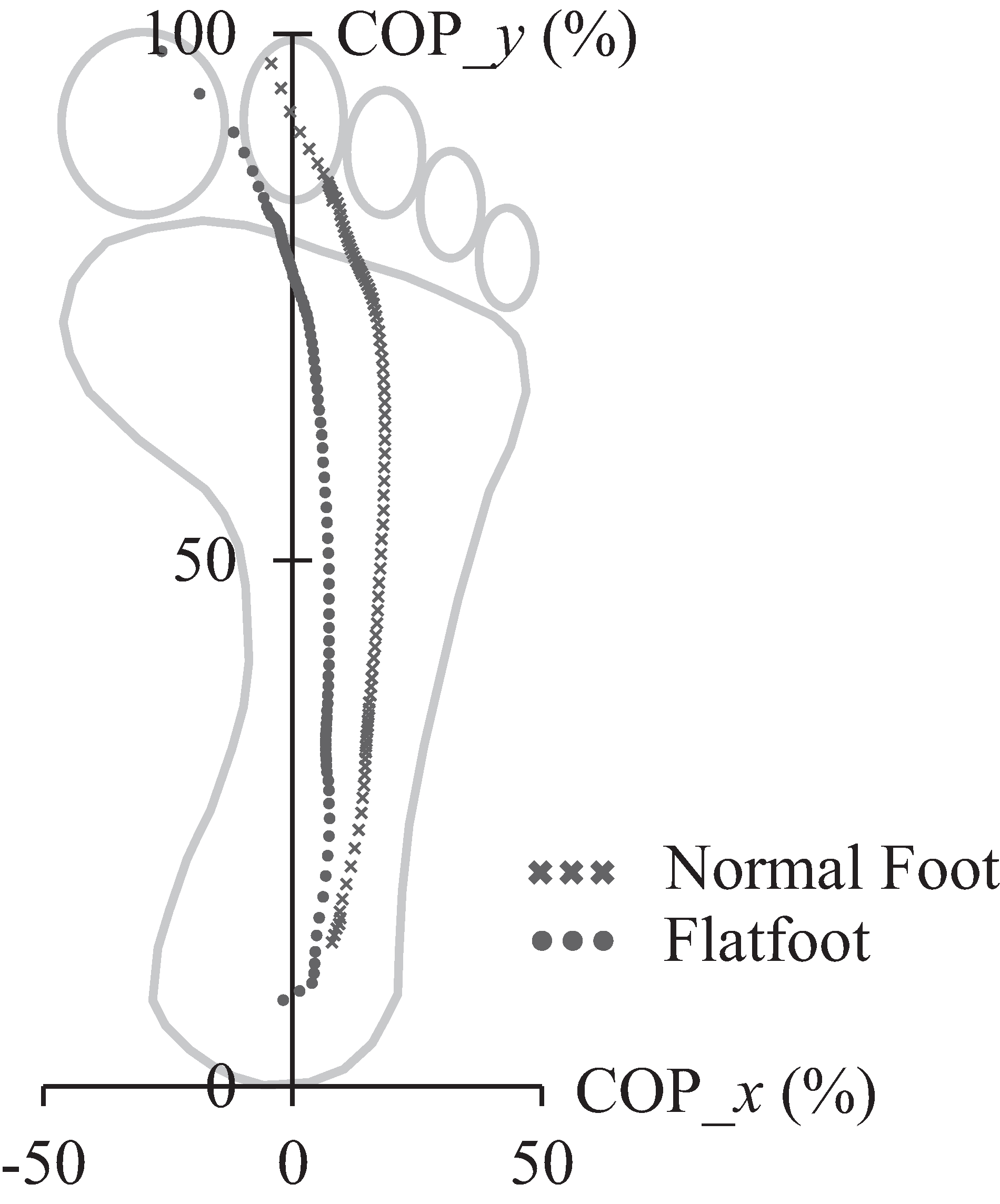
The COP positions during the stance phase are shown in
Table 2, and a graphical representation of the ensemble average is shown in
Figure 1. Flatfoot had significantly more medial COP positions throughout the stance phase compared with normal foot, except for the minimum value of the COP position during initial contact and preswing. There were medium-sized effects in the COP position throughout the stance phase between normal foot and flatfoot (effect size
r = 0.31–0.39).
Table 2.
Comparison of the COP Positions in the Mediolateral Direction During Subphases of the Stance Phase Between Flatfoot and Normal Foot
Table 2.
Comparison of the COP Positions in the Mediolateral Direction During Subphases of the Stance Phase Between Flatfoot and Normal Foot
Figure 1.
The center of pressure (COP) trajectory during the stance phase of gait in flatfoot and normal foot. The y-axis (anteroposterior direction) is the longitudinal axis of the foot, and the x-axis (mediolateral direction) is perpendicular to the y-axis. The COP positions in the anteroposterior were normalized to each individual’s foot length (the posterior distal aspect of the calcaneus, 0%; the most distal aspect of the second toe, 100%), and the mediolateral directions were normalized to each individual’s foot width (the most medial aspect of the foot, –50%; the most lateral aspect of the foot, 50%).
Figure 1.
The center of pressure (COP) trajectory during the stance phase of gait in flatfoot and normal foot. The y-axis (anteroposterior direction) is the longitudinal axis of the foot, and the x-axis (mediolateral direction) is perpendicular to the y-axis. The COP positions in the anteroposterior were normalized to each individual’s foot length (the posterior distal aspect of the calcaneus, 0%; the most distal aspect of the second toe, 100%), and the mediolateral directions were normalized to each individual’s foot width (the most medial aspect of the foot, –50%; the most lateral aspect of the foot, 50%).
Results of multiple regression analyses are presented in
Table 3. During initial contact, the range of ShCa motion in the sagittal and frontal planes and ShCa angles in the frontal plane were predictors of the COP positions (standardized coefficients were 0.312, 0.244, and −0.176, respectively). During midstance, the range of ShCa motion in the frontal plane and ShCa angles in the frontal and transversal planes were predictors of the COP positions (standardized coefficients were −0.222, −0.438, and 0.498, respectively). During terminal stance, the range of MiMe motion in the transversal plane, ShCa angles in the frontal and transversal planes, and CaMi angles in the frontal plane were predictors of the COP positions (standardized coefficients were 0.183, −0.462, 0.624, and −0.171, respectively). During preswing, ShCa angles in the transversal plane and MiMe angles in the sagittal plane were predictors of the COP positions (standardized coefficients were 0.321 and −0.219, respectively). These variables explained 19.4%, 29.3%, 36.4%, and 13.7% of the models’ variance (adjusted
R2) for the COP positions during initial contact, midstance, terminal stance, and preswing, respectively. The
P value for all of the models was less than 0.01.
Table 3.
Multiple Regression Analysis Results of the Variable That Affected the COP Positions in the Mediolateral Direction During Subphases of the Stance Phase
Table 3.
Multiple Regression Analysis Results of the Variable That Affected the COP Positions in the Mediolateral Direction During Subphases of the Stance Phase
Discussion
As hypothesized, the COP positions in flatfoot were displaced medially throughout the stance phase compared with normal foot, and the frontal plane motion of the calcaneus relative to the shank had a great effect on the COP positions during the stance phase. Moreover, it was found that the transversal plane motion of the calcaneus relative to the shank was also a significant predictor of the COP positions during the stance phase. The present findings suggest that the medial shift of the COP trajectory in flatfoot was affected by the eversion and adduction in the rearfoot, and controlling abnormal rearfoot position or motion from the initial contact may be important for correcting the medial shift of the COP trajectory in individuals with flatfoot.
Although previous studies reported characteristics of the COP trajectory during the stance phase of gait in individuals with flatfoot by using the CPEI, it has been unknown where the COP passes within the plantar surface. The present study revealed that the COP position in flatfoot was already displaced medially from the initial contact and kept being located approximately 10% medial until the preswing compared with normal foot (
Table 2). These findings indicated that the COP trajectory in individuals with flatfoot were characterized by displacing medially and less laterally throughout the stance phase. The present findings emphasize the need to assess where the COP passes within the plantar surface for understanding the characteristics of the loading pattern during gait in individuals with flatfoot. To prevent medial shift of the COP trajectory in individuals with flatfoot, it is necessary to guide the COP laterally from the initial contact and maintain the COP in the lateral position throughout the stance phase.
In the relationship between the foot joint kinematics and the COP positions during the stance phase of gait, as hypothesized, the frontal plane motion of the calcaneus relative to the shank was found to be a significant predictor of the COP positions in the mediolateral direction (
Table 3,
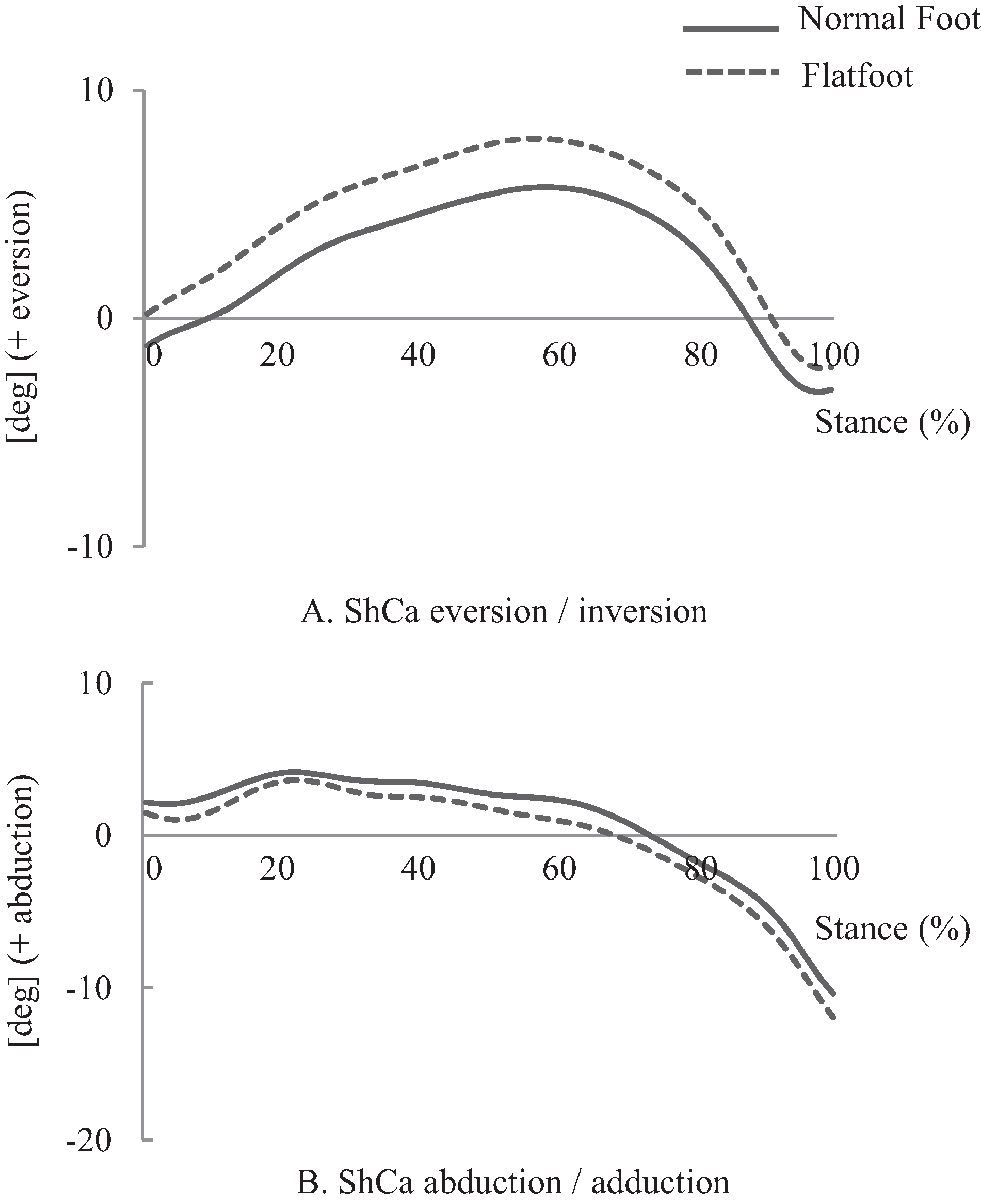
Fig. 2A). On the other hand, the transversal plane motion of the calcaneus relative to the shank was found to also be a significant predictor of the COP position in the mediolateral direction. Increasing adduction at the calcaneus relative to the shank was associated with medial shift of the COP position during initial contact to terminal stance. Interestingly, the calcaneus motion relative to the shank in the transversal plane had greater standardized coefficients than in the frontal plane. In vivo studies using intracortical pins and biplanar radiographs have reported that the tibiotalar and subtalar joints move not only in the sagittal and frontal planes but also in the transversal plane during gait [
26,
27]. Increasing the adduction angle at the calcaneus relative to the shank may cause a medial shift of the COP pathway as the calcaneus rotates medially. In addition. the rearfoot motion in the frontal plane has been reported to be not related to the rearfoot motion in the transversal plane, despite all three planes of the rearfoot motion appearing simultaneously [
28,
29]. To correct the medial shift of the COP position in individuals with flatfoot, it may be important to control not only the eversion but also the adduction motion of the rearfoot throughout the stance phase.
Figure 2.
Mean calcaneus relative to the shank eversion (+)/inversion (−) (A) and abduction (+)/adduction (−) (B) during the stance phase in individuals with flatfoot and normal foot.
Figure 2.
Mean calcaneus relative to the shank eversion (+)/inversion (−) (A) and abduction (+)/adduction (−) (B) during the stance phase in individuals with flatfoot and normal foot.
The present study revealed that the COP positions in individuals with flatfoot were displaced medially throughout the stance phase compared with normal foot and were mainly associated with the rearfoot kinematics in the frontal and transversal planes. The present findings suggest that to correct the medial shift of the COP position in individuals with flatfoot, it is important to control both excessive rearfoot eversion and adduction motion throughout the stance phase. However, there is a limitation of this study that warrants mention. The number of variations in the COP positions in the mediolateral direction were not fully explained by the present models. Models explained 19.4%, 29.3%, 36.4%, and 13.7% of variations in the COP positions in the mediolateral direction during initial contact, midstance, terminal stance, and preswing, respectively. The COP positions are also affected by proximal joint kinematics. Although the present study focused on investigating the association between the COP positions and foot joint kinematics, proximal joint kinematics were likely to be significant predictors in present models.
Conclusions
This study revealed that the COP position in flatfoot was already displaced medially from initial contact and closely correlated with the rearfoot motion in the frontal and transversal planes throughout the stance phase. To correct the medial shift of the COP trajectory in flatfoot, it is important to control excessive rearfoot eversion and adduction throughout the stance phase.