Increasing in popularity is a technique that uses synthetic hair extensions in hair braiding and requires the installer or hairstylist to set the braid and prevent it from unwinding by dipping the end of the braid in scalding hot water to seal the end. The exact mechanism of the burn injury occurs when receptacles of the boiling water are inadvertently spilled during the process.
These scald burns are associated with increased morbidity and have contributed to inpatient admissions for wound care, lengthy hospitalizations, multiple surgical interventions, and high costs of health care. It will often take immediate assessment and classification of the burn injury to provide an immediate plan of treatment in the outpatient setting or admission to the hospital, reconstructive procedures, and rehabilitation to achieve a favorable prognosis for burn patients [
1,
2,
3]. Shakir et al [
4] performed a retrospective review of patients who sustained burn injuries related to the hair braiding practice presenting to a burn center between January 1, 2006, and July 31, 2020. Forty-one patients were studied during this period, with increasing frequency of this burn injury over time. More than 90% of patients were younger than 18 years, African American, and female. The mean total body surface area (TBSA) burned was 5%. The most commonly involved areas were the back (54%), thigh/leg (37%), and neck (24%). To date, we have not encountered in the podiatric medicine literature accounts of burn wounds on the foot from scalding water during hair braiding. Ninety percent of the patients had partial-thickness burns only, with 10% having some degree of full-thickness injury. Upward of 90% of patients required hospitalization, and 34% required surgical intervention. Scald burn injuries related to this increasingly popular hair braiding technique are preventable burns, and it has become necessary to evaluate clinician experience treating this type of injury to direct future burn prevention efforts targeting populations most at risk for burn injury [
4].
Lower-extremity burns continue to present a major challenge due to effects on the histologic and anatomical capabilities and functional capabilities. It is, therefore, timely to review the evidence-based management of the scald burn injury of the foot and ankle and its association with this very popular hair braiding trend, highlighting recent guidelines produced by the American Burn Association [
5,
6]. Ongoing efforts to classify foot and ankle burns as significant injuries should be based on the fact that burns can be complicated, ranging from minor to severe, and can involve extensive destruction of the skin, which we know provides a protective barrier and controls and regulates the patient’s microenvironment and homeostasis. Lower-extremity burn injuries pose an added challenge because the ultimate goal in treating a patient with a lower-extremity burn injury is to restore functional capabilities and maintain a weightbearing foot and ankle [
7].
The coexistence of medical conditions such as diabetes mellitus, peripheral vascular disease, peripheral neuropathy, and/or impaired humoral response needs to be taken into consideration when treating burn injuries of the foot and ankle. The sequelae of events related to loss of protective sensation, poor circulation, and an immunocompromised state make at-risk populations more susceptible to complications related to the lower-extremity burn. The myriad of complications may include acute hospitalization, surgical intervention, infection, scarring, healing problems, contracture, adhesions, hypopigmentation, hyperpigmentation, and limb loss [
8,
9,
10].
Successful management of the lower-extremity burn must start with a greater knowledge of the structure of the lower-extremity skin, particularly of the foot and ankle. The skin on the dorsum of the foot is relatively thin compared with that on the sole of the foot, with minimal subcutaneous tissue, allowing for the gliding motion of the anterior compartment tendons. A burn injury in this location could cause healing problems, scarring, adhesions, and contractures, jeopardizing function and subsequent mobility, and is susceptible to infection and necrosis. The plantar skin of the sole of the foot has a thicker epidermal layer with a more solid stratum corneum, making it more durable to withstand trauma imposed during ambulation; however, it lacks hair, sebaceous glands, and melanocytes, and it has very few pigment cells [
11].
These varying characteristics need to be considered in lower-extremity burn cases in which reconstruction of the skin is needed. The literature supports replacing the injured skin with skin of like tissue concerning coverage of burn wounds [
12,
13].
Case Report
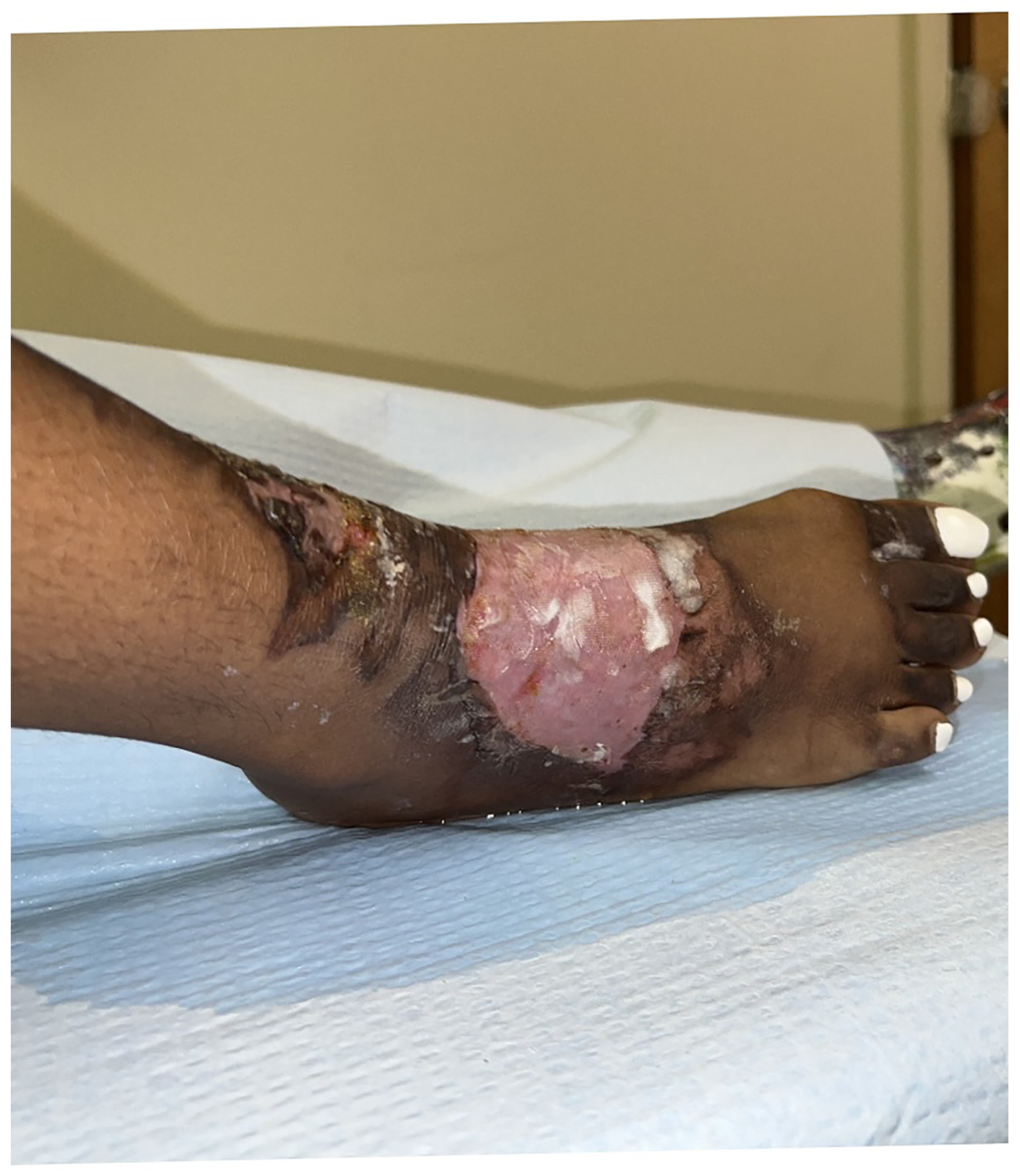
A 23-year-old African American woman presented to the outpatient burn center with second- and third-degree scald burns to her right leg and right foot. The TBSA burned was as follows: 1% TBSA right foot and 2% TBSA right leg (
Fig. 1). These were partial-thickness injuries. The patient was at work in a hair salon braiding hair. She dipped her client’s hair braids into a kettle of hot water, a common technique to seal the ends of the braids to prevent unraveling. She held the braids in one hand and removed the kettle of water with the other hand. She placed the kettle on a stool. The kettle tipped over, and she sustained the burn wound of the foot.
She was treated in the emergency department initially with topical silver sulfadiazine (Silvadene Cream; Pfizer Inc, New York, New York), pain medications, and an oral antibiotic for infection control. She was seen in the outpatient burn center weekly. The leg and foot were edematous and painful, with decreased range of motion of the foot and ankle. She required crutches to walk and could minimally bear weight. The burn wounds were open. Excisional debridement was performed using a forceps and scissor. Wound care consisted of topical silver sulfadiazine, nonadherent gauze (Adaptic; 3M, St. Paul, Minnesota), rolled gauze, and elastic bandages (Ace; 3M). The patient was given at-home wound care instructions to cleanse the wounds with soap and water daily. The burns healed after 4 weeks, with increased range of motion, decreased pain and tenderness, and decreased edema. At her 6-month follow-up visit, she had residual hypopigmentation and pruritus of the affected areas. The healed burns were treated with moisture three to four times a day for dryness and pruritus, and sunscreen use was advised for the next 12 months.
Discussion
The burn wound of the foot from scalding water during hair braiding was unique in that it is the first reported case of a burn injury of the foot from scalding hot water during hair braiding. The burn wound occurred when the water spilled on the foot of the person performing the procedure, rather than on the neck and shoulders of the client. The literature supports that most of these injuries occurred to the back, neck, and shoulders of the client, and there are no reports of a foot burn involving this mechanism of injury to the person performing the installation or procedure.
Injury to the lower extremity compromises the integrity of the skin’s protective barrier and functional capabilities. In the case reported herein, the burn injury affected the patient’s range of motion and ability to bear weight, requiring assistance with crutches to walk. After some time, the patient had full restoration of motion. The goal of any treatment plan for lower-extremity burns of the foot and ankle must focus not only on reconstruction but also on restoration of weightbearing and ambulation. This patient had full restoration of her weightbearing capabilities without requiring reconstruction or rehabilitation. She did not require extensive debridement or hospitalization. In this case, reported topical and systemic antibiotics were prescribed for infection control. A burn injury creates an environment that allows for the colonization and invasion of pathogens. Increased risk of infection can occur as a result of alterations in the immune function, highlighting the importance of topical and systematic antibiotics for infection control and the mitigation of serious risk such as septicemia, bacteremia, and a limb-threatening infection. Patients with coexisting morbidities such as diabetes mellitus, peripheral neuropathy, impaired immune response, and peripheral vascular disease may present an added challenge to their ability to heal. In the case reported herein, the medical history was unremarkable and the patient went on to heal uneventfully. Standards of wound care make necessary the education and prevention of lower-extremity burns in at-risk populations. We hope that with increasing reports and data related to this injury, more efforts will be made to prevent these injuries.
Financial Disclosure
None reported.