Dear Colleagues,
Ingrown toenails and pincer nails can have a huge impact on daily activities and cause extreme discomfort to patients. Non-invasive nail braces have been reported to be an efficient treatment for patients with ingrown toenails and pincer nails [
1,
2,
3]. However, 8.1% to 26.1% of the patients who received nail brace therapy showed recurrence of ingrown toenails or pincer nails [
1,
2,
3,
4]. The aim of our study was to demonstrate the efficacy of a new nail brace in the maintenance of recurrence-prone ingrown toenails and pincer nails.
Participants with ingrown toenails or pincer nails who were treated with Naspan nail braces (Gerlach GmbH, Germany) were retrospectively recruited. They were either patients who had not been treated before, but had the risk of recurrence or were those experiencing recurrence after treatment with COMBIped braces (3TO GmbH, Germany) at Wan Fang Hospital (between June 1, 2015 and May 31, 2018). This retrospective study was approved by the institutional review board of Taipei Medical University.
The COMBIped brace comprises two sides: one side is a spring wire and the other is fitted with a plastic pad. The wire is shaped into a hook. The hook is attached to one side of the nail rim, and the pad is fixed to the nail [
1]. The Naspan nail brace is a prefabricated one-piece brace with a sinusoidal shape and bilateral hooks. The size of the brace was chosen based on the width of the nail. The hook on one side was placed first, and that on the other side was slid down along the nail rim [
5]. After the application of the nail braces, follow-up with the patients was monthly. The nail brace was reapplied if the brace dropped off, unless the brace was lost. The outcomes were evaluated using physician global assessment (PGA) by the same doctor in the first, third, and sixth months by using photographs. Questionnaires were prospectively filled out by patients who experienced recurrence to compare the strength, maintenance, convenience, and aesthetic appearance of these two nail braces on the visual analog scale (VAS) (0–10).
Nine patients with 12 recurrent ingrown toenails or pincer nails and four patients with four treatment-naïve pincer nails were treated with Naspan nail braces. Pain relief was achieved in almost all the patients within a day. Of the 16 toenails, nine (56.3%) showed 90% improvement, three (18.7%) showed 75% improvement, and four (25%) showed 50% improvement in the first month. The PGA of all toenails remained the same in the third and sixth months. The average time taken to adjust to the nail brace was around 4 months.
We compared the VAS by paired t tests. The COMBIped brace exhibited greater strength than the Naspan brace (9.4 vs 6.4, P 5 0.01). However, the patients were more satisfied with the aesthetic appearance of the Naspan brace (9.67 vs 6.88, P < .001). The Naspan brace showed a trend of greater convenience (9.33 vs 8.56, P 5 .088). However, in terms of maintenance, there was no difference between the two nail braces (P = .753).
Although the COMBIped nail brace has greater strength than the Naspan nail brace, the Naspan nail brace has other benefits, including better aesthetic appearance, longer durability (4 vs 2 months) between each reapplication, and greater convenience for patients. Our study indicated that the Naspan brace was an effective and better option than the COMBIped nail brace for the maintenance of recurrence-prone nails.
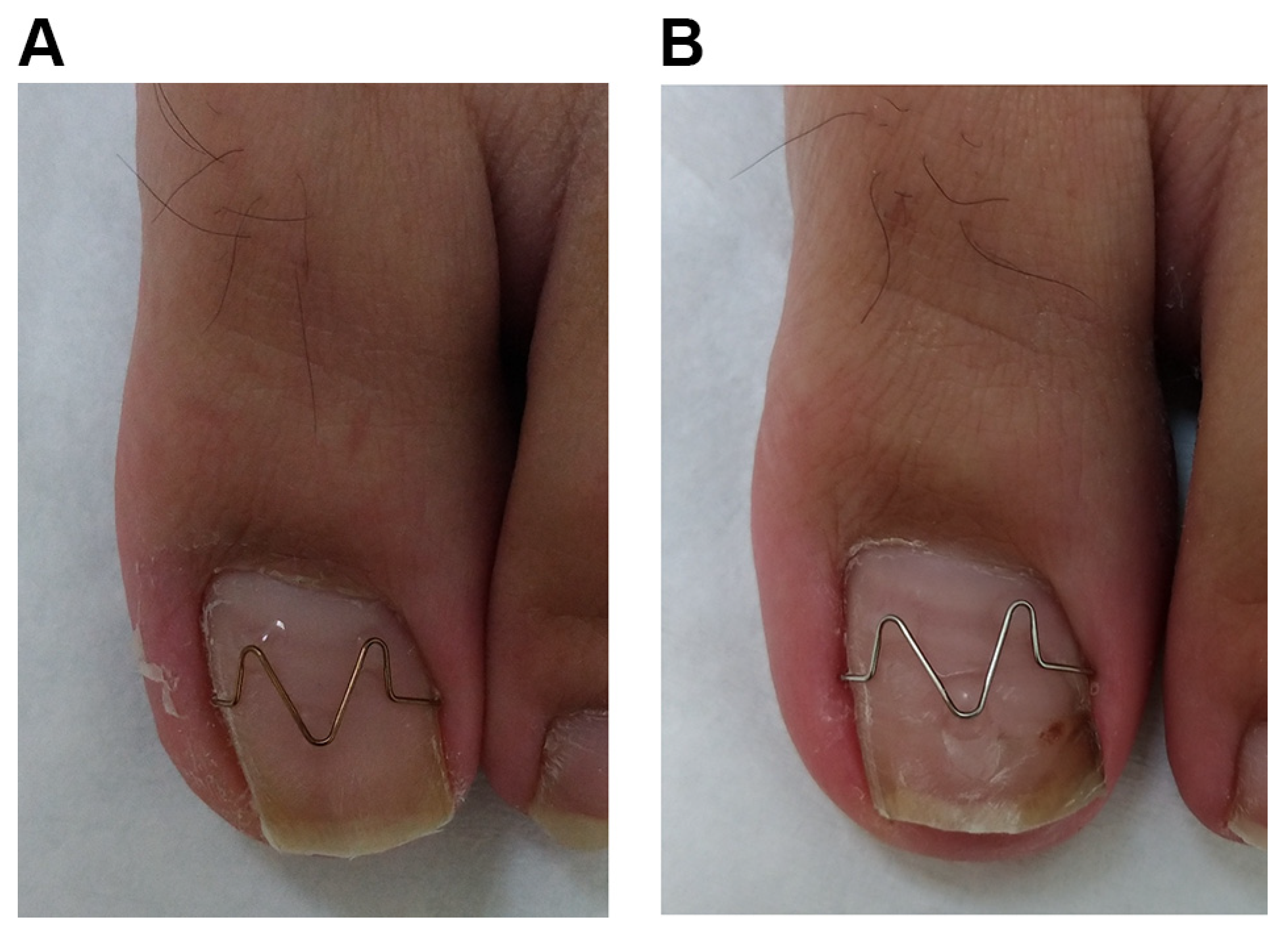
All nine of the toenails (including four treatmentnaïve pincer nails) with 90% improvement were thin toenails, thereby implying that the Naspan nail braces showed a better efficacy for thin nails rather than thick nails. Regarding the treatment of pincer nails that are thin and soft but prone to recurrence, the moderate strength of the Naspan nail brace might be enough to serve as a first-line treatment with satisfying results and as a long-term maintenance therapy (
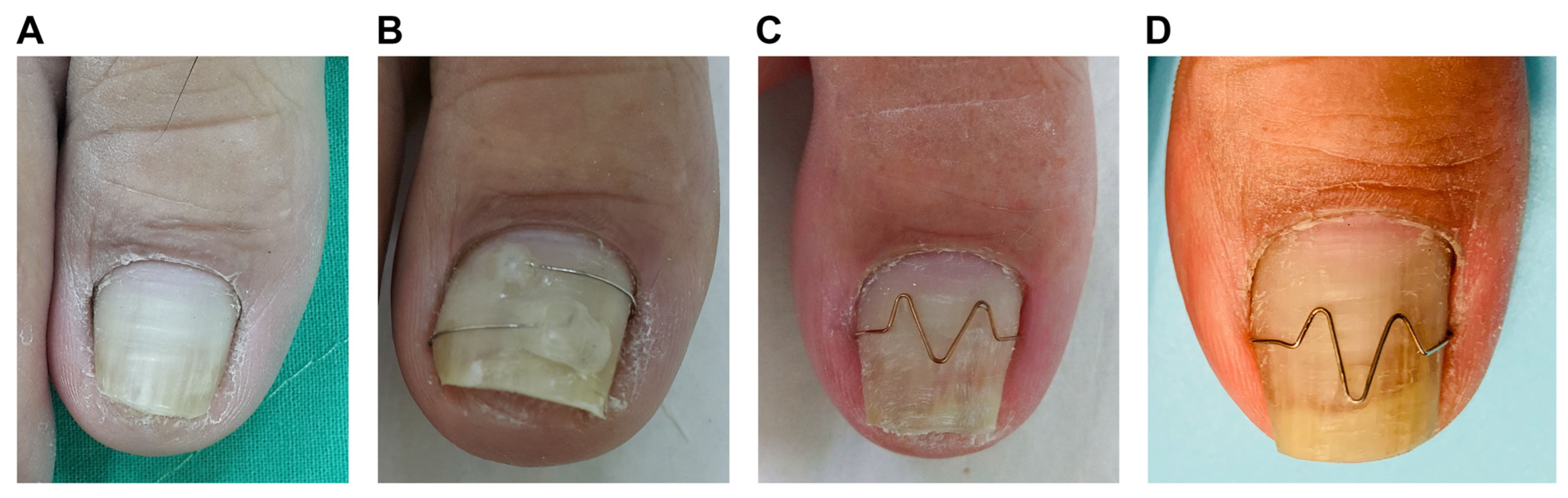
Fig. 1). However, for thick and hard nails, we suggest treatment with the stronger COMBIped nail brace first, followed by maintenance therapy with Naspan nail brace for recurrence-prone patients (
Fig. 2).
Our study was limited by the small sample size and retrospective design. Future studies are warranted to investigate the risk factors for recurrenceprone patients, and the preventive long-term application of Naspan nail braces for maintenance is recommended.