The prevalence of diabetes mellitus is increasing every year, and it is predicted that the total number of patients will reach approximately 629 million in 2045 [
1,
2]. Diabetes mellitus may lead to severe morbidity with extremity complications. The extremity complications, which may progress to loss of limb due to diabetes mellitus, are most frequently seen in the lower extremities. The lifetime incidence of foot ulcers in diabetic individuals has been reported to be 34% [
3,
4]. Foot ulcers, many of which are considered to be within the definition of diabetic foot, can be seen in severity ranging from superficial ulcers to critically infected wounds that require amputation. Approximately 1 million people each year are treated with amputation for diabetes mellitus– related causes [
5], which has a devastating effect on patients and their relatives, as well as a serious socioeconomic loss.
It is possible that this group of patients, who may undergo traumatic problems, such as fear of limb loss and psychosocial influence, may seek information and alternative suggestions on the Internet. We aimed to specify the parameters that may affect the content and quality of the information obtained through Internet search engines about the diabetic foot.
Results
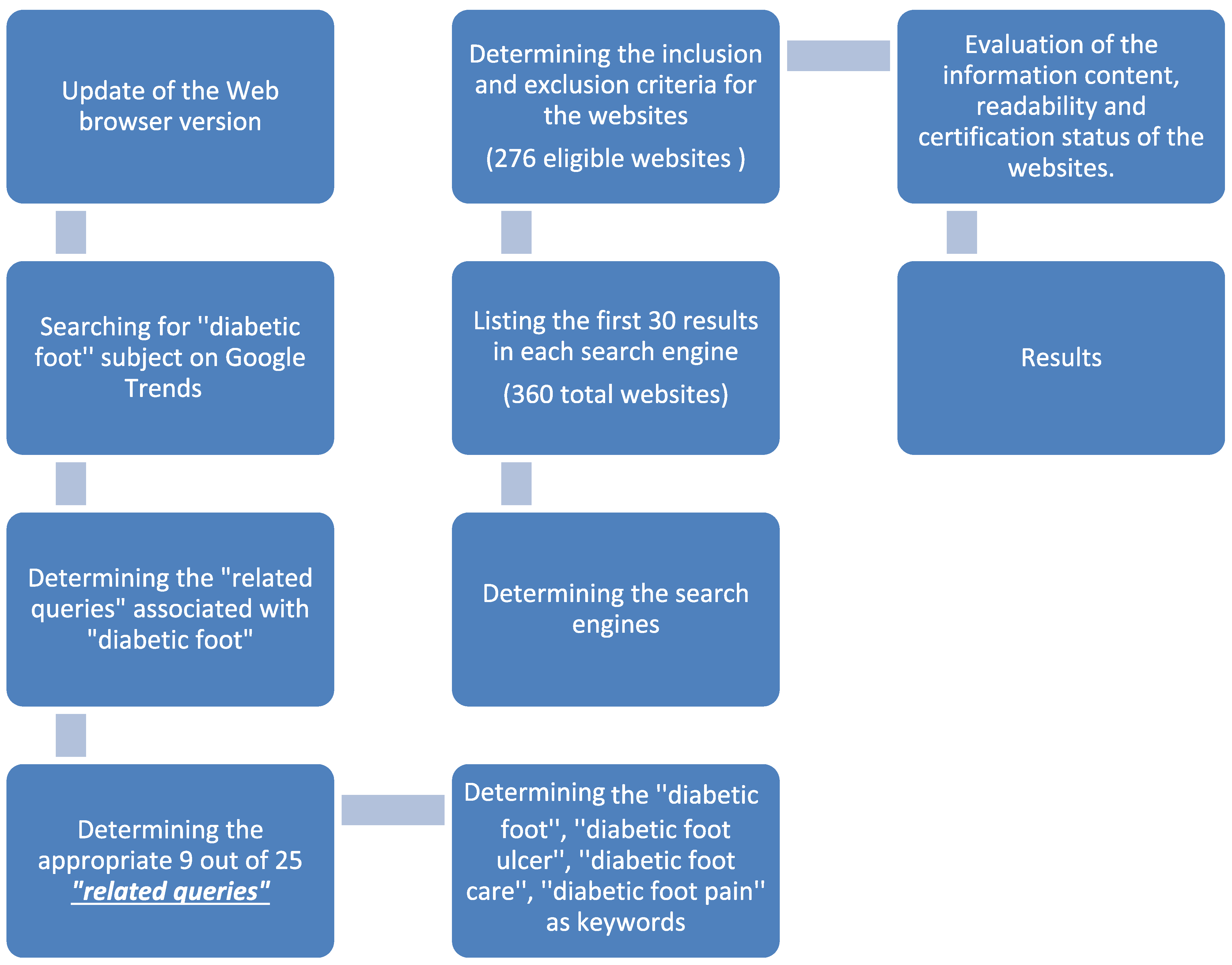
For four search words, an evaluation was made with 276 Web sites with appropriate content from 360 results Web pages obtained from three different search engines.
After evaluating the distribution of the number of Web sites accepted for the study according to search engines, it was observed that there was a significant difference between search engines concerning whether the obtained results were suitable for evaluation (
P < .005). The Google search engine offered more relevant results than did Bing and Yahoo, but there was no significant difference between Bing and Yahoo (
Table 3).
There was no significant difference in the comparison between search engines except that the
JAMA benchmark criteria were significantly higher only in the Yahoo search engine compared with the Google search engine (
Table 4).
Concerning the ICS, it was observed that there were no significant differences between search engines except for the Bing search engine treatment and rehabilitation subtitle (
P = .02) (
Table 4).
Regarding the information content, quality, and readability criteria according to the keywords, the Bing search engine statistically showed no significant difference, but the Google search engine statistically significantly showed a difference in all of the criteria except the
JAMA benchmark criteria (
Table 5). The Yahoo search engine showed a statistically significant difference for ICS treatment and rehabilitation, ICS complications and outcome, and total ICS scores (
Table 5). It was observed that there was no statistically significant difference in the evaluation of the validity between the evaluators (
Table 5,
P2 values).
Web sites with HONcode certification had a statistically significantly higher
JAMA benchmark score, but there were no statistically significant differences concerning other criteria (
Table 6).
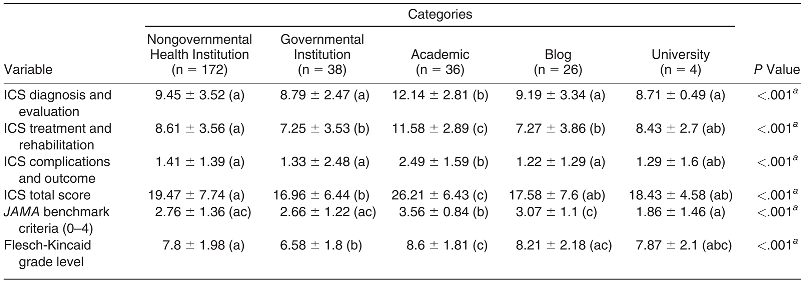
After categorization, the distribution of Web sites was as follows: 172 nongovernmental health institutions, 38 governmental institutions, 36 academic, 26 blogs, and four university Web sites (
Table 7). Comparing the Web sites concerning ICS diagnosis and evaluation and ICS total score, academic Web sites scored significantly higher than other Web site categories (
P < .005). Academic sites were also found to have higher readability grades than the nongovernmental health institution and governmental institution groups (
P < .005). Nongovernmental health sites had significantly higher readability grades than the governmental institution sites (
P < .005). Blog sites had significantly higher readability grades than official sites (
P < .005).
Discussion
This study focuses on Web sites related to the diabetic foot regarding information content, readability, quality of information, and medical certification. Although there is no statistically significant difference between search engine choice regarding information content, readability, quality of information, and medical certification, Web site type and keyword choice differences have led to variable effects.
The main result of the present study is that the choice of search engine did not show a statistically significant difference in the readability, information content, and medical certification in Internet searches related to the diabetic foot. In addition, the search validity of the Google search engine was statistically significantly high. In the literature, in studies that evaluate the information quality of specific medical subjects, usually a single information pool is obtained using all of the search engines [
13,
17,
18,
19,
20,
21,
22,
23,
24], so there are relatively few studies [
25,
26] that offer a similar comparison. Wang et al [
26] rated the results they obtained after the
breast cancer search insert with eight volunteer raters and compared four different search engines. When the data obtained after this comparison were evaluated, it was seen that the search engine with the highest search validity was Google, and the highest user satisfaction was Bing. The higher search validity of the Google search engine in the present study is similar to that of the study by Wang et al. Given that use of the Google search engine has continuously increased since publication of the studies, this difference can be considered normal.
Another result of the present study seems to be the effects of Web site subtype on information content, readability, and JAMA benchmark scores. Although this change has variable effects and several dimensions, it seems that it causes a change more remarkably than other variables. Given that academic Web sites show a significant elevation in ICS total and ICS diagnosis and evaluation subtitles make us think that such sites can provide more information to the reader.
Griffiths et al [
27] evaluated 50 Web sites obtained from three different search engines with the keyword
robotic-assisted total knee. As a grade of their study, they found that academic sites had higher information content scores, similar to the present study. There are also studies in the literature in which academic Web sites do not have the best performance. Shen et al [
13] focused on patient questions about total joint arthroplasty, evaluated Web sites in six categories (commercial, academic, medical practice, single surgeon, government, social media), and revealed that government and commercial sites had the highest
JAMA benchmark scores.
Another finding of the present study, which is that academic sites have higher readability grades, more detailed explanations, and higher information content, can be considered a normal finding. It made us think that the evaluation scale we developed specific to the present study was suitable for validity between users. Although such a comparison was not made in studies conducted using similar evaluation scales [
20,
21,
22] in the literature, we found it appropriate to present such a comparison to keep the errors caused by the evaluation difference between the users to a minimum.
In the comparison in which the results returned by the selected search word in the search engine were evaluated, there was no significant change in the results obtained with the Bing search engine and the word selection, but there were changes in all of the criteria except the JAMA benchmark criteria with the word selection in the Google search engine.
Similar to the result of the present study, many studies in the literature reported that the importance of keyword selection was emphasized and that richer content could be obtained with different keywords. Johnson et al [
23] studied Tommy John injuries, and Dy et al studied distal radius fractures [
28] and lateral epicondylitis [
18]; they all obtained different results in content, quality, and readability with the different selected keywords.
Although the difference in the results with the selected keywords in the present study varies by search engine, it is an important and distinct finding of the present study and draws attention as a generally accepted fact supported by different studies in the literature [
18,
23,
28].
Another result of the present study is that HONcode certification does not cause a statistically significant difference, except for the JAMA benchmark criteria, which has similar subevaluation criteria. This finding suggests that the current certification is not sufficient to reflect the information content of the diabetic foot search results.
O’Neill et al [
21] noted that the sites with HONcode certification for cauda equina syndrome have higher DISCERN and
JAMA benchmark scores. Their study differs from the present study in this aspect, and this difference may be because the search term
diabetic foot represents a more general medical problem that is more sought after and seen more frequently in society.
The main limitation of the present study is the small number of evaluators. Note that this limitation does not adversely affect the results of the study because the ICS evaluation has similar results in the interpersonal comparison, and the two evaluators performed only the ICS evaluation together.
Today, the Internet, which plays an important role in social medical awareness, will continue to be a crucial source of information for patients. The method of obtaining information about diabetic foot with search engines is affected by many parameters. Internet search results for diabetic foot may lead to lack of information and inequality in this sensitive patient group because of different readability, information content, and information quality rates.