Ankle sprains are one of the most common problems for people in sports and the general population [
1]. Inversion or supination ankle sprains, which account for 85% of all ankle sprains, are another name for lateral ankle sprains (LAS) [
2]. This is defined as chronic ankle instability (CAI) when problems such as pain and instability continue for a long-term LAS. Chronic ankle instability occurs in individuals who are long experiencing residual symptoms such as pain and instability [
3]. Chronic ankle instability is divided into mechanical instability and functional instability[
4,
5]; mechanical instability is defined as the pathology around the ankle joint complex. Individuals with functional instability present with a “giving away” sensation in the ankle, because of recurrent ankle sprains. Functional ankle instability may lead to a loss of joint position sense (JPS). Joint mechanoreceptors located in the joint capsule, ligament, and bones provide information about joint position sense and joint compression [
6,
7]. Cutaneous mechanoreceptors perceive senses, such as vibration, taking part in somatosensory function, and proprioception [
4]. After an ankle sprain, the ligament and joint capsule are damaged, and as a result, mechanoreceptor disruption occurs. As a result of this disruption, the proprioceptive sense is damaged, causing a feeling of giving away in the ankle and resulting in recurrent sprains. It has been argued that proprioception deficits may arise from deafferentation because of lateral ligament damage and the lack of afferent stimulus in the musculotendinous structure of the muscles involved in ankle stabilization. Joint position sense plays an important role in ankle control, thereby reducing the risk of injury. Given the relevant studies on this subject in the literature, it has been seen that in people with CAI commonly have deficits in JPS and reinjury risks [
8,
9]. However, the direct association of disruption in these senses with CAI has not been proven [
5]. Therefore, further studies are needed.
Several studies implemented many intervention programs to treat proprioception deficits in people with CAI [
7,
10,
11,
12]. In one of these studies, the researchers concluded that muscle strength training with elastic bands has significant effects on JPS in all ankle movements [
12]. These findings suggest that strength training without an emphasis on proprioception may be beneficial in improving proprioception deficits. In contrast, in another study, the researchers concluded that muscle strength training with elastic bands does not affect force sense [
7]. Moreover, in another review, the authors also stated that proprioceptive exercises have no additional effect on JPS, and more studies should investigate how to improve JPS in people with CAI [
11]. A combination of neuromuscular and proprioception deficits creates postural instability [
3]. Although some studies conclude no significant differences between these training methods on balance and postural stability in people with CAI [
10,
13], others state that combination training methods were effective on evaluation results [
14,
15]. Traditionally, rehabilitation programs include balance, strength, and combination training to enhance balance and postural stability. As a result of the literature reviews, it is unclear which component of the rehabilitation program contributed the most to the improvements in balance and JPS [
16]. By investigating how strength or balance training may improve both balance and proprioception, clinicians may allow patients to decrease treatment time and return to participation more rapidly [
7]. Furthermore, it is also suggested that there is a need for recommendations for therapists to practice specifically targeted exercises for people with CAI.
To our knowledge, to date, there have been no randomized controlled trials that have compared the effects of balance training “hop to stabilization” exercises and strength training on JPS in those with CAI. For the correct and effective use of these treatment methods for proprioceptive deficits in CAI, this study was designed to compare the effects of balance and strength training programs on ankle proprioception in people with CAI.
Methods
This study was performed as a single-blind randomized controlled trial at Yeditepe University between December of 2019 and May of 2020. The randomization was conducted using Microsoft Excel Programming (Microsoft Corp, Redmond, Washington). The names of the participants were written in alphabetical order in one column in the program. The program randomly assigned the group names to two empty columns. Randomization was performed by one the authors (C.Y.M.), who did not have a practitioner role in the article. The randomized controlled study protocol was conducted according to the principles of the Declaration of Helsinki, approved by the Yeditepe University Ethical Committee on November 21, 2019 (number 37068608-6100-15-1781).
Participants
Sixty-five people with CAI were considered during the enrollment process. According to the eligibility criteria, this study included 30 participants (eight men and 22 women; mean age ± SD, 26.79 ± 7.13 years) and participants were recruited from the Özel Sempati Özel Eğitim ve Rehabilitasyon Merkezi.
The included participants were selected from volunteers, including families of individuals receiving rehabilitation services at the center and workplace employees. The inclusion criteria were being between 18 and 30 years of age and having CAI according to the Cumberland Ankle Instability Tool (CAIT) [
1]. The CAIT has proven to be valid and reliable for assessing functional ankle instability. This measurement tool consists of nine items and can be used for both the right and left ankle and is graded of 30 points in which the instability increases with a lower score. The CAIT detects specific symptoms such as feelings of “giving away” and recurrent sprains and questions about physical activities that are challenging to perform [
1]. In CAIT results reveal participants with a score of greater than or equal to 24 are a low risk of reinjury and those less than or equal to 24 are a high probability of having functional ankle instability and would be more likely to resprain. Therefore, participants with a score of less than or equal to 24 were included in this study. Exclusion criteria were having a history of neuromusculoskeletal, balance, or vestibular disorders, and/or a lower limb trauma within 3 months prior to this study.
The minimum sample size to be included was calculated using the effect size of the JPS score (0.48) reported in a similar study with a 95% confidence interval (CI) as 29 patients using G*Power (version 3.1) software, with power (80%), and an error probability of .05 [
16]. The number of participants was determined as 30 patients, considering the dropout status for this study. Signed and informed written consent forms were obtained from participants who participated in the present study in the spirit of the Declaration of Helsinki.
Design
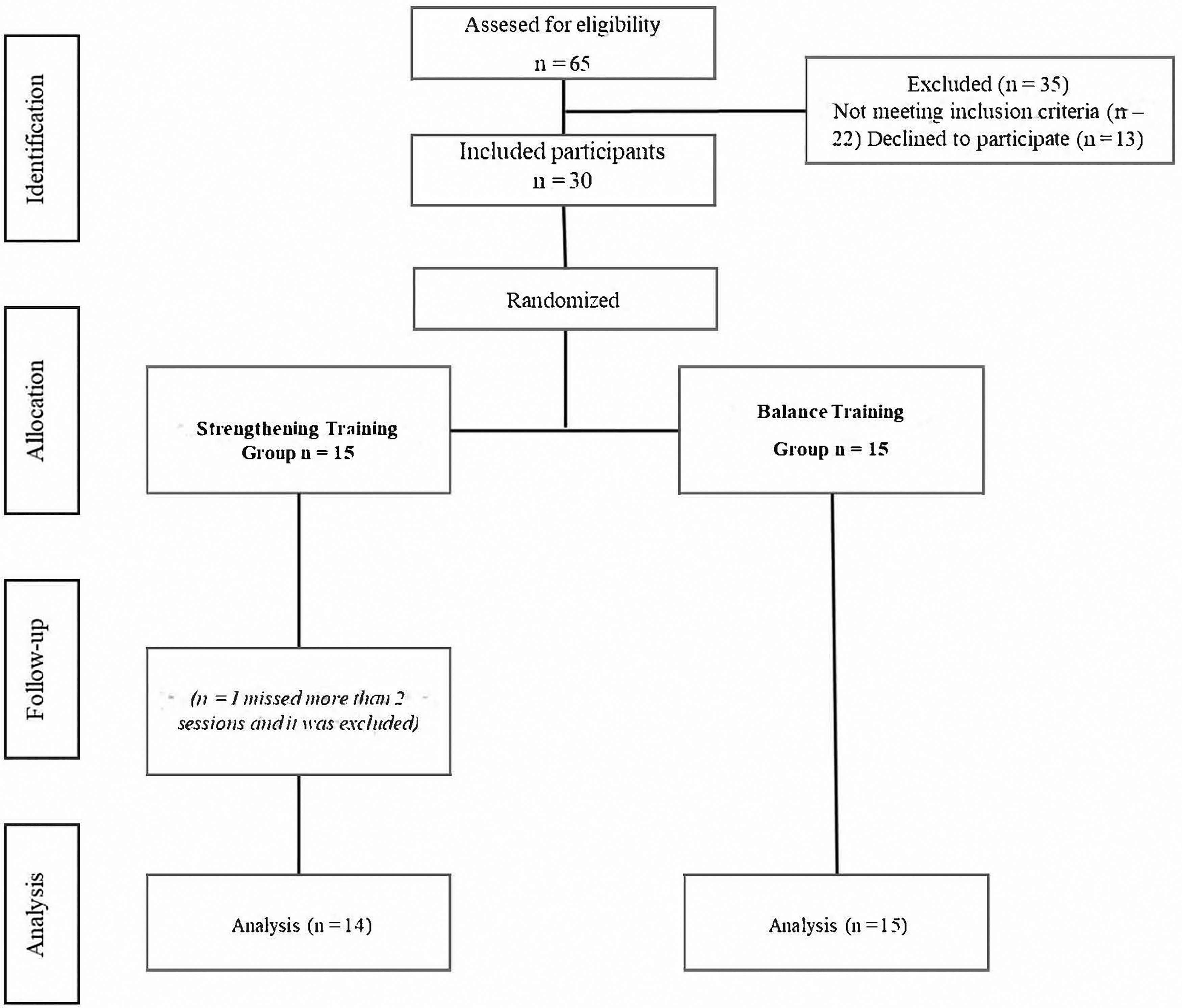
Demographic data (age, gender, BMI) and CAIT scores of the participants were recorded. The participants were randomly divided into two groups: balance training group (BG; n = 15) and strength training group (SG; n = 15). For both groups, dynamic balance and somatosensory evaluations were conducted. All evaluations and interventions were made by the same expert physical therapist, who had at least 5 years of professional experience. During this study, one participant from the SG failed to participate regularly and was excluded from the present study. The Consolidated Standards of Reporting Trials participant flow is reported in
Figure 1.
Figure 1.
Consolidated standards of reporting trials diagram flowchart.
Figure 1.
Consolidated standards of reporting trials diagram flowchart.
Outcome Measurements
The evaluations of the Y balance test (YBT), proprioception, and vibration sense were conducted within the scope of all participants’ dynamic balance and somatosensory evaluations.
Dynamic Balance Assessment of Participants
The YBT system provides an assessment of dynamic balance with movement in anterior, posteromedial (PM), and posterolateral (PL) directions. For the YBT, three red lines (tape measure) were fixed on the ground in a Y shape at equal angles (90° and 135°). For the starting position, participants stood with the unstable ankle on the ground and hands on their hips. The contralateral foot was stretched as far as possible along the red line with each direction and trial, and the reach distance was noted (in centimeters). The balance must be maintained for the test to be successful; and arms and heels should maintain in their initial positions throughout the trial. Before the test, four practice trials were completed in anterior, PM, and PL directions with the unstable ankle. Then, the participants performed the test three times on the unstable ankle and an average score was calculated for each direction. The resting time between the three directions was 15 seconds. The participants’ leg length was noted and used for the “reach distance average/limb length × 100”. The YBT standardized formula was used to calculate the reach distance for each direction [
17,
18,
19].
Somatosensory Assessment (JPS and Vibration Sense)
The JPS test was performed to assess proprioception on the unstable ankle, and the measurements were taken using an electronic goniometer (Baseline Digital Absolute Axis Goniometer; White Plains, New York). The participants were supine on a bed during the trial, with pillows placed under both legs and knees and their eyes kept closed. The pivot point of the goniometer was placed on the lateral malleolus. Then, the proximal arm of goniometer was leveled at the level of the lateral surface of the fibula and the distal arm at the fifth metatarsal level. In the beginning, the goniometer was set to 145° plantarflexion as the initial position of the ankle; then, the ankle was passively dorsiflexed to 105°, 120°, 130°, and 140°. Afterward, the participants relaxed their ankles to the initial resting position and actively dorsiflexed them to the same degrees. The test was completed with three repetitions and the average angle value was recorded.
Vibration sense evaluation was performed using a tuning fork (128 Hz; Elcon1 Medical Instruments, Tuttlingen, Germany). The medial malleolus, the first ray, and the fifth toe of the unstable foot were selected as reference points. The eyes of participants were closed during the entire trial. For every participant, the duration of the vibration sense was recorded by chronometer for each reference point. The duration of the vibration sense was measured from the moment the fork touched the patient’s bony prominence of the site of interest to when the patient said, “it has finished.” Three trials were made for each reference point and were averaged separately [
20].
For somatosensory measurement accuracy, before the vibration sense evaluation, the examiner applied the vibrating tuning fork on the patient’s wrist to make sure that the patient could recognize and understand the vibration sense. All of the evaluations lasted 45 minutes for each participant and were performed at the beginning and end of the 6-week intervention period.
Interventions
The training program for the treatment groups consists of strengthening or balance exercise components. For each component, participants were provided with visual and verbal feedback, and training complexity was increased once every 2 weeks for each treatment group. For both groups, training programs were held 2 days a week for 6 weeks.
Strength Training. In the SG, TheraBand elastic/resistive bands were used to enhance proprioception and strength. Exercises were implemented in the direction of ankle dorsiflexion, plantarflexion, eversion, and inversion. The strength of the elastic/resistive band increased from medium to heavy to extra heavy to provide progressive resistive exercises and a sufficient training overload. For the first 2 weeks, the red (medium strength) bands were used; then, in the second 2 weeks; the green (hard strength) bands were used; and for last 2 weeks, the blue (extra hard strength) bands were used to perform the exercises two times per week with 3 × 10 repetitions.
Balance Training. In the BG, hop to stabilization exercises were used. Each activity stage has its progression level and increases every 2 weeks according to the participant’s ability. These progression levels are intended to activate postural stability with increasing functional variability [
21]. Hop to stabilization exercises were performed 2 days a week for 6 weeks.
Hop To Stabilization. During the exercise, for level 1, participants were allowed to use their arms to aid in stabilizing balance. For level 2, they hopped with both hands on their hips while stabilizing balance after landing (45-cm hops for both levels). The protocol of hop to stabilization training is explained in
Table 1.
Table 1.
Hop to Stabilization Protocol for the BG
Table 1.
Hop to Stabilization Protocol for the BG
Participants were not able to move to the next level in each category until they could demonstrate 10 repetitions for hop-to-stablization, and five repetitions for hop-to-stablization and reach error-free. Errors were determined based on the following:
Touching down with the opposite limb.
Excessive trunk motion and inability to maintain upright position (leaning forward/sideways/backward).
Removal of hands from hips during hands-on hips activities.
Bracing the nonstance limb against the stance limb.
Missing the target.
Statistical Analyses
IBM SPSS (IBM Corp, Armonk, New York) version 26 was used to evaluate data obtained from this study. The Shapiro-Wilk test was used to investigate the suitability of quantitative variables to normal distribution. The χ
2 test was used to compare categorical variables between groups. The data obtained by comparing the pretreatment and posttreatment measurements (Δ) between the groups was tested with independent samples
t test for parametric variables and the Mann-Whitney
U test for nonparametric variables. The difference between the pretreatment and posttreatment values of all assessments taken from the groups was examined by a paired sample
t test for parametric variables and Wilcoxon test for nonparametric variables. In all statistical analyses,
P < .05 was accepted as the significance level. The Cohen
d was used to calculate effect sizes and interpreted as
d = 0.20 to 0.50, small; 0.50 to 0.80, medium; and greater than 0.80, large [
22]. Unless otherwise indicated, data were presented as mean ± standard deviation, corresponding to 95% CI.
Results
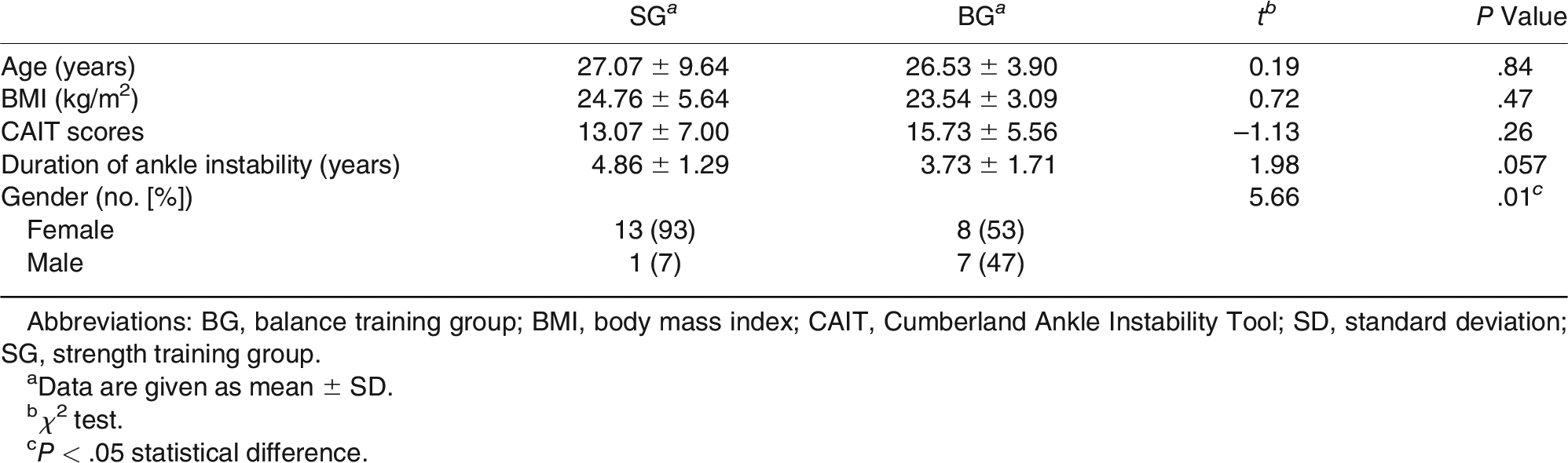
The demographic characteristics, CAIT scores, and duration of ankle instability values of the participants are presented in
Table 2. Although there was no statistical difference in between the groups in terms of age, BMI, CAIT scores, duration of ankle instability (
P > .05), there was a statistical difference in the gender distribution (
P = .01).
Table 2.
Demographic Characteristics and Clinical Features of Participants
Table 2.
Demographic Characteristics and Clinical Features of Participants
In the pretreatment comparison of the YBT, vibration sense, and JPS between groups, the anterior, PL, and PM directions of the YBT; vibration sense at medial malleolus, first ray, and fifth toe; and JPS at 105° and 130° showed no significant difference (P > .05). There was only a statistically significant difference in JPS at 140° and 120° between groups in favor of the BG (P = .02 and P = .01, respectively).
In the intragroup comparison of the pretreatment and posttreatment evaluation values, the PM and PL, the distance reach of the YBT (BG,
P < .001; SG,
P < .001), the medial malleolus vibration senses (BG,
P = .02; SG,
P = .04), and the fifth toe and the first ray vibration sense (SG,
P = .02; BG,
P = .03) and JPS at 120° and 140° (SG,
P = .01; SG,
P < .001) in both groups showed a statistical difference. In the first ray vibration sense, there was no statistical difference in the SG (
P > .05). For JPS at 120°, the effect size was medium, and small for the other angles (
Table 3).
Table 3.
Changes in Dynamic Balance and Somatosensory Evaluations After the Intervention for Both Groups
Table 3.
Changes in Dynamic Balance and Somatosensory Evaluations After the Intervention for Both Groups
In the comparison of posttreatment results between groups, there were no statistical differences in anterior, PL, and PM directions of the YBT (
P > .05) and the vibration sense of the first ray (
P > .05) and medial malleolus (
P > .05). However, there were statistical differences in vibration sense of the fifth toe and JPS at 140° in favor of SG group (
P < .001). Detailed information about the results is presented in
Table 3.
Discussion
This study investigated the differences between balance and strength training on ankle proprioception in people with CAI. For this purpose, the BG and SG groups were compared for dynamic balance, ankle position sense, and vibration sense before and after the training programs. According to our results, the SG had a more positive effect on JPS and vibration sense and was equally effective in improving dynamic balance as the hop to stabilization exercises.
Consistent with the hypothesis, the current study shows more significant improvements in JPS at 140° of the ankle in favor of the SG. For intragroup comparison, in the SG, a significant improvement was found for JPS at 140° and 120° of plantarflexion in the ankle, although there was no significant difference at 105°. Also, there was no significant difference between pretreatment and posttreatment values for JPS in the balance group.
The current study’s results are of particular interest because, to our knowledge, there is no study in the literature comparing elastic/resistive bands to hop to stabilization exercises regarding JPS. When the studies, included in the systematic review conducted by Holmes and Delehunt [
23] were examined, some results related to JPS were obtained. Parallel to our results, in the review, it was revealed that both elastic band and combined exercise with balance exercises increased JPS. The ankle dorsiflexion and plantarflexion muscles are involved in stabilization and should work in harmony [
24]. According to that, some of the studies observed improvement, especially in dorsiflexion and plantarflexion JPS, after 6 weeks of a combined training program [
14]. Similar to our study, these studies used the electronic goniometer method to evaluate proprioception. Dorsiflexion is a crucial component of ankle stabilization. An individual’s ability to feel the dorsiflexion angle can help to adjust the ankle inversion angle and prevent repeated sprains. Parallel to this, in this study, we showed that the proprioceptive direction of dorsiflexion improved with elastic/resistive exercises. This may be explained by the more specific effects of elastic/resistive bands on muscle and tendon structures compared to the balance exercises. Elastic/resistive bands or strengthening training may restore the muscle motor neuron stimulus mechanism by eliminating chronic adaptations, such as muscle weakness and deterioration of flexibility. In this way, the feeling of giving away and the risk of a recurrent sprain may be reduced.
In addition to the proprioceptive sense, other deep senses, such as the vibration sensation, may also be affected and may cause recurrent sprains [
4]. In the vibration sense assessment, the vibration sense of the fifth toe for the elastic/resistive bands exercises showed better results than the hop to stabilization exercises. To our knowledge, no other study investigating the effects of elastic/resistive band and hop to stabilization exercises on vibration senses is present in the literature. Studies show that the pressure in the lateral and central regions decreases when the foot’s arch is unstable, and people with CAI have a loss of control, especially in the lateral part of the foot, resulting in a feeling of giving away in the ankle [
25,
26].
Elastic/resistive band exercises, applied in this study, may positively affect arc stabilization; provide a partial increase in lateral zone pressure; and eventually increase the lateral region vibration sense. Although the connection is not fully understood, we can say that elastic/resistive band exercises can also enable the activation of cutaneous sensations other than proprioception, and they have positive effects on both the muscle contraction mechanism and the peripheral afferent stimulus. Furthermore, a significant improvement in the medial malleolar vibration sense was observed in both groups. Although significant improvements were found, the effect sizes of these results were small. This significant improvement in the balance group may be caused by the connection between postural stabilization and somatosensory sensation. It suggests that balance exercises may positively affect somatosensory performance, which should be remembered for training sessions. We know that people with CAI, especially in the lateral part of foot, have a sensation of giving away in the ankle. The improvement in the sense of vibration of the fifth toe of participants might be related to the feeling of giving away in the ankle. In addition, treatments that increase the sense of vibration should be included in rehabilitation programs for CAI.
In the dynamic balance assessment, although there was no significant difference between the two groups for the pretreatment and posttreatment values, there were significant differences between the SG and BG groups. Delays and deterioration in stabilization, especially for dynamic adjustments, are more common deficits in people with CAI. To improve dynamic balance, in the 4-week combined exercise study conducted by Hale et al [
15], a significant improvement was found in the posttreatment values in the dynamic balance values.
In the literature, it has been shown that giving the strengthening exercise alone is not sufficient for dynamic balance, and its combination with other exercises is clinically recommended [
13,
27]. However, the current study has shown that only progressive elastic/resistive band exercises can improve dynamic balance. It may be because elastic/resistive band exercises positively affect the muscle contraction mechanism, which may improve functional performance.
We believe our findings that elastic/resistive band exercises improve ankle vibration sense and increase dynamic balance in CAI are important aspects of this study. This study has limitations: there was no control group, lack of a follow-up assessment, and unequal gender distribution.
Conclusions
In conclusion, elastic/resistive band exercises that were applied progressively for 6 weeks had a more positive effect on the JPS and vibration senses than hop to stabilization exercises and were as effective as hop to stabilization exercises on dynamic balance. Given the positive effects of balance and strength exercises, these exercises could be implemented separately or combined to treat CAI. This study sheds light on the effects of strengthening and balance studies on proprioception and vibration sense in people with CAI.
Further studies could be conducted with a higher number of participants and may focus more on somatosensory evaluation for CAI. It is recommended that the methods of this study can be applied to a large sample of different populations, such as athletic, obese/overweight, older, and younger populations. Also, comparisons according to BMIs and gender differences should be made. We think that the outputs of our study provide a scientific basis for the design, implementation, and interpretation of further studies on different populations.