Foot pain is a common presentation affecting 17% to 42% of adults, with significant effects on quality of life and function [
1]. Many people with foot pain do not seek professional treatment, thereby underestimating the prevalence. Feet are the base of support for the entire body. However, each body is unique, with different medical conditions, variable body types, distinctive functional needs, and unique pain presentations. Understanding foot mechanics and the specific individual are paramount to creating a treatment plan for foot pain. Reducing foot pressure on the painful area while concomitantly addressing the pathomechanical function of the foot causing the injury, in conjunction with a patient’s systemic status, is complicated. In addition, the complexities of a patient’s social necessities and life make limiting weightbearing status for a patient unsustainable for an extended period.
Nonweightbearing and weightbearing casts exist and are essential to many treatment plans of severe foot injuries and fractures. Functional, accommodative, prefabricated, and over-the-counter inserts exist and are crucial for long-term management of some foot conditions. Surgical shoes, diabetic shoes, and offloading insole systems are needed for the management of some foot conditions; however, there is still an unmet need for a sleek, simple, inexpensive, immediately customizable, anatomical, waterproof device that can increase patient compliance. If a patient is not compliant with their offloading device, even the best device will be largely ineffective [
2].
We devised the PopSole, an anatomical insole that can be customized to individual foot types and placed in sensible shoes without disruption of the mechanics of the superstructure. We previously reported the outcomes of 10 patients using the PopSole at 2- and 4-week follow-up [
3]. Using the PopSole was associated with improved pain and function from baseline to week 2 and week 4; however, longer term data were needed to determine the durability and efficacy of the device. We thus expanded our patient population and aimed to report our entire experience with 3-month outcomes of PopSole in relieving various causes of foot pain.
Methods
We conducted a prospective validation study to assess the long-term effectiveness of the PopSole device. Patients were enrolled if they had foot pain lasting longer than 6 months, whereas patients with open foot ulcerations, fractures, osteomyelitis, neuropathy, or superstructure injury that affected gait were excluded from the study. Other exclusion criteria included history or intention of pregnancy or prior foot surgical intervention in the past 6 months. Baseline information was collected during the screening visit and patients underwent complete foot examination including neurovascular checks. This trial is registered under the name “Validation of a Novel Foot Offloading Device (PopSole2),” clinicaltrials.gov identification number NCT04378270 (
https://clinicaltrials.gov/ct2/show/NCT04378270/).
The PopSole device was modified for each patient based on their pain and pressure points (
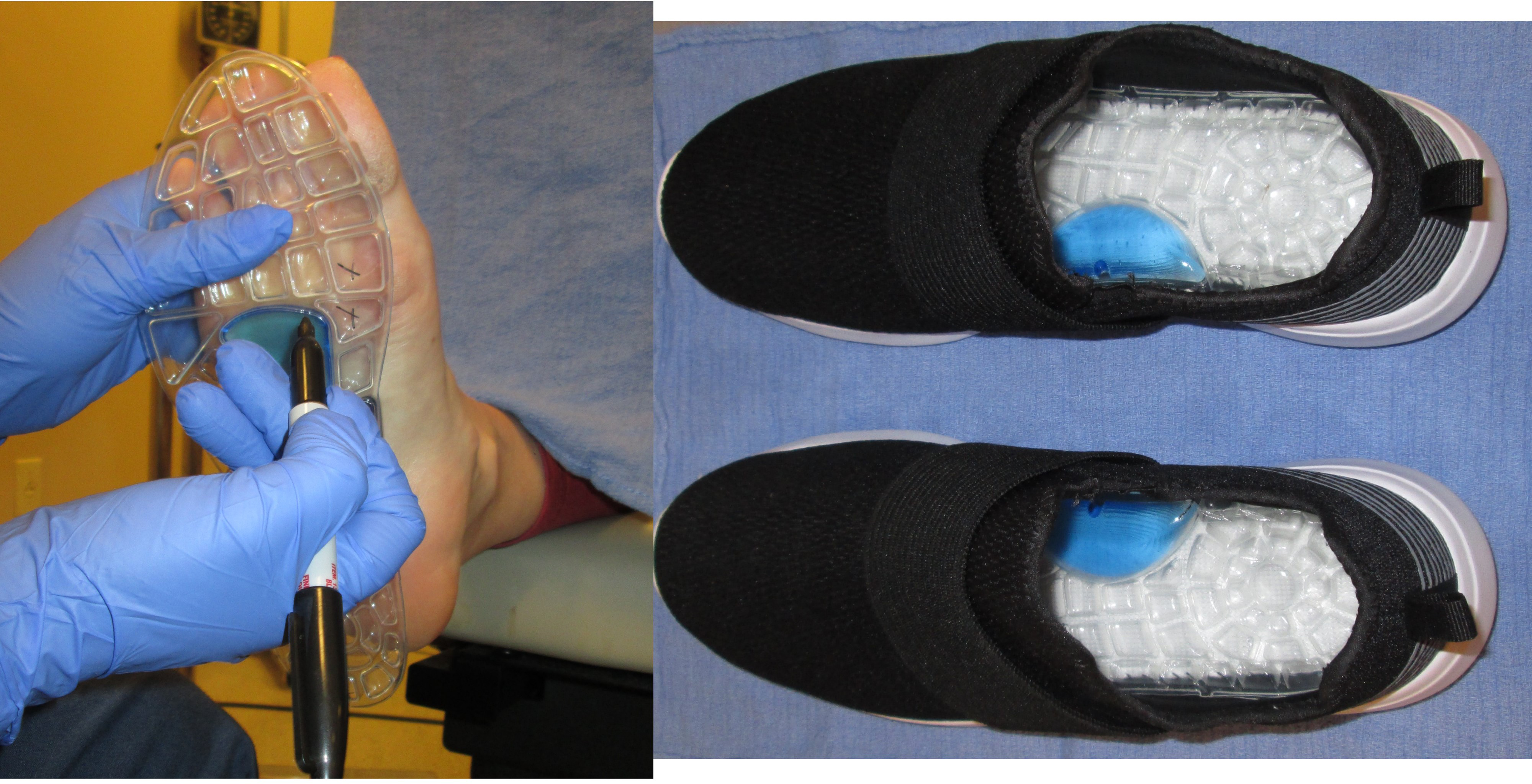
Fig. 1). The device is translucent and placed up to the foot allowing the provider to mark the corresponding bubbles on the bottom of the insole to the area of pain with a pen. A pushpin is then used to deflate the marked bubbles, resulting in perfectly tailored areas of reduced pressure. A sticker is placed over the popped holes to prevent them from refilling with air. The arch and metatarsal pad have varying heights and may be maintained or deflated accordingly (cavus versus pes planus foot).
Figure 1.
The area of pain is marked by the provider and is offloaded by deflating the corresponding bubbles. The device is placed inside the patient’s shoes.
Figure 1.
The area of pain is marked by the provider and is offloaded by deflating the corresponding bubbles. The device is placed inside the patient’s shoes.
Follow-up was scheduled at 2 weeks, 4 weeks, 2 months, and 3 months. As approved by the Institutional Review Board of the University of Pittsburgh, an initial cohort was selected for a 1-month trial, and then another trial was approved for a 3-month period to further test durability and efficacy. Patient-reported outcomes (PROs) were collected using multiple validated surveys including the Mayo Survey, the Manchester Foot Pain and Disability Index, the American Orthopaedic Foot and Ankle Society ankle-hindfoot scale, the Foot and Ankle Ability Measure (FAAM) sports, FAAM activities of daily living, and the Pittsburgh foot survey. Informed consent was obtained from all patients as part of this institutional review board–approved study. The Friedman test was used to assess differences in PROs scores across the multiple data points. Statistical significance was set at P < .05.
Results
Fifteen patients were enrolled in this study (nine in the 1-month follow up study and six in the 3-month follow-up study). Mean age was 61 ± 15 years and mean body mass index was 30 ± 6.3 kg/m2. Foot pain presentations included metatarsalgia type pain (n = 9) and plantar fasciitis (n = 6, all with heel pain), with two of the patients having compensatory type pains in addition to their main concerns. Foot types included cavus foot with supinated gait (n = 9) and flexible foot type with a pronated gait (n = 6). Two patients used assistive walking devices. Eleven patients presented with gross bone abnormalities such as hallux abducto valgus, tailor’s bunion deformity, hammer toe deformity, and degenerative joint disease, in addition to their chief complaint.
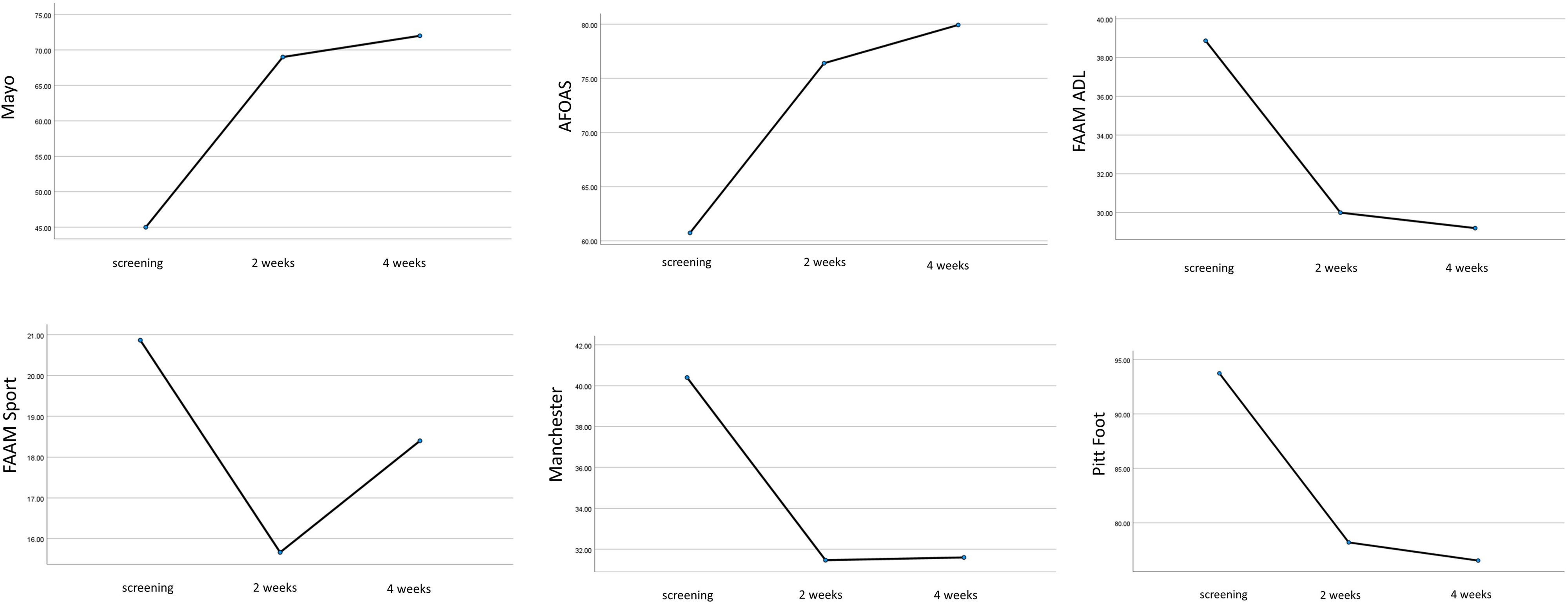
PRO scores for the different surveys at baseline, 2 weeks, and 4 weeks are summarized in
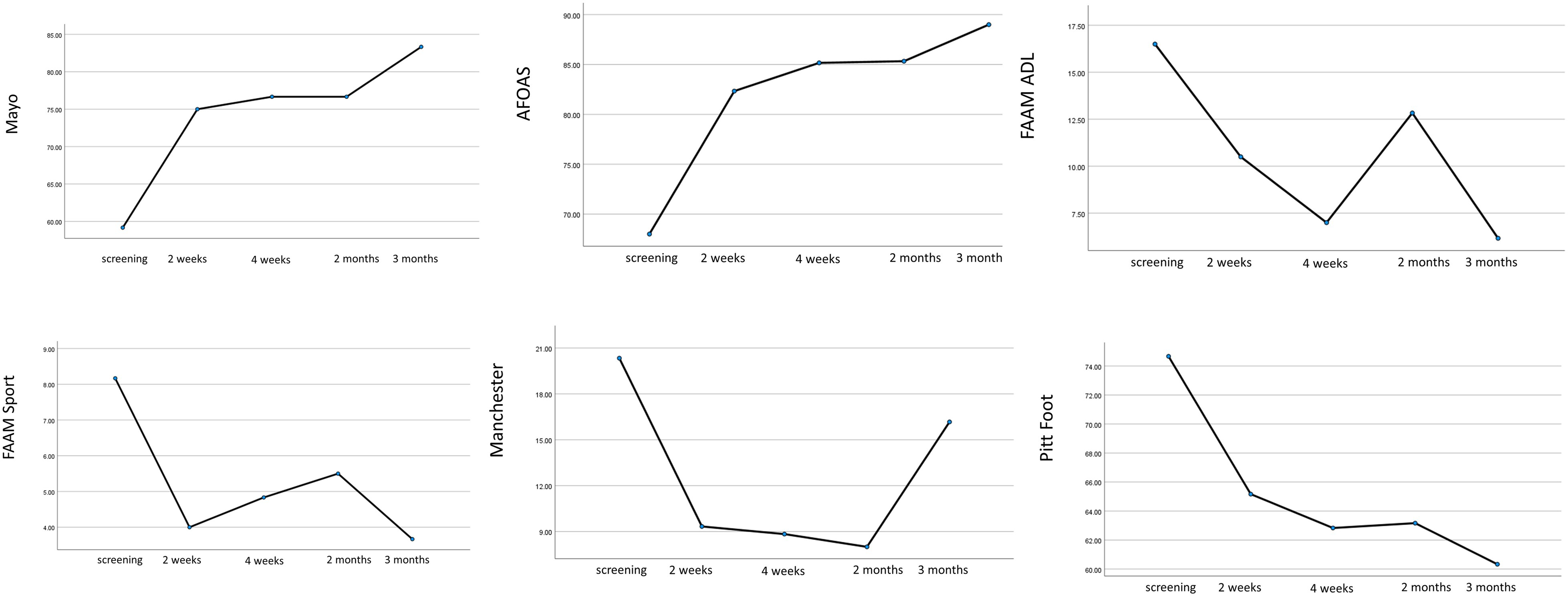
Figure 2. At 4 weeks, pain, function, and quality of life across all surveys showed statistically significant improvement. Because of the positive response of the first cohort, the study was extended, and thus six patients had 3 months of follow-up (
Fig. 3). Patients reported improvement in their pain, function, and quality of life across all surveys, which was significant in the Mayo survey (
P = .018), the Manchester Foot Pain and Disability Index (
P = .014), the American Orthopaedic Foot and Ankle Society ankle-hindfoot scale (
P = .032), the FAAM activities of daily living (
P = 0.009), and the Pittsburgh foot survey (
P = .01), whereas the FAAM sports approached statistical significance (
P = .058). One patient who used the device aggressively with a 6-mile-long hike developed blisters. Her blisters healed while she continued to use the device on 1.5-mile walks daily. All participants experienced bubble deflation or deformation over time, as the device conforms to the foot, but still reported improvement in pain and activity.
Figure 2.
Fifteen participants had reported outcomes at baseline screening, at 2 weeks, and at 4 weeks, using the Mayo survey (P < .001), the Manchester Foot Pain and Disability Index (P = .038), the American Orthopaedic Foot and Ankle Society ankle-hindfoot scale (P < .001), the Foot and Ankle Ability Measure sports (P = .01), the Foot and Ankle Ability Measure activities of daily living (P = .005), and the Pittsburgh foot survey (P = .017). The y axis represents the score of the respective surveys.
Figure 2.
Fifteen participants had reported outcomes at baseline screening, at 2 weeks, and at 4 weeks, using the Mayo survey (P < .001), the Manchester Foot Pain and Disability Index (P = .038), the American Orthopaedic Foot and Ankle Society ankle-hindfoot scale (P < .001), the Foot and Ankle Ability Measure sports (P = .01), the Foot and Ankle Ability Measure activities of daily living (P = .005), and the Pittsburgh foot survey (P = .017). The y axis represents the score of the respective surveys.
Figure 3.
Six participants had reported outcomes at baseline screening, at 2 weeks, at 4 weeks, at 2 months, and at 3 months using the Mayo survey (P = .018), the Manchester Foot Pain and Disability Index (P = .014), the American Orthopaedic Foot and Ankle Society ankle-hindfoot scale (P =.032), the Foot and Ankle Ability Measure sports (P = .058), the Foot and Ankle Ability Measure activities of daily living (P = .009), and the Pittsburgh foot survey (p = .01). The y axis represents the score of the respective surveys.
Figure 3.
Six participants had reported outcomes at baseline screening, at 2 weeks, at 4 weeks, at 2 months, and at 3 months using the Mayo survey (P = .018), the Manchester Foot Pain and Disability Index (P = .014), the American Orthopaedic Foot and Ankle Society ankle-hindfoot scale (P =.032), the Foot and Ankle Ability Measure sports (P = .058), the Foot and Ankle Ability Measure activities of daily living (P = .009), and the Pittsburgh foot survey (p = .01). The y axis represents the score of the respective surveys.
Discussion
In this validation study, we demonstrated the durability and effectiveness of using PopSole as a pressure offloading and pain relief device in patients with foot pain. Using multiple validated surveys, we found that patient pain, function, and quality of life improved for the 3 months of use.
Limiting pressure on a painful foot area, foot mechanics, a patient’s superstructure, systemic medical conditions, and social needs must all be taken into consideration when treating an injury. The versatility of the PopSole can augment the multifactorial plan necessary for patients with foot pain.
One of the advantages of the PopSole device is that it could be instantly customized (even by the patient) by popping the bubbles where they have pain or in areas of pressure. In collaboration with bioengineers, ideal bubble parameters (height and material stiffness) were established using computer modeling to optimize pressure offloading to the painful area while limiting contact pressure on the surrounding skin [
4]. In addition, pliable, softer insole material has been shown to have more benefit on pressure reduction on localized foot areas, as it creates a more uniform foot pressure distribution, and the deformable material has the ability to envelop and cushion a localized area [
5].
Compliance is an essential factor for maximum effectiveness of foot pressure offloading devices [
2]. Compared to other commonly used devices, the PopSole is not bulky. It is easy to use, waterproof, and can be placed in a slide for use at home and in the shower. The PopSole is also used in both shoes, regardless of whether pain was unilateral or not, maintaining proper alignment of the superstructure [
6]. Anecdotally, participants reported improvement in back pain and joint pain as they limited their gait compensations and felt more properly aligned. In one participant, although it did not cure her forefoot pain, the PopSole eliminated her lateral foot pain caused by her compensatory gait. By calming the rest of the foot, the origin of the patient’s pain was targeted so that future treatment could be properly focused. Participants appreciated that the PopSole was hidden in their shoe and not an eyesore. This helps improve compliance in wearing the device, even at home.
One disadvantage of the PopSole device is the possibility of bubble deflation with continuous use. This may be caused by air leak over time, or bubble expansion and distortion from pressure. Mitigation includes possible future design changes, and exchange of the device when the bubbles deflate. We anticipate that by 3 months, a new set of devices should be issued until further durability testing with advanced iterations are established. Another complaint we received from the patients was discomfort in use during hot weather and squeaking sound. However, patients were overall satisfied with the device and wanted to keep using it. There was no skin irritation with reasonable use and no problems with slippage or feeling of instability. We encouraged our participants to use the device aggressively with workouts, including weight lifting and hiking, to assess durability. One participant had a blister with excessive use but healed it while continuing to use the device to offload the blister site.
PopSole in not a replacement for the nonweightbearing casts, weightbearing casts, or surgical shoe. When patients need to be offloaded because of a fracture or surgery, these modalities are the gold standard. Shoe gear with flatbeds can lead to plantar fasciitis [
7]. PopSole may augment flatbed devices by providing support and cushion. PopSole may also serve as a transition device as these patients begin to “walk again.” The walking casts are protective. Patients may lack confidence, balance, joint mobility, and muscle strength in their leg and foot when they progress out of the cast to a sneaker [
8]. PopSole may aid in the rehabilitation of one’s foot by offloading the healing area in their shoe. This will encourage a patient to walk through the gait cycle properly and with confidence, avoiding a compensatory antalgic gait that will prolong healing and delay return to activity.
Our study has several limitations. Although we used multiple validated surveys to assess PROs, we only had 15 participants enrolled in both studies, with only six in the 3-month study. It would have been important to assess the impact of different patient characteristics (such as body mass index) on patient response but, because of small sample size, such analysis was not feasible. Moreover, the study lacks a control group, which is critical in assessing the effectiveness of this device compared to other products available on the market. We did, however, conduct a separate trial comparing PopSole to Darco (DARCO International, Inc, Huntington, West Virginia) with PegAssist insole pressure devices [
6]. Although the benefit of the PopSole device persisted at the 3-month follow-up, it likely will require replacement between 2 and 3 months of use, if the foot pain is not completely resolved, or as the bubbles deflate. Future studies will focus on assessing the value of PopSole in various foot conditions, including diabetic ulcer remission, comparison to other products, and use over a longer period.
Conclusions
The benefit of the PopSole device over this 3-month study suggests its versatility as a recovery insole. The bubble deflation over time suggests it likely will require replacement at between 2 and 3 months of use if the foot pain is not completely resolved. There is promise that the PopSole may serve as a prequel to a more permanent solution. It may comfortably maintain weightbearing status while healing, help mobilize a patient from a nonweightbearing status with more confidence, and help eliminate compensatory pain in complex foot pain presentations to allow for more focused and expedited treatment plans.