Next Article in Journal
Effect of Nail Disorders on Quality of Life Scale Scores: A Prospective, Cross-sectional Study from a Tertiary Referral Center
Previous Article in Journal
The Injury Mechanism of Achilles Tendon Rupture in Professional Athletes: A Video Analysis Study
 
 
Journal of the American Podiatric Medical Association is published by MDPI from Volume 116 Issue 1 (2026). Previous articles were published by another publisher in Open Access under a CC-BY (or CC-BY-NC-ND) licence, and they are hosted by MDPI on mdpi.com as a courtesy and upon agreement with American Podiatric Medical Association.
Article

Dermatofibromas on the Foot and Ankle: A Clinicopathologic Characterization of 31 Cases

Foot and Ankle Specialists of the Mid-Atlantic LLC, 199 E Montgomery Ave. Suite 100, Rockville, MD 20850
*
Authors to whom correspondence should be addressed.
J. Am. Podiatr. Med. Assoc. 2024, 114(3), 21207; https://doi.org/10.7547/21-207
Published: 1 May 2024

Abstract

Background: Dermatofibroma (DF) is a common benign soft-tissue tumor. It occurs anywhere on the body but is commonly seen on the upper and lower extremities. It is frequently found in young to middle-aged adults and predominantly in females. Methods: Thirty-one patients with DF on the foot and ankle diagnosed and treated during a 6-year period were characterized. Results: The patients (16 males, 15 females) were aged 7 to 75 years (average, 55 years). Clinically, 17 patients noted painful symptoms, and 14 were painless. Grossly, DF manifested as a raised red, pink, tan, or skin-colored soft mass. The tumor size ranged from 0.3 to 1.5 cm (average, 0.67 cm in diameter). Twenty-six DFs (84%) were localized on the dorsal surface of the foot and ankle, and five (16%) were found on the plantar aspect. Eighteen patients were treated by surgical excision of the tumor (>0.5 cm), and 13 patients had observational follow-up after punch biopsy due to the small size (≤0.5 cm) and benign nature of these lesions. Further follow-up found that only one patient (3.2%) had a local recurrence, 37 months after surgical excision, which was completely reexcised. Histologically, DF is characterized by proliferation of spindle fibroblasts and histiocytes, in a vague fascicular pattern, and thickened collagen bundles. Conclusions: Dermatofibroma on the foot and ankle predominantly occurs in patients in their 50s, without a preponderance by sex. It needs to be differentiated from other benign and malignant tumors with histologic analysis and immunostaining with factor XIIIa, CD68, and other biomarkers. Treatment options include either surgical excision or observational follow-up after biopsy, depending on the clinical characteristics and effect on functional activity. (J Am Podiatr Med Assoc 114(3), 2024; doi:10.7547/21-207)

Dermatofibroma (DF), also known as cutaneous benign fibrous histiocytoma, is one of the most common subcutaneous benign soft-tissue tumors. Analysis of 18,677 benign soft-tissue tumors during a 10-year period, from January 1, 1980, to December 30, 1989, in the Armed Forces Institute of Pathology showed that the prevalence of DF was 13% among benign soft-tissue tumors, secondary to lipomas (16%).[1] It was predominantly located on the upper and lower extremities, head, neck, and hip/buttock.[1] More than half of the DFs (57%) were diagnosed in patients younger than 45 years.[1] The ratio of incidence between male and female was 1.2 to 1.0.[1] However, other studies reported a female predominance, ranging from slightly more than twice as common in females compared with males.[2,3] Clinically, most DFs manifest as a tan-pink to reddishbrown, firm, nontender cutaneous nodule or plaque.[3]
Dermoscopic examination typically shows a central white patch and peripheral pigment network.[4,5] Physical examination, with lateral inward digital pressure of the lesion, leads to a central dimpling over the skin surface of the tumor, a characteristic sign known as the dimple sign. Histologically, DF is characterized by proliferation of the spindled fibroblasts admixed with histiocytoid cells in the dermis. Treatment options for DF include surgical excision or observation, depending on the DF’s location, size, rate of growth, symptom(s), and effect on the patient’s functional activity. The prognosis is generally good due to the benign nature of these lesions. Local recurrence is rare if clear margins are achieved in the specimen. Metastasis to lymph nodes or long distant organs is extremely rare.[6,7,8]
The incidence of DF on the foot and ankle was reported to be 7.4% among all benign soft-tissue tumors.[1] However, most reported cases were mainly single or mini-series.[9,10,11,12] We, therefore, present 31 cases of DF, diagnosed and treated during a 6-year period, from a podiatric medical institute with the goal shedding light on its clinical features, histopathologic features, differential diagnosis, and treatment options.

Materials and Methods

Thirty-one patients diagnosed as having and treated for DF on the foot and ankle were retrieved from Foot and Ankle Specialists of the Mid-Atlantic (FASMA) during a 6-year period, from September 1, 2015, to August 30, 2021. All of the patients’ hematoxylin and eosin and immunostain slides were reviewed again for confirmation of the original diagnosis (X.H.). The clinicopathologic data were collected from FASMA’s database, analyzed by one observer (X.H.), and then confirmed by the corresponding podiatric physicians, who treated and followed the patients. The Executive Board of FASMA, acting as the institutional review board, approved the study. Consent for collection of each patient’s specimens and clinical data was granted by patients with written documentation through our Health Insurance Portability and Accountability Act and office policy forms. The study was conducted in compliance with ethical practices.

Results

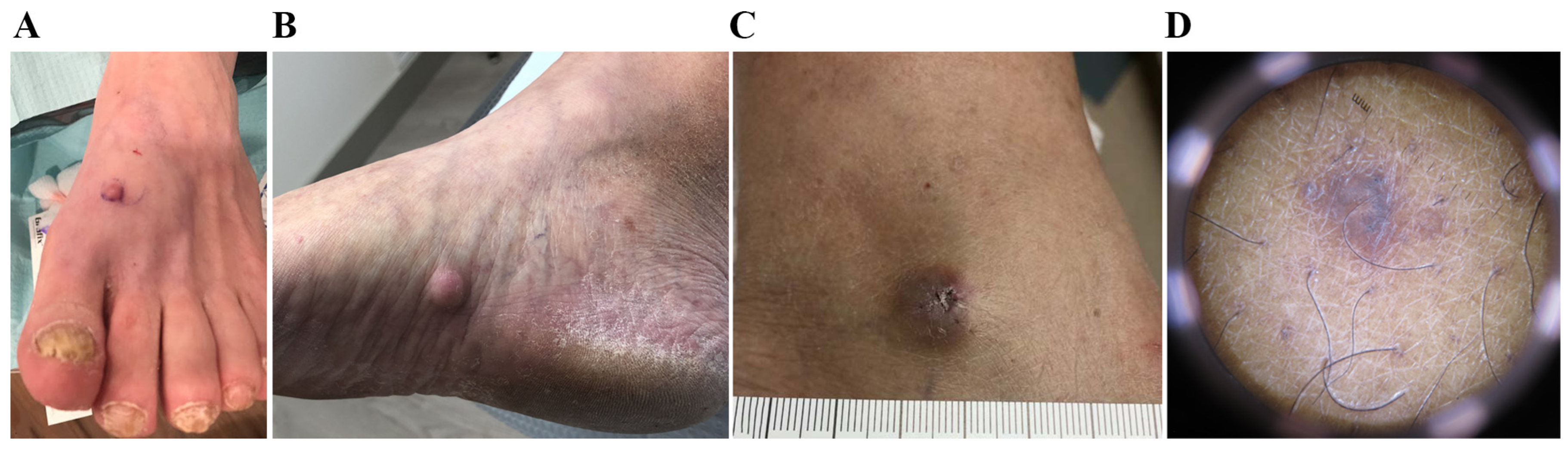
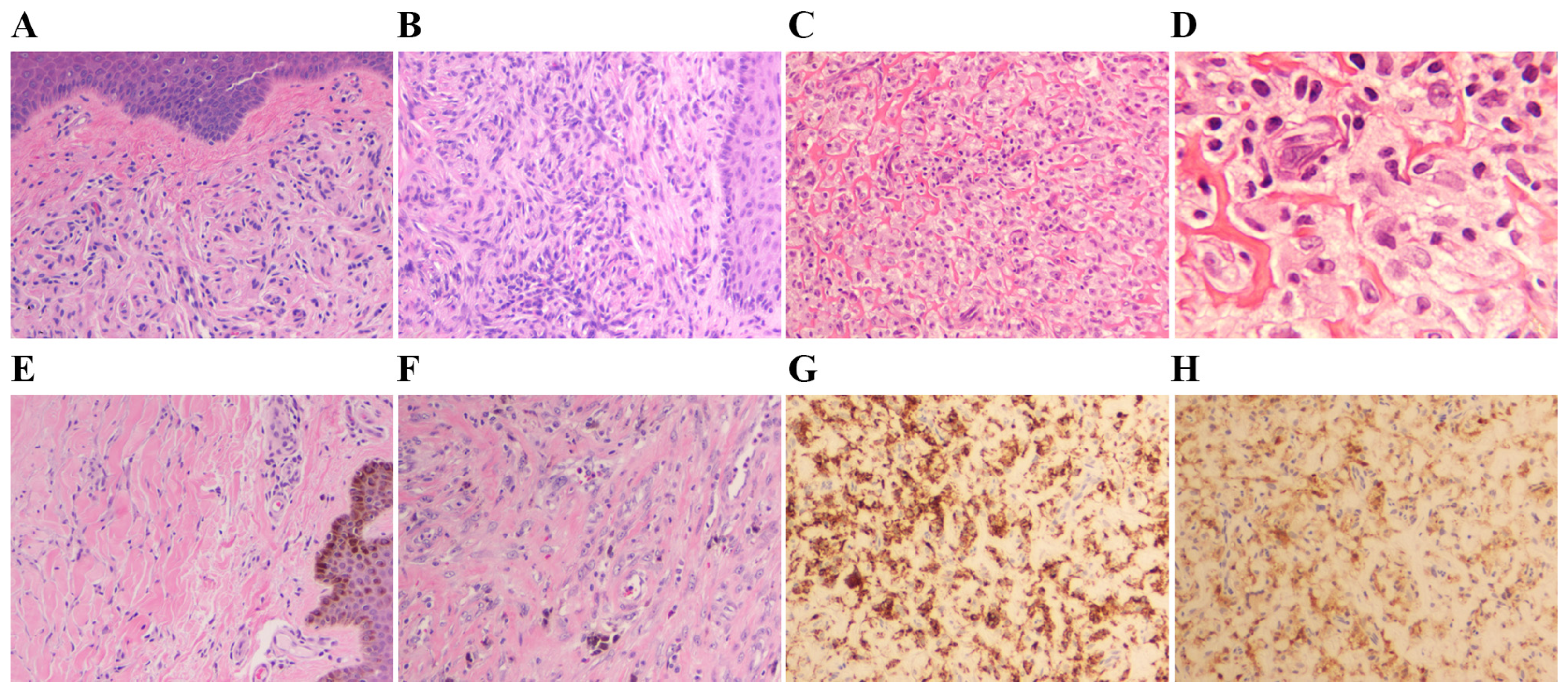
Of the 31 patients, 16 were males and 15 were females, with the ratio of males to females being almost 1:1. Patient age ranged from 7 to 75 years, with an average age of 55 years and a median age of 59 years. Fourteen patients (45.2%) had type 2 diabetes mellitus (DM), and five (16.1%) had cancer histories. Clinically, the patients with DF presented with either painful (n = 17, 54.8%) or painless (n = 14, 45.2%) raised red, pink, tan, hyperpigmented, hypopigmented, or skin-colored nodules or plaques on the foot and ankle (Figure 1). The duration from when the patient noticed symptoms to the diagnosis ranged from several weeks to 60 years, with a mean duration of 16 months and a median duration of 5.5 months. The tumor size ranged from 0.3 to 1.5 cm in diameter, with a mean size of 0.67 cm and a median size of 0.55 cm in diameter. Twenty DFs (64.5%) occurred on the left side and 11 (35.5%) on the right side. Twenty-six DFs (83.9%) were localized on the dorsal surface and five (16.1%) on the plantar aspect. Six DFs (19.4%) were found on the ankles and eight (25.8%) on the toes. All of the patients were diagnosed through biopsy-based histologic evaluation. Eighteen patients with larger nodular lesions (>0.5 cm) were biopsied through local surgical excision, and 13 patients with small nodular (≤0.5 cm) or flat lesions through punch biopsy. Histologically, DF showed a proliferation of spindle cells (fibroblasts) in a vague fascicular pattern admixed with histiocytes and thickened collagen bundles (Figure 2 A and B). Variants, including histiocytoid (Figure 2 C and D), sclerotic (Figure 2E), and hemosiderotic (Figure 2F), were observed. Immunostains of the dermal spindled cells were positive for CD68 (Figure 2G) and factor XIIIa (Figure 2H) but negative for CD34, Melan-A, HMB-45, and S100.
No further treatments were conducted in these patients after either local surgical excisional biopsy or punch biopsy. These patients were followed up for 16 to 74 months, with an average of 43.3 months. Only one patient (3.2%) showed local recurrence, at 37 months, The patient was then treated with surgical reexcision, and no recurrence occurred at follow-up of 8 months. No local invasion or long distant organ metastasis was observed for any patient at either the primary or subsequent follow-up visits.

Discussion

In the present study, we found that the incidences of DF on the foot and ankle are equal. Although DF on the foot and ankle was observed in all age groups, with a range from 7 to 75 years, it was mainly observed in the middle-aged to senior populations, with an average age of 55 years and a median age of 59 years. Analysis of 122 DFs showed that they were predominant in women, with a ratio of male to female being 1.0:2.6, and DF frequently occurred in younger patients, with a mean age of 36.3 years.[3] Increased incidences of DF in women and younger populations were also reported by another group.[13] The differences in sex and age distribution between the present data and previous reports may be due to the location of the DF on the foot and ankle.
Interestingly, we found that 45.2% of patients had type 2 DM. Increased incidences of cancers, including pancreas, liver, breast, endometrium, bladder, and kidney, have been reported in patients with DM.[14,15,16] Malignant melanoma is frequently reported in the patient with diabetic foot ulcer.[17,18,19] We previously reported that two of seven patients with acral lentiginous melanoma had DM.[20] In the present study, we observed that nearly half of patients with DF had type 2 DM, suggesting that DM is a predisposing factor for the development of DF. Because diabetic patients frequently visit a podiatric medical practice for foot care, podiatric physicians need to be aware of DF on the foot and ankle when encountering patients with DM.
Clinically, DF predominantly manifested as pink, red, tan, or skin-colored nodules or plaques less than 1.5 cm. Histologically, DF has multiple variants, including cellular, histiocytic, lipidized, angiomatous, aneurysmal, clear cell, monster cell, myxoid, keloidal, palisading, osteoclastic and epithelioid types of cellular changes.[2,3] Some variants, including sclerotic, histiocytoid, hemosiderotic, and angiomatous types, were observed in this series.
The clinical and histologic presentations of DF resemble other tumors, including malignant and nonmalignant lesions such as dermatofibrosarcoma protuberans,[21] malignant fibrous histiocytoma,[22] Kaposi sarcoma, basal cell carcinoma,[23] melanoma,[24] fibroma, leiomyoma, and neurofibroma. Therefore, DF needs to be differentiated from these tumors. Histologic evaluation of the biopsy sample with immunohistochemical analysis of factor XIIIa, CD68, and other biomarkers is helpful to make a final diagnosis.
Treatment options for individual patients should depend on the patient’s clinical symptom(s), tumor site, size, growth rate, and effect on functional activity. Larger, nodular tumors (>0.5 cm) affecting daily activity or with cosmetic concern should be treated with local surgical excision. Slow-growing smaller (≤0.5 cm) or flat tumors that do not affect daily activity can be observed after diagnosis. Only one patient (3.2%) in the present study showed relapse after surgical excision. Similar results were reported in other series.[25] These data indicate that the prognosis of DF after treatment is excellent, with rare recurrence.

Conclusions

A DF is a benign subcutaneous soft-tissue tumor. Dermatofibroma on the foot and ankle frequently occurs in patients in their 50s. There seems to be no sex predilection when DF occurs on the foot and ankle. Dermatofibroma needs to be differentiated from other benign and malignant tumors. Histologic analysis combined with immunohistochemical analysis of factor XIIIa, CD68, and other biomarkers is essential for the differential diagnosis. Larger nodular lesions (>0.5 cm) should be treated with local excisional biopsy for both diagnosis and treatment. Smaller nodular (≤0.5 cm) or flat lesions can be treated with observational follow-up after punch biopsy. The decision for treatment with either surgical excision or observational follow-up should be based on the individual’s clinical symptom(s) and on the size, location, and rate of growth of the DF. The prognosis of DF is excellent, with rare recurrence or relapse.

Financial Disclosure

None reported.

Conflicts of Interest

None reported.

References

  1. KRANSDORF MJ, MEIS JM: From the archives of the AFIP: extraskeletal osseous and cartilaginous tumors of the extremities. Radiographics 13: 853, 1993.
  2. ALVES JV, MATOS DM, BARREIROS HF, ET AL: Variants of dermatofibroma: a histopathological study. An Bras Dermatol 89: 472, 2014.
  3. HAN TY, CHANG HS, LEE JH, ET AL: A clinical and histopathological study of 122 cases of dermatofibroma (benign fibrous histiocytoma). Ann Dermatol 23: 185, 2011.
  4. KELATI A, AQIL N, BAYBAY H, ET AL: Beyond classic dermoscopic patterns of dermatofibromas: a prospective research study. J Med Case Rep 11: 266, 2017.
  5. JULIANDRI J, WANG XY, LIU ZJ, ET AL: Dermoscopic patterns of dermatofibroma in 72 chinese patients. Chin Med J (Engl) 132: 2121, 2019.
  6. AROUNI MA, BEWTRA C, ALBANO WA, ET AL: Atypical, cutaneous fibrous histiocytoma with early metastasis. Nebr Med J 71: 126, 1986.
  7. MOOSAVI C, JHA P, FANBURG-SMITH JC: An update on plexi-form fibrohistiocytic tumor and addition of 66 new cases from the Armed Forces Institute of Pathology, in honor of franz m. Enzinger, md. Ann Diagn Pathol 11: 313, 2007.
  8. GU M, SOHN K, KIM D, ET AL: Metastasizing dermatofibroma in lung. Ann Diagn Pathol 11: 64, 2007.
  9. WOLLINA U, SCHO¨ NLEBE J, NOWAK A: Cellular fibrous dermatofibroma of the sole. Georgian Med News 256-257: 11, 2016.
  10. HATTORI T, MATSUMINE A, UCHIDA K, ET AL: Benign fibrous histiocytoma of the talus: a case report. J Foot Ankle Surg 58: 762, 2019.
  11. MOON A, YOON N, KIM HS: Myxoid dermatofibroma on a great toe: a case report. Int J Clin Exp Pathol 8: 7605, 2015.
  12. LEHMER LM, RAGSDALE BD: Digital dermatofibromas— common lesion, uncommon location: a series of 26 cases and review of the literature. Dermatol Online J 17: 2, 2011.
  13. GLEASON BC, FLETCHER CD: Deep “benign” fibrous histiocytoma: clinicopathologic analysis of 69 cases of a rare tumor indicating occasional metastatic potential. Am J Surg Pathol 32: 354, 2008.
  14. LIN CM, HUANG HL, CHU FY, ET AL: Association between gastroenterological malignancy and diabetes mellitus and anti-diabetic therapy: a nationwide, populationbased cohort study. PLoS One 10: e0125421, 2015.
  15. Wojciechowska J, Krajewski W, Bolanowski M, et al.: Diabetes and cancer: a review of current knowledge. Exp Clin Endocrinol Diabetes 124 (5): 263, 2016.
  16. VRACHNIS N, IAVAZZO C, ILIODROMITI Z, ET AL: Diabetes mellitus and gynecologic cancer: molecular mechanisms, epidemiological, clinical and prognostic perspectives. Arch Gynecol Obstet 293: 239, 2016.
  17. HUSSIN P, LOKE SC, NOOR FM, ET AL: Malignant melanoma of the foot in patients with diabetes mellitus: a trap for the unwary. Med J Malaysia 67: 422, 2012.
  18. GAO W, CHEN D, RAN X: Malignant melanoma misdiagnosed as diabetic foot ulcer: a case report. Medicine (Baltimore) 96: e7541, 2017.
  19. YASEAR ZAY, BLOOMER L, SIDDIQUE R, ET AL: When acral malignant melanoma facades as diabetic foot! BMJ Case Rep 14: e242918, 2021.
  20. HAO X, YIM J, CHANG S, ET AL: Acral lentiginous melanoma of foot and ankle: a clinicopathological study of 7 cases. Anticancer Res 39: 6175, 2019.
  21. HAO X, BILLINGS SD, WU F, ET AL: Dermatofibrosarcoma protuberans: update on the diagnosis and treatment. J Clin Med 9: 1752, 2020.
  22. WU KK: Malignant fibrous histiocytoma of the foot. J Foot Surg 29: 298, 1990.
  23. STANOSZEK LM, WANG GY, HARMS PW: Histologic mimics of basal cell carcinoma. Arch Pathol Lab Med 141: 1490, 2017.
  24. RUPP M, KHALLUF E, TOKER C: Subungual fibrous histiocytoma mimicking melanoma. JAPMA 77: 141, 1987.
  25. GAUFIN M, MICHAELIS T, DUFFY K: Cellular dermatofibroma: clinicopathologic review of 218 cases of cellular dermatofibroma to determine the clinical recurrence rate. Dermatol Surg 45: 1359, 2019.
Figure 1. Clinical presentation of the dermatofibroma on the foot and ankle. A, A slightly raised, solid, erythematous, soft-tissue nodule on the dorsal surface of the right foot. B, A raised skin-colored mass on the medial arch of the right plantar surface. C, A slightly raised, hyperpigmented, circular plaque on the surface of the right medial malleolus after punch biopsy. D, Several irregularly shaped hyperpigmented plaques with interrupted skin lines on the left dorsal surface of the foot revealed by a dermoscope.
Japma 114 21207 g001
Figure 2. Histopathologic analysis of the dermatofibroma on the foot and ankle. A, Fibroblastic type: Elongated fibroblasts in a vague fascicular pattern beneath the epidermis without involvement of the grenz zone (H&E, 100x1). B, Fibroblastic type: Elongated fibroblasts in a vague fascicular pattern beneath the epidermis involving the grenz zone (H&E, 100x1). C (H&E, 100x1) and D (H&E, 400x1), Histiocytoid type: Foamy histiocytoid cells intermingled with fibrocollagenous tissue. E, Sclerotic type: Thickened collagen bundles admixed with few fibroblasts (H&E, 100x1). F, Hemosiderotic type: Elongated fibroblasts admixed with hemosiderophages (H&E, 100x1). G, Cytoplasmic staining of CD68 (3,3’-diaminobenzidine, 100x1; same tissue as C and D). H, Cytoplasmic staining of factor XIIIa (3,3’-diaminobenzidine, 100x1; same tissue as C and D).
Japma 114 21207 g002