Hallux abducto valgus (HAV) is a commonly encountered abnormality in ballet dancers, involving medial deviation of the first metatarsal, abduction and valgum of the hallux, in addition to lateral subluxation of the sesamoids. [
1,
2] There is conflicting evidence regarding the involvement of dance in the development of HAV, with some arguing that, rather than causing the deformity, ballet simply provides an environment that places genetically predisposed individuals at an increased risk of developing HAV. [
3–
7] It has been proposed that the unique internal and external forces exerted on the foot when assuming ballet positions and performing movements, particularly with incorrect technique, is a causative factor for HAV in those dancers with a family history. [
8–
10]
Steinberg et al [
11] found that young female dancers have a significantly higher incidence of HAV (47.3%) compared to an age-matched control group (34.1%). The authors noted that this increase could be attributable to genetic predisposition, concurrent excessive mechanical loads, and stresses on the growth plates of young dancers. [
11] Alternately, Kadel [
9] proposed incorrect technique, such as forcing turnout (external rotation of the entire lower limb), may only exacerbate an existing HAV deformity, rather than be the sole cause.
Ballet involves repetitive and excessive movements during the use of both a soft leather slipper and pointe shoes, maximal ankle plantarflexion, and extreme dorsiflexion and plantarflexion of the first metatarsophalangeal joint (MPJ)—which places huge stresses on an immature skeleton, all while maintaining an externally rotated lower limb. [
8,
11,
12] This externally rotated posture of the lower limb is called functional turnout, which involves maximal lower limb external rotation, foot abduction with the knees extended, heels contacting, and the patellae in line with the second metatarsals. [
6,
8,
12] Young dancers with reduced hip external rotation are more likely to compensate for this limitation by means of foot abduction, rather than forcing turnout through knee external rotation. [
12] Dancers are able to accentuate their turnout by planting their feet in an overturned position in demi-plié (bent knee) with subsequent knee extension. [
12] Friction between the foot’s plantar surface and the ground helps to maintain the foot in a passively overturned position. [
12] The rotational force is suggested to be diminished by means of internal rotation of the tibia relative to the foot, and subtalar joint pronation (calcaneal eversion, talar plantarflexion, and adduction). [
6,
12]
A forced turnout position will lead to abduction forces on the hallux as a result of increased subtalar joint pronation. [
6,
12] Carter et al [
12] measured the differences in the hallux abduction angle (HAA) angle from parallel stance to functional turnout to forced turnout of pre–professional dancers (aged 16 years and older) using motion capture. The authors found 13 of the 18 dancers demonstrated increased HAA in forced turnout; however, no statistically significant increase was found. Carter et al [
12] suggested metatarsal head shape may explain why some dancers have a greater HAA angle when the dancers assumed a forced turnout position. They also noted that, of the 18 dancers, six dancers had an HAV deformity. Therefore, it is unknown whether ballet caused the HAV deformity or simply exacerbated the deformity, particularly because those dancers are closer to skeletal maturity. Thus, it would be prudent to examine a younger population, to investigate whether forcing turnout increases a dancer’s HAA and ultimately their risk of developing HAV.
In the literature concerning HAV, the metatarsal head shape appearance is believed to be a result of metatarsal rotation rather than the physical structure of the bone. [
13–
16] It has been suggested that the increased abduction forces at the first MPJ may facilitate rotation of the first metatarsal which, radiographically, may lead to a rounded appearance of the lateral first metatarsal head. [
13–
16] Okuda et al [
14] found that individuals with a rounded lateral first metatarsal head shape had a greater recurrence rate of HAV after corrective surgery compared with other head shapes. Numerous population studies have suggested a relationship between the first metatarsal head shape and development of HAV, but there is no current literature that has studied the effect of the head shape on the development of HAV in a nonpathologic population or even a dancing population. [
13–
15]
A number of methods have been developed to classify the metatarsal head shape based on radiographic images. [
13–
15] Kilmartin and Wallace
13 radiographically examined the metatarsal head shapes of a juvenile population who had been clinically diagnosed with HAV. The authors compared both subjective and objective methods to classify metatarsal head shapes into “round” and “square,” and reported that the subjective method was able to accurately distinguish between the two shapes. Okuda et al [
14] classified the lateral first metatarsal head shapes into three types (angular, round, or intermediate) using a quantitative method. Yamaguchi et al [
15] expanded on the work of Okuda et al [
14] but used a slightly modified method to make their measurements. Both of these study populations consisted of adults who had undergone corrective HAV surgery.
The clinical classification of HAV, which requires radiographic bisection of the first metatarsal and the first proximal phalanx, is considered one of the standard measurements. This measurement is called the hallux valgus angle. [
17] In contrast, nonradiographic measurements of HAV are influenced by the presence of soft-tissue structures. The use of photographs to assess the HAV has been reported in the literature. [
17,
18] However, the use of paper to manually draw the HAA has not yet been explored as a viable method to assess the HAV. A paper-drawing method would require less equipment and be safer for patients, as it does not expose them to radiation. The method would also be more easily accessible for practitioners compared to either a photographic or radiographic method.
Despite these differences, there is no agreed terminology in the literature to differentiate between radiographic and nonradiographic measurements. [
14,
17,
18] Therefore, we propose the terms hallux valgus angle and HAA be used exclusively for radiographic and nonradiographic measurements, respectively, and believe this differentiation is appropriate because of the influence of soft-tissue structures on HAA and not hallux valgus angle.
The main aim of this study was to determine whether the lateral first metatarsal head shape would lead to a significant increase in HAA in pre-pointe female ballet dancers, which may suggest a potential for developing HAV in later life. Because of a lack of established evidence on the cause of HAV, young dancers and their caretakers may be apprehensive about the risk of developing the deformity because of ballet. It was hypothesized that individuals with a rounded lateral first metatarsal head would demonstrate a larger increase in HAA from a natural double-leg upright posture to forced turnout stance compared to those with an angular shape. The secondary aim was to determine the reliability of using bony landmarks drawn onto paper to determine the HAA compared to using photographs. Findings of our study could assist in identifying individuals potentially at a higher risk of developing HAV because of the shape of their lateral metatarsal head.
Methods
Study Design
This was a quantitative, cross-sectional, pilot study.
Selection and Description of Participants
Seventeen female pre-pointe ballet students from Perth metropolitan dance schools volunteered for this study (
Table 1). Written and verbal consent was gained from the parent(s)/guardian(s) of all participants. The participant’s parent(s)/guardian(s) were able to withdraw their child at any point without consequence. This study was approved by the University of Western Australia Ethics Committee (RA/4/20/4968).
Table 1.
Descriptive Statistics for the Participants
Table 1.
Descriptive Statistics for the Participants
Inclusion/Exclusion Criteria.
Female pre-pointe ballet dancers 9 to 13 years of age were recruited. Dancers were excluded if they had commenced pointe work; were currently injured; had HAV or other foot deformities; received previous treatment for foot deformities such as foot orthoses; or had a history of lower-limb surgery, systemic arthropathies, and/or an inability to understand instructions.
Experimental Procedures
Each participant’s dominant foot was assessed using a validated questionnaire called the Waterloo Footedness Questionnaire. [
19] Participants were assisted by parents/guardians and the researchers with completing the questionnaire when necessary.
To obtain a better understanding of confounding factors, each participant was assessed for lower-limb joint hypermobility using the Lower Limb Assessment Score (LLAS), [
20] and a Foot Posture Index (FPI) [
21] score was obtained to determine their foot type (ie, supinated, neutral, or pronated). Both of these tools have been validated for use in a pediatric population [
22] and were conducted by one of authors (P.H.D.).
Measuring HAA Using Paper
For each of the participants, the navicular tuberosity, medial first MPJ, and the medial first interphalangeal joint of the participant’s dominant foot were palpated and marked with a ball-point pen. Participants were then asked to stand in their natural double-leg upright posture, and functional and forced turnout positions:
- 1.
Natural double-leg upright posture: Participants were instructed to stand in normal stance with their feet hip-width apart.
- 2.
Functional turnout: Participants were instructed to stand still in their preferred turnout angle in first position.
- 3.
Forced turnout: Participants were instructed to stand still in a forced turnout angle in first position. Dancers had to be able to maintain balance while holding the forced turnout angle.
For each position, the corresponding locations of the anatomical landmarks were marked on a piece of paper beneath the participant’s dominant foot. This process was repeated three times, each by two of the authors (D.M.H. and A.P.). Lines were drawn connecting the three dots, and the HAA was measured using a tractograph.
Measuring HAA Using Photographs
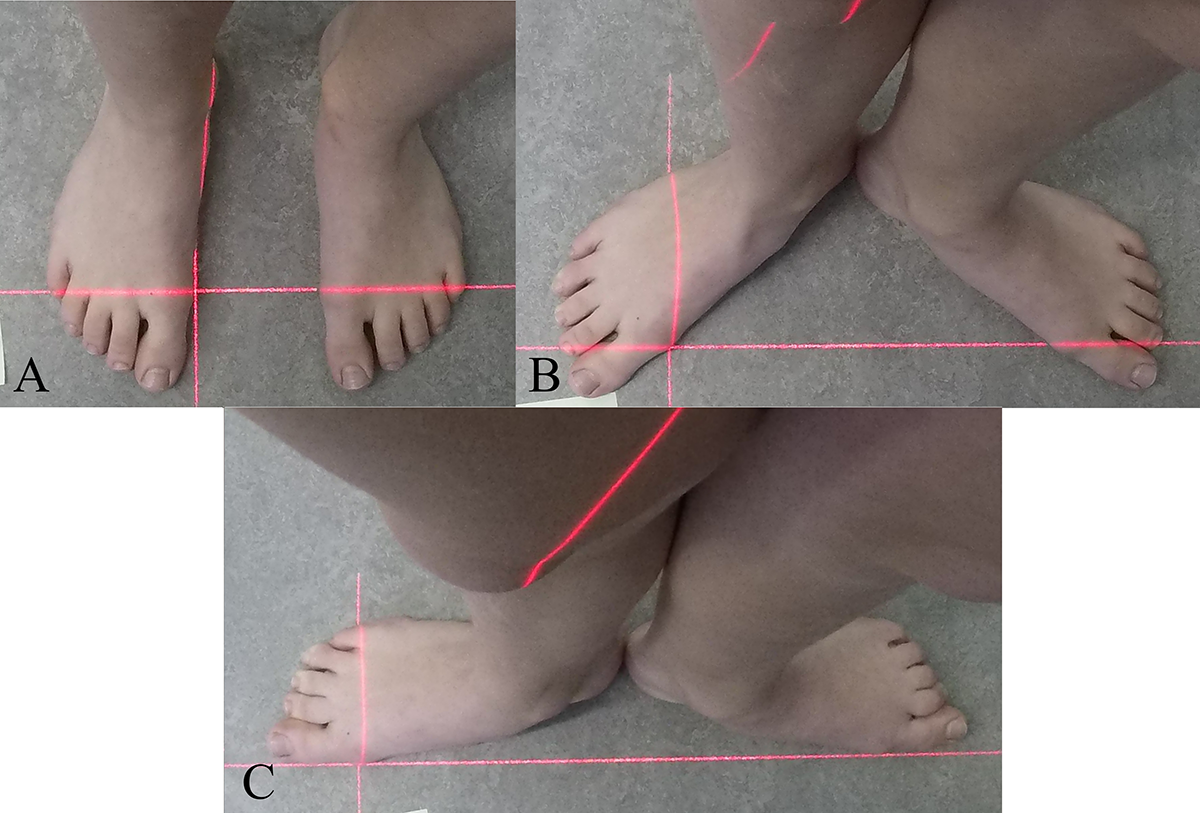
Participants were asked to stand in their natural double-leg upright posture, preferred functional turnout stance, and forced turnout stance as shown in
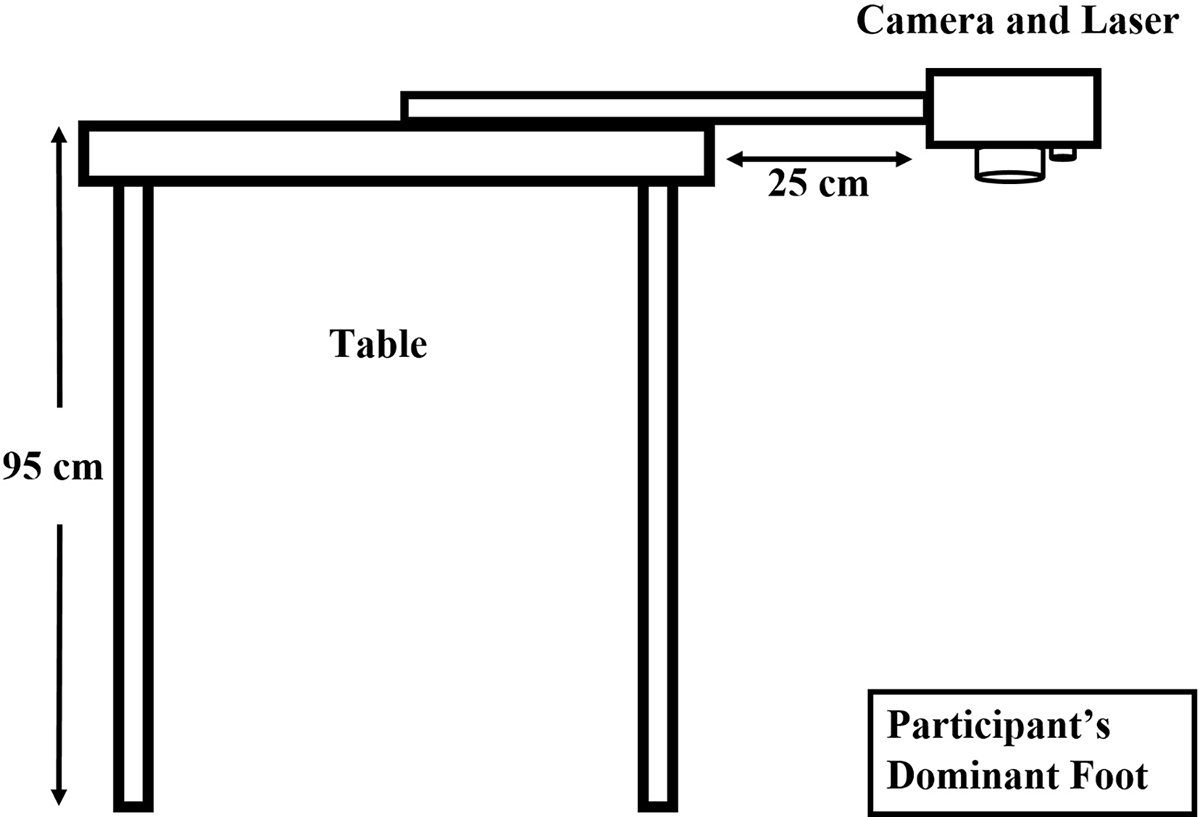
Figure 1. The photographs were taken by one of the authors (S.P.) using a digital camera (HERO5; GoPro Inc, San Mateo, California) at a fixed height of 98 cm perpendicular to the ground (
Fig. 2).
Figure 1.
Dorsal view images of a female pre-pointe ballet dancer. A, Natural double-leg upright posture. B, Functional turnout position. C, Forced turnout position.
Figure 1.
Dorsal view images of a female pre-pointe ballet dancer. A, Natural double-leg upright posture. B, Functional turnout position. C, Forced turnout position.
Figure 2.
A pictorial illustration of the photographic setup. A camera and a laser pointer were secured on a 98-cm-high table at a distance of 25 cm from the edge of the table. Participants were asked to assume the three different positions with their feet directly underneath the camera. To maintain consistency between each photograph, each participant’s dominant foot was aligned at the medial eminence first metatarsophalangeal joint using the laser pointer.
Figure 2.
A pictorial illustration of the photographic setup. A camera and a laser pointer were secured on a 98-cm-high table at a distance of 25 cm from the edge of the table. Participants were asked to assume the three different positions with their feet directly underneath the camera. To maintain consistency between each photograph, each participant’s dominant foot was aligned at the medial eminence first metatarsophalangeal joint using the laser pointer.
The photographic HAA was defined as the angle formed by the medial borders of the first metatarsal and hallux. The proximal line passed from the navicular tuberosity to the medial eminence of the first MPJ. The distal line was drawn from the medial eminence of the first MPJ to the eminence of the first interphalangeal joint. These lines were drawn digitally using the software Siliconcoach Live (The Tarn Group, Dunedin, New Zealand). The photographic HAAs were independently measured (P.H.D., D.M.H., and S.P.). The measurements were performed three times by each rater to determine interrater and intrarater reliability, with a 2-week interval between each measurement.
Classification of the Lateral First Metatarsal Head Shape Using Fluoroscopy
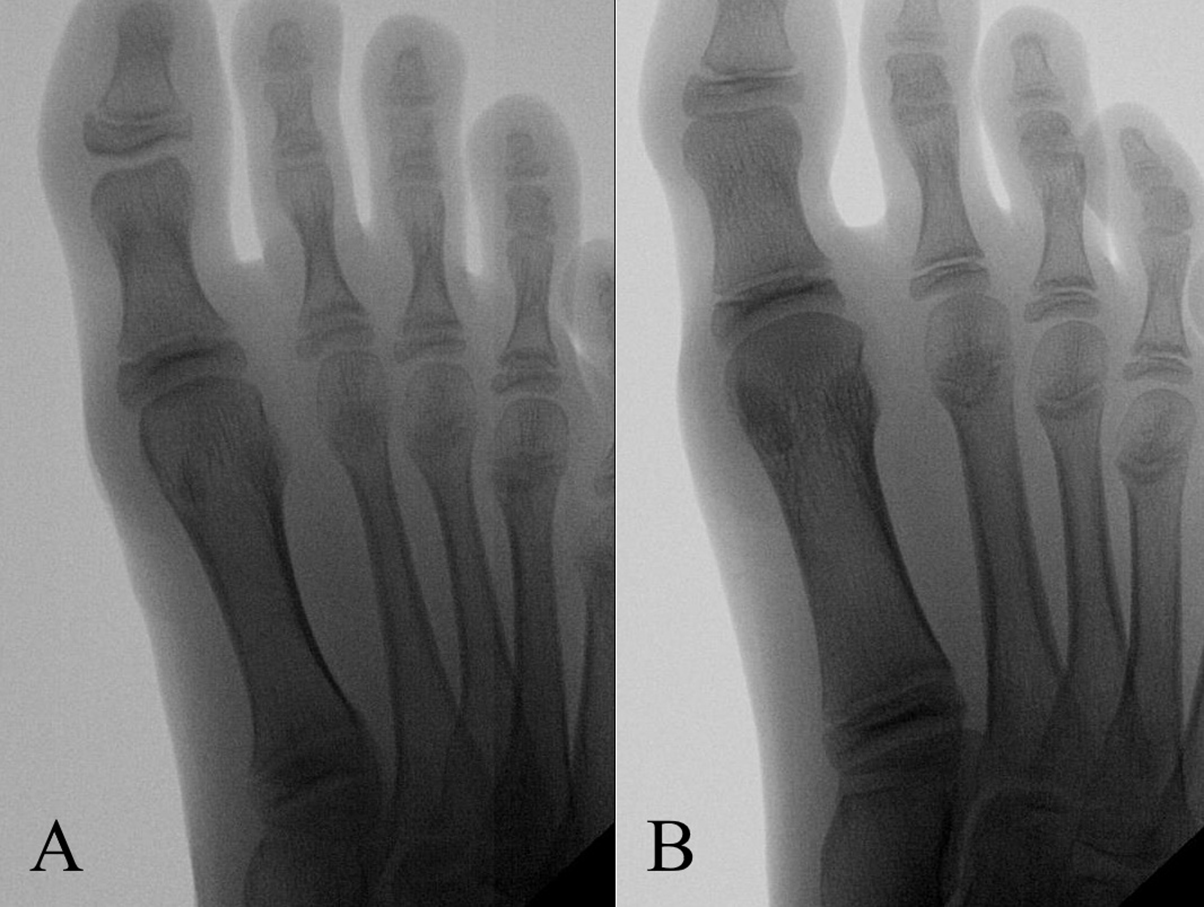
The lateral first metatarsal head shapes were assessed by taking a single fluoroscope image with the participant in a semiweightbearing position. The lateral first metatarsal head shapes were classified visually into round or angular, using examples provided to the raters from Okuda et al [
14] as shown in
Figure 3. The lateral first metatarsal head shape was classified by three different assessors of varying levels of experience in podiatry: a final year DPM student (A.P.), a registered podiatrist (S.L.C.), and a registered podiatric surgeon (R.N.). For reliability testing, this exercise was repeated three times, with intervals of 2 weeks between each assessment. In the event of any rater discrepancy, a raters’ meeting was organized, and a unanimous decision was formed on the definitive lateral first metatarsal head shape.
Figure 3.
Fluoroscopic images demonstrating (A) a rounded lateral first metatarsal head shape and (B) an angular lateral first metatarsal head shape.
Figure 3.
Fluoroscopic images demonstrating (A) a rounded lateral first metatarsal head shape and (B) an angular lateral first metatarsal head shape.
Statistical Analysis
All data analysis was performed using SPSS for Microsoft Windows (v.25; IBM Corp, Armonk, New York). Normality of our photographic and paper data was determined by segregating the data into the round and angular lateral first metatarsal head shapes and then plotting histograms. The histograms were visually assessed for a unimodal and symmetric data distribution, and only the photographic data were able to fulfil these criteria and thus be considered normally distributed.
To determine a relationship between the change in HAA and lateral first metatarsal head shape, an independent samples t test was conducted for the photographic data. As the paper data, LLAS, and FPI were nonparametric, Mann-Whitney U tests were conducted.
A paired samples t test was conducted to determine whether there was a significant increase in the HAA values obtained from the natural double-leg upright posture and forced turnout stances using the photographic method data. For the paper method, a Wilcoxon signed rank test was conducted to determine the significant difference between the HAA values obtained from the natural double-leg upright posture and forced turnout stances. Wilcoxon signed rank tests were used to determine the significant difference between the HAA measurements obtained from the paper and photographic methods for the natural double-leg upright posture, functional turnout, and forced turnout stances.
Pearson and Spearman correlation were used to determine a correlation between our study demographics and HAA for the photographic and paper data, respectively. [
23] The interrater and intrarater reliability of the photographic and paper methods were assessed by using intraclass correlation coefficient calculations. [
14] The Fleiss kappa coefficient was used to calculate the interrater and intrarater reliability of lateral first metatarsal head shape determination. [
24] A 5% significance level was assumed for all tests.
A post hoc power analysis was performed using Power and Sample Size Calculations (v.3.1.2; Vanderbilt University, Nashville, Tennessee) [
25] for the independent samples
t test, Mann-Whitney
U test, and correlation analyses.
Results
The HAA measured using the paper method increased from natural double-leg upright posture to forced turnout in both the round (mean ± SD, 2.3° ± 2.3°) and angular (mean ± SD, 2.9° ± 3.1°) lateral first metatarsal shape dancers. Similarly, the photographic method also showed an increase in the HAA, with round head shaped dancers demonstrating a 4.1° ± 4.2° and the angular head shaped dancers a 4.9° ± 3.0° difference. Even though the photographic method demonstrated a larger increase in the HAA, no significant difference was found. Regardless of the head shape, the 17 dancers demonstrated a significant increase in the HAA when moving from natural double-leg upright posture to forced turnout for both the photographic (4.6° ± 3.4°; P < .001) and paper (2.6° ± 2.8°; P = .007) methods.
The comparison between the photographic and paper methods in measuring HAA revealed no statistically significant differences in the HAA measurements across the three stances (
Table 2). Participants with a rounded lateral first metatarsal head shape had significantly higher FPI (
P = .015) and LLAS (
P = .008) values than those with an angular lateral first metatarsal head shape (
Table 1).
Table 2.
Wilcoxon Signed-Rank Tests for the Correlation Between the Photographic and Paper Methods
Table 2.
Wilcoxon Signed-Rank Tests for the Correlation Between the Photographic and Paper Methods
Lateral first metatarsal head shape and HAA changes with confounding factors revealed only one correlation. There was a high positive relationship between the duration of ballet study and the HAA change in those with an angular head shape when using the paper method data (P = .016; r = 0.734).
Reliability Analysis
Lateral First Metatarsal Head Shape Classification.
During data analysis, there were four rater discrepancies with regard to lateral first metatarsal head shape classification. The discrepancies were resolved with a unanimous decision by the raters on the definitive lateral first metatarsal head shape.
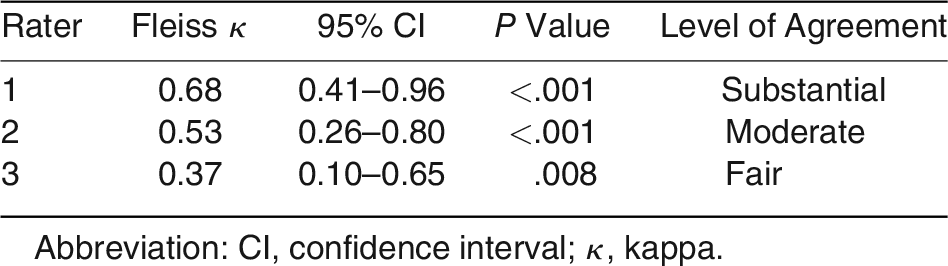
For intrarater reliability, raters 1, 2, and 3 reported agreement levels of substantial, moderate, and fair, respectively (
Table 3). The interrater reliability between the three raters produced a fair level of agreement for the lateral first metatarsal head shape classification between the three trials (Fleiss kappa coefficient = 0.29; 95% confidence interval, 0.02 to 0.57;
P = .037).
Table 3.
Intrarater Reliability for Lateral First Metatarsal Head Shape Classification Across the Three Raters
Table 3.
Intrarater Reliability for Lateral First Metatarsal Head Shape Classification Across the Three Raters
The paper method demonstrated a moderate to very high intrarater reliability, and a high interrater reliability for the three stances (
Table 4). The photographic method demonstrated a high to very high intrarater reliability for all stances across the three raters, and there was a very high degree of interrater reliability (
Table 5).
Table 4.
Intrarater and Interrater Reliability for the Mean HAA Measurements Obtained from the Paper Method
Table 4.
Intrarater and Interrater Reliability for the Mean HAA Measurements Obtained from the Paper Method
Table 5.
Intrarater and Interrater Reliability for the Mean HAA Measurements Obtained from the Three Raters for the Photographic Method
Table 5.
Intrarater and Interrater Reliability for the Mean HAA Measurements Obtained from the Three Raters for the Photographic Method
Power Analysis
A post-hoc power analysis for the primary hypothesis produced a power of 0.76 for a sample size of 17 participants using the paper method data. The mean and the standard deviation of the change in HAA for the paper method was 2.6° and 2.7°, respectively. The type I error, sample size, and ratio groups were set at 0.05, 17, and 1:1, respectively. The estimated sample size to reach 0.8 power was 19 participants.
A power of 0.96 was produced for the primary hypothesis using the photographic method data. The mean and the standard deviation of the change in HAA for the photographic method were 4.6° and 3.4°, respectively. The type I error, sample size, and ratio groups were set at 0.05, 17, and 1:1, respectively.
Discussion
This study aimed to determine whether the lateral first metatarsal head shape would lead to a significant increase in HAA in pre-pointe female ballet dancers using nonradiographic methods. No significant association was detected between the round and angular lateral first metatarsal head shape and a change in HAA from natural double-leg upright posture to forced turnout positions using both the paper and photographic methods. It should be noted that both methods produced similar results for the HAA for all three positions. Therefore, our findings reject our primary hypothesis. Our findings are inconsistent with Okuda et al, [
14] who postulated a rounded lateral first metatarsal head shape could lead to a higher recurrence of a HAV deformity following corrective surgery. The conflict between Okuda et al [
14] and our results could be attributable to our study’s small sample size; the inclusion of a juvenile, nonpathologic population rather than a post–corrective surgery population; and qualitative classification of lateral first metatarsal head shape as opposed to quantitative methods.
There was a significant increase in HAA from natural double-leg upright posture to forced turnout. This reaffirms the idea that valgus/abduction forces are applied on the hallux when assuming a forced turnout position. This is a significant finding within this study, and is strengthened by the retrospective power analysis results of the photographic method. However, this does not seem the case with dancers who have reached skeletal maturity, as Carter et al [
12] found no significant increase in the first MPJ abduction angle using the same stances in adult pre–professional ballet dancers.
There are no muscles that insert on the first metatarsal head and, as a consequence, it is vulnerable to extrinsic forces. [
26] If the metatarsal is destabilized and starts to sublux medially, the tendon drifts laterally about the first MPJ. [
26] The stabilizing muscles of the first MPJ then become deforming forces because of their lateral pull along the longitudinal axis of the first ray. [
26] As dancers continue to assume a forced turnout position, their halluces will continue to undergo valgus/abduction forces, which over time may contribute to destabilization of the first metatarsal, resulting in its medial subluxation. This may subsequently initiate progression of a HAV deformity. Therefore, we recommend that HAV prevention modalities should be uniformly used among all young ballet dancers, such as gel toe separators to be worn in ballet flats or pointe shoes.
Hypermobility (especially of the first ray) and pes planus could be predisposing factors for the development of HAV, especially within a juvenile population. [
27,
28] Our study found that dancers with a round lateral first metatarsal head shape had greater FPI and LLAS values. This suggests a round lateral first metatarsal head shape could be associated with a more hypermobile and pronated or pes planus foot type.
Dancers with an angular lateral first metatarsal head shape who had more years of ballet experience were more likely to demonstrate a greater increase in HAA when assuming a forced turnout position. However, this finding was only significant when using the paper method data and nonparametric tests, which reduces the power of the finding. This study also did not take into account other possible HAV development risk factors such as commencement of puberty/menstruation, the type of footwear worn, the first and second metatarsal lengths, first ray hypermobility, and/or the presence of metatarsus primus varus. [
27,
28]
Reliability of Methods
Lateral First Metatarsal Head Shape Classification.
There was a fair to substantial level of agreement for intrarater reliability and a fair level of agreement for interrater reliability. Our method of lateral first metatarsal head shape classification demonstrates an acceptable level of consistency, regardless of experience in podiatric practice. However, a stronger level of agreement, especially for interrater reliability, would have been desirable to improve and consolidate the repeatability of this classification method for future research and clinical use.
Photographic HAA Measurement.
Hallux abduction angle measurement using photographs demonstrated acceptable intrarater and interrater reliability, which denotes good repeatability and consistent measurements between raters. These findings are also consistent with Yamaguchi et al, [
17] whom we based this study’s HAA measurement method on. Furthermore, a strength of this study is the use of a fixed camera as opposed to participant self-photography, and a laser pointer to consistently align the participants’ feet under the camera. However, the use of the laser pointer occasionally obstructed visibility of the anatomical landmarks, thereby possibly reducing accuracy in measuring the HAA. As the setup used for the photographic method in this study is novel, it requires further validation to determine its accuracy and use as a clinical tool in measuring the HAA.
Paper HAA Measurement.
HAA measurements using the paper method demonstrated a moderate to very high intrarater agreement, and a high interrater agreement. The high reliability of both the paper and photographic methods could be attributable to the ease of definition of the two reference lines used to measure the HAA. This highlights the potential for the use of these methods in a clinical setting, specifically because of the accessibility and short time in which they can be completed.
This study also had certain limitations. Because of very specific inclusion criteria and population demographics, the study acquired a small population sample size. Furthermore, because of this being a novel study, there were no existing parameters in the literature to determine a meaningful effect size. Therefore, it was necessary to conduct a post hoc power analysis and use nonparametric statistical tests. The paper method data obtained a power of 0.76, which is below the standard accepted power value of 0.8. Future studies with larger sample sizes and refined methodologies should be able to achieve sufficient power as observed in the photographic method.
The fluoroscopic images were taken in a semiweightbearing position, and thus it would have been unreliable to perform radiographic angle measurements using the fluoroscopic images. Yamaguchi et al [
15] found the metatarsal head rotation, which occurs with pronation and supination during full weightbearing, can change the radiographic appearance of the first metatarsal head. Therefore, future studies should use full weightbearing radiographs or fluoroscopy images to determine the metatarsal head shape. It may also be worthwhile to investigate the complete first metatarsal head shape for differences in HAA or hallux valgus angle in addition to using a more standardized method in future studies. Moreover, a consensus should be reached on a metatarsal head shape classification system, given the number of varying terminologies and techniques in the current literature. [
13–
15,
29]
The high level of agreement demonstrated by the photographic method may be further improved by using a more refined technique to align the feet under the camera, so as not to obstruct the visibility of bony landmarks and account for soft-tissue bulging. This could include improvements such as positioning the foot on a marked point on the floor. With regard to the paper method, given its potential use as a clinical tool, we recommend using thicker paper to reduce the likelihood of distortion. Future studies may also compare the HAA values obtained from both the paper and photographic methods to radiographic hallux valgus angle measurements to determine their accuracy in a clinical setting. Longitudinal cohort studies would be required to determine whether there is a clinically significant forced turnout HAA value increase that would increase the risk of HAV development later in life.
Conclusions
Our findings suggest no association between the HAA and the lateral first metatarsal head shape; however, HAA does increase when a dancer assumes forced turnout. The paper method for measuring HAA demonstrated a similar reliability to the photographic method in all stances. In addition, despite a rounded lateral first metatarsal head shape having no direct impact on the HAA, it could still be a factor in the development of HAV. This is because of the possible association between a rounded lateral first metatarsal head shape and a hypermobile or pronated foot type.