


Abstract
Although chondroid syringoma rarely occurs outside the head and neck, the majority of malignant chondroid syringomas are identified in the extremities. Here, we present a case of atypical chondroid syringoma in the fifth toe. Diagnosis of chondroid syringoma with atypical cells was made following initial excisional biopsy and histology, necessitating repeated surgery for positive margins. In this case report, we examine the radiopathologic correlation of this diagnosis, detail the imaging findings of benign and malignant chondroid syringomas, and highlight how magnetic resonance imaging can be used to guide surgical planning and treatment course of this potentially malignant tumor.
Chondroid syringoma is a mixed tumor of the skin that arises from eccrine epithelium and mesenchymal tissue, first described in 1961 for its sweat gland elements (“syringoma”) and cartilage-like material (“chondroid”).[1,2] Patients with these tumors are typically middle-aged, with a 3:1 male-to-female predilection.[3] Although they may be malignant, chondroid syringomas are typically benign lesions with a low incidence ranging from 0.01% to 0.1% of all skin lesions.[1,4,5,6]
Chondroid syringomas are most commonly found in the head and neck region. However, they have also been reported in several other parts of the body, including the upper and lower extremities, axilla, flank, and scrotum.[2,7,8,9,10] According to the two largest case series of choroid syringoma published in the literature, totaling 322 patients, nearly 72% of cases were observed in the head and neck, with less than 4% of cases occurring in the foot.[2,8] However, more than 80% of malignant chondroid syringomas were found to affect the extremities. Therefore, appropriate workup and diagnosis of chondroid syringomas in the extremities is especially important.[11] Because of its often-silent clinical course and varied sites of appearance, these lesions can present challenging clinical diagnoses. In this article, we present a case of atypical chondroid syringoma in the fifth toe, with particular focus on the lesion’s magnetic resonance imaging (MRI) appearance and histologic features.
Case Report
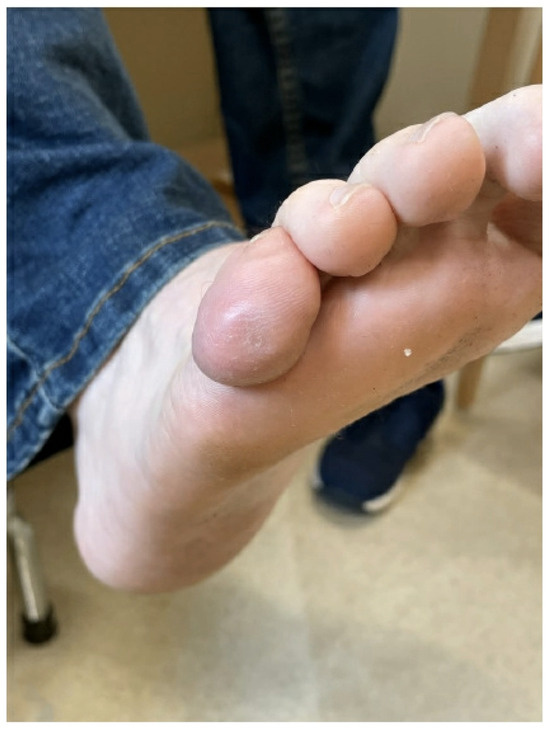
A 48-year-old man initially presented for evaluation of a soft-tissue mass on the plantar surface of his right fifth toe. He first noticed the lesion more than 1 year prior, associated with pain while walking, but denied local trauma, pain at rest, redness, or warmth. His physical examination revealed a soft-tissue mass, measuring approximately 3 × 2 cm, on the plantar surface of his right fifth toe (Figure 1
). The patient was referred to surgery for excision of the mass.
Figure 1.
A 48-year-old man presenting with a soft-tissue mass on the plantar surface of the right fifth toe, measuring approximately 3 × 2 cm.
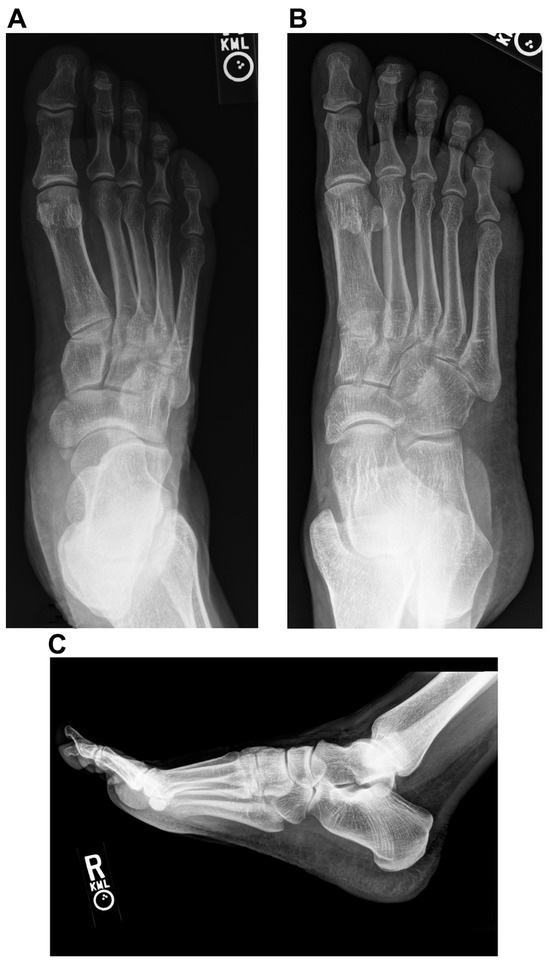
Radiographs demonstrated soft-tissue swelling of the plantar lateral aspect of the fifth digit without evidence of soft-tissue mineralization or osseus destruction (Figure 2
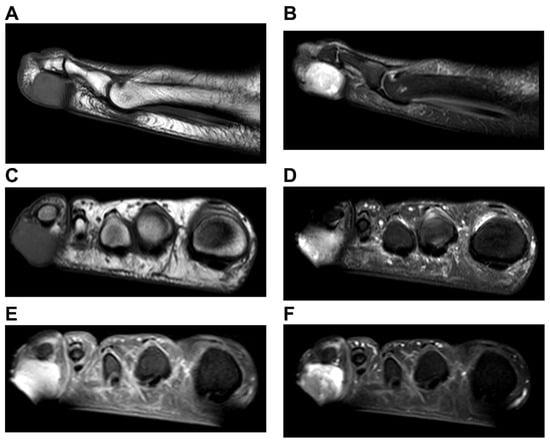
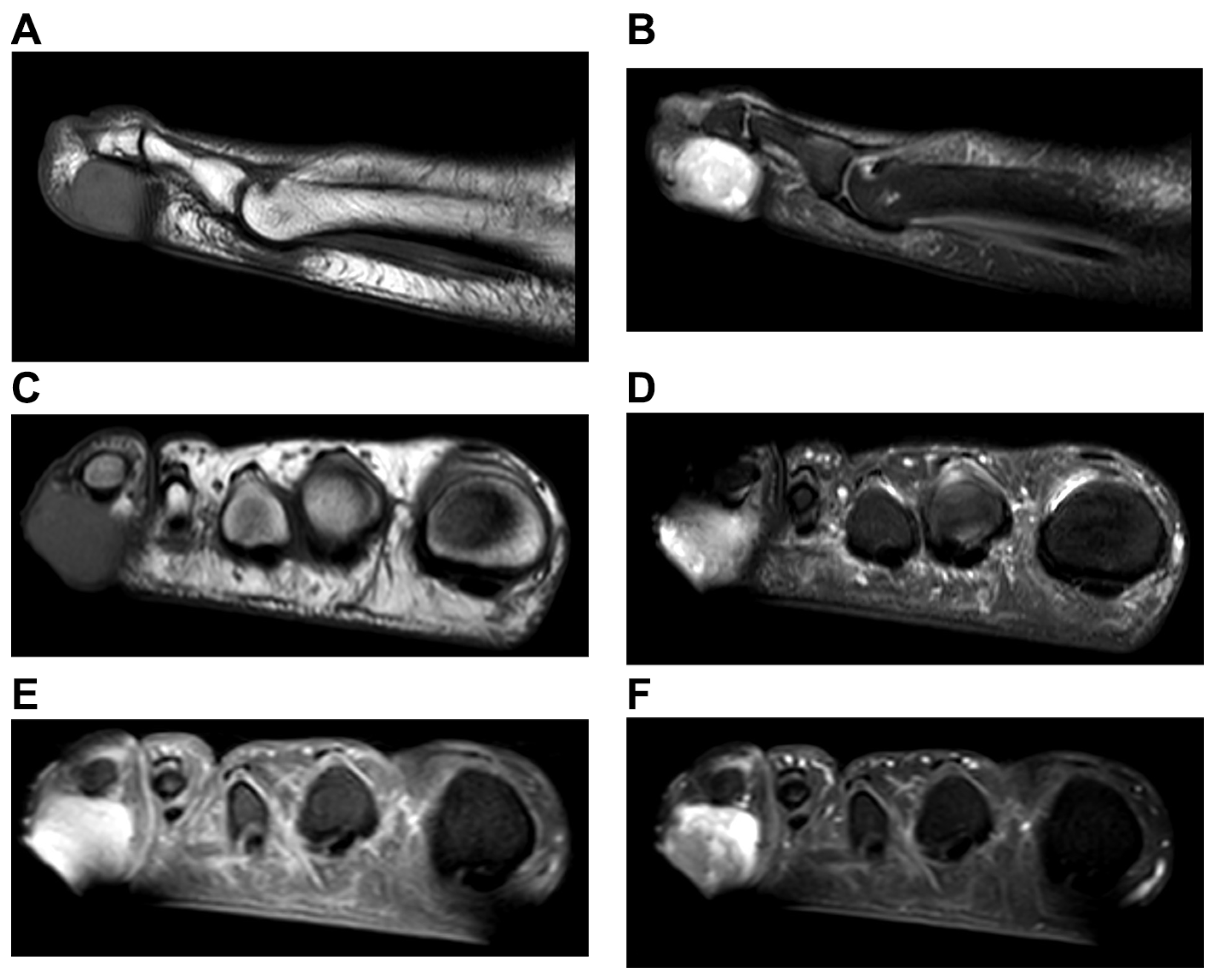
). On MRI, an ovoid circumscribed mass centered within the plantar soft tissues of the fifth toe, measuring 17 (anteroposterior) × 13 (craniocaudal) × 15 (transverse) mm was visualized (Figure 3
). The mass demonstrated broad-based dermal contact and contact with the plantar aspect of the fifth flexor digitorum longus tendon. It was also observed to be in close proximity to the underlying fifth proximal interphalangeal joint and the plantar aspect of the conjoined fifth middle and proximal phalanges. Bone marrow signals within the fifth phalanges were normal. There was no evidence of an associated fifth proximal interphalangeal joint effusion. The mass was predominantly hyperintense to muscle on T2-weighted images and isointense to muscle on T1-weighted images, with focal areas of enhancement.
Figure 2.
Right foot radiographs. A, anteroposterior; B, anteroposterior oblique; and C, lateral views, demonstrate focal soft-tissue swelling at the plantar lateral aspect of the fifth toe without soft-tissue mineralization or osseous destruction.
Figure 3.
Magnetic resonance imaging scans of the left foot. A, sagittal T1; B, sagittal T2; C, short axis T1; D, short axis T2 fat saturated (FS); E, short axis T1 FS precontrast; and F, short axis T1 FS postcontrast images, demonstrate a lobulated mass that is T2 hyperintense and T1 isointense to muscle, with areas of internal enhancement at the plantar aspect of the fifth toe, with broad-based dermal contact and dorsal displacement of the fifth flexor digitorum longus tendon.
Differential diagnosis for the mass, based on its location, was thought to include giant cell tumor of the tendon sheath and a skin appendage lesion given broad-based dermal contact. The patient underwent an uncomplicated excision of the mass, with tissue sent for pathologic evaluation. The mass was described grossly as soft, brown, and bluntly expressible from the wound. Residual mass was then dissected off the tendon sheath and surrounding tissue.
The specimen was received as tissue fragments.
Sections
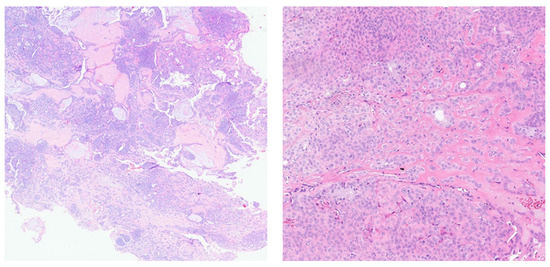
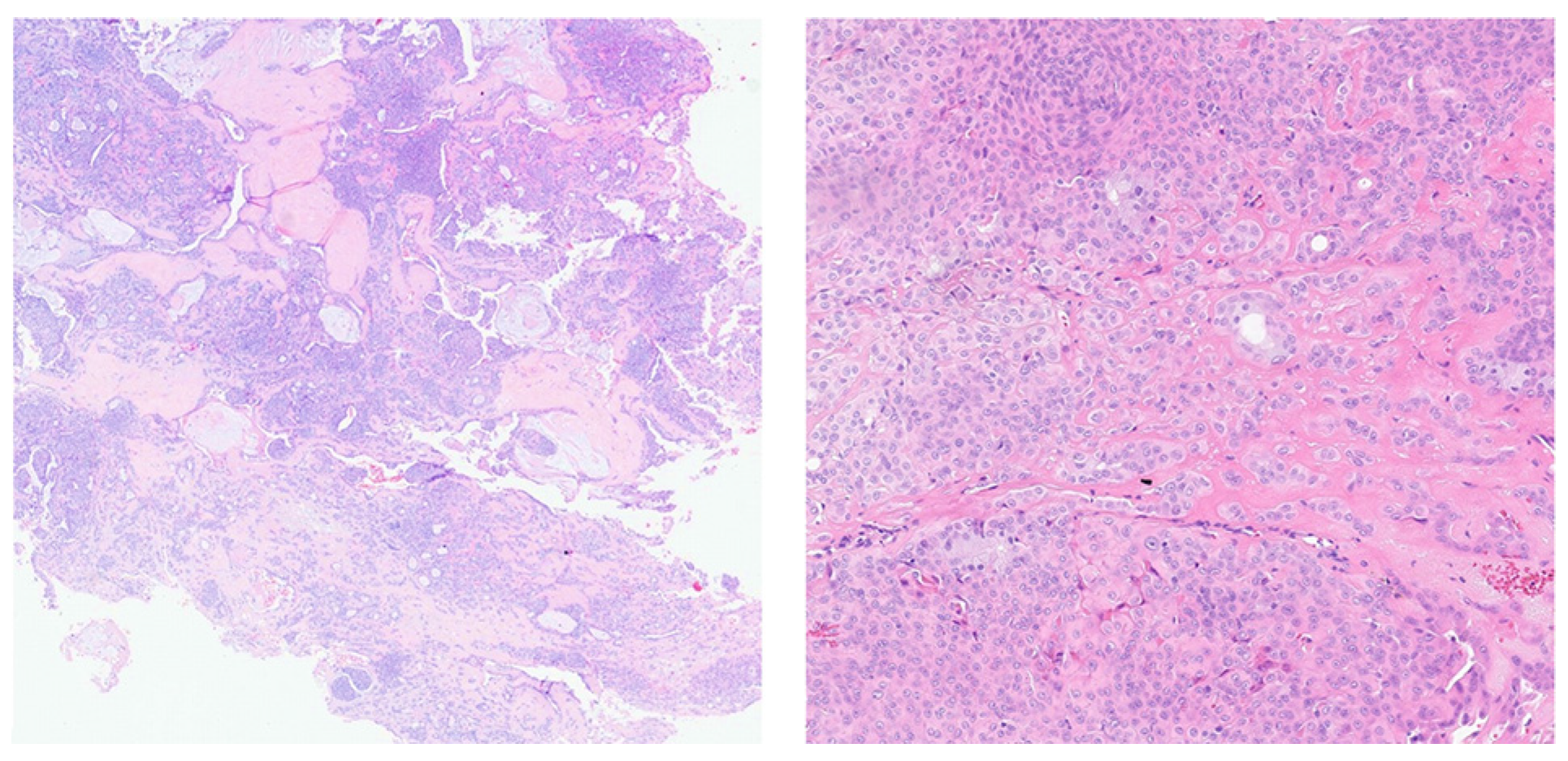
revealed an epithelial neoplasm with sclerotic and chondroid stroma (Figure 4
). In most areas, the tumor cells were uniform, small, and round, forming nests and strands and glands and ducts. However, there were also areas of papillary protrusion into the glandular spaces, hypercellularity with nuclear atypia, and rare mitosis. No tumor necrosis was observed. Epithelial cells were positive for SK903, CK5/6, and S100 and negative for P63 and CD68. Smooth muscle actin highlighted rich vasculature and calponin-stained patch myoepithelial cells. Ki-67 confirmed the presence of sparse mitotic activity. Overall, this appeared to be a mixed tumor of sweat gland origin with some atypical histologic features, including poor demarcation and focal cytologic atypia with mitotic activity. Although the specimen did not appear frankly malignant, the entire lesion was not available for evaluation and complete removal of the tumor was recommended. The patient returned for a complete reexcision, including the overlying involved skin, and pathologic analysis confirmed the diagnosis of a residual chondroid syringoma with margins free of involvement, indicating a successful full excision. At follow-up 8 weeks later, the patient was doing well.
Figure 4.
Epithelial neoplasm with sclerotic and chondroid stroma. The tumor cells are mostly small and uniform forming nests, strands, glands, and ducts. Focal papillary formation, hypercellularity, mild nuclear atypia, and rare mitosis are present. No tumor necrosis was observed.
Discussion
Since the case series in 1961, there have been at least seven published case reports of a chondroid syringoma in the toe, as seen in our patient[12,13,14,15,16,17,18]; however, only two of these studies discuss the MRI features of the tumor, and do so minimally.[13,14] The mass in our case exhibited T2 hyperintense signal with enhancement, which is similar to what has been described in the literature.[13,14] The mass in our case also demonstrated broad-based dermal contact. Differential diagnoses on the basis of MRI would include skin appendage lesions such as epidermal inclusion cysts, although the extent of enhancement would be unusual. As the mass abutted the fifth flexor digitorum longus tendon sheath, giant cell tumor of the tendon sheath was also a consideration; however, the mass did not encapsulate the tendon sheath and was more hyperintense than expected on the T2- and T1-weighted images for a tenosynovial giant cell tumor. Prospectively, the diagnosis of chondroid syringoma is difficult to make solely on the basis of imaging features alone. Similarly, a 2001 case report discusses the MRI features of malignant chondroid syringoma in the palm, noting that the imaging characteristics are often nonspecific but can still reveal valuable information about tumor location, degree of invasion, and relationship to neighboring structures.[19] Magnetic resonance imaging serves a similar function in our case of atypical chondroid syringoma in the toe in helping guide surgical excision.
Malignant chondroid syringoma is a much rarer entity than its benign counterpart, with a predisposition toward the extremities and a tendency for rapid growth after years of slow or no growth.[11] Malignant mixed tumors are documented to have high rates of recurrence (50%), and local (39%) and distant metastases (36%).[13] Histopathologically, malignant chondroid syringomas are characterized by varying degrees of nuclear atypia, mitotic figures, and areas of epithelial tumor necrosis.[20] Our patient’s pathology specimen demonstrated some but not all of these features, suggesting an atypical histologic appearance without frank malignancy.
Complete surgical excision is the treatment of choice for both benign and malignant chondroid syringomas.[3] Because of the tumor’s often lobulated structure, residual tissue is a frequently occurring complication, and recurrence is not uncommon. Therefore, surgeons should approach these masses with a technique that allows for unimpeded histologic analysis of margins to confirm a successful complete excision. In our case, once initial histology revealed a mixed tumor of sweat gland origin, the patient was advised to return for full reexcision. In cases of malignant chondroid syringoma in the toe with bone invasion, amputation is the definitive curative treatment.[13,18]
Conclusions
Although cases of benign chondroid syringoma are well documented, the malignant counterpart is extremely rare and can present in myriad ways, both histologically and radiographically. Magnetic resonance imaging is an invaluable tool to guide surgical planning and treatment of this difficult to diagnose and potentially deadly tumor.
Funding
None reported.
Conflicts of Interest
None reported.
References
- Chen, A.H.; Moreano, E.H.; Houston, B.; et al. Chondroid syringoma of the head and neck: clinical management and literature review. Ear Nose Throat J. 1996, 75, 104. [Google Scholar] [CrossRef] [Scilit] [PubMed]
- Hirsch, P.; Helwig, E.B. Chondroid syringoma. Mixed tumor of skin, salivary gland type. Arch. Dermatol. 1961, 84, 835. [Google Scholar] [CrossRef] [Scilit] [PubMed]
- Plachta, I.; Kleibert, M.; Czarnecka, A.M.; et al. Current diagnosis and treatment options for cutaneous adnexal neo-plasms with apocrine and eccrine differentiation. Int. J. Mol. Sci. 2021, 22, 5077. [Google Scholar] [CrossRef] [Scilit] [PubMed]
- Hermann, G.; Moss, D.; Norton, K.I.; et al. Case report 450: skeletal metastases secondary to malignant chondroid syringoma. Skeletal. Radiol. 1987, 16, 657. [Google Scholar] [CrossRef] [Scilit] [PubMed]
- Sundling, R.A.; So, E.; Logan, D.B. Chondroid syringoma. Foot. Ankle Spec. 2017, 10, 167. [Google Scholar] [CrossRef] [Scilit]
- Yavuzer, R.; Basterzi, Y.; Sari, A.; et al. Chondroid syringoma: a diagnosis more frequent than expected. Dermatol. Surg. 2003, 29, 179. [Google Scholar] [CrossRef] [Scilit] [PubMed]
- Wollina, U.; Sturm, U.; Schonlebe, J. Benign chondroid syringoma (mixed tumor of skin) on the flank with sat-ellites: case report and literature review. Wien. Med. Wochenschr. 2014, 164, 377. [Google Scholar] [CrossRef] [Scilit] [PubMed]
- Stout, A.P.; Gorman, J.G. Mixed tumors of the skin of the salivary gland type. Cancer 1959, 12, 537. [Google Scholar] [CrossRef] [Scilit] [PubMed]
- Miyakawa, A.; Tachibana, M.; Horiguchi, Y.; et al. Intrascrotal chondroid syringoma. Br. J. Urol. 1997, 79, 293. [Google Scholar] [CrossRef] [Scilit] [PubMed]
- Ki, S.Y.; Lim, H.S.; Lee, H.J.; et al. Chondroid syringoma of the axilla masquerading as a metastatic lymph node. Breast. J. 2020, 26, 1402. [Google Scholar] [CrossRef] [Scilit] [PubMed]
- Harrist, T.J.; Aretz, T.H.; Mihm, M.C., Jr.; et al. Cutaneous malignant mixed tumor. Arch. Dermatol. 1981, 117, 719. [Google Scholar] [CrossRef] [PubMed]
- Toback, T.G.; Toback, C.J. Chondroid syringoma. A review of the literature and case report. JAPMA 1989, 79, 563. [Google Scholar] [CrossRef] [Scilit] [PubMed]
- Takahashi, H.; Ishiko, A.; Kobayashi, M.; et al. Malignant chondroid syringoma with bone invasion: a case report and review of the literature. Am J Dermatopathol 2004, 26, 403. [Google Scholar] [CrossRef] [Scilit] [PubMed]
- Sirinoglu, H.; Ersoy, B.; Tezel, E. Benign chondroid syrin-goma: atypical presentation of a rare eccrine tumor. J. Foot. Ankle Surg. 2011, 50, 364. [Google Scholar] [CrossRef] [Scilit] [PubMed]
- Potter, G.K.; Baldinger, H.G.; Boxer, M.C. Chondroid syringoma in a toe. Cutis 1982, 30, 339. [Google Scholar] [PubMed]
- Lu, H.; Chen, L.F.; Chen, Q.; et al. A rare large cutaneous chondroid syringoma involving a toe: a case report. Medicine 2018, 97, e9825. [Google Scholar] [CrossRef] [Scilit] [PubMed]
- Barreto, C.A.; Lipton, M.N.; Smith, H.B.; et al. Intraosseous chondroid syringoma of the hallux. J. Am. Acad. Dermatol. 1994, 30, 374. [Google Scholar] [CrossRef] [Scilit] [PubMed]
- Watson, J.A.; Walker, M.M.; Smith, N.P.; et al. Malignant chondroid syringoma—a rare cause of secondary bone tumour. Clin. Exp. Dermatol. 1991, 16, 306. [Google Scholar] [CrossRef] [Scilit] [PubMed]
- Nicolaou, S.; Dubec, J.J.; Munk, P.L.; et al. Malignant chondroid syringoma of the skin: magnetic resonance imag-ing features. Australas. Radiol. 2001, 45, 240. [Google Scholar] [CrossRef] [Scilit] [PubMed]
- Metzler, G.; Schaumburg-Lever, G.; Hornstein, O.; et al. Malignant chondroid syringoma: immunohistopathol-ogy. Am. J. Dermatopathol. 1996, 18, 83. [Google Scholar] [CrossRef] [Scilit] [PubMed]
© 2023 American Podiatric Medical Association