Sesamoid injuries can be a painful, disabling problem, especially in athletes. They are most prevalent in athletes with “explosive” movements where the hallux is dorsiflexed. This frequently includes dancers, runners, and gymnasts.[
1,
2] Most sesamoid injuries seen are stress fractures (∼80%), with acute traumatic injuries occurring less frequently.[
3] Most cases can be treated conservatively. In fact, it is estimated that 80% to 90% of cases are treated conservatively in the literature.[
3] However, in cases in which nonoperative management fails, surgical intervention is warranted.
Aper et al[
4,
5] published two landmark articles that analyzed the biomechanical effects after sesamoid excision. Using a cadaver, they quantified the effective tendon moment arm in progressive sesamoid resection. They analyzed the impact of partial and total excision of the tibial sesamoid, fibular sesamoid, or both on the flexor hallucis brevis (FHB) and flexor hallucis longus (FHL) muscles. They found that partial excision resulted in no significant decrease in either tendon. Only total excision of both sesamoids decreased the moment arm of the FHB muscle. However, total excision of either sesamoid significantly weakened the FHL muscle. It can be concluded that with singular total sesamoid excision, all of the attachments of the FHB muscle are still intact, which preserves the function. The FHL muscle, on the other hand, has no capsular attachments and can move closer to its center of rotation, which causes weakening of the tendon.[
4,
5]
Although biomechanics and postoperative outcomes have been analyzed in research, the present case study presents a rare occurrence of a tibial sesamoid fracture along with congenital absence of the fibular sesamoid. The biomechanical effects of having fewer than one sesamoid and long-term outcomes have yet to be analyzed.
Case Study
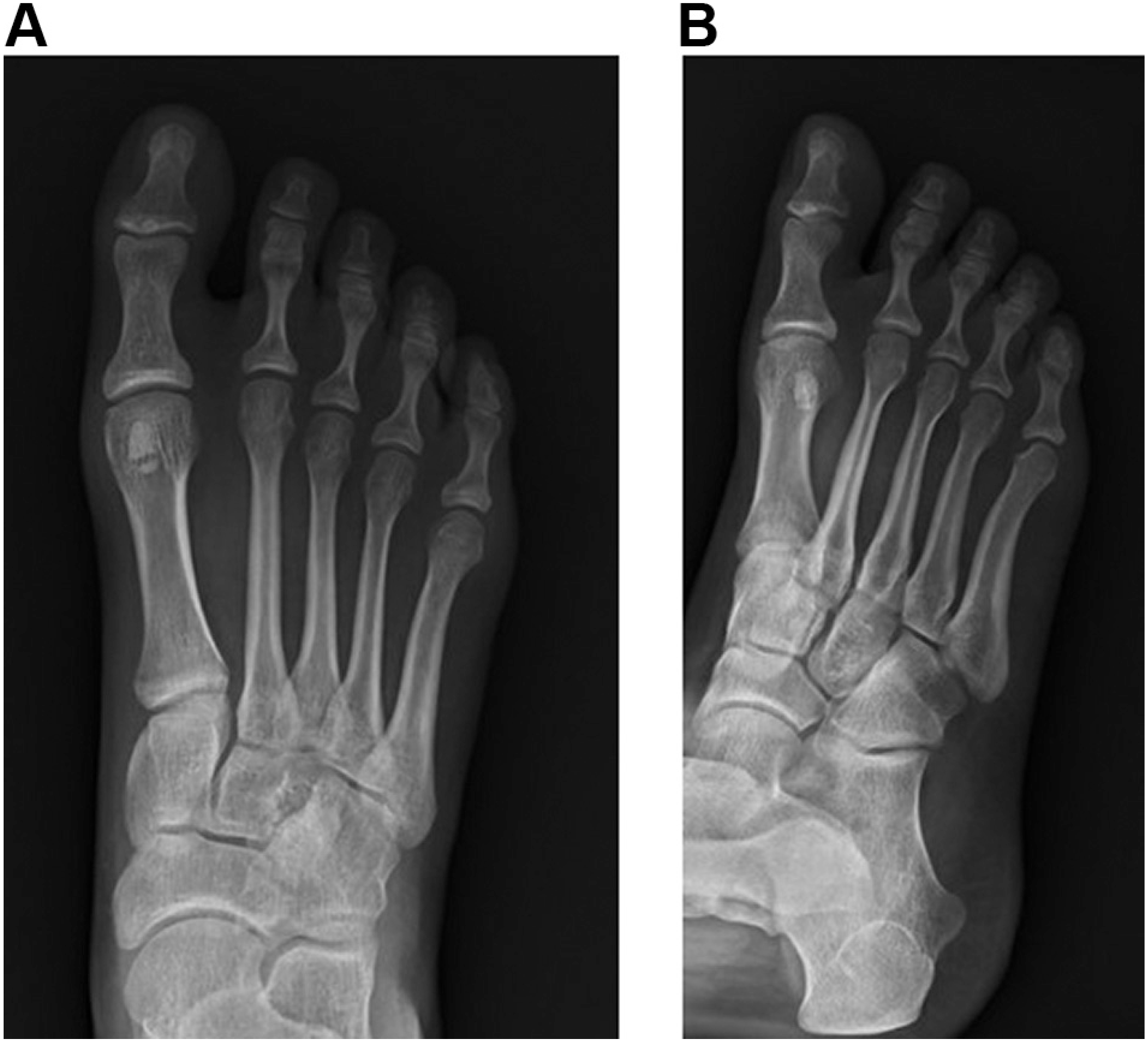
A 17-year-old female high school senior presented to the clinic with right hallux pain. The patient was a pitcher for her high school team and played in a travel softball league. She first noticed pain in Spring training and presented to the podiatric medical clinic for initial evaluation 3 months after symptoms began. Radiographs at this encounter showed congenital absence of the lateral sesamoid and evidence of an avulsion fracture of the proximal medial tibial sesamoid (
Fig. 1). The proximal pole of the tibial sesamoid demonstrated sharp, uneven, uncorticated lines consistent with a fracture; a bipartite sesamoid would have two corticated fragments with smoother edges. The patient was unsure of a mechanism of injury but relayed that after a 17-inning game she had severe, nonradiating, aching pain under her first metatarsal head. She was initially treated in a boot for 12 weeks, followed by 4 weeks of insoles. However, the patient was unable to tolerate the orthotic device. Multiple shoe accommodations were made for the patient for off-loading of the sesamoids. Despite months of conservative treatment, she continued to have a pain level of 7 of 10 with ambulation in tennis shoes. The pain had worsened to the point where she could no longer play softball and was having pain on ambulation and day-to-day activities. Due to the patient’s continued worsening pain, surgical intervention was discussed 3.5 months after initial presentation to the podiatric medical clinic. After discussing the risks and benefits, the patient decided to undergo partial excision of the tibial sesamoid.
Figure 1.
Anteroposterior (A) and medial oblique (B) preoperative radiographs showing fracture of the tibial sesamoid and congenital absence of the fibular sesamoid.
Figure 1.
Anteroposterior (A) and medial oblique (B) preoperative radiographs showing fracture of the tibial sesamoid and congenital absence of the fibular sesamoid.
Surgical Technique
The patient was placed in the supine position and the foot was prepared and draped in the usual sterile manner. Local block was performed at the first ray. A longitudinal incision approximately 3 cm long was directed to the plantar aspect of the right first metatarsal. The incision was medial to the FHL tendon and over the medial sesamoid. Careful dissection took place, and vital structures were retracted. Careful dissection of the proximal medial hallucal sesamoid fracture was performed. Intraoperative fluoroscopy was used to identify the fractured medial sesamoid bone. The dissection was taken deeper over the proximal extent of the fractured medial sesamoid. The first metatarsophalangeal joint was analyzed and found to be free of defects. The remaining portion of the tibial sesamoid was smoothed with a bone rasp.
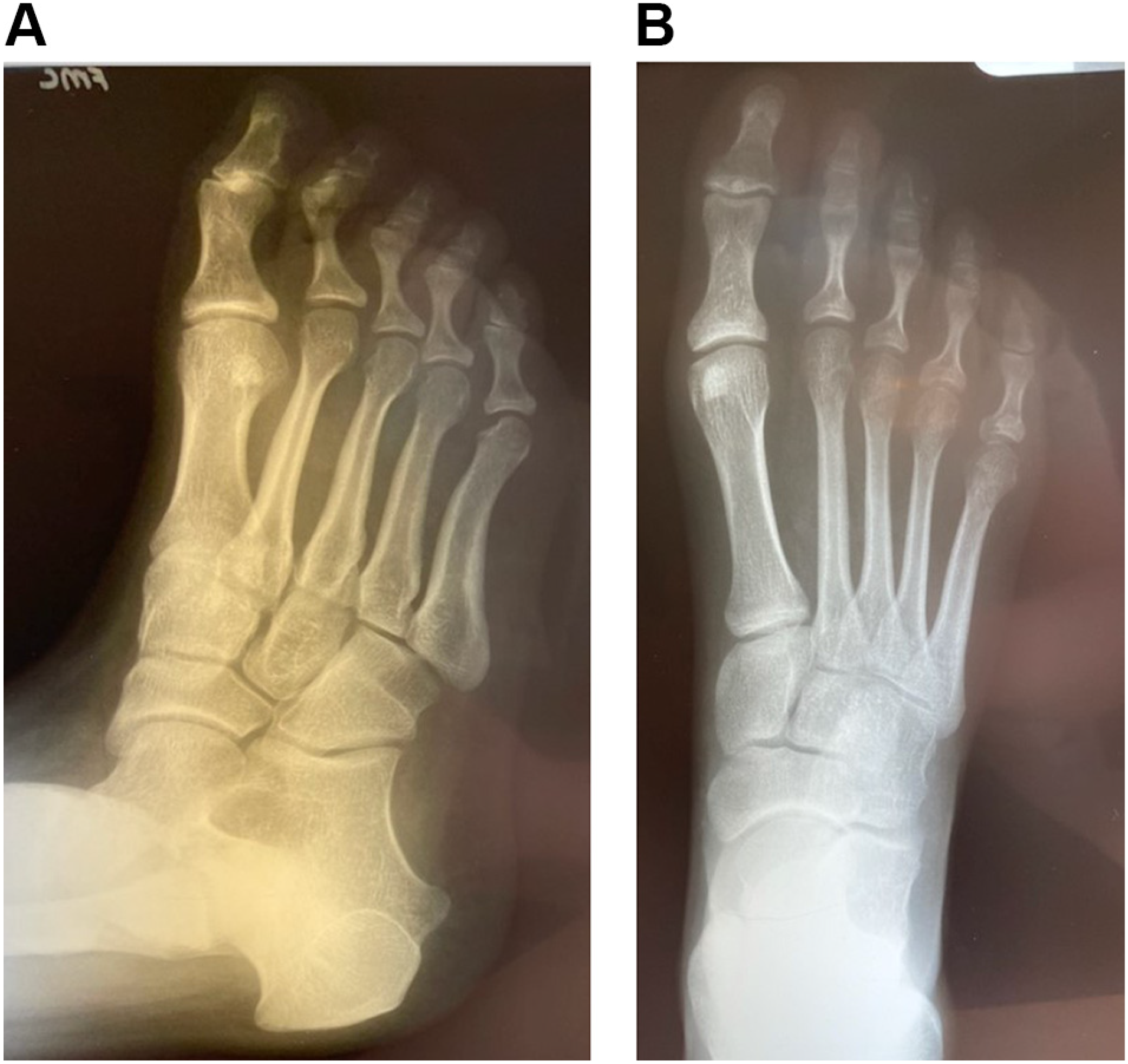
Figure 2 demonstrates postoperative radiographs with removal of the proximal pole of the tibial sesamoid. The FHL muscle remained retracted during the entire procedure and was found to have no defects. The surgical site was flushed and closed in layers and then dressed with sterile 4 × 4-inch gauze sponges, a cotton roll, a gauze bandage roll (Kerlix; Covidien, Dublin, Ohio), and a Jones compression bandage.
Figure 2.
Medial oblique (A) and anteroposterior (B) postoperative radiographs showing removal of the proximal pole of the tibial sesamoid.
Figure 2.
Medial oblique (A) and anteroposterior (B) postoperative radiographs showing removal of the proximal pole of the tibial sesamoid.
Postoperative Course
The sutures were removed approximately 2.5 weeks postoperatively. She remained nonweightbearing for approximately 1 month and was then transitioned to weightbearing as tolerated in a CAM boot. Two months postoperatively she was transitioned from a CAM walker to orthoses with a metatarsal pad in supportive tennis shoes. She was told to continue to minimize activity, with no athletic activity. Two and a half months postoperatively she had no pain with ambulation in tennis shoes with orthoses. She was advanced to cross-training but was not allowed to start jumping for another month. When she returned to softball 6 months after surgery, she began to have pain after softball practice. However, the pain was resolved with ice. She played for several months after her surgery and was able to tolerate softball using ice and orthoses. However, at her follow-up visit 1.5 years after her surgery, she states that she had to eventually give up softball due to increased pain. She continued to be seen in the podiatric medical clinic for sesamoiditis. She had no functional limitations in day-to-day activities but had to limit activities with push-off. She was given new orthotic devices and a suggestion to wear rocker-bottom shoes at this encounter.
Discussion
Multiple articles have been published on outcomes after sesamoid excision in athletes. In one such article, Dean et al[
6] compared athletes and nonathletes after sesamoid excision to differentiate success based on athletic status. They found that 80% of competitive athletes were able to return to sports in a mean of 4.62 months after surgery.[
6] The present patient initially returned to her sport but was not able to continue to play competitively due to pain at her first metatarsal. Lee et al[
7] found that after isolated tibial sesamoidectomy, 30% of patients had extreme difficulty or inability to stand tiptoe. This is consistent with the present patient, who was a pitcher and required her hallux to dorsiflex during throws.
Ford et al[
8] analyzed efficacy, outcomes, and alignment after an isolated sesamoidectomy. Their retrospective study had a median 5-year follow-up. They found that visual analog scale pain scores improved from 6 preoperatively to 1 postoperatively. They reported that 80% of patients would have the surgery again and 70% were “very satisfied” with their result.[
8] In the present case study, the patient had minimal pain postoperatively and in day-to-day exercise. She rated her pain 7 of 10 preoperatively with ambulation and postoperatively had 0 of 10 pain in day-to-day activities. However, she continued to have pain with competitive softball.
Saxena and Krisdakumtorn[
9] looked at 26 sesamoidectomies in 24 patients, reviewing complications, time to return to activity, and incision location. It was found that pain and swelling was the most common complaint preventing patients with tibial sesamoidectomies from returning to activity. It was concluded that this complication was caused by the tibial sesamoid bearing a greater portion of weight than the fibular sesamoid.[
9] In the present case study, the patient did not have a fibular sesamoid, causing more pressure on the tibial sesamoid. This may have contributed to the patient’s inability to return to softball.
We hypothesize that the patient was unable to return to softball due to the repetitive hyperdorsiflexion required during pitching. The patient was able to perform day-to-day movements that did not aggravate her foot, which leads us to conclude that the specific movements of softball pitching are what stressed her sesamoid complex. McCormick and Anderson[
10] analyzed the decreased push-off strength after excision of isolated sesamoids. They found that with excision of the fibular sesamoid, tibial sesamoid, or both sesamoids, 16%, 10%, and 30% of push-off strength, respectively, was lost.[
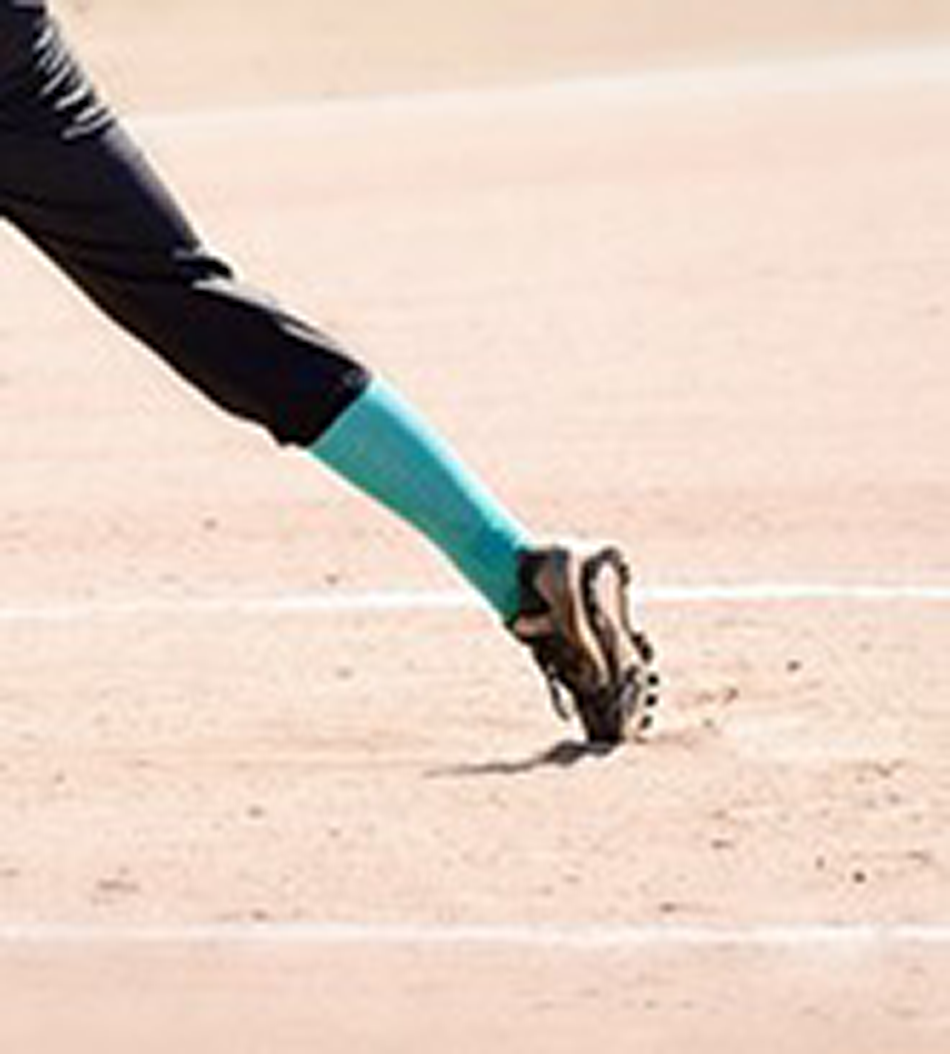
10] In pitching, the hallux is brought through a dorsiflexed position during each pitch (
Fig. 3). Because the patient had congenital absence of the fibular sesamoid, she was now left with only half of a tibial sesamoid, greatly affecting her push-off strength.
Figure 3.
Hallux dorsiflexion during pitching.
Figure 3.
Hallux dorsiflexion during pitching.
In a literature review, they found that 80% to 92% of athletes returned to activity after isolated sesamoidectomy.[
6,
11] However, none of these studies included cases where the patient had a congenital absence of the fibular sesamoid. Having the congenital absence complicated the treatment plan of the present patient. Although only a partial tibial sesamoidectomy was performed, the patient was left with only part of the tibial sesamoid, altering the biomechanics of her foot. Overall, the patient had improved pain in day-to-day activities: 7 of 10 preoperatively and 0 of 10 postoperatively. Due to the explosive nature of her sport, absence of one sesamoid weakens the FHL muscle and continues to cause her pain in propulsive movements. This case demonstrates a unique sesamoid fracture in an athlete complicated by congenital absence of the fibular sesamoid.