Residency training is a consistent requirement for all of the medical physician specialties. However, not all residency programs have the resources conducive for resident physicians to cultivate their clinical and surgical acumen with reasonable autonomy. As a result, attending physicians may hesitate to provide resident physicians with the autonomy to treat their patients clinically and surgically. Many residency training programs, including podiatric surgery, provide resident-run clinics. These are medical clinics typically in an underserved community in which the resident physician performs all medical decision making and provides treatment under direct attending supervision.
Few reports are available demonstrating the effectiveness of resident-run clinics in residency training programs. In a survey of ten graduating chief residents in a plastic surgery resident-run clinic, Day et al [
1] found that they regarded the clinic as valuable for surgical experience (4.1 of 5), operative autonomy (4.4 of 5), and medical knowledge development (4.7 of 5). Ingargiola et al [
2] surveyed 32 plastic surgery residencies with a resident-run cosmetic clinic in which the residents would perform common surgeries such as abdominoplasty, breast augmentation, and liposuction. Overall, 26 of the 32 respondents with a resident-run clinic did report feeling satisfied or very satisfied with the resident aesthetic clinic, and the authors concluded that the clinics were an effective training method for surgical technique and resident autonomy [
2]. Pyle et al [
3] also assessed resident-run cosmetic clinics and found that in a 7-year period the rate of revision and minor complications was expected and acceptable for the profession at large. Thus, they concluded that a resident-run clinic is not only an effective learning tool for the resident but also safe and beneficial for the patient.
General surgery resident-run clinic efficacy and safety were investigated by Wojcik et al. [
4] They found that the postprocedure complication rate was not statistically significantly different between a resident performing the procedure versus an attending performing the procedure. They also noted that resident evaluations overwhelmingly supported the clinic, citing the increased operative autonomy as a great benefit [
4].
Within urology, Witherspoon et al [
5] found that residents involved in such a clinic had an overall confidence in their ability to manage the clinic (8.25 of 10). Patients also reported their confidence in the resident’s capabilities at 9.07 of 10, and 100% of the patients surveyed would recommend a friend to the clinic [
5]. Robertson et al [
6] found patient satisfaction to be 9.29 of 10 for patients treated in a resident-run hand trauma clinic.
These studies regarding resident-run clinics are promising when considering the safety and the educational purpose of the clinic. The clinic seems to provide an environment of autonomy that is beneficial for resident physician and patient alike.
After an extensive literature review, it was determined that there has not been any research investigating the effectiveness of a primarily resident-run clinic in a podiatric medical residency program in the United States. The purpose of this study was to provide a preliminary investigation into the utility of a resident-run clinic in podiatric surgical residency. Unlike previously mentioned studies, we sought to gather information from residents with aresident-run clinic and those without a resident-run clinic. We hypothesized that residents with a resident-run clinic may have increased confidence in clinical scenarios compared with those without a resident-run clinic. Thus, we undertook a survey study with the aim of gathering preliminary data demonstrating the subjective perspective of residents with and without such a clinic to assess whether this clinic enhanced a resident’s clinical confidence.
Methods
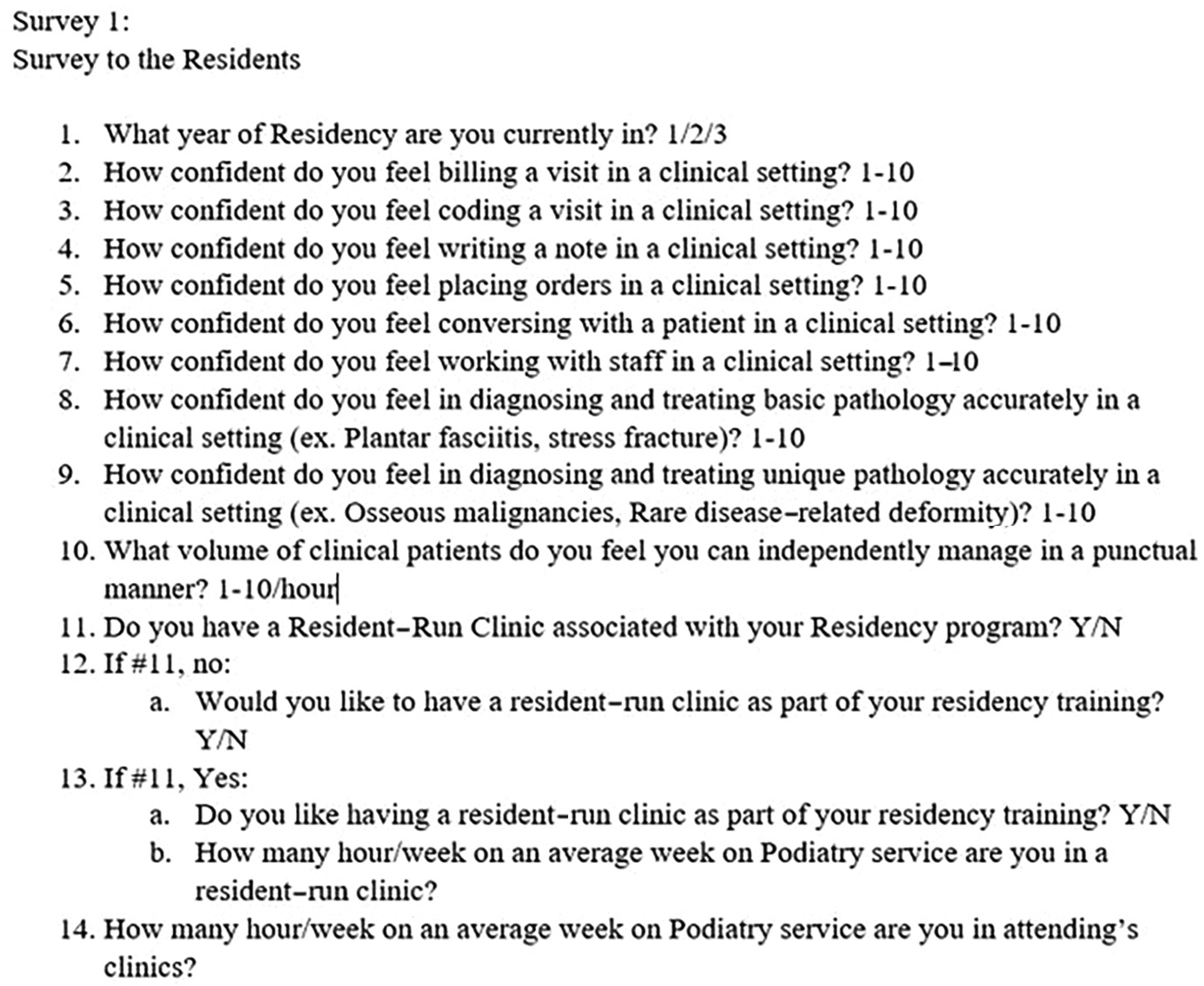
A survey examining various aspects of a resident-run clinic and resident clinical performance was distributed to all Doctor of Podiatric Medicine programs recognized by the Council on Podiatric Medical Education in the United States. The survey included multiple-choice and yes-or-no answer options (
Figure 1
).
To be included in the study, a program must have had a contact e-mail listed in the Central Application Service for Podiatric Residencies (CASPR) residency contact directory. By the nature of the study design, podiatric medical residents attending a program that does not have a contact e-mail listed in the CASPR residency directory were excluded. We also excluded podiatric medical residents at the authors’ training institution and those at training programs outside of the United States. A total of 208 residency programs met the inclusion and exclusion criteria.
Institutional review board approval was obtained from OhioHealth Grant Medical Center before distribution of the study survey. Per the author’s institutional policies, no financial or monetary incentives were used to encourage participation. The survey, along with appropriate instructions and a link for survey completion, was sent to the residency program e-mail address listed on the CASPR Web site directory. The survey was directed to be sent to all of the podiatric medical residents in the training program. No personal information, including name or residency program, was gathered from participants, and the survey was voluntary. Reminder e-mails were sent 2 weeks and 4 weeks after the original send date. The survey closed after 6 weeks, and no more responses were accepted. This process took place from February 2021 until April 2021.
Survey data were collected using the study-specific data collection tool Research Electronic Data Capture (REDCap; Vanderbilt University, Nashville, Tennessee). REDCap is a secure Web-based application used to build and manage online surveys and databases. The REDCap program and the resulting data were maintained on internal servers and backed up regularly. The previously mentioned collection method has the technical capabilities to be Health Insurance Portability and Accessibility Act and 21 CFR 11 compliant. Only deidentified or nonidentifiable data were reported in the study, and only delegated research staff was allowed access to participant information.
Normality was determined using a Shapiro-Wilk test. All of the data are summarized with descriptive statistics. Continuous variables are summarized with means and SDs for normal variables and with medians and ranges for nonnormal variables. Categorical variables were summarized with counts and percentages. Comparisons in continuous variables were made using independent-samples t tests or Mann-Whitney U tests. Comparisons in categorical variables were made using x 2 tests. Significance was set a priori at P < .05.
Results
The survey was distributed to 208 residency programs. Of 126 people who opened the survey, 29 were excluded for incomplete surveys and not meeting the inclusion criteria. Overall, 97 residents were included in the study.
Fifty-eight participants (59.79%) were residents associated with a resident-run clinic and 39 (40.21%) were residents who were not associated with a resident-run clinic. Thirty-two participants (32.99%) were first-year residents, 26 (26.80%) were second-year residents, and 29 (29.90%) were third-year residents. Ten participants chose to not answer the inquiry regarding what year in residency they were. This accounted for 10.31% or participants whose year is unknown.
Of the 58 participants who had a resident-run clinic as part of their residency training, 52 (89.66%) reported that they did like having a resident-run clinic. Of the 39 participants who did not have a resident-run clinic as part of their residency training, 21 (53.85%) reported that they would like to have a resident-run clinic and 18 (46.15%) reported that they would not.
The average amount of time spent in an attending clinic for all of the participants who completed the survey was 16.91 hours per week. Those who did not have a resident-run clinic spent an average of 18.31 hours per week. Those who did have aresident-run clinic spent an average of 15.87 hours per week in an attending clinic, in addition to an average of 10.29 hours per week in a resident-run clinic. This difference did not meet statistical significance (P = .281).
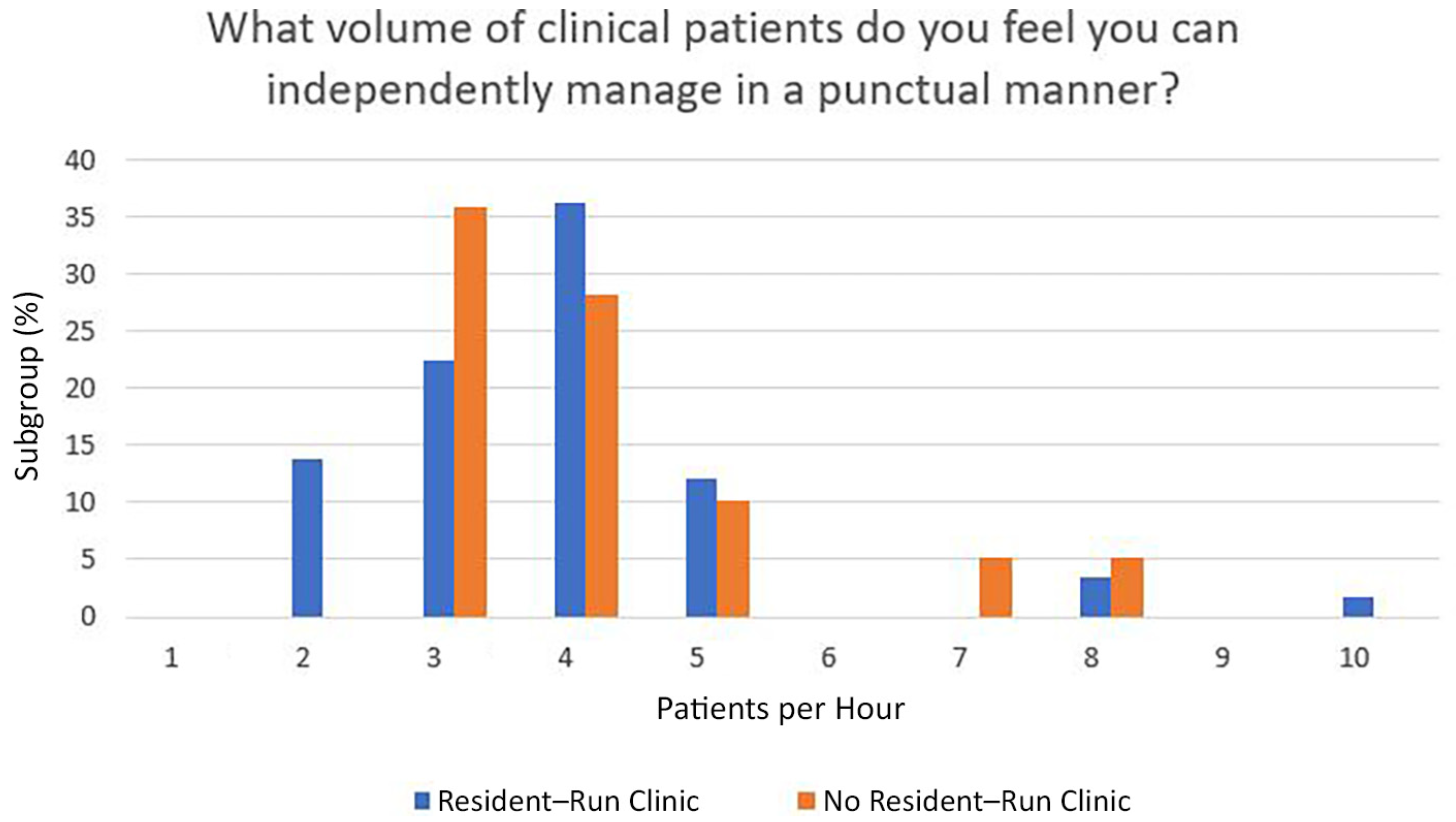
Each resident was asked what volume of clinical patients they felt they could independently manage per hour. The most common response was four patients per hour (32 residents [32.99%]), followed by three patients per hour (27 residents [27.84%]). Other responses included two patients per hour (eight residents), five patients per hour (11 residents), seven patients per hour (two residents), eight patients per hour (four residents), and ten patients per hour (one resident). There was no statistically significant difference between responses in the group of residents with a resident-run clinic and the group without a resident-run clinic (
P = .111) (
Figure 2).
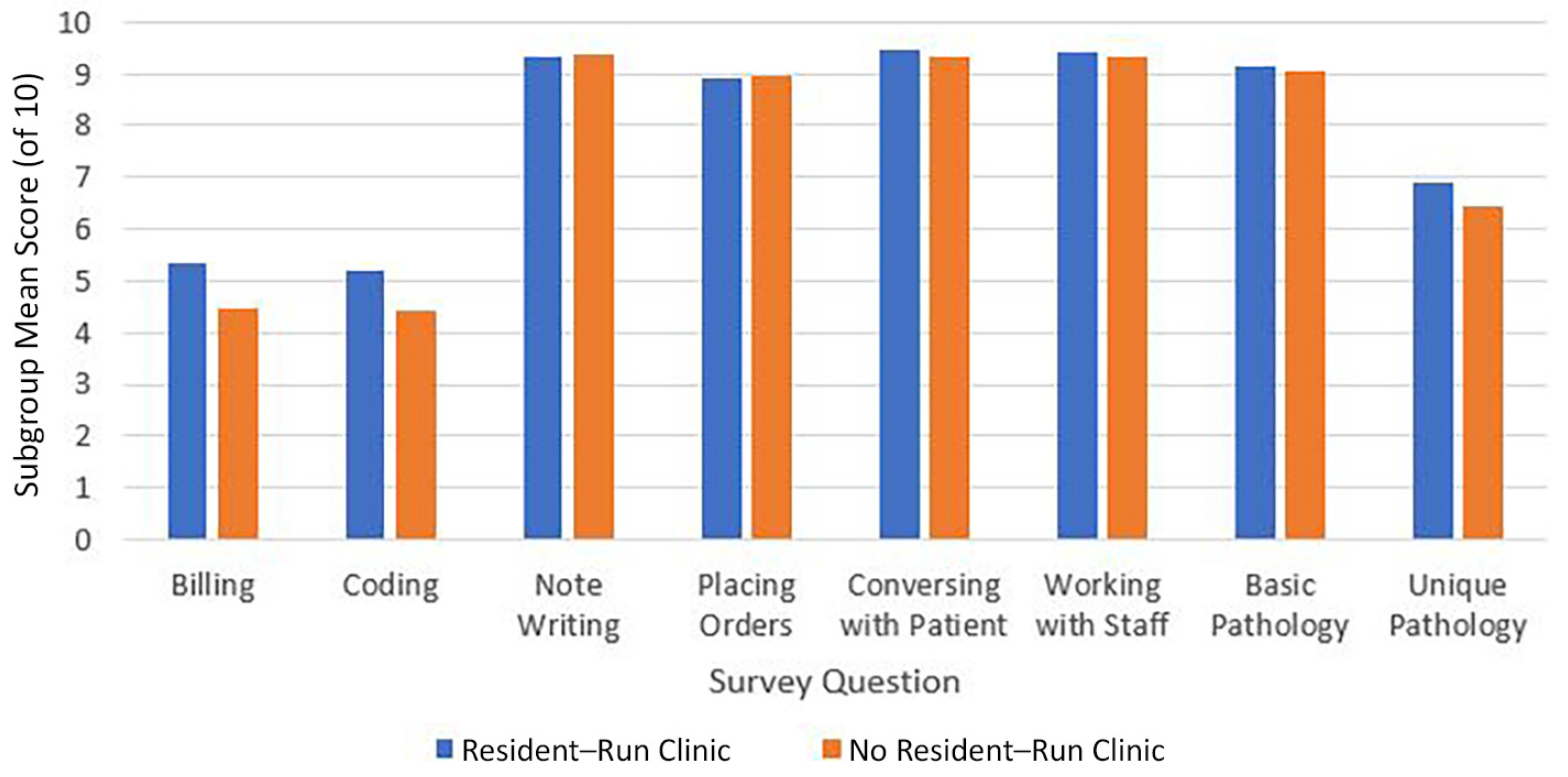
Residents were asked their level of confidence in the following clinical scenarios: billing, coding, writing a note, placing orders, conversing with a patient, working with staff, diagnosing and treating basic pathology, and diagnosing and treating unique pathology. In each of these categories, no statistically significant difference was noted between residents with a resident-run clinic and those without a resident-run clinic (
Figure 3
).
Discussion
Many specialties, including podiatric surgery, have training programs with a resident-run clinic.
These are medical clinics separate from attending physician’s offices, where residents serve as the primary caregiver with attending supervision. The clinics serve as hands-on educational spaces where residents perform most of the clinical and administrative work. Although often found, the clinic is not standard among podiatric medical training programs.
In a review of the literature from other medical specialties, it does seem that the evidence supports the use of resident-run clinics in residency training. These clinics are safe for the patients, with complication rates similar to those of attending physician clinics and high patient satisfaction. Trainees report that these clinics are helpful in providing them with clinical and operative autonomy and building confidence in clinical scenarios. However, none of the studies reviewed compared residents with a resident-run clinic and residents without a resident-run clinic [
1,
2,
3,
4,
5,
6].
This study serves as a first of its kind assessing resident-run clinics in podiatric medical residency training. After distributing the survey to 208 residency programs, we had a total of 97 participants. It was anticipated that those with a resident-run clinic would be satisfied with their clinical experience and that it would improve their overall confidence level in clinical scenarios. Unique to the other studies discussed, the present study did compare those with a resident-run clinic with those without such a clinic. Of residents who have a resident-run clinic, 89.66% report that they like having a resident-run clinic; of residents who do not currently have a resident-run clinic, 53.85% report that they would like to have a resident-run clinic.
Residents who had a resident-run clinic were not found to feel more confident in managing an increased patient load in a clinical setting. Furthermore, there was no statistically significant difference in subjective confidence in managing simple or complex clinical scenarios between residents with a resident-run clinic and those without.
This preliminary study is limited in that it is a survey study and carries inherent subjective bias. The level of resident confidence in a scenario does not always equate with competence, and, thus, this information should not be extrapolated as such. It is possible that once one is exposed to a clinic where they are the primary provider and incur all of the responsibilities associated, perception of capabilities would change. Furthermore, study results are limited to residents who completed the survey. Although the total number of participants and the response rate is similar to that found in similar studies, it does represent a minority of the total podiatric medical residency population. We sought to combat this anticipated issue with frequent reminder notifications and a set and prompt deadline for participation; however, the response rate was still low. As such, we understand the need for additional investigation into this topic before making a firm conclusion and recommendations for residency training programs.
The focus of this study was to specifically evaluate subjective benefit of a resident-run clinic. Future study should include a more objective focus by gathering opinions of competency from supervising attendings. In addition, determining confidence and competence based on graduated level of responsibilities in each training year may provide additional insight into the growth and educational value of a resident-run clinic. Furthermore, surveys distributed to recent graduates may provide additional insight into the benefit of resident-run clinics.
Overall, findings from this preliminary study suggest that residents do not have increased confidence in their capabilities in a clinical setting if they have a resident-run podiatric medical clinic compared with if they do not have a resident-run podiatric medical clinic. However, almost all of the residents who have a resident-run clinic are satisfied with their experience, and more than half of the residents without a resident-run clinic would like to have one. Additional research is needed to provide further insight and conclusions regarding the utility of these clinics in podiatric medical residency training.
Financial Disclosure
None reported.