Next Article in Journal
Unusual Phlegmon in the Plantar Foot of a Healthy Patient
Previous Article in Journal
The March Against Onychomycosis: A Systematic Review of the Sanitization Methods for Shoes, Socks, and Textiles
 
 
Journal of the American Podiatric Medical Association is published by MDPI from Volume 116 Issue 1 (2026). Previous articles were published by another publisher in Open Access under a CC-BY (or CC-BY-NC-ND) licence, and they are hosted by MDPI on mdpi.com as a courtesy and upon agreement with American Podiatric Medical Association.
Article

Desmoplastic Fibroblastoma: A Case of a Rapidly Growing Mass in the Foot

by
Trusha Jariwala
1,*,†,
Michael I. Gazes
2 and
Martin M. Pressman
1
1
Yale Hospital, New Haven, CT
2
Department of Podiatric Surgery, Yale New Haven Hospital, New Haven, CT
*
Author to whom correspondence should be addressed.
This author is now in private practice, 136 Mimosa Drive, Asheville, NC
J. Am. Podiatr. Med. Assoc. 2022, 112(5), 20097; https://doi.org/10.7547/20-097
Published: 1 September 2022

Abstract

Desmoplastic fibroblastomas are benign and uncommon soft-tissue tumors. They are typically slow-growing, painless masses found in adult men. Rapidly growing masses have been previously reported, but are more rare. A 56-year-old man presented with a rapidly growing mass in his left foot, which was diagnosed as a desmoplastic fibroblastoma after pathologic evaluation. Although many case reports have been published in the dermatology literature, it is important to be aware of this benign neoplasm to avoid confusion with other rapidly growing malignant soft-tissue masses reported in the podiatry literature.

Desmoplastic fibroblastomas, otherwise known as collagenous fibromas, are benign and rare fibrous soft-tissue tumors, typically occurring intramuscularly, subcutaneously, and dermally [1,2]. They have been reported in a wide variety of anatomical regions, including the oral cavity, neck, finger, arm, shoulder, chest wall, sacrum, genital, thigh, and foot [2–10]. Desmoplastic fibroblastomas are prevalent in adult men. They do not typically recur following resection [4,10]. These collagenous mobile masses are generally reported as painless and slow growing; however, recent reports have also demonstrated rapidly growing masses labeled as “invasive” desmoplastic fibroblastoma, which can mimic a more malignant etiology [6,11].

Case Report

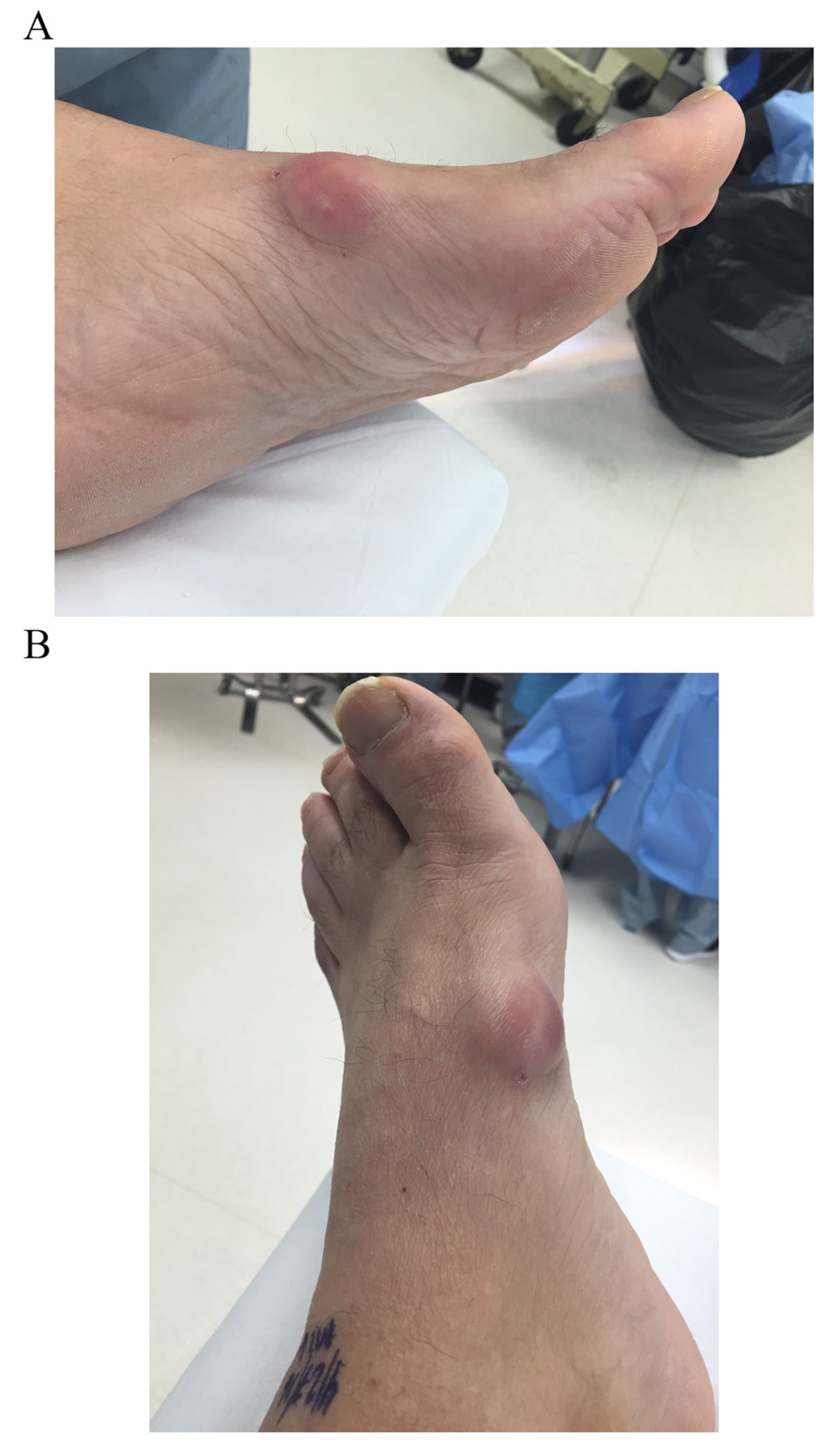
A 56-year-old man presented to our clinic with a 2-month history of a painful growing mass on his left foot, located on the dorsomedial arch (Fig. 1). On physical examination, his neurovascular status was normal. He had a 3-cm mass on his left arch that did not transilluminate. Because of the quick onset and growth of the lesion, local anesthesia was provided, and an in-office Tru-Cut (Merit Medical, South Jordan, Utah) needle biopsy was performed on the lesion. He was scheduled for surgical excision within 2 weeks. Pathology results were consistent with desmoplastic fibroblastoma, with no evidence of malignancy.
Figure 1. Prominent soft-tissue mass at the dorsal medial arch of the foot.
Japma 112 20097 g001
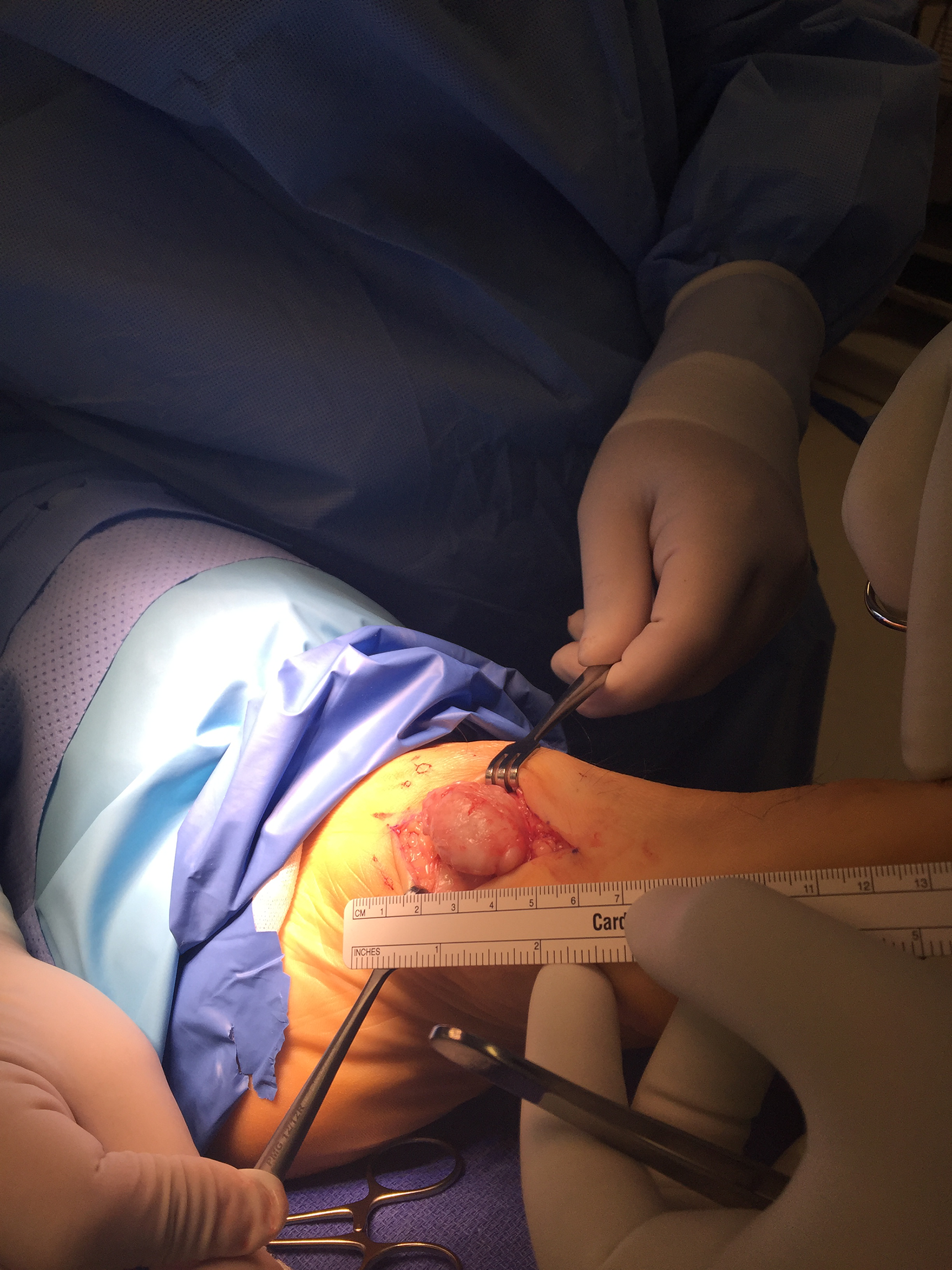
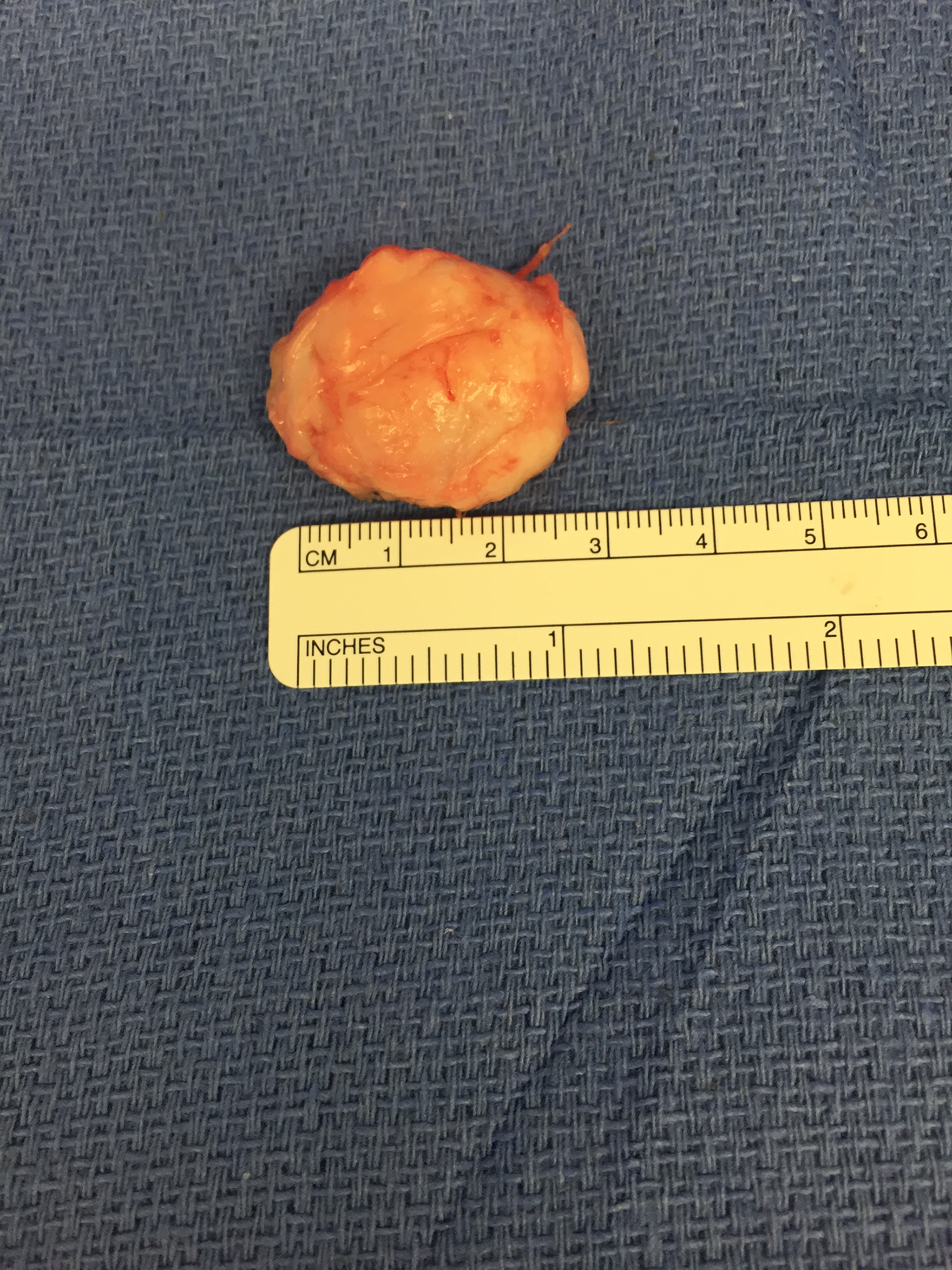
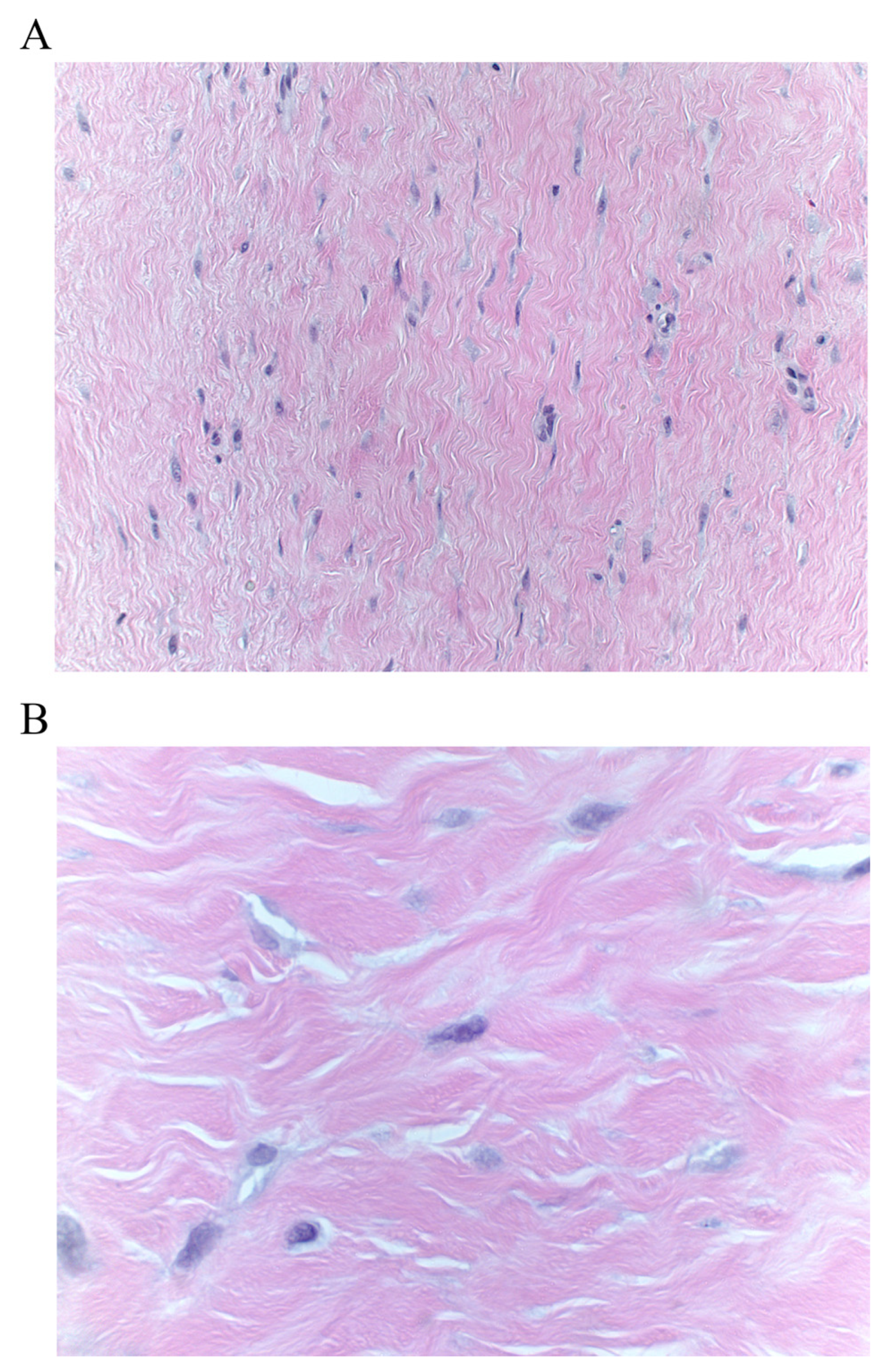
In the preoperative area, the patient revealed that the lesion was no longer painful, but was irritating when he wore shoes. A 6-cm longitudinal incision was made parallel to the long axis of the foot, with the soft-tissue mass centrally located within the incision (Fig. 2). The mass was located in the subcutaneous tissues and carefully excised in toto (Fig. 3), and the specimen was sent for pathologic evaluation (Fig. 4). Then, the site was irrigated with normal sterile saline and closed. The pathology department reported an encapsulated nodule measuring 3.5 × 2.5 × 1.5 cm. Surfaces were solid, rubbery, and pink-white in color. The results were consistent with desmoplastic fibroblastoma. The resection margins were not clear; however, these lesions usually show no local recurrence even when the tumor remains present at the margins. Sutures were removed and the foot healed well. At the 3-year follow-up, the patient showed no evidence of discomfort or further soft-tissue mass recurrence in the left foot.
Figure 2. Soft-tissue mass centrally located within the incision.
Japma 112 20097 g002
Figure 3. Excised mass measuring 3.5 × 2.5 × 1.5 cm.
Japma 112 20097 g003
Figure 4. A, Low-power (x20) micrograph. The lesion consists of a hypocellular proliferation of bland spindle to stellate cells, which are widely spaced and embedded in a dense collagenous stroma. B, High-power (x40) micrograph. The cellularity is composed of spindled and stellate shaped fibroblasts with minimal cytologic atypia admixed in a stroma composed of myxocollagenous fibrils.
Japma 112 20097 g004

Discussion

Our patient was an adult man who presented with a painful, rapidly growing mass on his left foot of approximately 2 months’ duration. There was a possibility that this mass had been present for more than 2 months; however, it had become painful and noticeable to the patient 2 months before initial evaluation. Although the lesion presented on the dorsomedial aspect of his foot, it had likely developed more recently, as it was hard and would have been difficult to disregard. A biopsy was performed in the office, and the patient was promptly scheduled for surgical excision of the mass because of concern for the rapid growth of the lesion. The biopsy revealed a desmoplastic fibroblastoma. Our patient underwent a surgical excision, revealing that the mass was completely within the subcutaneous tissues, with no evidence of deeper invasion. Pathologic analysis reconfirmed the diagnosis as a desmoplastic fibroblastoma. Typically, these lesions are slow growing, including in the foot, but have also been reported in some cases to be invasive, leading to the initial concern for malignancy [12]. Desmoplastic fibroblastomas can also ulcerate and present in a form of a diabetic foot ulcer that podiatrists encounter almost every day [13]. As a podiatrist, it is important to be aware of this benign type of neoplasm to avoid confusion with other rapidly growing malignancies within the soft tissue.

Acknowledgments

D. Kathryn Pressman for editorial expertise regarding our manuscript.

Financial Disclosure

None reported.

Conflict of Interest

None reported.

References

  1. HuSCS, LinCL: Dermal desmoplastic fibroblastoma presenting as a large sacral mass. Australas J Dermatol57: 296, 2016.
  2. BhagaliaS, JainM, PardheN, et al: Collagenous fibroma (desmoplastic fibroblastoma) of the oral cavity. J Oral Maxillofac Pathol16: 277, 2012.
  3. SassiSH, DoghriR, KanounML, et al: Desmoplastic fibroblastoma of the foot [in French]. Rev Chir Orthop Reparatrice Appar Mot94: 188, 2008.
  4. EvansHL: Desmoplastic fibroblastoma. Am J Surg Pathol19: 1077, 1995.
  5. PereiraT, De LacerdaJC, Porto-MatiasMD, et al: Desmoplastic fibroblastoma (collagenous fibroma) of the oral cavity. J Clin Exp Dent8: e89, 2015.
  6. KawaguchiY, FujitaT, HanaokaJ: Invasive desmoplastic fibroblastoma in the chest wall. Ann Thorac Surg99: e85, 2015.
  7. ParkJS, BaeKH, OhHK, et al: Genital desmoplastic fibroblastoma (collagenous fibroma). Urol J11: 1849, 2014.
  8. VargheseT, PillaiKS, SarojiniSB, et al: Desmoplastic fibroblastoma (collagenous fibroma) in the oral cavity. J Indian Sec Pedod Prev Dent32: 238, 2014.
  9. KimJH, OhDY, KimSW, et al: Desmoplastic fibroblastoma of the finger tip in an adult. Arch Plast Surg39: 84, 2012.
  10. MicciniM, BorgheseO, CassiniD, et al: Desmoplastic fibroblastoma of the thigh. A case report. Ann Ital Chir82: 225, 2011.
  11. NagarajaV, ColemanHG, MorganGJ: Desmoplastic fibroblastoma presenting as a parotid tumour: a case report and review of the literature. Head Neck Pathol7: 285, 2013.
  12. NielsenGP, O’ConnellJX, DickersinGR, et al: Collagenous fibroma (desmoplastic fibroblastoma): a report of seven cases. Mod Pathol9: 781, 1996.
  13. ParkJM, KohJK, LeeMG: Unusual case of desmoplastic fibroblastoma (collagenous fibroma) with ulceration on toe: mimicking diabetic foot ulcer. J Dermatol39: 420, 2012.