Hammertoe deformities are among the most common conditions treated by foot and ankle surgeons, affecting approximately one-third of the population.[
1] Arthrodesis of the proximal interphalangeal joint (PIPJ) plays a critical role in addressing this abnormality. There are many surgical techniques that have been explored to fuse this joint. Since being described by Taylor[
2] in 1940, temporary fixation with a single Kirschner wire has remained the most common method of fixation. Kirschner wire fixation is cost-effective, time saving, easily removable in case of infection, and easy to use, and has produced reliable results.[
3] Although single–Kirschner wire fixation technique produces reliable outcomes, there are some disadvantages associated with its use. Some of these disadvantages include wire failure (bend/breaking), pin-site infection, and patient anxiety associated with removal.[
4] Other limitations when using a Kirschner wire are the lack of rotational stability and pistoning. This occurs because single–Kirschner wire fixation allows the surgeon only one point of fixation. Both pistoning and lack of rotational control can lead to nonunion, fibrous union, or malunion. The literature reports that the nonfibrous or fibrous union rate can be as high as 20%.[
5] This lack of fusion can lead to malalignment, recurrence, revision and, most importantly, patient dissatisfaction.
Since the single–Kirschner wire technique was introduced, there have been several other forms of fixation used. One example is two–Kirschner wire fixation, which attempts to address the lack of stability and pistoning by using two points of fixation.[
6] However, it is difficult to get two Kirschner wires across the PIPJ in smaller digits because of the lack of bone. In addition to lack of space, other drawbacks include pin loosening, broken hardware, and patient anxiety with pin removal.[
7] Single-screw fixation is another technique used. Although this fixation allows for compression and prevents pistoning, it does not provide rotational stability because of the single point of fixation. Other disadvantages include placement because of the size of smaller digits and broken or loosening hardware because of excessive forces on the screw. Absorbable intramedullary pins are yet another technique that surgeons have used, but disadvantages with these include difficulty in hardware removal and digital swelling. This technique also lacks two points of fixation and does not offer compression to prevent pistoning. Finally, implants have become a popular technique to fixate the PIPJ. Some drawbacks to this technique include difficulty sizing the implant or positioning the implant to correct the deformity, difficulty in removing the implant, loss of a significant amount of bone if revision is needed, and price.[
7] This fixation also lacks rotational stability because of only one point of fixation and lacks compression to help prevent pistoning.
The senior author (G.A.) uses a technique called the suturedesis to address some of the disadvantages seen in the techniques discussed above. A similar technique to the one that will be described below has been mentioned by Harris et al.[
8] The technique describe by Harris et al[
8] also uses stainless steel suture to provide rotational stability, but instead of two sutures, it uses only one, which is placed in a different orientation. This one point of fixation may not adequately provide rotational stability. The other disadvantage is that the technique can be more challenging than the suturedesis. The rotational stability and compression that is seen with suturedesis may lead to higher fusion rates, longer-lasting alignment, and better patient satisfaction.
Surgical Technique
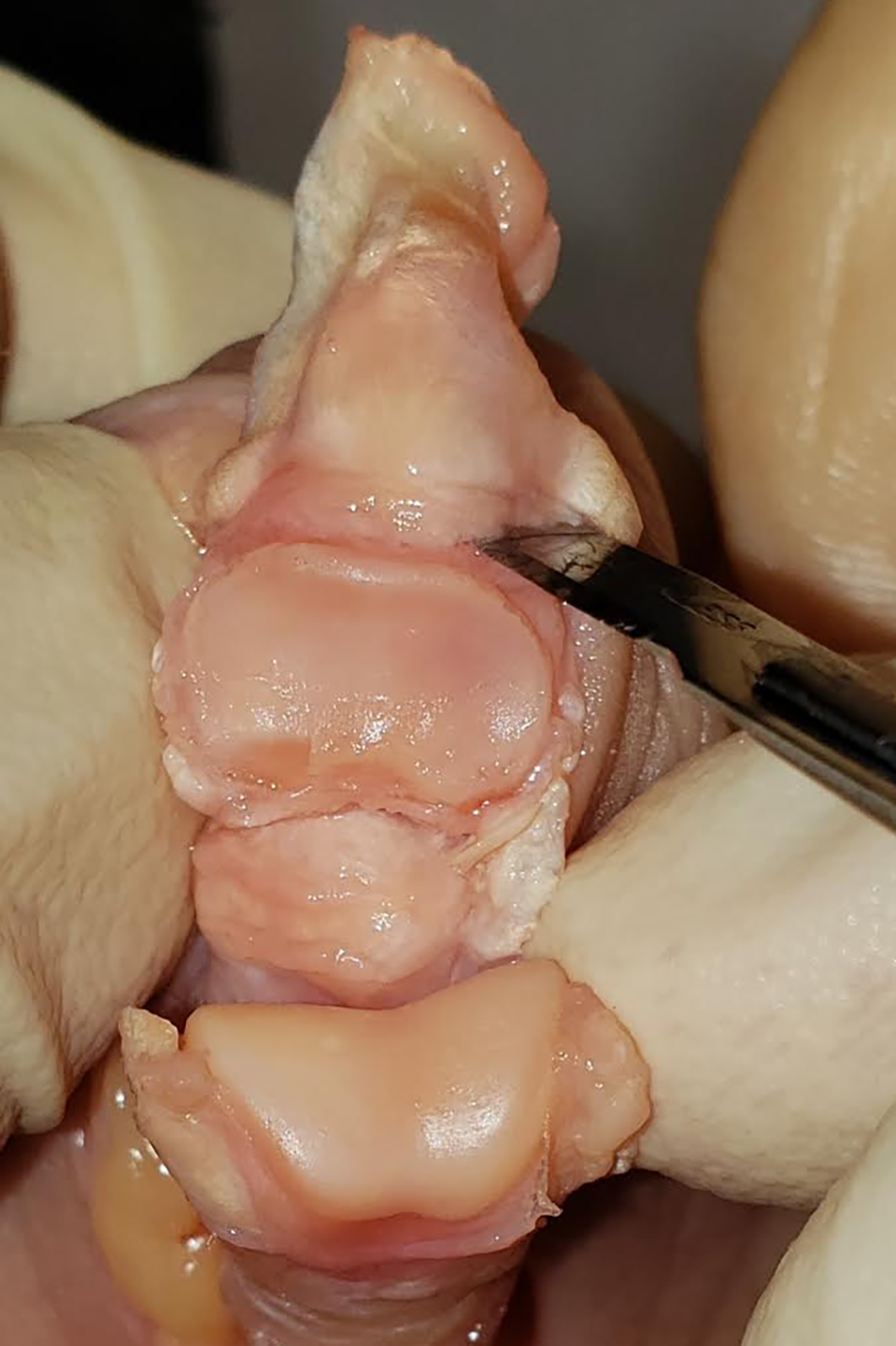
This technique begins with anatomical dissection through skin down to subcutaneous tissue. This layer is then brushed away from the deep fascia layer. Once down to the deep fascia, the extensor tendon is identified, followed by identification of the PIPJ. Extensor tenotomy is performed transversely. It should be noted that the tenotomy is performed proximal to the flare of the head of the proximal phalanx. This allows the surgeon to more readily retract for greater distraction during dissection and suture the two ends back together. It also allows for proper placement of the guide holes, which will be discussed later. Following the tenotomy, the extensor tendon is reflected off the dorsal aspect of the proximal phalanx. Reflection of the tendon only needs to be carried out proximally in a minimalistic fashion unless procedures are required at the metatarsophalangeal joint; then, reflection of the tendon can be carried out to the level of the metatarsophalangeal joint. After dissection, the head of the proximal phalanx is saw resected. The cut is made distal to the flare of the proximal phalanx head, with efforts not to overshorten the phalanx. The cut is angled slightly from dorsal distal to plantar proximal (
Fig. 1). Cutting the proximal phalanx first will make it easier to dissect the middle phalanx.
Figure 1.
Orientation of proximal phalanx cut.
Figure 1.
Orientation of proximal phalanx cut.
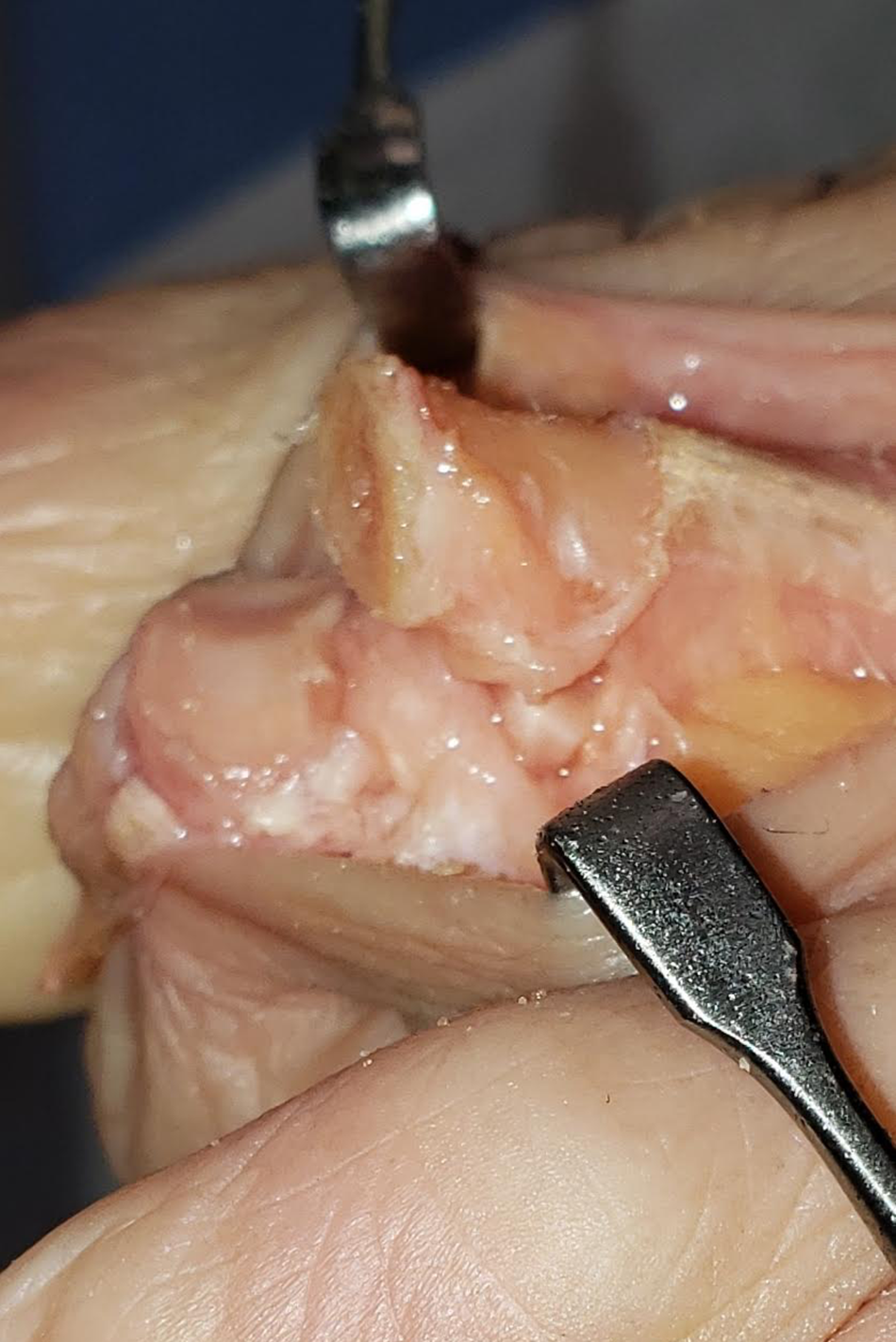
Attention is then directed to the base of the middle phalanx. Care is taken to circumferentially dissect tissue off the base of the middle phalanx (
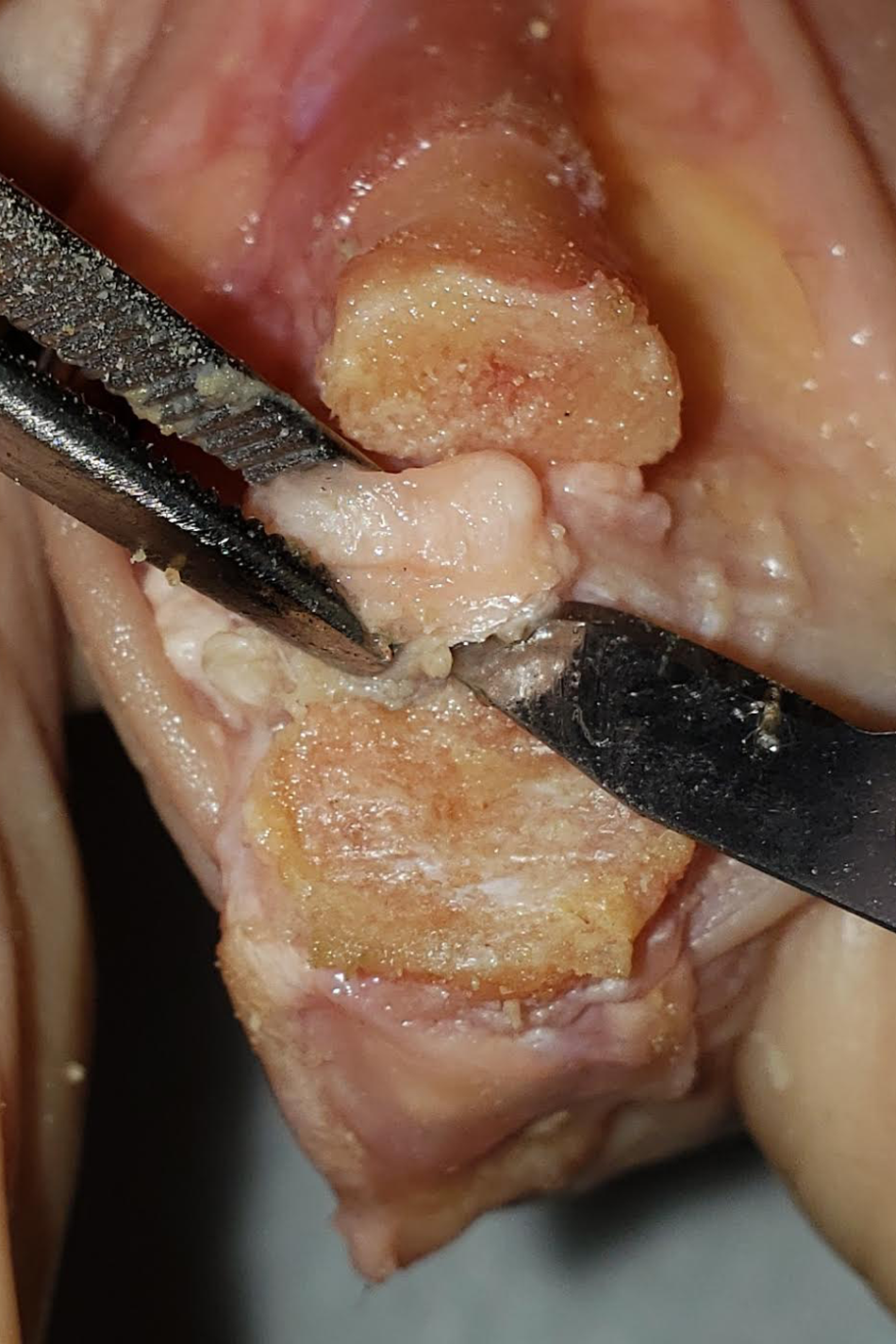
Fig. 2). This will allow for proper placement of the guide holes and allow for proper passing of the suture, which will be discussed later. Next, the base of the middle phalanx is saw resected. Not much bone needs to be resected off of the middle phalanx. The surgeon can use Adson-Brown forceps to hold the middle phalanx to gain more control for this resection. The cut is made with a slight proximal dorsal–to–plantar distal orientation. One can imagine the orientations of the cuts on the proximal phalanx and middle phalanx making a triangle with the fulcrum at the dorsal aspect. The reason that these cuts are made in this manner is to provide the digit with a nature curl appearance at the end of the procedure. After resection of the middle phalanx, the plantar plate of the PIPJ is sharply dissected out and discarded (
Fig. 3). This is done to prevent any soft tissue from preventing arthrodesis and to eliminate the contraction created by the flexor tendons. At this point in the procedure, positioning and alignment of the joint are reevaluated.
Figure 2.
Circumferentially dissecting around the middle phalanx to help create enough access for guide hole placement.
Figure 2.
Circumferentially dissecting around the middle phalanx to help create enough access for guide hole placement.
Figure 3.
Removal of plate to eliminate contraction of flexors and prevent complications with arthrodesis.
Figure 3.
Removal of plate to eliminate contraction of flexors and prevent complications with arthrodesis.
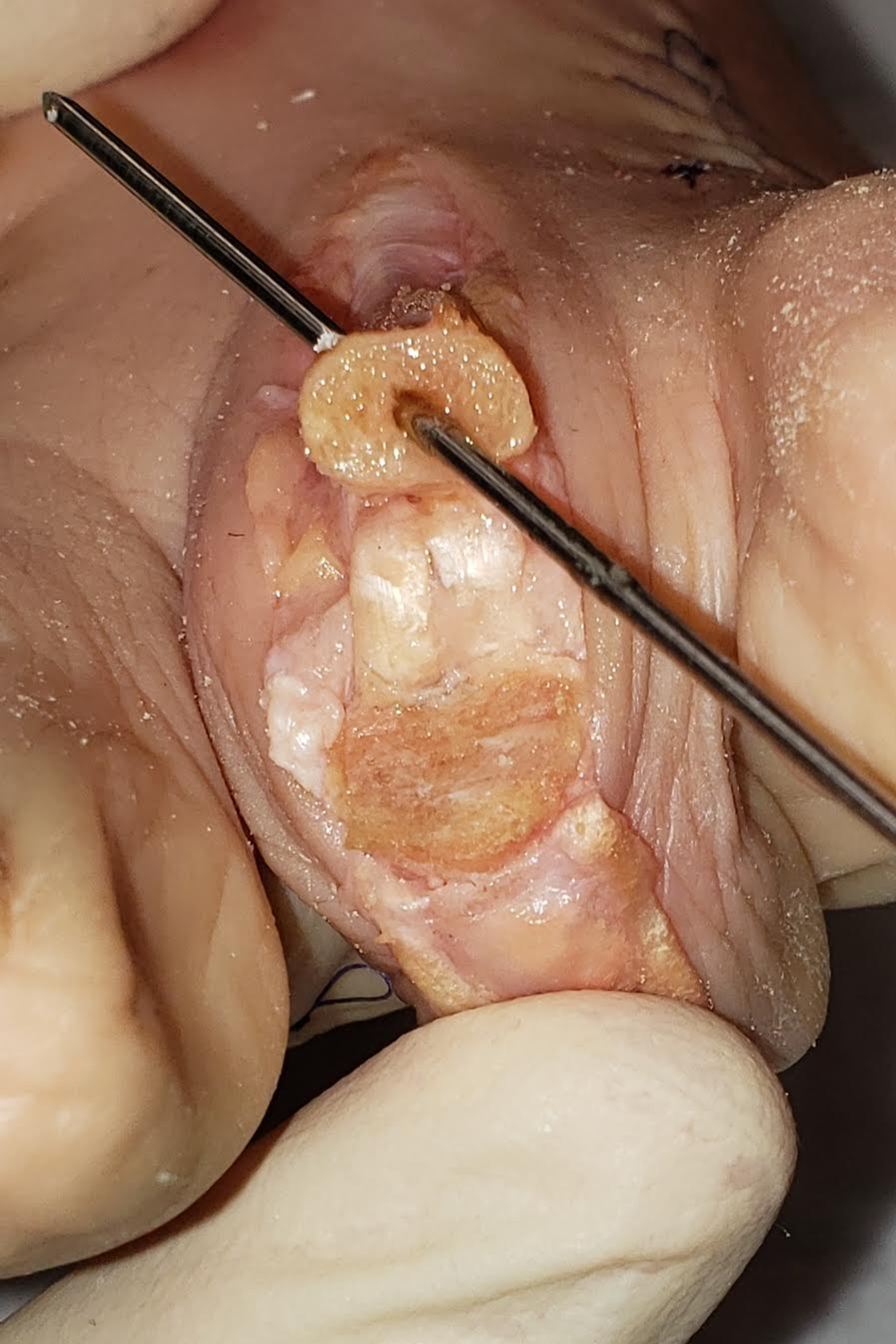
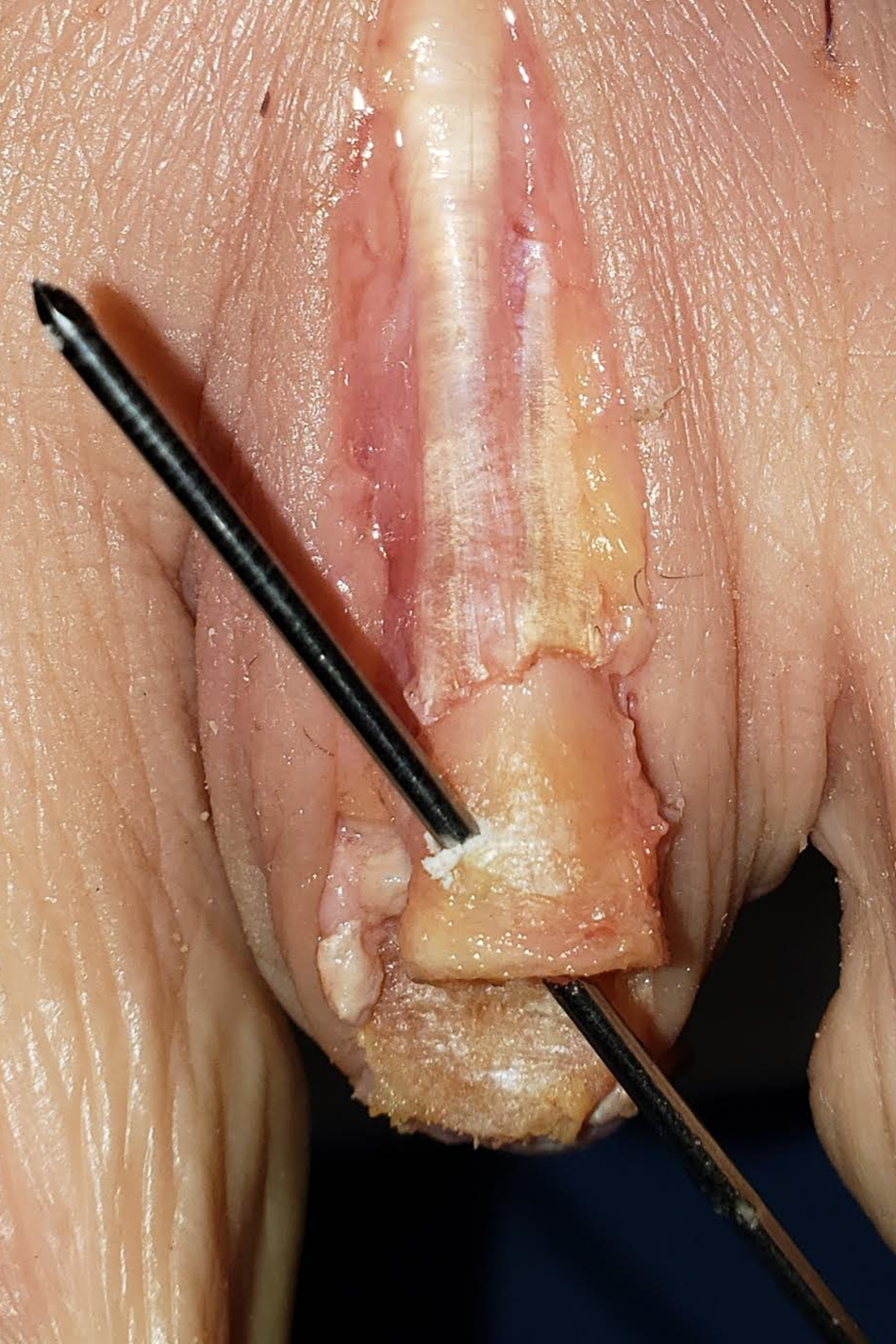
Once alignment and positioning of the PIPJ are adequate, the surgeon will take a 0.045-inch Kirschner wire and drill a pilot hole centrally in the proximal phalanx. From this central pilot hole, the surgeon will angulate the Kirschner wire in a dorsolateral fashion. The exit point of this guide hole is just distal to the flare and on the dorsolateral aspect of the proximal phalanx (
Figs. 4 and
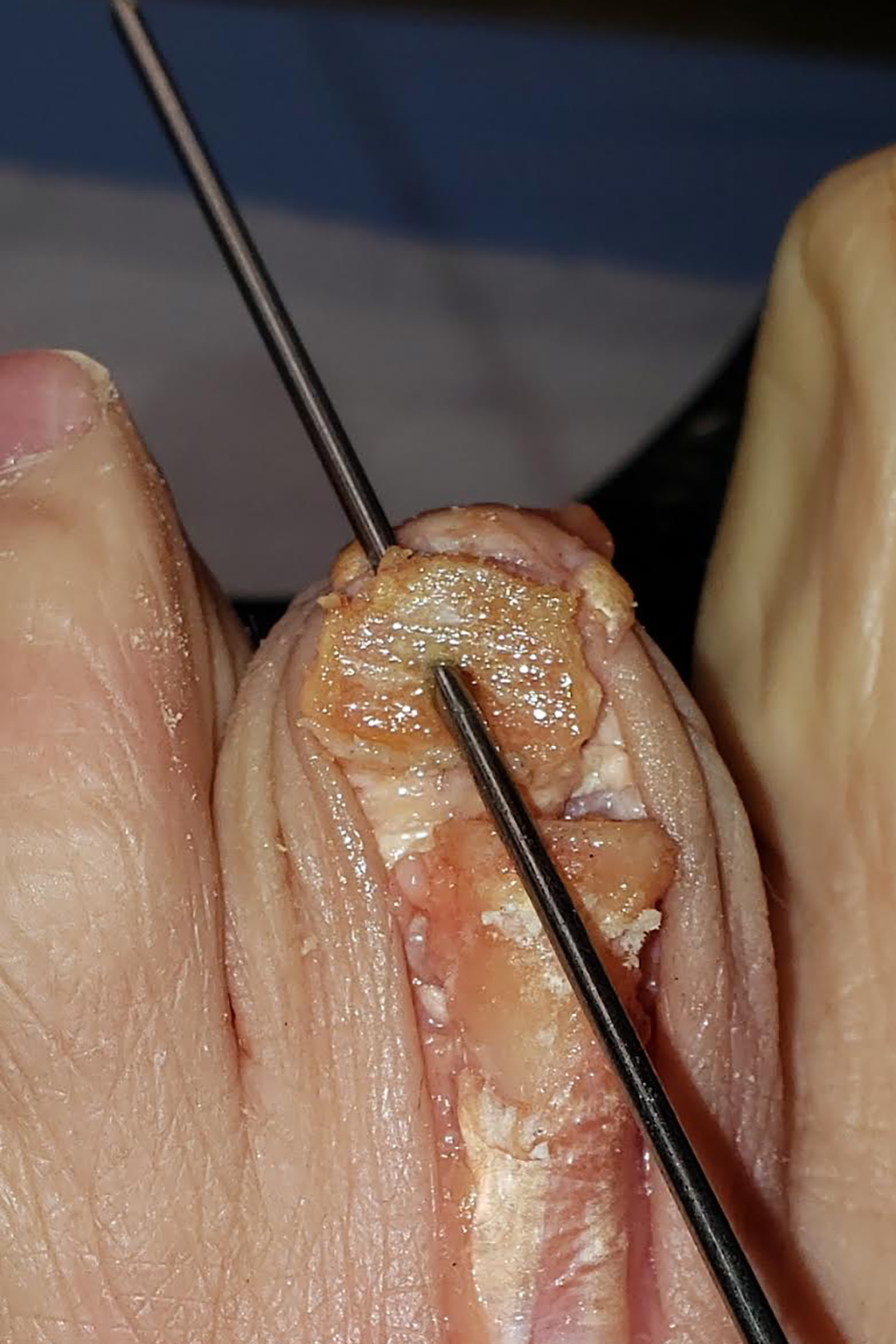
5). Next, another guide hole is drilled from the central pilot hole and will exit just distal to the flare and on the dorsomedial aspect of the proximal phalanx. After the guide holes are placed in the proximal phalanx, attention is then directed to the middle phalanx. The same sequence is carried out, with a central pilot hole in the middle phalanx being drilled first (
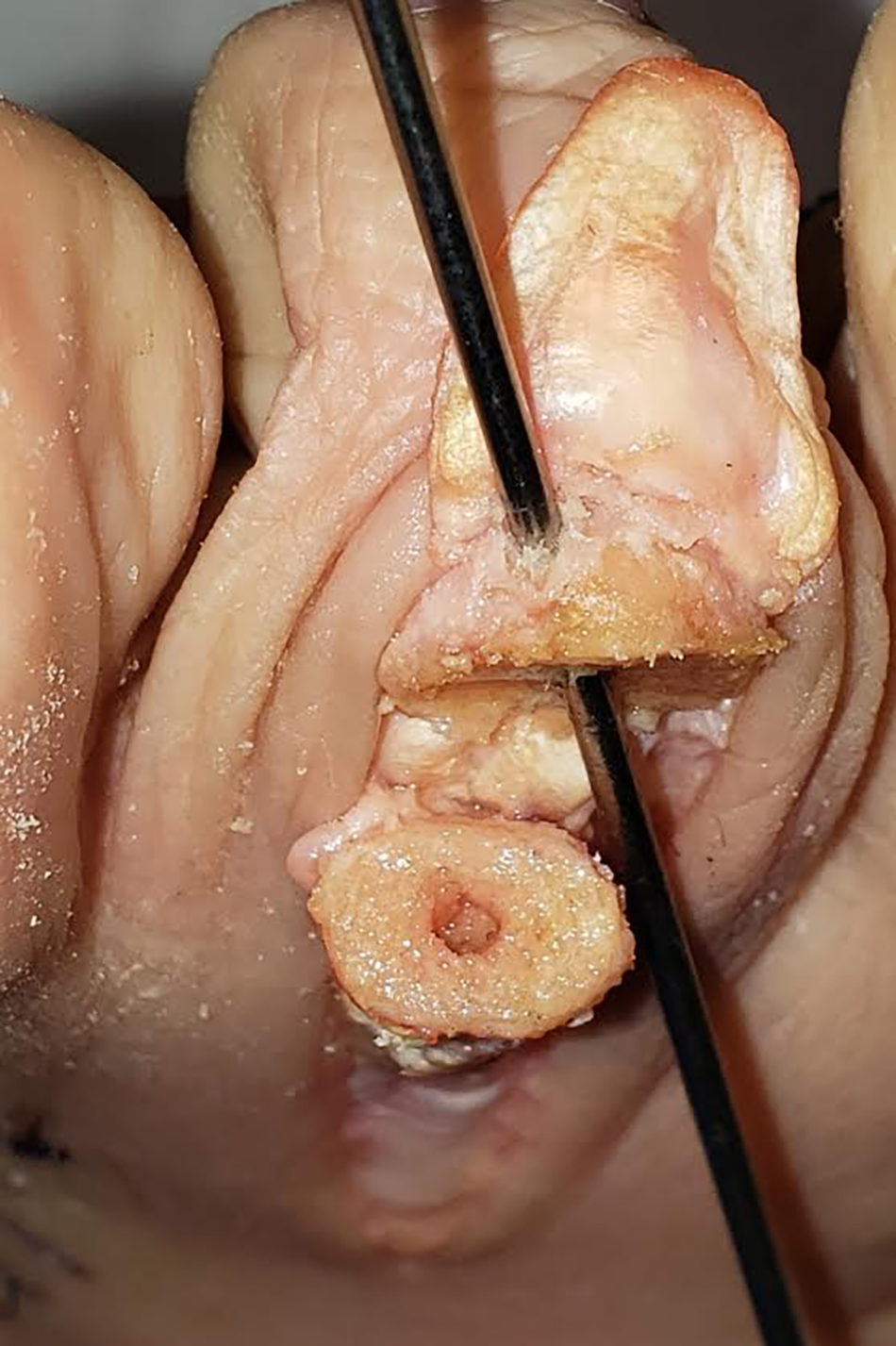
Figs. 6 and
7). Then, in similar fashion, the exit points will be to the dorsomedial and the dorsolateral aspect of the middle phalanx.
Figure 4.
Orientation of guide holes in the proximal phalanx.
Figure 4.
Orientation of guide holes in the proximal phalanx.
Figure 5.
Orientation of guide holes in the proximal phalanx from the dorsal view.
Figure 5.
Orientation of guide holes in the proximal phalanx from the dorsal view.
Figure 6.
Orientation of guide holes in the middle phalanx.
Figure 6.
Orientation of guide holes in the middle phalanx.
Figure 7.
Orientation of guide holes in the middle phalanx from the dorsal view.
Figure 7.
Orientation of guide holes in the middle phalanx from the dorsal view.
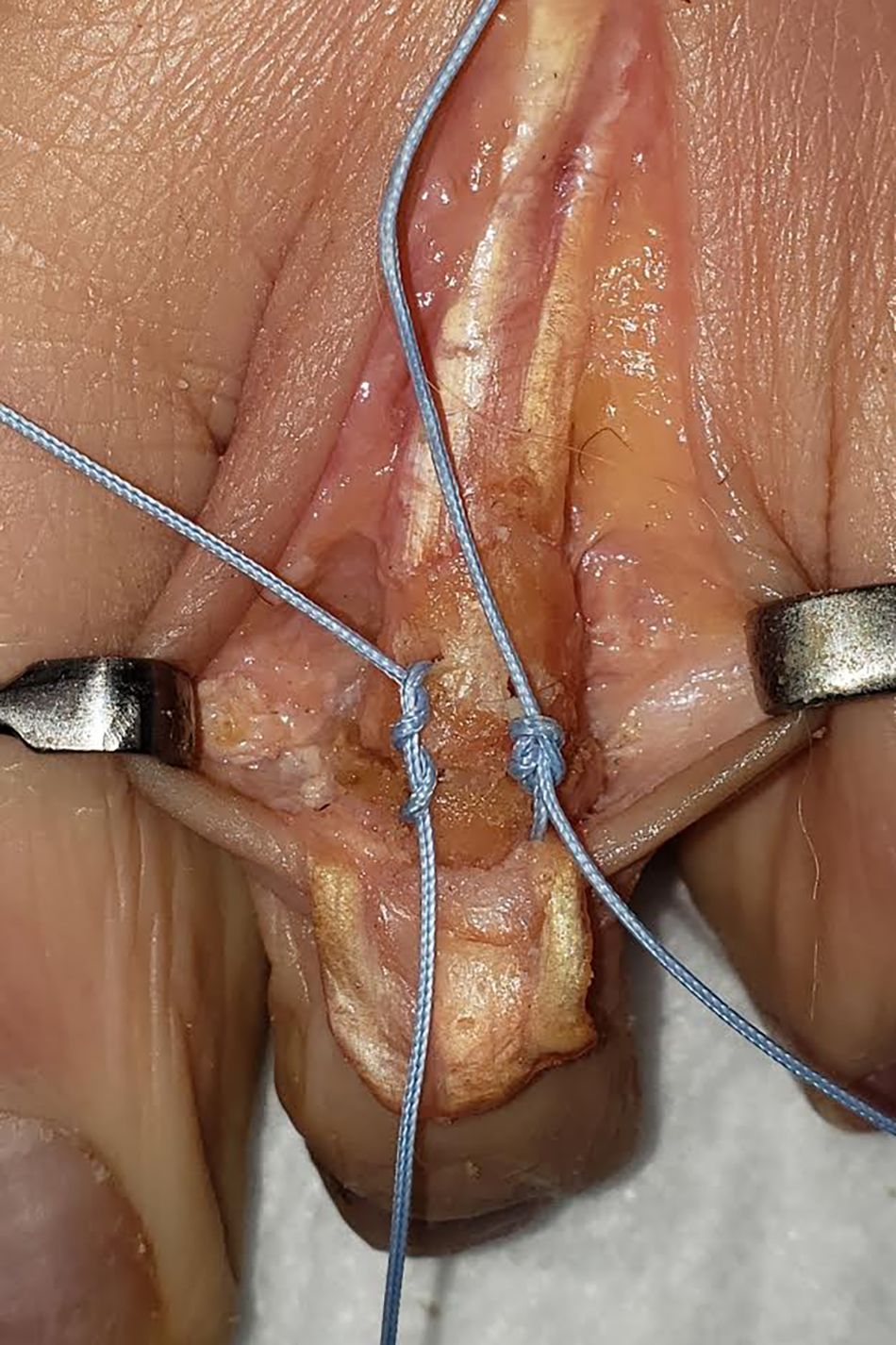
Once the guide holes are place, 3-0 stainless steel on a curved needle or small half-circle needle is passed through the holes (
Fig. 8). The suture is passed through the two medial guide holes first. Care must be taken to not bend or kink the stainless steel as it passes through each set of guide holes. The stainless steel is then cut in manner that will leave an adequate amount of tail for cinching down of the suture. Next, another 3-0 stainless steel suture is passed through the lateral guide holes, and the suture is then cut to leave enough tail for tightening. At this time, the PIPJ can again be revaluated for positioning and alignment. The sutures are then tightened down starting with the medial or lateral side. The surgeon does two throws in total. The first throw will reapproximate and tighten the two joint ends, and the second throw will keep the construct in place. After this is performed, the stainless steel is cut and the ends are tamped down toward the midline of the proximal phalanx. This will allow the extensor tendon to lie off the stainless steel, which will minimize any prominent suture material. At this point, the surgical site is washed out and closure begins with reapproximating the extensor tendon with 3-0 Vicryl (Ethicon Inc, Somerville, New Jersey). The subcutaneous layer and skin are closed with 4-0 and 5-0 Vicryl, respectively.
Figure 8.
In this example, the sutures are shown tied down, and the fiber wire was used for better visualization of placement. However, the surgeon consistently uses stainless steel suture.
Figure 8.
In this example, the sutures are shown tied down, and the fiber wire was used for better visualization of placement. However, the surgeon consistently uses stainless steel suture.
Discussion
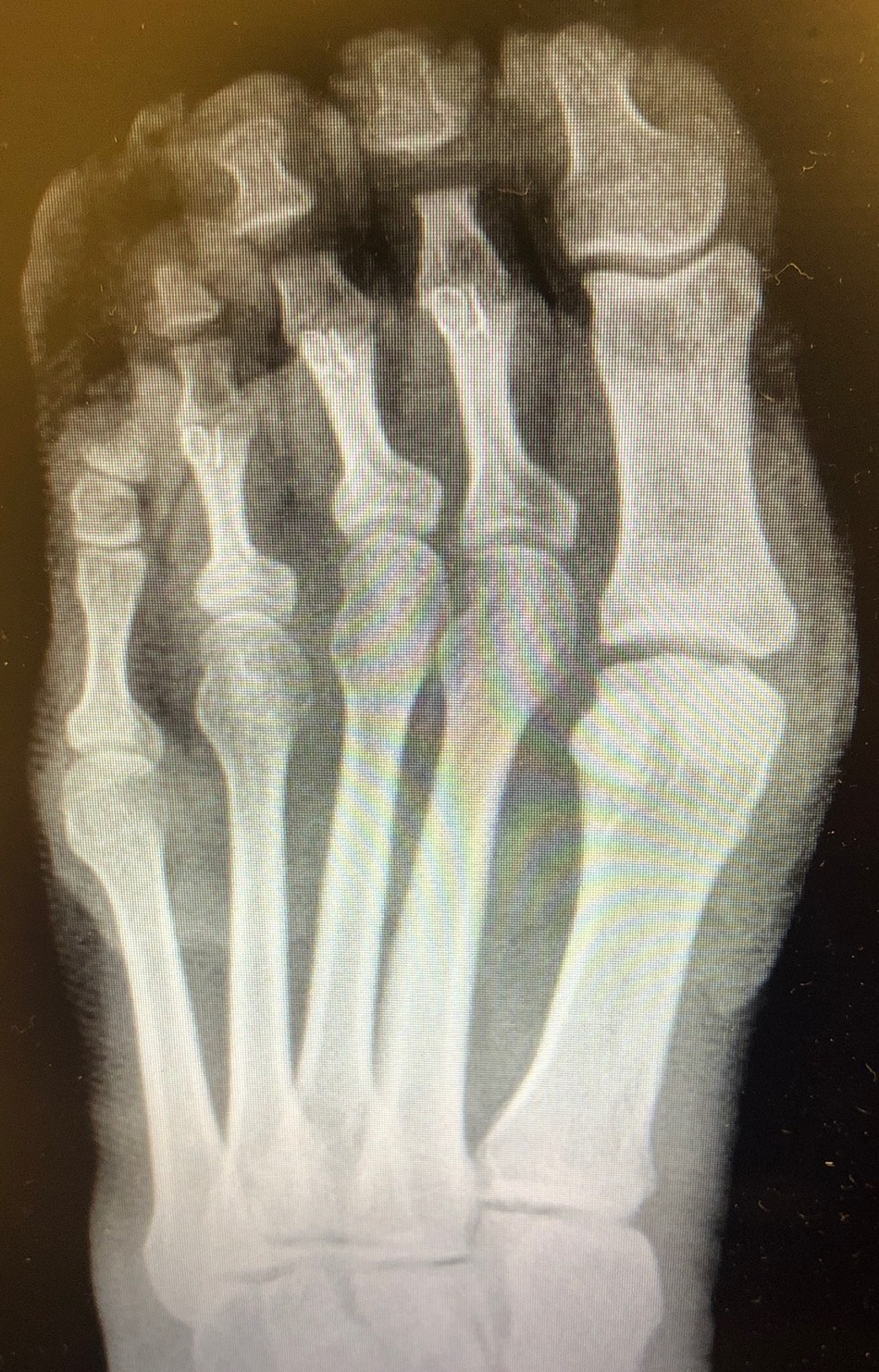
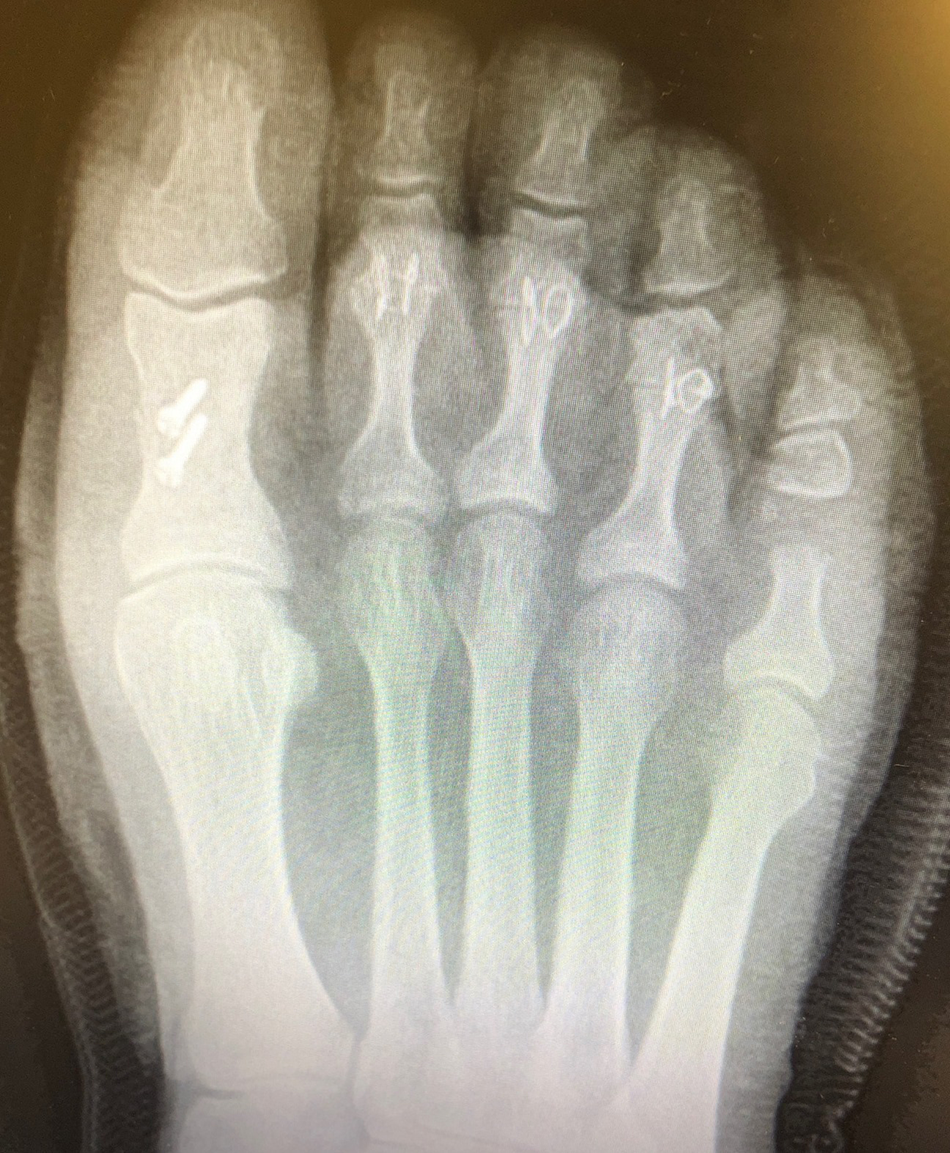
Two of the most glaring limitations with many hammertoe repair techniques are the lack of rotational stability and pistoning. The suturedesis technique addresses both of these limitations by using two points of fixation with two 3-0 stainless steel sutures. The use of two points of fixation with sutures has several advantages. First, two points of fixation eliminates any concern regarding rotation in the frontal plane. Second, the orientation of the guide holes in the proximal and intermediate phalanges makes throwing the sutures easy. It is much easier to retrieve and secure the suture when the surgeon is able to see it with dorsally placed guide holes instead of placing the guide holes too far medial or lateral. Third, using sutures instead of other fixation makes it much easier in smaller structures to place two points of fixation (
Fig. 9). The 3-0 suture fits many of the smaller digits because it does not require a lot of bone. If the surgeon believes 3-0 is too large, it is acceptable to use a smaller suture. It should also be noted that one may choose to use other types of suture (eg, Vicryl) when implementing the sutures and still achieve all three of these advantages. However, it is in the opinion of the senior author (G.A.) that stainless steel is the best choice because of the added security it provides. Ultimately, the two points of fixation used in the suturedesis provide a great deal of stabilization, which may lead to better long-term alignment and patient satisfaction.
Figure 9.
Postoperative radiograph demonstrating that suturedesis can easily be used in smaller areas and still provide rotational stability.
Figure 9.
Postoperative radiograph demonstrating that suturedesis can easily be used in smaller areas and still provide rotational stability.
The suturedesis also addresses the problem of pistoning by adding compression to the proximal interphalangeal joint. A lack of adequately coapted bone ends leads to higher rates of pseudoarthrodesis, nonunions, and malunions. The stainless steel used in this technique may be more manageable in a small area than a screw while still achieving adequate compression (
Fig. 10). The authors believe that two points of placement with one suture being more laterally placed and the other suture being more medially placed ensures that the entire joint is adequately compressed. The compression with this technique is achieved with the first tie-down. Thus, it is important to adequately secure the stainless steel with the first throw. Once again, one may decide to use other sutures material because they do not have the same memory as stainless steel and are easier to manipulate. Despite the memory of stainless steel, the senior author (G.A.) uses it because it is stronger than other sutures. It is the belief of these authors that this added strength allows the surgeon to adequately compress the PIPJ and maintain the compression postoperatively. The compression factor of this technique may lead to higher union rates, but additional studies would have to be performed to confirm this theory.
Figure 10.
Postoperative radiograph demonstrating how suturedesis provides compression.
Figure 10.
Postoperative radiograph demonstrating how suturedesis provides compression.
As with every procedure, there are some disadvantages to consider, which include the following: increased time to perform the suturedesis and possible removal of the sutures. There are more steps to perform in this technique in comparison to the single–Kirschner wire fixation technique that add to the time of the procedure. The author has not compared operating times of suturedesis to traditional single–Kirschner wire fixation, so there are no concrete data, but timing is a valid concern. However, it should be noted that the more comfortable the surgeon becomes with the suturedesis procedure, the more efficiently the surgeon will execute it and thus can reduce operating times. A second disadvantage may include removal of painful sutures. The senior author has not found removal of the sutures to be difficult, nor has he had to remove many of them. If required, removal is simple; the sutures are readily accessible after minimal dissection. Once the surgeon is down to the hardware, it only requires a simple snip and pull to remove. There is no problem removing the suture because it is much smaller than the guide hole.
Conclusions
In conclusion, the authors believe that the suturedesis technique for PIPJ arthrodesis is a viable option when addressing painful hammertoe deformities. It is the opinion of the authors that the suturedesis technique addresses both the rotational instability and lack of compression that may be seen with a single–Kirschner wire fixation technique. Further research is warranted to investigate the benefits of suturedesis compared to more traditional approaches in correcting hammertoe deformities. However, the authors believe that this technique can adequately bring stability to the frontal plane by controlling rotation and can eliminate pistoning by compressing the PIPJ, which may lead to better fusion rates, better postoperative alignment, and better patient satisfaction.