


Abstract
Background: Historically, Kirschner wires have been used for fixation of the interphalangeal joints of the toe. They are still the most popular form of fixation, likely due to training patterns, ease of use, and decreased cost. Recently, numerous medullary fixation devices have become available, including medullary screws. Methods: After performing various forms of fixation for the correction of toe deformities, the authors have developed a new pilot hole technique for screw fixation advancing on the previously described pilot hole technique for Kirschner wire fixation. Results: The authors have found this method to provide intraoperative confidence that improper hardware placement has not occurred. Conclusions: The pilot hole technique described in this paper is a safe and effective technique that may be employed by surgeons using screw fixation for the treatment of hammertoe deformities. The technique reduces the possibility of surgeon error and helps to ensure that the screw is properly placed within the phalanges when properly employed.
Traditionally, hammertoe deformity correction with proximal interphalangeal joint arthrodesis has been performed with Kirschner wires. The advantages of this fixation method include its low-cost, simple, and time-efficient technique and its minimal violation of the distal interphalangeal joint. Another benefit of using Kirschner wires is the ability to extend fixation across the metatarsophalangeal joint to correct deformities at this level. In addition, if the wire is placed improperly, the effect is temporary because the wire will be removed. However, there are multiple drawbacks to Kirschner wire fixation. Most prominently, removal of the Kirschner wire is typically performed in the office setting, which can cause anxiety for some patients. In addition, due to the temporary nature of Kirschner wire fixation, digital deformity can recur, leading to decreased patient satisfaction [1,2]. While the wire is in place, the patient cannot immerse the foot in water, making bathing difficult for several weeks postoperatively. For these reasons, there has been an emergence of medullary devices available for proximal interphalangeal arthrodesis. In most instances, these are metallic devices that are placed in the medullary canal of the proximal and middle phalanges. If revisional surgery is required to remove the implant, it can be technically demanding and may cause significant bone destruction during the process. Thus, many surgeons, including us, have avoided these devices and have started using medullary screw fixation. Herein we describe the surgical technique for insertion of a medullary screw while minimizing the risk of surgical error and postoperative complications.
Technique
An incision is made over the dorsal aspect of the digit, and dissection is performed to access the proximal interphalangeal joint. A Z-lengthening of the extensor digitorum longus tendon is performed (Fig. 1). The head of the proximal phalanx and the base of the middle phalanx are resected using a power saw. It is not necessary to remove the articular surfaces of the distal phalangeal joint unless deformity or arthritis needs to be addressed, as this joint is not symptomatic postoperatively after screw placement despite the lack of arthrodesis. Next, the guidewire for a 2.0- or 2.5-mm screw is inserted by hand in the medullary canal of the proximal phalanx (Fig. 2). This is the creation of the traditional pilot hole. It is important that this is performed freehand because the wire is more likely to enter the center of the medullary canal with the force applied by hand. If this wire placement is performed with a driver, the wire may exit the canal and pass through cortical bone, resulting in improper wire placement. The placement of the wire in the proximal phalanx is confirmed in the dorsoplantar, oblique, and lateral fluoroscopic views. Once the placement is confirmed, the predrill of the proximal phalanx is performed over the guidewire (Fig. 3). This creates the complete pilot hole for medullary screw fixation. Performing this step now ensures that the guidewire will enter the medullary canal properly when the wire is retrograded. The sharp end of the guidewire is then placed in the center of the middle phalanx and driven using power partially out the end of the toe. Fluoroscopy is used to confirm that the wire is centered in the middle and distal phalanges on the dorsoplantar view and the lateral view. Once confirmed, a small incision is made at the distal tip of the toe, and the predrill is performed through the distal and middle phalanges. This may be done with a hemostat on the proximal blunt tip of the wire so that the wire position is not lost on exiting with the drill (Fig. 4). The guidewire in many screw sets is blunt on one end. Because the sharp tip is used to exit the distal end of the toe, the blunt end of the wire is then retrograded into the canal. Having the hole already in place makes the presence of a blunt tip inconsequential. The wire is then placed in the pilot hole. Countersinking is performed, and the screw length is measured after taking a fluoroscopic image to confirm the wire placement. The screw is then inserted (Fig. 5). Care should be taken while the screw is being inserted to stabilize the toe with your hand so that the toe cannot rotate in the frontal plane when turning the screwdriver. The screw should also be inserted such that all of the threads cross the proximal interphalangeal joint to allow for compression and prevent distraction of the joint. The screw head should also be seated completely to the distal cortex of the distal phalanx. Fluoroscopy is then used to confirm proper screw placement.
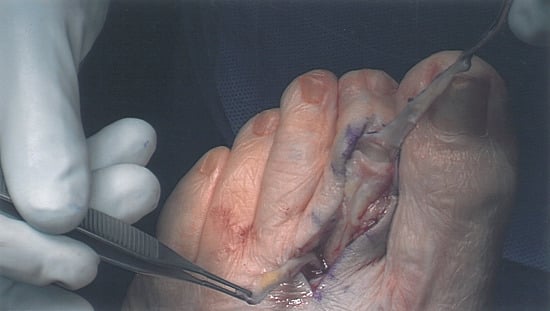
Figure 1.
The incision is made over the dorsal aspect of the digit, and dissection is performed to access the proximal interphalangeal joint. A Z-lengthening of the extensor digitorum longus tendon is performed.
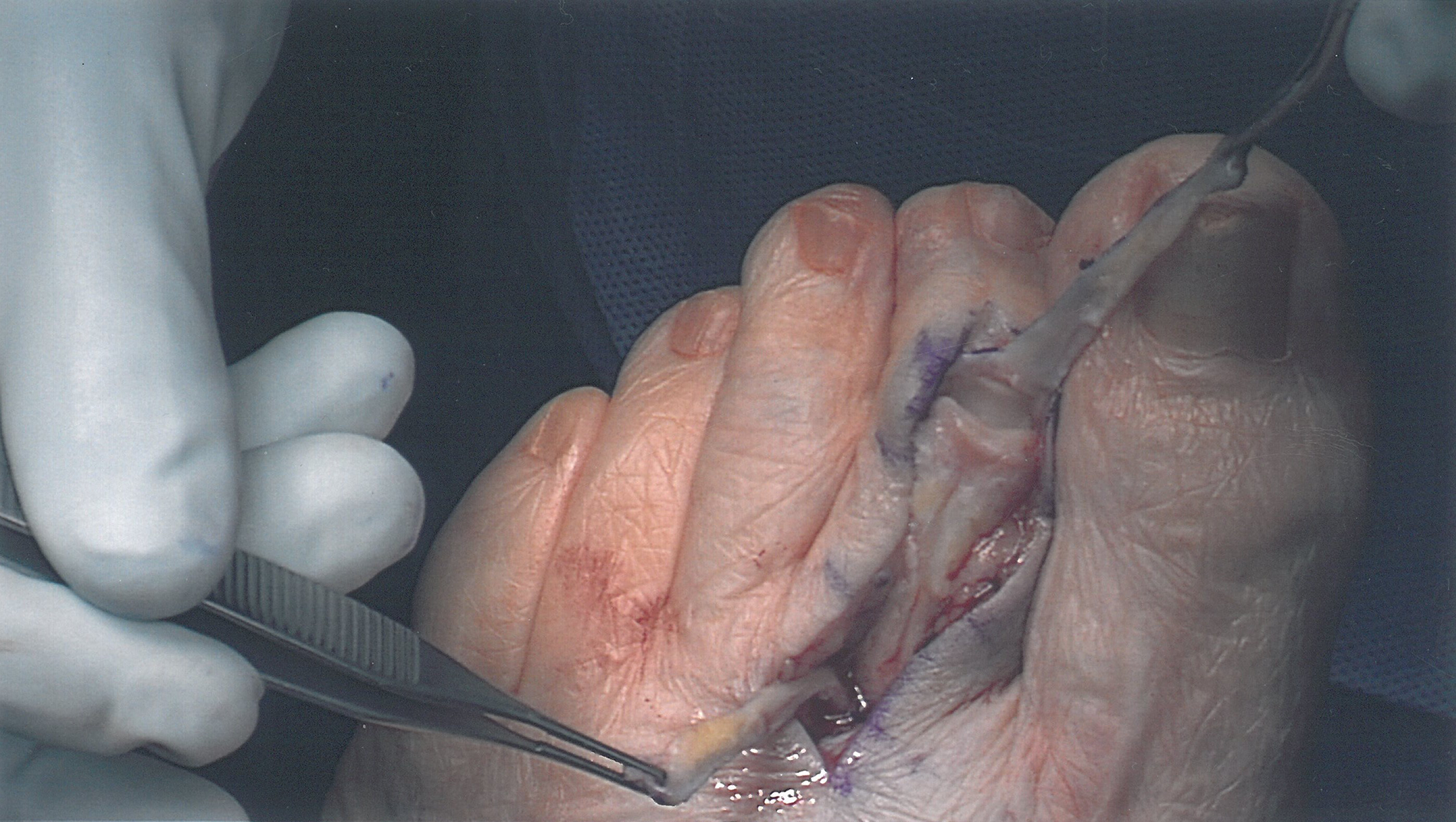
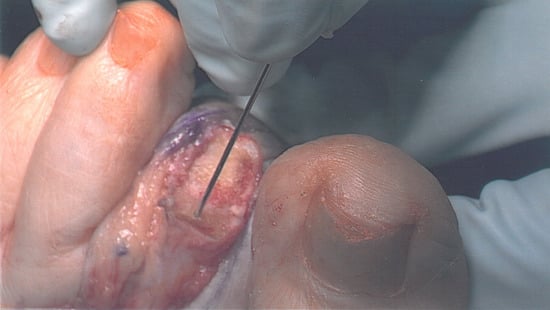
Figure 2.
After the head of the proximal phalanx and the base of the middle phalanx are resected using a power saw, the guidewire for a 2.0- or 2.5-mm screw is inserted by hand in the medullary canal of the proximal phalanx. This is the creation of the traditional pilot hole.
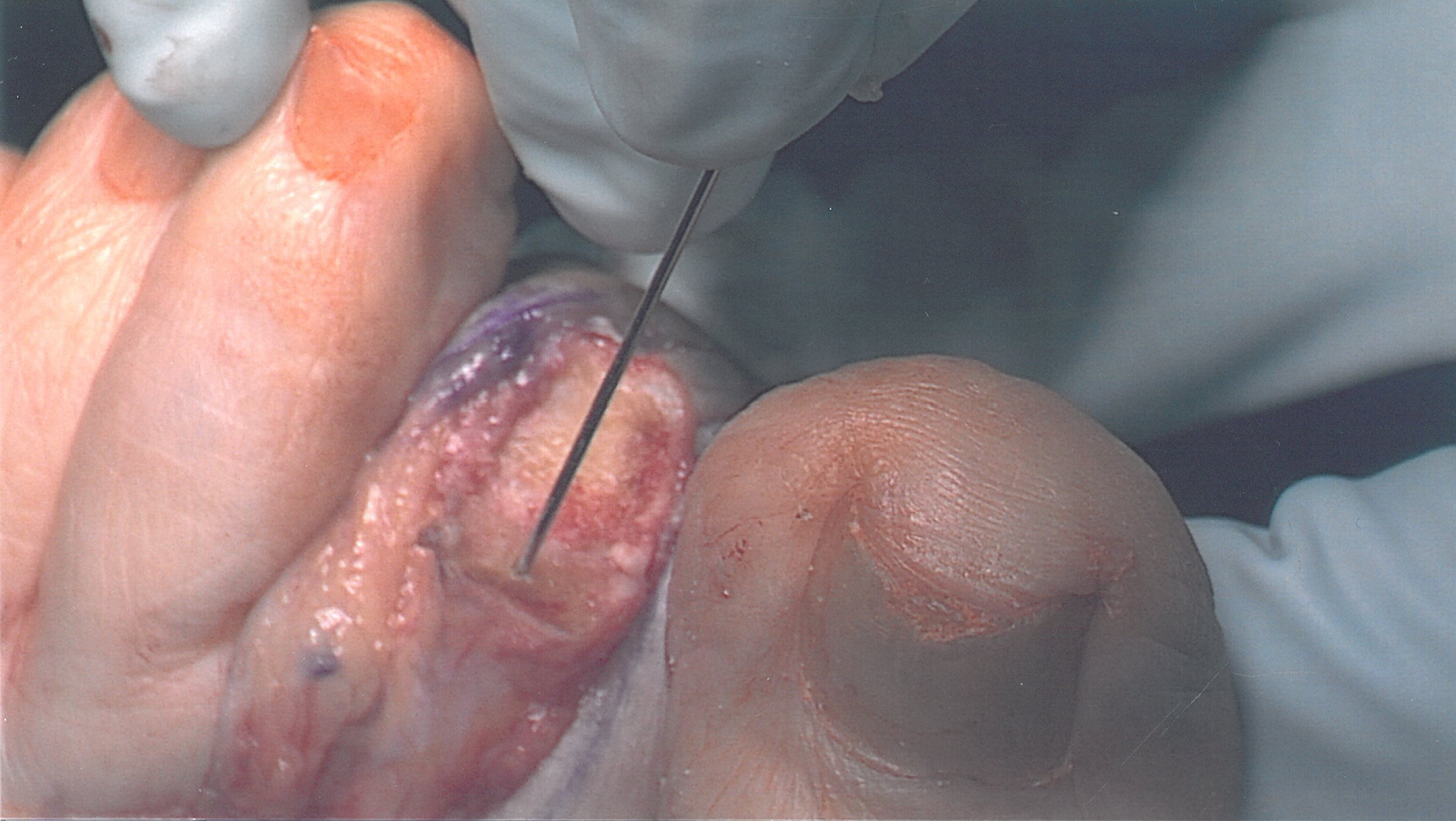
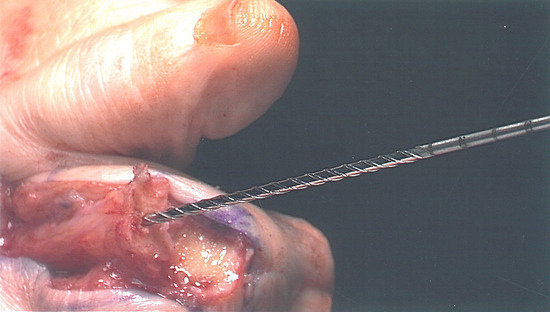
Figure 3.
Once the placement of the guidewire is confirmed, the predrill of the proximal phalanx is performed over the wire. This creates the complete pilot hole for medullary screw fixation.
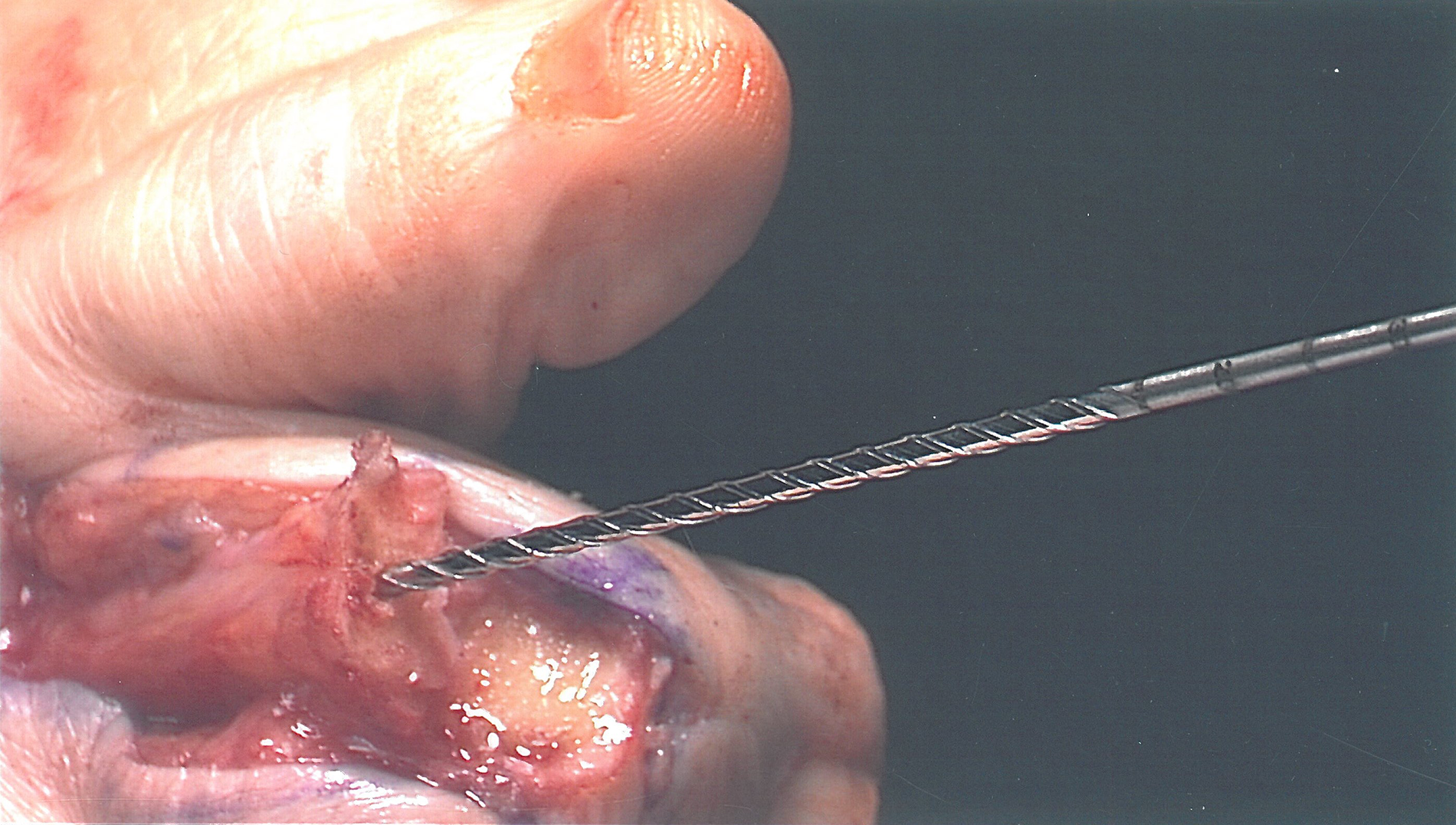
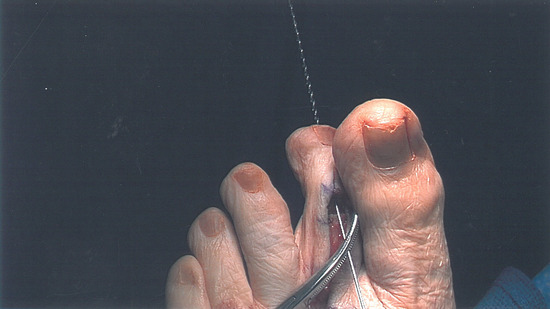
Figure 4.
The sharp end of the guidewire is then placed in the center of the middle phalanx and driven using power partially out the end of the toe. Once placement of this wire is confirmed, a small incision is made at the distal tip of the toe and the predrill is performed through the distal and middle phalanges. This may be done with a hemostat on the proximal blunt tip of the wire so that the wire position is not lost on exiting with the drill.
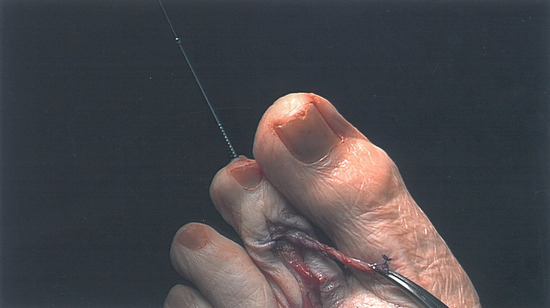
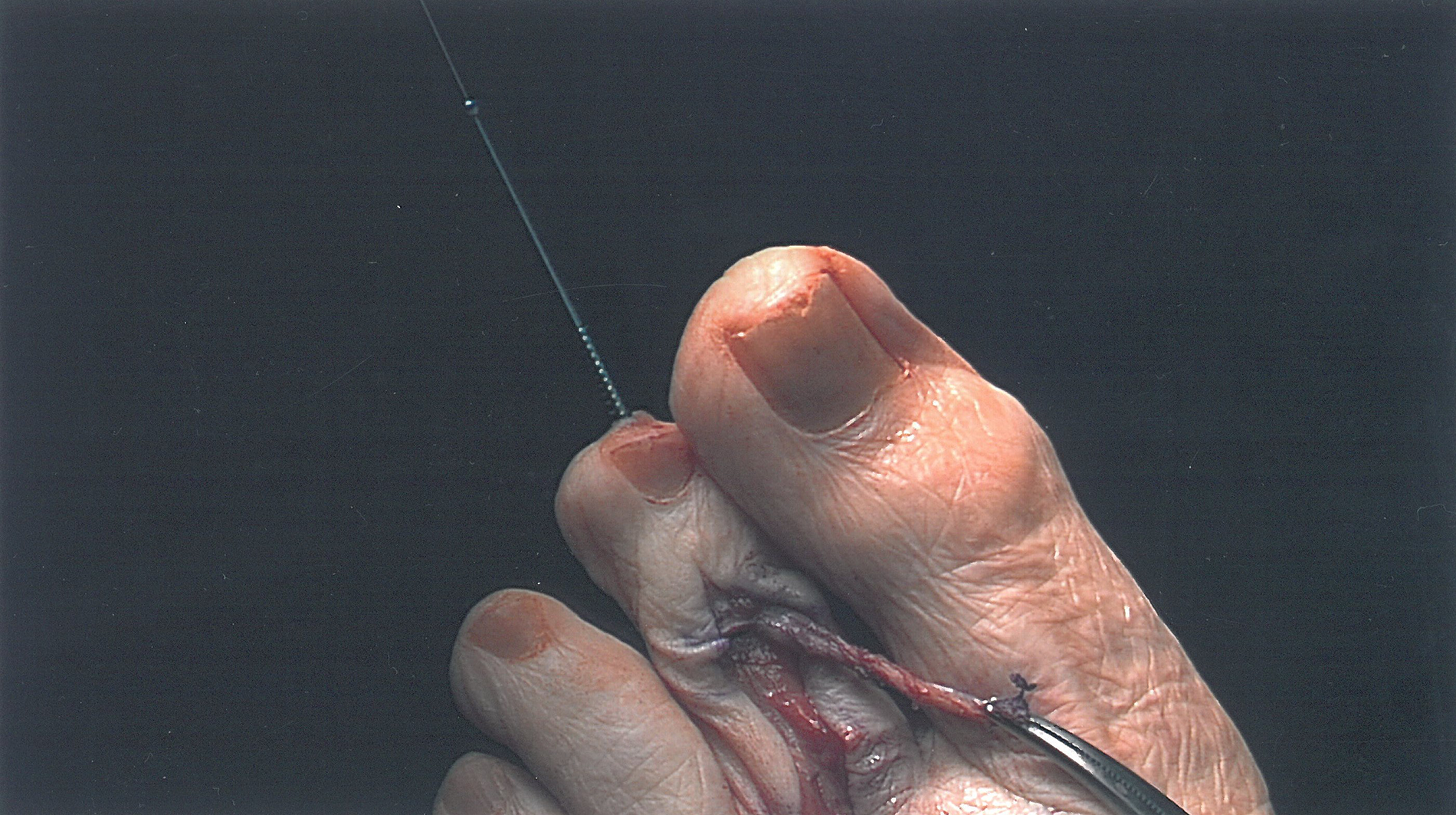
Figure 5.
The wire is then placed in the pilot hole. Countersinking is performed, and the screw length is measured after taking a fluoroscopic image to confirm the wire placement. The screw is then inserted. Care should be taken while the screw is being inserted to stabilize the toe with your hand so that the toe cannot rotate in the frontal plane when turning the screwdriver. The screw should also be inserted such that all of the threads cross the proximal interphalangeal joint to allow for compression and prevent distraction of the joint. The screw head should also be seated completely to the distal cortex of the distal phalanx.
Discussion
Although the pilot hole technique has been described for Kirschner wire fixation [3], the pilot hole technique for medullary screw fixation has not been described in the literature. Arthrodesis of the proximal interphalangeal joint with intramedullary screw fixation has been described, with fusion achieved in 48 of 51 toes with an average American Orthopaedic Foot and Ankle Society score of 86.5 at a mean of 2.6 years of follow-up. These authors concluded that intramedullary screw fixation decreases the risks of infection, radiographic nonunion, and mallet toe deformity compared with Kirschner wire fixation [4].
It is essential that the screw is placed properly because the device is intended to be inserted permanently. The primary benefit of medullary screw fixation is longstanding correction of the deformity so that the interphalangeal joints cannot again deform due to the presence of the screw. Although the presence of the screw prevents recurrence of deformity at the interphalangeal joints, it does not prevent deformity at the metatarsophalangeal joint. An extension contracture can occur at the metatarsophalangeal joint if the skin and tendon are not addressed. For this reason, we recommend that surgeons have a low threshold for performing a Z-lengthening of the extensor digitorum longus tendon as well as address any skin contractures present.
Most medullary screws used for toes have very-small-diameter guidewires, typically less than 1 mm. Although the guidewire can be inserted across the metatarsophalangeal joint inside the screw to stabilize the joint in a corrected position, there is substantial risk that patients could break the wire if they are not compliant with nonweightbearing status. Therefore, if metatarsophalangeal joint fixation is necessary, a larger wire may be inserted percutaneously from the base of the proximal phalanx into the metatarsal head as long as the wire is inserted into the phalanx base proximal to the tip of the screw. The surgeon should also ensure that the screws are of adequate length. The screw length required to allow the screw threads to cross the proximal interphalangeal joint is often greater than 35 mm. However, many 2.0/2.5 screw sets have screw lengths of 20 mm or less. Therefore, care should be taken by the surgeon to ensure that the set being used has screws of adequate length before initiating the procedure. Regarding screw diameter, the second toe in some patients may accommodate a 2.5 or even 3.0 cannulated screw, whereas the third and fourth toes typically require a lesser diameter due to the lesser diameter of the medullary canal of these toes. Inserting a screw that is too large can result in significant complication in our experience, including blowout of the middle or distal phalanx or bending or even breakage of the screw being inserted. Therefore, we consistently use 2.0 cannulated screws because this diameter is routinely accommodated by the medullary canal of all the lesser toes. We also encourage surgeons to take appropriate intraoperative fluoroscopic images, significantly reducing the chance of surgical error. It can be easy for a surgeon to place a wire improperly, which results in improper screw placement that looks appropriate on the dorsoplantar view but the screw is actually exiting the bone and entering the soft tissues either dorsal or plantar. If the appropriate images are not obtained and reviewed carefully, this complication can be missed. This is why we recommend that the pilot hole is started by hand so that the wire freely enters the canal with light pressure. This and drilling the pilot hole under direct visualization of the proximal phalanx minimize this risk. The techniques outlined above help minimize complications, particularly for novice surgeons still developing their dexterity and ability to feel where a wire is in the bone during advancement.
Financial Disclosure
None reported.
Conflicts of Interest
None reported.
References
- Coughlin MJ, Dorris J, Polk E: Operative repair of the fixed hammertoe deformity. Foot Ankle Int 21: 94, 2000.
- Lehman DE, Smith RW: Treatment of symptomatic hammertoe with a proximal interphalangeal joint arthrodesis. Foot Ankle Int 16: 535, 1995.
- Sharma N, Morley D, Damany D: “Pilot hole” technique for interphalangeal joint fusion of toes. JAPMA 106: 305, 2016.
- Caterini R, Farsetti P, Tarantino U, : Arthrodesis of the toe joints with an intramedullary cannulated screw for correction of hammertoe deformity. Foot Ankle Int 25: 256, 2004.
© 2022 American Podiatric Medical Association