Eumycetoma, caused by fungi (specifically,
Madurella mycetomatis) found as inhabitants of soil and water, is a chronic granulomatous infection. The fungal elements break through the skin barrier, often on an injured surface of the foot, incubate and proliferate subcutaneously, and progressively develop into the clinical characteristic triad of painless subcutaneous tumor-like masses, multiple sinuses, and discharged grains [
1]. If untreated, the fungal elements can spread through muscular fascial spaces or lymphatics to muscles and bones and lead to severe consequences, including deformation, disability, amputations, and even death. Any part of the body can be infected, but nearly 70% of the lesions are localized on the foot [
1,
2].
It has been known that eumycetoma mainly affects poorer populations in the remote, rural areas of the tropical and subtropical countries, between 30° north and 15° south, the so-called (eu)mycetoma belt, including Sudan, Somalia, Senegal, Yemen, India, Mexico, and Venezuela [
3,
4]. Men are three to five times more frequently infected than women. Any age group can be affected, but most of the patients are young adults, between 15 and 40 years of age [
2], the usually barefooted active labor forces in farming, herding, and other outdoor activities in these underdeveloped countries. Because of the shortage of medical services, including well-trained medical personnel, diagnostic facilities, and treatment options, these patients do not receive adequate medical care [
4]. Eumycetoma has therefore been classified as a “neglected tropical disease” by the World Health Organization [
5].
Eumycetoma needs to be differentiated from other infectious and noninfectious diseases. In endemic regions, infectious skin diseases should be first considered for differential diagnosis, including cutaneous tuberculosis, coccidiomycosis, chromomycosis, hyalohyphomycosis, sporotrichosis, blastomycosis, dermatophyte pseudomycetoma, and botryomycosis [
6]. In nonendemic regions, benign and malignant lesions including fibroma, rheumatoid nodule, keloid, fibrolipoma, dermatofibroma, Kaposi sarcoma, malignant melanoma, and verrucous carcinoma should be first considered.
The diagnosis of eumycetoma is less difficult based on the clinical characteristic triad of symptoms in endemic regions. However, it is a challenge in nonendemic regions, because of the lack of typical clinical manifestation and lack of awareness by clinicians. Therefore, diagnosis of suspected patients should include the evaluation of grain discharges under microscopic observation, imaging studies with ultrasonography and magnetic resonance imaging, mycologic and bacterial culture, biopsy for histopathologic evaluation with special stains for bacteria and fungi, and molecular sequencing to identify the causal species [
6,
7].
Eumycetoma is treated with antifungal agents in combination with surgical excision. Itraconazole (400 mg daily or 200 mg twice daily) is considered the “gold standard” regimen for eumycetoma [
6,
7,
8,
9]. whereas terbinafine is an alternative [
6,
7]. Ravuconazole has been recently shown to be effective against
M. mycetomatis in an in vitro study [
10], and could provide another potential drug to treat eumycetoma. Surgical intervention for eumycetoma is most suitable for localized lesions less than 5 cm or for the patients not responding to antifungal therapy. For giant or multiple lesions, itraconazole is initially given to arrest the fungal growth to reduce the size of the swelling masses and to promote the proliferation of fibroblasts to encapsulate the eumycetoma, and then followed with surgical excision of the enclosed lesion to avoid extensive surgical operations [
11,
12]. In nonendemic regions, such as North America, especially with atypical, undiagnosed masses, surgical excision is the first choice to remove the lesions for diagnosis; then, antifungal therapy is initiated.
Autochthonous eumycetoma occurs rarely in United States [
2,
13,
14], especially in Northern areas. In this article, we report a case of eumycetoma in the state of Maryland. It is our goal to raise clinicians' awareness of this devastating disease that can show up in unexpected climate regions.
Case Report
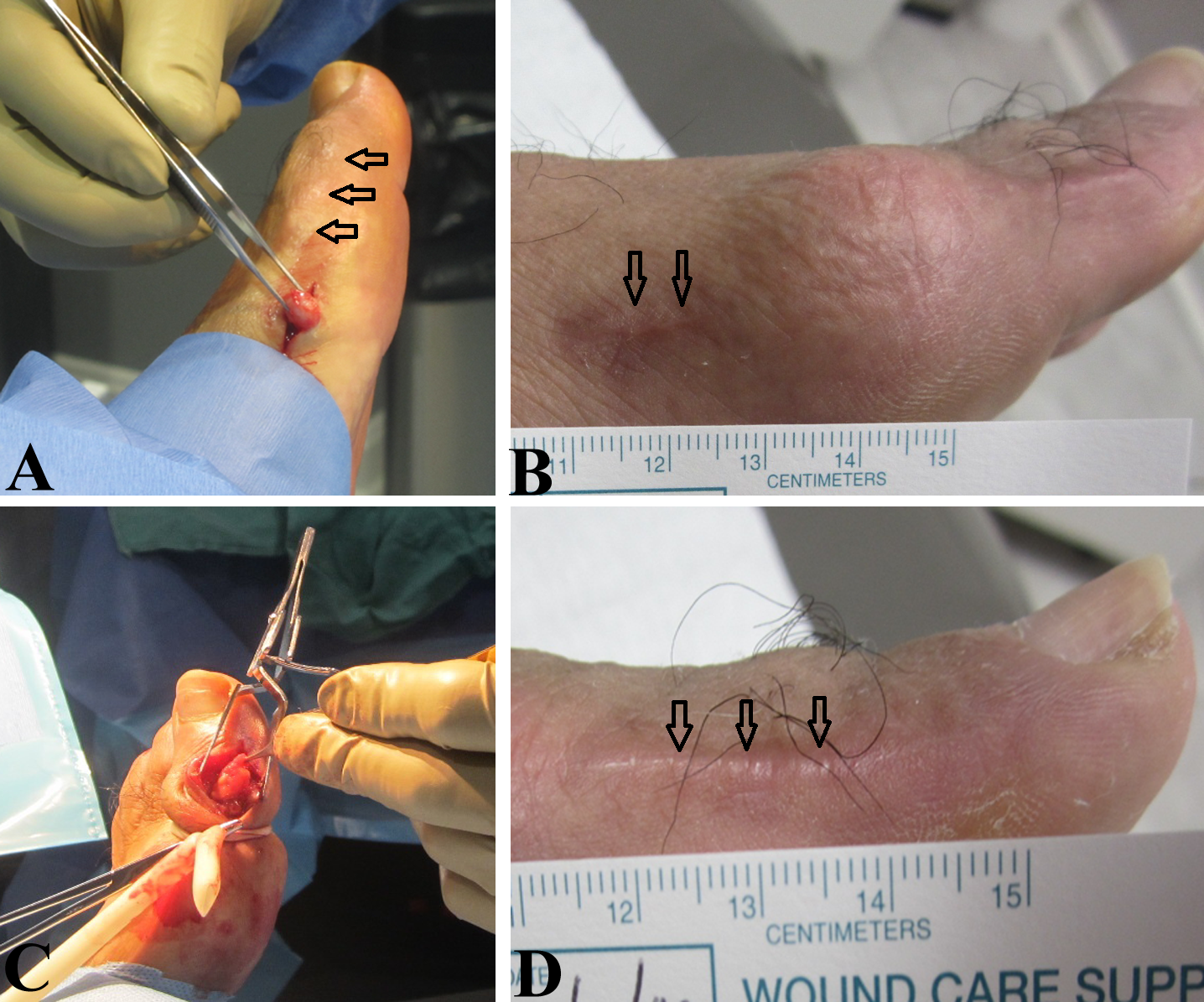
A 51-year-old man presented with complaints of multiple, slightly painful, gradually enlarging nodules on his left great toe. These had developed over the past year, and a new lesion on the left plantar arch had been increasing in size over the past 6 months. The patient had never traveled out of the United States since he immigrated to the United States from Guatemala 19 years earlier. The patient's medical history included diabetes mellitus, high cholesterol, and hypertension. Physical examination revealed a 1-cm-diameter, tender lesion with mild erythema, at the distal medial aspect of the left arch area, just proximal to the medial first metatarsal head (
Fig. 1A), and several 0.5- to 2-cm-diameter, soft, nonpainful, subcutaneous nodules on the dorsal medial aspect of the left hallux, extending from the base of the nail plate to the metatarsal phalangeal joint (
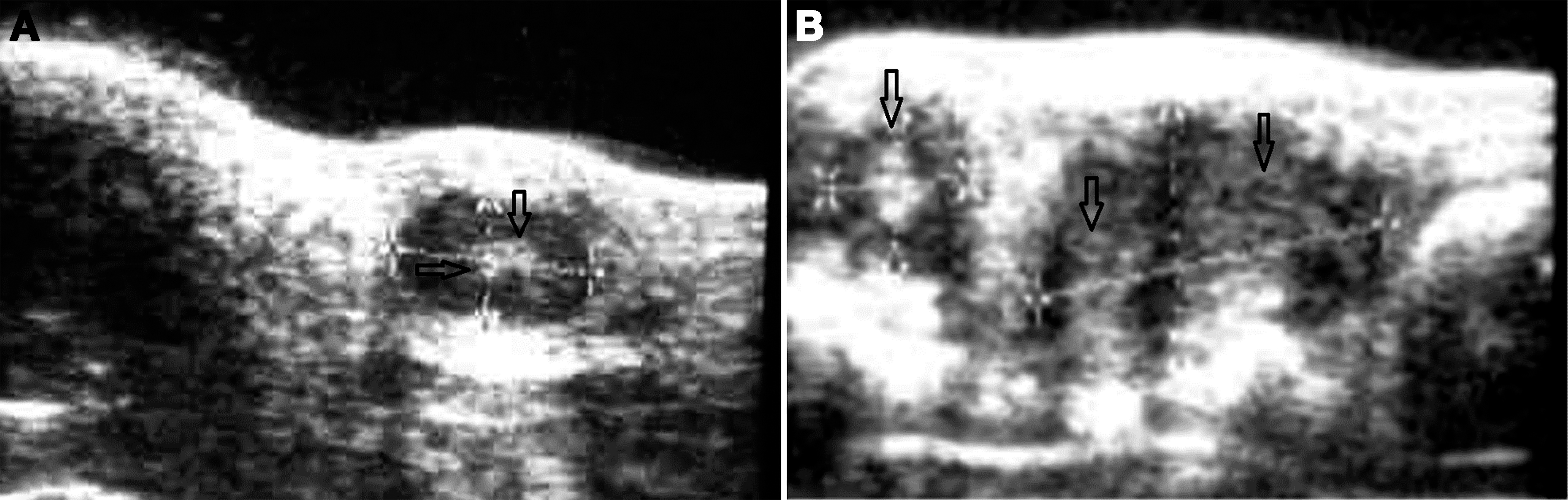
Fig. 1 A, C). Attempted aspiration failed to drain any fluid from the nodules. Three views of the left foot radiographs did not reveal any calcification within the soft tissue or any bone erosions. Ultrasound of the medial arch revealed a 1.0 × 0.5-cm, well-defined nodule within subcutaneous tissue, and three additional nodules over the proximal phalanx of the left hallux. The nodular lesions showed a “dot-in-circle” sign on the ultrasound sonograph characterized by discrete small round hyperintense circles with central hypointense dots in the hypointense matrix of the mass (
Fig. 2A). The distal one measured 0.50 × 0.73 cm, and two of the proximal ones coalesced, measuring 1.79 × 0.85 cm (
Fig. 2B). The four nodules had similar textures.
Figure 1.
Clinical and surgical images of the eumycetoma on the left foot. A, A nodule excised from the left medial arch margin and several nodules on the dorsal surface of the left hallux (arrows). B, Recovered surgical excision line from A (arrows). C, Nodules excised from the dorsal surface of the left hallux. D, Recovered surgical excision line from C (arrows).
Figure 1.
Clinical and surgical images of the eumycetoma on the left foot. A, A nodule excised from the left medial arch margin and several nodules on the dorsal surface of the left hallux (arrows). B, Recovered surgical excision line from A (arrows). C, Nodules excised from the dorsal surface of the left hallux. D, Recovered surgical excision line from C (arrows).
Figure 2.
Ultrasound images of the eumycetoma on the left foot. A, A nodule in the left medial arch with “dot-in-circle” sign (arrows). B, Three nodules on the dorsal inner surface of the left hallux with dot-in-circle sign (arrows); the right two nodules were coalesced. The size of the maximal longitudinal and transverse length of the nodular diameter was measured digitally on the screen of the ultrasound sonograph.
Figure 2.
Ultrasound images of the eumycetoma on the left foot. A, A nodule in the left medial arch with “dot-in-circle” sign (arrows). B, Three nodules on the dorsal inner surface of the left hallux with dot-in-circle sign (arrows); the right two nodules were coalesced. The size of the maximal longitudinal and transverse length of the nodular diameter was measured digitally on the screen of the ultrasound sonograph.
To make a diagnosis and relieve the pain on the plantar surface, the patient opted for surgical excision of the nodule on the left medial arch. A 2-cm linear incision was centered directly over the nodule and the nodule was dissected out, with care taken to avoid causing any damage to the surrounding neurovascular structures (
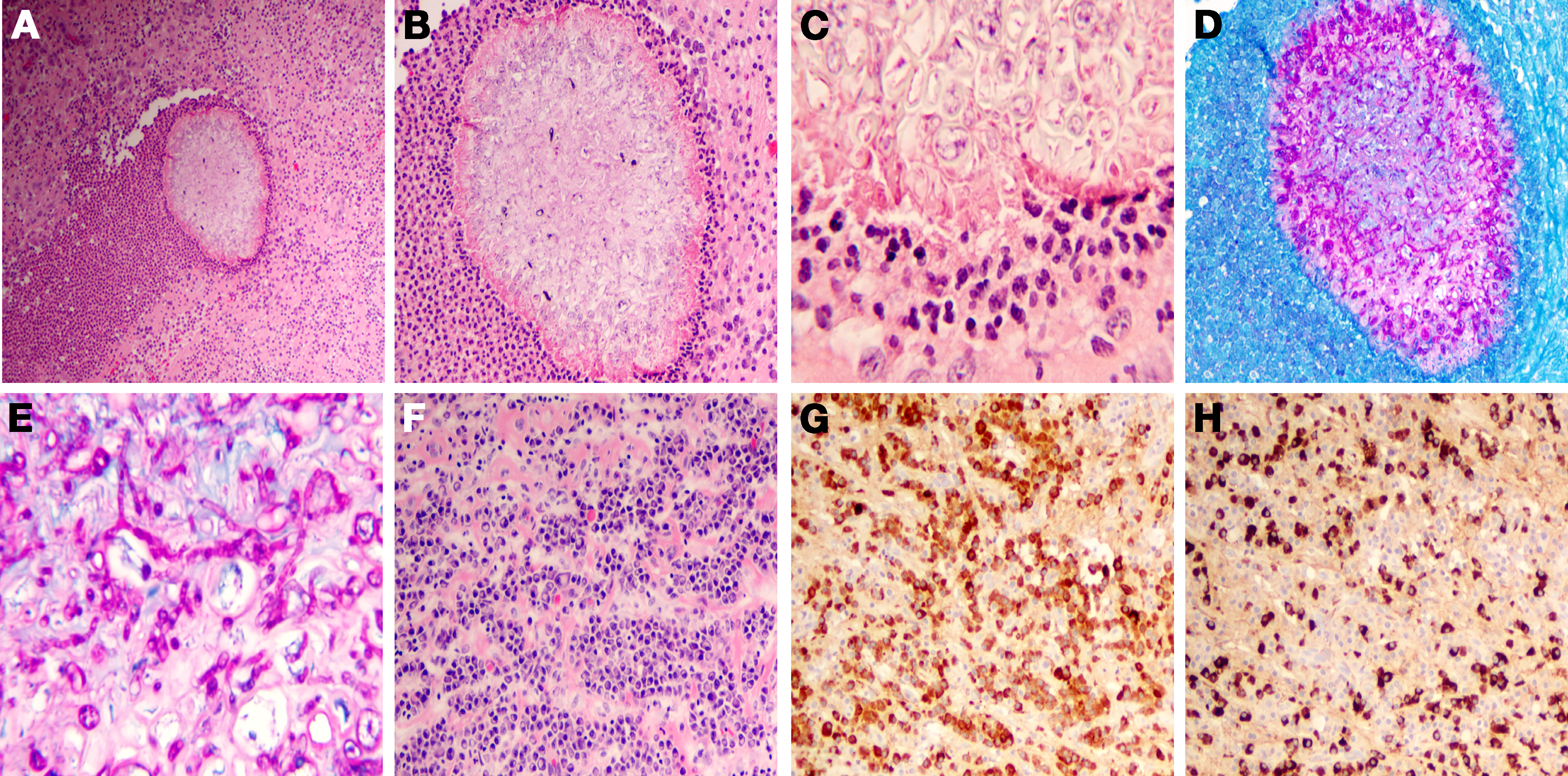
Fig. 1A). Pathologic examination revealed a grayish, well-defined, encapsulated soft-tissue nodule. It was smooth on the outside, and measured 10 × 10 × 6 mm. The tissue was bisected and the cut surface was noted to be a well-circumscribed, grayish, solid, noncystic, nonhemorrhagic mass. Hematoxylin and eosin–stained slides exhibited granulomatous changes with multiple central abscesses and surrounding inflammatory reactions. A typical finding of eumycetoma was observed with the characteristic Splendore-Hoeppli phenomenon, characterized by an amorphous eosinophilic center filled with numerous tangled fungal hyphae and a surrounding cuff of neutrophils (
Fig. 3 A-C and F); further surrounded by granulomatous tissues consisting of numerous plasma cells, macrophages, lymphocytes, and neutrophils; and further encapsulated by proliferative fibroblasts at the outermost layer. Periodic acid-Schiff stain demonstrated wide, thick septate fungal hyphae in the center of granulomatous tissue (
Fig. 3 D and E). Kappa and lambda immunostains showed mixed populations of either kappa- or lambda-positive plasma cells, which is indicative of a reactive inflammatory process (
Fig. 3 G and H). Special stains (Fite, Warthin starry, and Gram stains) were negative for mycobacterial and bacterial microorganisms, respectively.
Figure 3.
Histopathology of the eumycetoma. A (H&E, ×40), B (H&E, ×100), and C (H&E, ×400). An amorphous eosinophilic center filled with numerous tangled fungal elements, and a surrounding cuff of neutrophils, and further surrounded by granulomatous tissues composed of plasma cells, macrophages, lymphocytes, and neutrophils and further encapsulated by proliferative fibroblasts at the outermost layer (Splendore-Hoeppli phenomenon). D and E, Periodic acid-Schiff staining showing positive fungal elements (hyphae and spores) in the center of granuloma (D, Periodic acid-Schiff, ×100; and E, periodic acid-Schiff, ×400). F, Numerous plasma cells surrounding fungal elements (H&E, ×100). G, Immunostain showing kappa-positive plasma cells surrounding fungal elements (diaminobenzidine, ×100). H, Immunostain showing lambda-positive plasma cells surrounding fungal elements (diaminobenzidine, ×100).
Figure 3.
Histopathology of the eumycetoma. A (H&E, ×40), B (H&E, ×100), and C (H&E, ×400). An amorphous eosinophilic center filled with numerous tangled fungal elements, and a surrounding cuff of neutrophils, and further surrounded by granulomatous tissues composed of plasma cells, macrophages, lymphocytes, and neutrophils and further encapsulated by proliferative fibroblasts at the outermost layer (Splendore-Hoeppli phenomenon). D and E, Periodic acid-Schiff staining showing positive fungal elements (hyphae and spores) in the center of granuloma (D, Periodic acid-Schiff, ×100; and E, periodic acid-Schiff, ×400). F, Numerous plasma cells surrounding fungal elements (H&E, ×100). G, Immunostain showing kappa-positive plasma cells surrounding fungal elements (diaminobenzidine, ×100). H, Immunostain showing lambda-positive plasma cells surrounding fungal elements (diaminobenzidine, ×100).
Two months later, all three nodules on the dorsal medial aspect of the left hallux were surgically removed (
Fig. 1C). The pathologic examination of all three nodules showed the same histomorphology and periodic acid-Schiff staining patterns as the previous one. All lesions were diagnosed as eumycetomas. Polymerase chain reaction–based sequencing revealed
Cladosporium cladosporioides as the causal pathogen in the granuloma.
The patient recovered well from the two surgical excisions (
Fig. 1 B and D) and returned to normal activities at 3 months' follow-up. The patient was further treated with oral fluconazole [
15], at a dose of 100 mg daily for 10 days and another course of oral fluconazole, after 30 days, postoperatively. The patient had no recurrence at a follow-up of 20 months.
Discussion
We report an atypical variant of eumycetoma in the state of Maryland. The patient's histomorphologic results showed characteristic eumycetoma with the Splendore-Hoeppli phenomenon, characterized by an amorphous eosinophilic center filled with numerous fungal hyphae highlighted by periodic acid-Schiff stain and a surrounding cuff of neutrophils. Molecular sequencing identified
Cladosporium cladosporioides as the causal pathogen.
Cladosporium cladosporioides was reported in eumycetomas [
6]. These data suggest that the fungal species causing eumycetoma are more diverse than previously reported [
6].
All visible nodular lesions were surgically removed. Surgical excision is performed not only for optimal treatment but also for histologic diagnosis. The patient was further treated with two courses of oral fluconazole with a dose of 100 mg daily for 10 days and with an interval of 30 days because multiple nodules developed within 1 year. Successful treatment of eumycetoma with fluconazole was reported previously [
15]. The patient was followed up periodically and did not show any sign of recurrence at 20 months' follow-up. The selection of the antifungal agents and the duration of the antifungal treatment should be based on the individual's clinical features and immune functional status, and should be adjusted according to the patient's response.
Because our patient had immigrated from Central America, we believe that the patient was infected with fungi in his home country. The incidence of eumycetoma in the United States is most likely higher than thought because of the presence of millions of immigrants from tropical and subtropical regions [
16,
17]. It is therefore necessary to raise awareness of the clinical presentation, differential diagnosis, imaging investigation, pathologic features, and treatment of eumycetoma to clinicians, especially podiatrists and dermatologists.