Idiopathic clubfoot is a congenital foot deformity comprising forefoot adduction, midfoot cavus, hindfoot varus, and ankle equinus [
1]. It is that which occurs in an otherwise healthy baby [
2]. It is one of the commonest congenital musculoskeletal abnormali-ties, with approximately 200,000 cases seen annually in the developing world [
3].
Its diagnosis is clinical. Several treatment modalities have been used in the treatment of this condition, ranging from nonoperative to operative procedures. Presently, nonoperative methods are preferred, among which the Ponseti method has gained universal acceptance with good outcomes. Morcuende et al [
4] reported an initial correction rate of as much as 94%. It has also reduced the total cost of care and modified the pattern of surgery if surgery must be performed [
5]. The Ponseti method involves manipulation and serial plaster of Paris casting to progressively correct the various components of the deformity from cavus to dorsiflexion [
1,
6]. To achieve correction of the dorsiflexion, more than 90% of the patients require percutaneous Achilles tenotomy [
2] in which the Achilles tendon (AT) is aseptically divided close to its point of attachment on the calcaneus. Ultrasonographic studies have confirmed repair of the AT after tenotomy [
7,
8,
9,
10]. The divided tendon usually reunites in approximately 3 weeks [
2,
11]. Achilles tenotomy is an office procedure according to the Ponseti treatment protocol [
12].
Although the procedure of percutaneous Achilles tenotomy is simple to perform, it is not without complications. Reported complications associated with this procedure include bleeding due to injury to the contiguous vessels, injury to the tibial or sural nerves, and incomplete division of the AT [
13,
14,
15].
To reduce the risk of these complications, knowledge of the size of this tendon in children with clubfoot would be beneficial. This knowledge will guide the surgeon as to the extent to which the tenotomy blade should be inserted to avoid injury to the surrounding tissues and yet achieve a complete tenotomy. Musculoskeletal ultrasound is now being used more frequently, especially for superficial structures such as the AT [
16]. This study aimed to ultrasonographically determine the thickness of the AT at different levels from its insertion into the calcaneum in children with clubfoot and to relate these findings to those obtained in healthy children.
Materials and Methods
This is a prospective comparative study comprising consecutively recruited children 4 years and younger who presented with idiopathic clubfoot at the Pediatric Orthopedic outpatient clinic of Obafemi Awolowo University Teaching Hospital Complex along with age-matched healthy children selected from the local community.
The study group comprised patients who had undergone Ponseti serial manipulations and casting and required tenotomy according to the Ponseti method. Patients who have previously had Achilles tenotomy or syndromic, neurogenic, postural, atypical, or acquired clubfoot were excluded from this study. Each patient had serial manipulation and casting performed according to the Ponseti proto-col, with correction of all of the components of the deformity achieved except dorsiflexion. Percutaneous tenotomy was required in these patients because the dorsiflexion achieved in them was less than 58. The control group comprised children with no musculoskeletal deformity. Informed consent was taken from the parents or guardians of the children.
Ultrasonographic evaluations of the AT were performed only on the affected foot or feet in the study group and on the two healthy feet in the control group. For the study group, ultrasonography was performed before the tenotomy was performed. Clinical data collected from the children in both groups include age, sex, weight, length/height, and body mass index (BMI). For the ultrasonographic evaluation, the patients were put in the prone position on their parent’s/guardian’s lap. The ATs of the patients were scanned using a 12-MHz musculoskeletal probe of a scanner (Shenhzhen Mindray Bio-Medical Electronics Co Ltd, Shenzhen, China). The ultrasonographic data collected include the thickness of the AT 1 and 2 cm from the calcaneal insertion of the AT, the thickness of the thinnest portion of the tendon along its length, and the distance of this thinnest portion from the calcaneal insertion. Ethical clearance for the patients was obtained from the ethics and research committee of the Obafemi Awolowo University Teaching Hospital Complex. The transport fares of the parents/guardians of the participants were subsidized by the authors, and ultrasonography was performed at no cost. Data collected from the study were analyzed using a statistical software program (SPSS for Windows, Version 16.0; SPSS Inc, Chicago, Illinois). A P = .05 was taken to be statistically significant.
Results
Fifty children were enrolled in this study. The study group comprised 27 children with clubfoot (23 boys [85.2%] and four girls [14.8%]); 11 of them (40.7%) had bilateral clubfeet and 16 (59.3%) had a unilateral clubfoot, making 38 feet in the study group. The control group comprised 23 children without musculoskeletal deformity, of which 14 (60.9%) were boys and nine (39.1%) were girls. The feet were considered bilaterally for each of the children in the control group, making a total of 46 feet in this group.
The median age of the study group was 5 months (range, 1–48 months), and that of the control group was 9 months (range, 1–36 months). The mean weight, length/height, and BMI values of the two groups are given in
Table 1. Homogeneity of the anthropometric measurements in both groups was statistically confirmed (
P = 0.39,
P = 0.72, and
P = 0.85, respectively) (
Table 1).
Mean AT thickness values 1 and 2 cm from the calcaneal insertion in the study and control groups are shown in
Table 2. The differences in the mean tendon thicknesses between the two groups at the two reference points were not significant (
P = .35 at 1 cm and
P = .28 at 2 cm). The mean thickness of the thinnest portion of the AT along its length in both groups and the distance of these thinnest portions from the calcaneal insertion of the tendon are also shown in
Table 2.
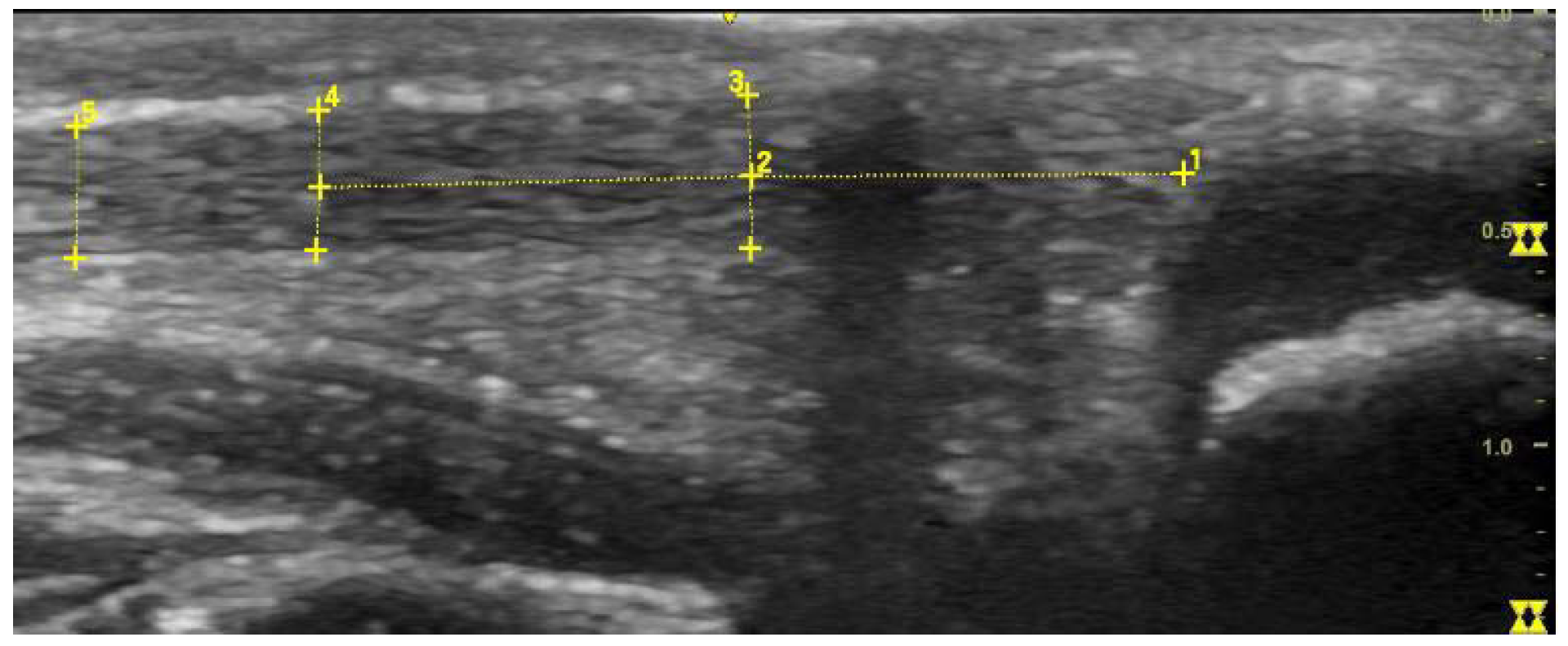
Figure 1 shows a sonographic image of a scanned AT with the measured dimensions.
Considering the correlation between the average thickness of the AT and some potentially related demographic factors, there was no correlation between the AT thickness (1 and 2 cm from the calcaneal insertion) and age, sex, weight, length/ height, or BMI in the study group. However, in the control group there was a moderately positive correlation between the age and length/height of the children and the AT thickness both 1 and 2 cm from the calcaneal insertion. Moreover, in the control group, BMI also showed a moderately positive correlation with the AT thickness but only 1 cm from the calcaneal insertion (
Table 3).
Discussion
Achilles tenotomy is required in most patients to achieve adequate correction of dorsiflexion deformity in Ponseti management of clubfoot. To control the complication rate associated with this procedure, knowledge of the dimension of the AT is of immense importance as it would serve as a guide to safe and complete tenotomy.
Most of the Achilles tenotomies performed for clubfoot are limited to the distal 2 cm of the tendon. Hence, the ultrasonographic field of view for the tendon evaluation was limited to this portion of the AT. Some authors perform the Achilles tenotomy 1 cm [
17,
18] and some 2 cm [
19,
20] proximal to its calcaneal insertion. Therefore, in this study, these two sites were considered for measurement of the thickness of the AT for comparison and then to know the thinnest portion of the AT.
In the present study, the mean thickness of the AT was lower 1 cm from its calcaneal insertion in the study group compared with the control group; however, this was not of statistical significance (
Table 2). This pattern was also observed between the two groups 2 cm from the AT insertion point. Although there is no significant difference in the AT thickness between the two groups, the relative reduction in the AT thickness in the patients with clubfoot might be related to the atrophy of the calf muscle that is part of the pathoanatomical features of this foot deformity [
21]. From the previously mentioned findings, the AT is thicker 1 cm from its calcaneal insertion than it is at 2 cm. This is because the tendon normally flares out distally as it attaches to the calcaneum [
22]. The mean thickness of the AT measured 1 cm from the calcaneal insertion in both groups is similar to the findings in the study performed in Brazil by Bezerra et al [
23] in which the average AT thickness values in children with healthy feet of similar age group measured at the level of the medial malleolus were 2.4 mm in boys and 2.5 mm in girls. Another study conducted in India by Agarwal et al in children with clubfoot aged 1 to 11 months (mean age, 5 months) had a mean 6 SD AT thickness of 2.87 6 1.81 mm in the affected feet [
10]. This study showed that the AT of children with clubfoot in India seems to be slightly thicker than in Nigeria. However, the work by de Mello et al [
24] showed that there was no relationship between the AT thickness and race.
The mean thickness of the thinnest portion of the AT measured in the ultrasonographic field of view was 2 mm at 1.8 cm from the calcaneal insertion in both groups. To our knowledge, there has been no study that assessed the thinnest portion of the AT in patients with clubfoot. This finding is important because it provides information as to the point where an incision should be made while performing a percutaneous tenotomy considering the depth of tenotomy blade insertion so as to avoid damage to adjacent structures and achieve a complete tenotomy. Achieving a complete tenotomy would help reduce the rate of relapse in the Ponseti clubfoot treatment. However, it is also important to consider the varying thicknesses of the soft tissue overlying the AT in each child to determine the actual depth of tenotomy blade insertion.
Regarding correlation of the thickness of the AT with potentially related factors, there was no correlation between the AT thickness and factors such as age, sex, length/height, or BMI in the children with clubfoot. This can be due to the pathologic process underlying the AT in this deformity. However, in the children with healthy feet, the study shows that the thickness of the AT moderately correlates positively with the age and length/height of the children at the two reference points except for the correlation at 1 cm from the calcaneal insertion, where it correlates positively only with the BMI. A study by Koivunen-Niemela¨ and Parkkola [
25] also showed that there was a statistically significant correlation between the tendon thickness and body height. They further explained that the differences in population height could account for the measured differences in normal AT thickness found in studies of Japanese individuals compared with studies of European and American individuals [
25]. Few studies have been conducted to evaluate AT thickness in children, which limited the extent of comparing this work with other studies.
Conclusions
This study showed that the mean 6 SD thickness values of the AT in children with and without clubfoot 1 cm from its calcaneal insertion were 2.4 ± 0.7 and 2.5 ± 0.7 mm, respectively; 2 cm from the calcaneal insertion they were 2.1 ± 0.7 and 2.3 ± 0.7 mm, respectively, with the differences not statistically significant. The mean 6 SD thickness of the thinnest portion of the AT was 2 mm at 1.8 cm from the calcaneal insertion in both study groups. With the dimensions given previously herein, safe and complete percutaneous tenotomy would most likely be achieved when performed 1.8 cm from the calcaneal insertion, with the mean AT thickness of 2 mm being a guide as to what the insertion depth of the tenotomy blade should be. This knowledge would also help control the rate of relapse in the Ponseti treatment of idiopathic clubfoot.