Next Article in Journal
Management of Periprosthetic Polyvinyl Alcohol Synthetic Cartilage Implant Infection with Staged First Metatarsophalangeal Joint Arthrodesis. A Case Report
Previous Article in Journal
Additional Akin Proximal Phalanx Procedure Has a Limited Effect on the Outcome of Scarf Osteotomy for Hallux Valgus Surgery
 
 
Journal of the American Podiatric Medical Association is published by MDPI from Volume 116 Issue 1 (2026). Previous articles were published by another publisher in Open Access under a CC-BY (or CC-BY-NC-ND) licence, and they are hosted by MDPI on mdpi.com as a courtesy and upon agreement with American Podiatric Medical Association.
Article

The Beneficial Effects of Erbium:Yttrium-Aluminum-Garnet Laser in an Ulcer Caused by Lower Leg Arteriopathy

by
Aysenur Botsali
*,
Ercan Caliskan
and
Mustafa Tunca
University of Health Sciences, Gulhane Training and Research Hospital, Department of Dermatology, General Dr. Tevfik Saglam Cad., SBU¨ Gu¨ lhane EAH Dermatoloji AD, Ankara, Turkey
*
Author to whom correspondence should be addressed.
J. Am. Podiatr. Med. Assoc. 2021, 111(6), 20099; https://doi.org/10.7547/20-099
Published: 1 November 2021

Abstract

Ablative fractional laser is suggested to promote wound healing in diabetic and venous leg ulcers. In this article, we report the treatment outcome of a recalcitrant foot ulceration related to lower leg arteriopathy. A 43-year-old man with typical digital substraction angiographic findings of arteriopathy was admitted to our department after 30 sessions of hyperbaric oxygen therapy. There was heterotopic tissue within the ulcer consistent with osseous metaplasia and mature bone tissue. This tissue was removed with full-field erbium:yttrium-aluminum-garnet laser, and the remaining parts received fractional erbium:yttrium-aluminum-garnet laser for the induction of wound healing. A decrease in ulcer dimensions was achieved by the second month of laser interventions without recurrence in the first-year control.

The induction of dermal collagen and restoration of tissue remodeling by ablative lasers is the rationale for the preference of carbon dioxide (CO2) laser and erbium:yttrium-aluminum-garnet (Er:YAG) lasers during the management of scars. The stimulative property of fractional ablative resurfacing on chronic wound healing was discovered coincidentally in military veterans. A single application of CO2 laser to the scar tissue related to traumatic blast injuries provided total closure of chronic recalcitrant ulcers located inside these scars. [1=] The proposed mechanisms for this substantial effect on chronic wound healing are the destruction of biofilm, bactericidal efficacy (together implicated as photomicrodebridement), the reversal of chronic wound healing to the acute phase, and the improvement of sclerosis surrounding the wound. The induction of type III collagen instead of type I collagen along with the induction of growth factors (ie, vascular endothelial growth factor and basic fibroblast growth factor) and the supression of transforming growth factor-β was demonstrated in a diabetic foot model. [2,3=]
Initially, the stimulative properties of CO2 lasers were emphasized more than that of Er:YAG lasers, as Er:YAG laser is regarded as the gentler and cooler one. Still, Er:YAG laser has an additional advantage during the management of chronic wounds because of its higher selectivity for water. Erbium:YAG laser lacks the prominent coagulation zone in the treated area, which is a significant feature of CO2 laser. Thus, Er:YAG laser acts as a smooth laser knife and, recently, Er:YAG laser–assisted debridement has been reported to be superior to conventional sharp debridement. [4=]
Er:YAG laser has been administered for a long time by periodontists and maxillofacial surgeons for hard- and soft-tissue ablation, granulation tissue removal, and bactericidal effect, with a faster healing duration compared to conventional scalpel surgery. [5=] The implementation of Er:YAG laser applications to the management of venous and diabetic ulcers stands as a relatively novel approach. [4,6=]
Despite the scarcity of data defining the promotion of chronic wound healing, the efficacy of Er:YAG laser should be evaluated further for different subtypes, including arterial ulcers. In this article, we describe our experience with a chronic foot ulcer caused by lower leg arteriopathy. We achieved complete epithelialization by the combination of fractional and full-field Er:YAG laser treatment. A single full-field application was successful for the removal of the osseous tissue within the scar, and fractional applications were repeated biweekly for the stimulation of wound healing.

Case Report

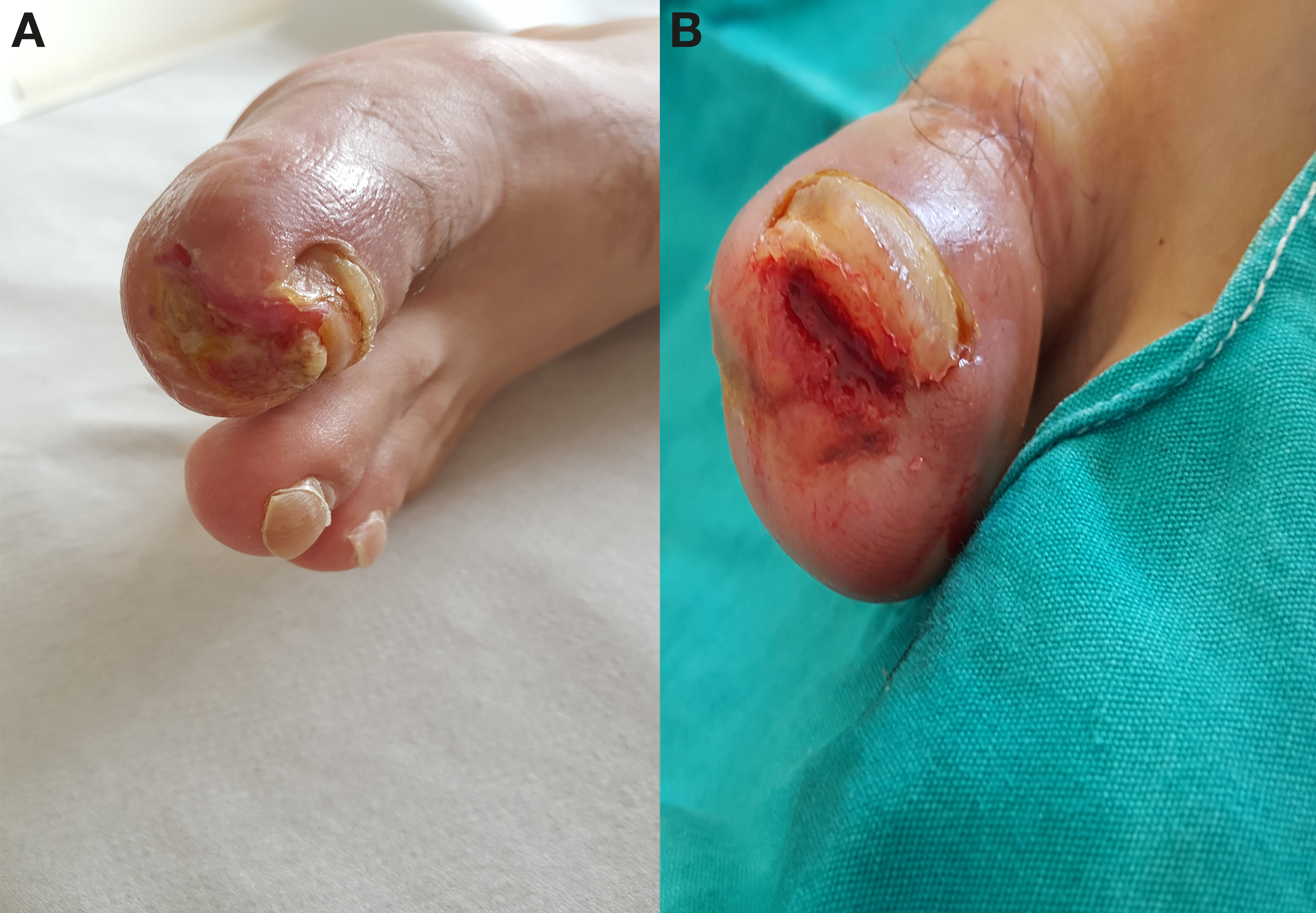
A 43-year-old male patient was admitted to our clinic for a refractory foot ulceration of 3 months' duration. The patient did not mention any other systemic diseases. The ulceration started after a surgical procedure for an ingrown nail. Because of the recalcitrant nature of this ulceration, and the complaint of adjunctive claudication, blood flow of the lower extremities has been evaluated further. The flow pattern of both left arteria tibialis anterior and posterior were monophasic resistant, and the acceleration time was prolonged on lower extremity arterial Doppler ultrasonography. On digital substraction angiography, complete occlusion of the posterior tibial artery along with corkscrew collateral vessels were noted. Initially, Ilomedin (Schering, Berlin, Germany) infusion was introduced to this patient. Thereafter, he received 30 sessions of hyperbaric oxygen therapy with partial improvement. In addition, he was receiving clopidogrel and cilostazol treatments. Dermatologic examination revealed a 4-cm2 ulceration located on the hyponchium of the first toe of the left foot, extending toward the plantar surface with a narrowing base. The ulceration included a 1.2 × 0.2-cm linear hard heterotopic tissue lying just beneath the free margin, which was submitted to biopsy and reported as inflammatory exudate and osseous metaplasia with mature bone formation (well mineralized with mature osteocytes) (Fig. 1A).
Figure 1. A, Thromboangiitis obliterans: dermatologic examination revealed a 4-cm2 ulceration located on the hyponchium of the first toe of the left foot. B, Clinical image after the ablation of osseous tissue at week 6.
Japma 111 20099 f01
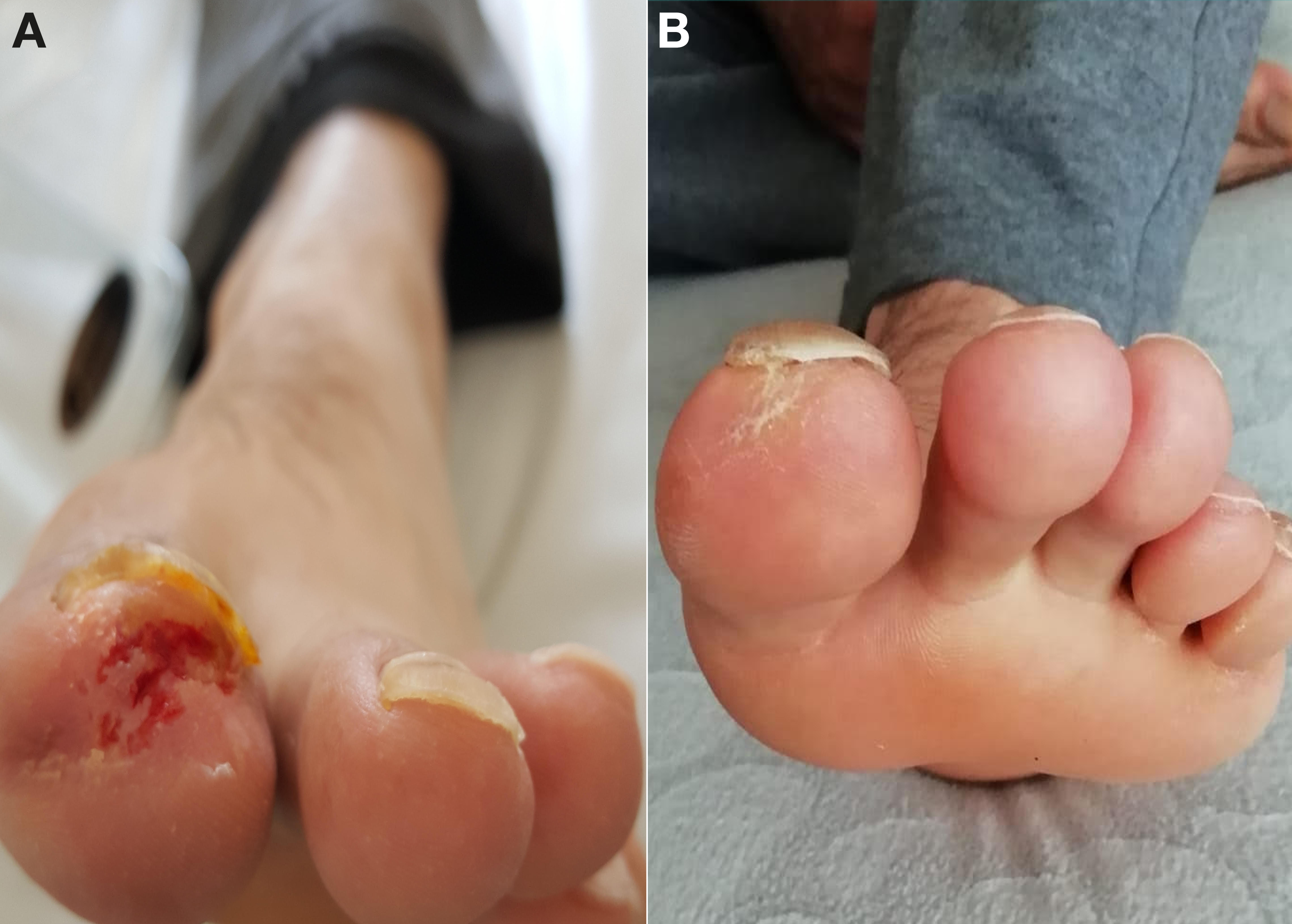
Fractional Er:YAG laser (XR Dynamis; Fotona, Ljubljana, Slovenia) was applied with 100-μsec pulse width, 10-Hz frequency, and fluencies of 8 to 10 J/cm2. Epithelialization was evident after three consecutive fractional Er:YAG applications every 2 weeks except the osseous tissue forming a mechanical barrier for wound closure. Full-field Er:YAG laser application was performed to ablate this tissue within the ulcer 6 weeks after the first intervention of Er:YAG laser (Fig. 1B). The treatment was done at 300-μsec pulse width and 22 J/cm2 with an R-11 handpiece followed by two additional sessions of fractional ablative Er:YAG laser. A decrease of ulcer dimensions was achieved at the ninth week of laser therapy (Fig. 2A). The follow-up result of the first year is shown (Fig. 2B).
Figure 2. A, Clinical image obtained at week 9. B, Follow-up result at 1-year. At the last control, because of the moderate keratinization overlying the previous ulceration area, antikeratolytic agents were prescribed.
Japma 111 20099 f02

Discussion

In our case, even for recalcitrant ulceration with underlying arterial hypoperfusion, we were able to obtain a remarkable response with fractional Er:YAG laser application. The promotion of chronic wound healing by ablative fractional lasers is explained mainly by the reversal of chronic inflammatory changes accentuating the healing process to the acute stage. [2=] The efficacy in different chronic wound types may be explained mainly by this mechanism. In addition, the ablation of osseous tissue was crucial, as it disrupted wound closure. The effect of Er:YAG laser on hard tissues is explained by Hibst and Keller [7=] in a different way from that of the skin as the theory of “microexplosions.” The increase of internal presssure caused by vapor is thought to be the cause of the destruction of inorganic components by explosion; thus, mechanical damage rather than thermal damage is apparent.
We previously observed the beneficial effects of Er:YAG laser on recalcitrant ulcerations related to pyoderma gangrenosum and suggested the use of 2,940-nm Er:YAG laser under adjunctive immunosuppressive treatment as the optimal approach for minimizing the risk of the pathergy phenomenon. [8=] Again, in this article, we report the beneficial effects of fractional Er:YAG laser therapy in an arterial ulcer, as it offers a precise, level-controlled debridement, targeting more superficial tissues with less thermal damage when administered in short pulse durations. In addition, in a recent study comparing Er:YAG laser debridement to sharp steel debridement, similar treatment outcomes were achieved, with a lower bacterial load for the laser-treated group. [4=] Erbium:YAG laser is available in limited centers and, because of the cost of the device itself, is clearly costly compared to sharp debridement. However, Er:YAG laser debridement is not associated with a consumption cost on repeated use and thus may be preferred if available. For our patient, the fractional laser settings were adjusted to avoid peripheral tissue damage, which was critical because of the underlying arterial vascular spasm and hypoperfusion.

Conclusions

The strong effect of this superficial laser on hard tissues should also be kept in mind during the management of suitable cases.

Acknowledgments

Financial Disclosure: None reported.
Conflict of Interest: None reported.

References

  1. ShumakerPRKwanJMBadiavasEV: Rapid healing of scar-associated chronic wounds after ablative fractional resurfacing. Arch Dermatol148: 1289, 2012.
  2. MortonLMDoverJSPhillipsTJ: Treatment of ulcers with ablative fractional lasers. Semin Cutan Med Surg34: 37, 2015.
  3. LeeHNBaeJMGooBCL: Promotion of wound healing through low-fluence ablative fractional laser treatment in diabetic mice. Lasers Med Sci34: 421, 2019.
  4. HajhosseiniBChiouGJDoriG: Er:YAG laser vs. sharp debridement in management of chronic wounds: effects on pain and bacterial load. Wound Repair Regen28: 118, 2020.
  5. IshikawaIAokiATakasakiAA:Potential applications of erbium:YAG laser in periodontics. J Periodontal Res39: 275, 2004.
  6. JohnsonMJCrisologoPATruongDH: Erbium: yttrium aluminum garnet laser accelerates healing in indolent diabetic foot ulcers. J Foot Ankle Surg58: 1077, 2019.
  7. HibstRKellerU:Experimental studies of the application of the Er:YAG laser on dental hard substances: I. Measurement of the ablation rate. Lasers Surg Med9: 338, 1989.
  8. CaliskanE:Er: YAG laser ablation: an adjuvant treatment for medically resistant pyoderma gangrenosum. Dermatol Surg43: 1405, 2017.