Hallux valgus (HV) is one of the most common forefoot deformities in adults, [
1-
5] and there are a vast number of articles studying its clinical correlations and treatment methods. Despite that, we still face the problem of insufficient data regarding the influence of additional correctional procedures that are often used in conjunction with major techniques such as scarf or chevron osteotomies.
The scarf osteotomy has become popular in recent years. Literature describes the operational technique and the results. [
6-
14] Some articles describe the results for solitary use of the scarf procedure, or in combination with additional forefoot corrections, such as Akin or Weil. [
15-
24] However, there is lack of work comparing the results of the application of additional correction with the results of patients without this addition.
One of most common supplementary techniques to bunion surgery is proximal phalanx correction proposed by Akin. [
25] The aim of this study was to compare the clinical and radiologic outcome of solitary scarf osteotomy of the first metatarsal and the exact procedure in combination with an additional Akin proximal phalanx procedure for HV correction.
Methods
This article is part of a larger prospective HV correction study that was carried out at the university hospital, between January of 2011 and December of 2016 (local ethical committee approval No. RNN/636/13/KB). During this period, 267 adult patients scheduled for HV surgery were reviewed. Inclusion criteria were moderate to severe hallux valgus deformation based on the Manchester scale proposed by Garrow et al. [
26] Primary exclusion criteria were recurrent deformation, underweight or obese (body mass index <18.5 or >30 kg/m
2) body habitus, cigarette smoking, diabetes mellitus, rheumatoid arthritis, osteoporosis, lower limb joint instability or axis deformity, recent trauma, neurologic conditions, peripheral vascular disease, and severe first metatarsophalangeal joint arthrosis. Of the patients that met inclusion criteria, 198 gave written consent to participate and were included in the study. All of them were women. Next, the participants were randomly divided into two groups: G0 (solitary use of the scarf procedure) or G1 (where the scarf procedure was followed by an additional Akin procedure).
All patients underwent examination at two time points: preoperatively and at the 2-year follow-up by two authors independently (M.M. and K.N.). Collected medical data included age, body mass index, comorbidities, disease course, family history, running, wearing of high heels, and tobacco use. Visual analog scale (VAS) score for pain and American Orthopaedic Foot & Ankle Society Hallux Metatarsophalangeal Index (AOFAS-HMI) [
27] scores were collected. Hallux valgus angle (HVA) and intermetatarsal angle (IMA) were obtained from the weightbearing radiographs as described previously by Coughlin and Jones. [
2] Patients with an HVA of more than 30° and an IMA of more than 10° were qualified for scarf osteotomy. In addition, on follow-up, VAS scores for satisfaction with the treatment and willingness to grant a reconsent for the procedure were obtained.
Scarf corrective surgery was performed in all cases (G1 and G0 groups simultaneously) as described previously by Weil. [
28] A single dose of intravenous antibiotic for prophylaxis was administered preoperatively (second-generation cephalosporin). Spinal anesthesia into the subarachnoid space was induced. A tourniquet was applied. A medial approach was performed. The longitudinal Z-shaped osteotomy of the first metatarsal shaft was carried out according to the technique. The segments were displaced and rotated until satisfactory adjustment was obtained. Bone segments were fixated with two 2.5-mm cannulated cortical screws (Pyxis; EOS, Salon de Provence, France). Next, lateral release was performed. At this point, the additional Akin proximal phalanx closing-wedge osteotomy was applied in the G1 group. In these patients, the skin incision was extended distally approximately 1 cm. Bone was fixated with one titanium staple. The joint capsule was closed. The wound was closed in anatomical layers. Skin closure was performed with a continuous everting mattress suture. A Barouk shoe was applied for 6 weeks postoperatively. No crutches were used, and immediate motion was instructed. Patients were given enoxaparin (40 mg subcutaneously daily) prophylaxis for 7 days postoperatively. Tramadol with paracetamol for pain control in the early postoperative stage was prescribed. Nonsteroidal antiinflammatory drugs were avoided. All patients were discharged after 1 to 2 days. Stitches were removed 2 weeks postoperatively.
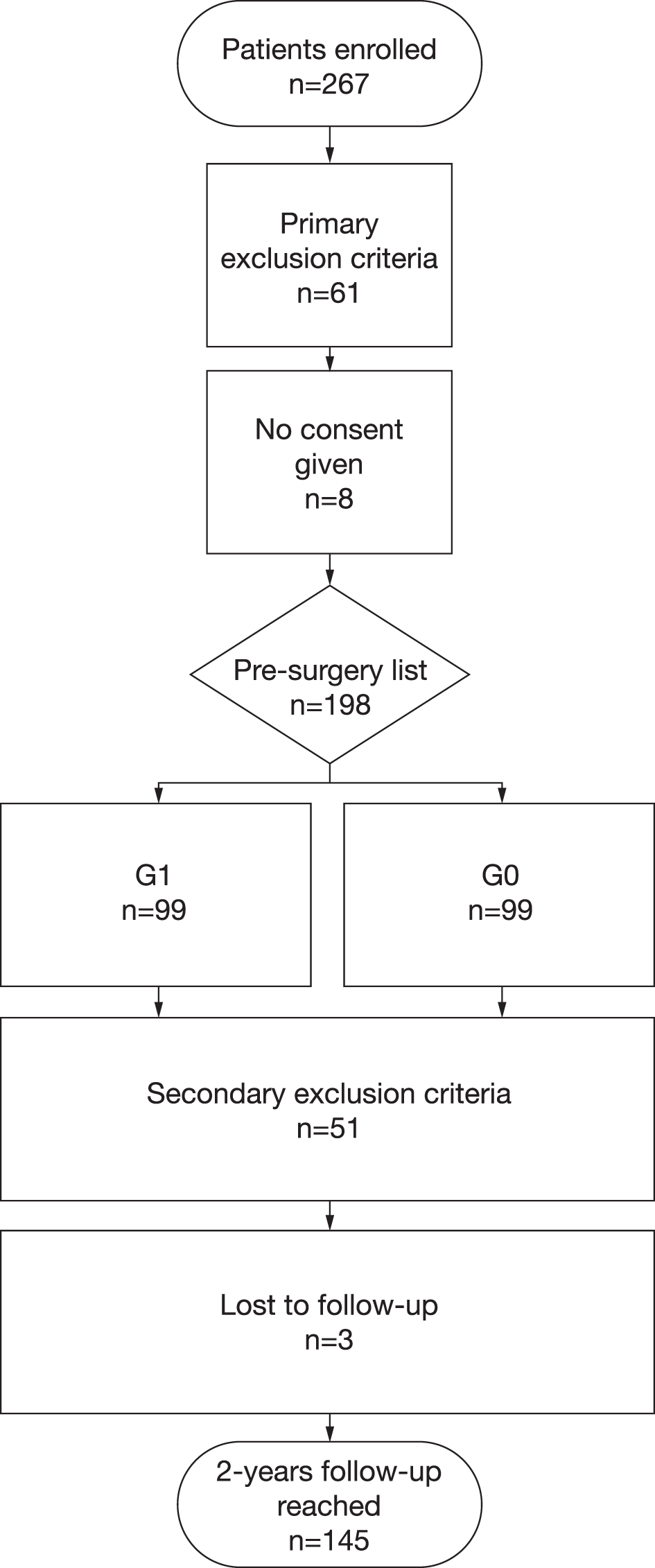
Patients with additional forefoot correction, such as hammertoe correction, were excluded from the studies (n = 51) (secondary exclusion criterion). Three patients were lost to follow-up. The final number of patients that reached 2-year follow-up (range, 22 to 28 months) was 145 (
Fig. 1).
Figure 1.
Flowchart of the study.
Figure 1.
Flowchart of the study.
Statistical Analysis
Nominal variables were given as numbers with appropriate percentages, whereas continuous variables were presented as medians with interquartile ranges; χ2 tests, with appropriate corrections, were used to test associations between categorical variables. Statistica Software version 12.5 (StatSoft, Tulsa, Oklahoma) was used for the analyses. Values of P < .05 were considered statistically significant.
Results
One hundred forty-five patients underwent HV surgery. Eighty-seven scarf (G0 group) and 58 scarf with Akin (G1 group) procedures were performed. The clinical and radiologic data at the initial examination were comparable between the groups (
Table 1). The median HV angle was 35.0° and 35.5°, the IMA was 13.0° and 14.0°, and the AOFAS-HMI score was 47.5 and 47.0 (G1 and G0 groups, respectively). The VAS score for pain was 5, and satisfaction with the appearance of the foot was only 3.5% in both groups.
Table 1.
Patient Data Seta.
Table 1.
Patient Data Seta.
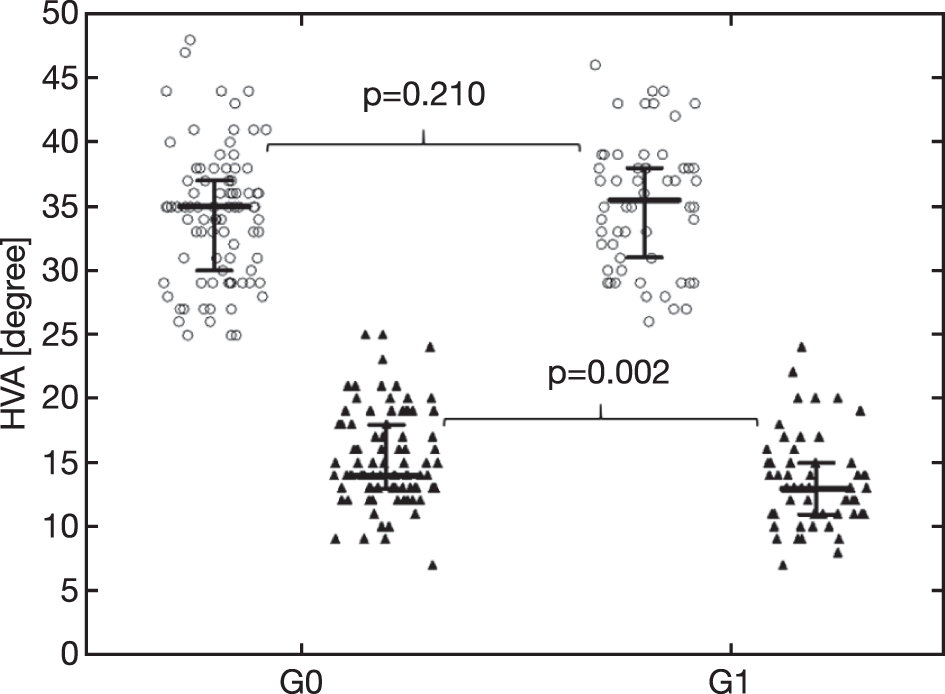
At the 2-year follow-up, we observed a significant difference in HVA between the groups. In the G1 group, the median was 13.0° higher and in the G0 group it was 1° higher (
P = .002) (
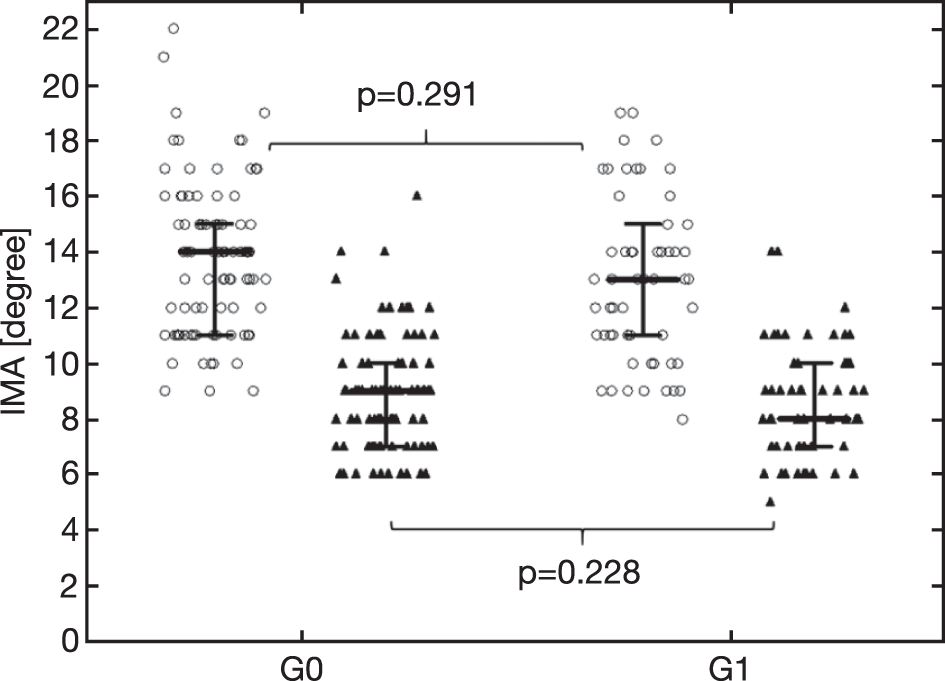
Fig. 2). The other characteristics measured—IMA (
Fig. 3), AOFAS-HMI (
Fig. 4), VAS for pain, and VAS for satisfaction with the procedure—improved similarly in both groups (
Table 1). The appearance of the foot was assessed slightly lower by patients in the G0 group, but no statistically significant difference was noted.
Figure 2.
Hallux valgus (HVA) results: horizontal bars represent median, and whiskers represent interquartile range (25th–75th percentile). Raw data from the first time point (before surgery) are presented as circles, whereas raw data from the second time point (2-year follow-up) are presented as triangles.
Figure 2.
Hallux valgus (HVA) results: horizontal bars represent median, and whiskers represent interquartile range (25th–75th percentile). Raw data from the first time point (before surgery) are presented as circles, whereas raw data from the second time point (2-year follow-up) are presented as triangles.
Figure 3.
Intermetatarsal angle (IMA) results: horizontal bars represent median, and whiskers represent interquartile range (25th–75th percentile). Raw data from the first time point (before surgery) are presented as circles, whereas raw data from the second time point (2-year follow-up) are presented as triangles.
Figure 3.
Intermetatarsal angle (IMA) results: horizontal bars represent median, and whiskers represent interquartile range (25th–75th percentile). Raw data from the first time point (before surgery) are presented as circles, whereas raw data from the second time point (2-year follow-up) are presented as triangles.
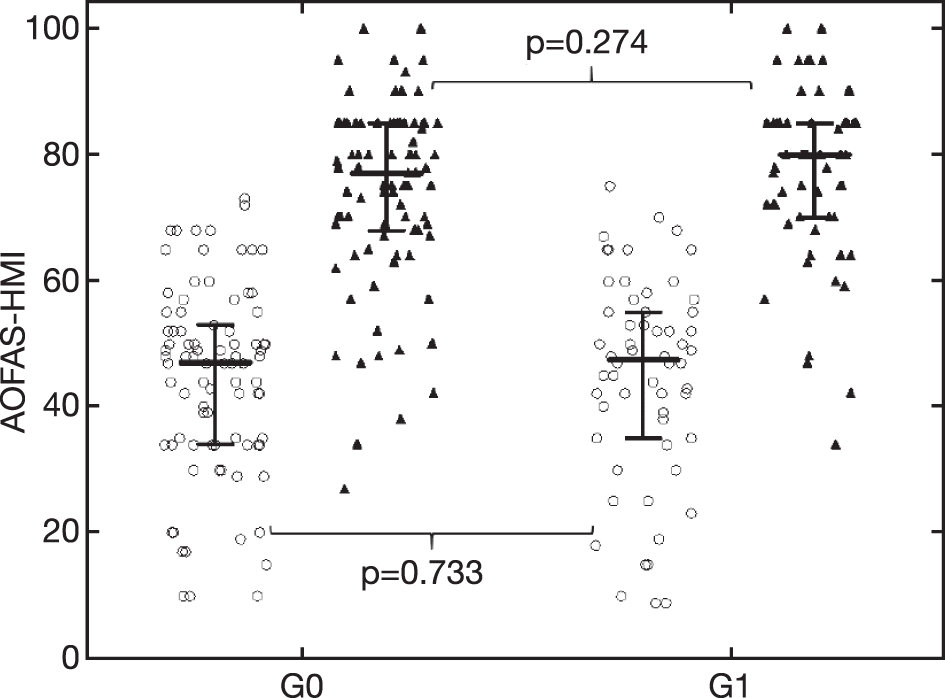
Figure 4.
American Orthopaedic Foot & Ankle Society Hallux Metatarsophalangeal Index (AOFAS-HMI) results: horizontal bars represent median, and whiskers represent interquartile range (25th–75th percentile). Raw data from the first time point (before surgery) are presented as circles, whereas raw data from the second time point (2-year follow-up) are presented as triangles.
Figure 4.
American Orthopaedic Foot & Ankle Society Hallux Metatarsophalangeal Index (AOFAS-HMI) results: horizontal bars represent median, and whiskers represent interquartile range (25th–75th percentile). Raw data from the first time point (before surgery) are presented as circles, whereas raw data from the second time point (2-year follow-up) are presented as triangles.
The overall complications rate was 13%. We registered eight cases of surgical-site infection, nine cases of persistent pain, four cases of prominent screw with skin irritation, and five cases of troughing. The overall recurrence rate was 9.7%, with no significant difference between the groups. All infections were successfully treated with oral antibiotics, with no report of chronic inflammation or fistula formation. All four patients with prominent screw and skin irritation presented with persistent pain, and were scheduled for metal evacuation surgery after the 2-year follow-up examination.
There was no difference in the median VAS for satisfaction score, which was 3.0 (interquartile range, 2.00 to 4.00) in both groups (P = .998). Finally, the secondary consent for therapy would be given by 86.2% of patients, again with no group restriction.
Discussion
The Akin proximal phalanx osteotomy is widely used as an adjunct procedure in HV correction, as it offers a greater degree of correction. Some surgeons admit that they use the scarf method only in combination with the Akin procedure. [
16-
18,
20,
22] Nevertheless, there is no evidence that the combined scarf-Akin procedure has a positive effect on the outcome or is merely a personal preference for the surgeon.
To the authors' knowledge, there is only one article comparing scarf osteotomy with and without an additional Akin procedure for HV correction in a retrospective study. [
20] We aimed to compare differences in the radiographic and clinical outcome between the groups in a prospective study.
In our study, radiographic parameters of forefoot deformation before the surgical procedure were comparable between groups. In a similar study by Malviya et al, [
20] there were differences in HVA and IMA before surgery, which might have influenced the outcomes. Without surprise, in our study, in the G1 group, in which the Akin procedure was also performed, the HVA values are significantly lower than in the G0 group. The median difference in the HV angle between the time points was 20° in the G0 group and 22° in the G1 group. The 2° difference in postsurgery HVA between the groups, although statistically significant, is clinically irrelevant. The correction of this parameter is higher in the Akin group because of the application of the procedure itself. As the closing-wedge osteotomy shifts the HVA distal measurement point on the proximal phalanx, it leads to lower values obtained on radiographs. At the same time, there was no difference in the IMA values, because the Akin procedure does not affect the metatarsal bones. Interestingly, in both groups, we observed a comparable recurrence of HV, which was 9.7%. None of the 14 patients affected by a relapse evaluated the results of the treatment poorly or was interested in undergoing a revision procedure.
Our overall complication rate reached 13%, which was similar to other studies. [
12,
29] Because we were aware of the steep learning curve associated with scarf surgery, in our studies, all the patients were operated on by the same surgeon, who had the most experience in HV surgery on the team, with approximately 100 feet operated on before. We excluded patients from this study with conditions that could hypothetically affect the complication rate, such as diabetes mellitus, rheumatoid arthritis, and obesity. [
29] The five cases of troughing we observed did not need revision surgery, and presented with AOFAS-HMI results just below average for this study.
Although the mean preoperative AOFAS-HMI results were comparable between the two groups, we observed slightly higher scores in the scarf-Akin group at the follow-up (80 points versus 77 points). The difference is not statistically significant (P = .274).
As mentioned above, all patients with screw migration presented with symptoms of chronic pain resulting from irritation of the skin through conflict with metal. If we subtract these cases from the total number of patients with chronic pain, we have an overall number of five patients with pain of a different cause (3.4%).
The overall satisfaction with the appearance of the foot after the treatment was 98.6% in this study. In the G1 group, we found no unsatisfied cases. The two patients in the G0 group who did not feel content with the appearance of their feet, at the same time had chronic pain, resistant to conservative treatment. The VAS score for pain reported in the final assessment was 2 points higher than it was before surgery in both cases. It is worth mentioning that these patients also had the two lowest AOFAS results in the G0 group, whereas their radiographic parameters were among the mean values.
Patients asked for the assessment of satisfaction with the whole treatment usually showed a good level of satisfaction (median VAS score, 3.0), regardless of the research group. In addition, nine of 10 patients would undergo the entire treatment again. This is a confirmation of the fact that the scarf procedure for HV surgery, despite the high demands on the operator, is not a heavy burden for the patient. As there was no significant difference between the groups, we can acknowledge that the scarf procedure for HV is satisfactory for the patient regardless of the addition of the Akin procedure.
The use of additional Akin proximal phalanx correction to scarf first metatarsal osteotomy leads to an increase in the extent of the procedure, and it seems surprising that there are no differences in most of the parameters observed, in particular with regard to the number of complications. Taking into account the increase in costs resulting from the use of additional material (eg, staples) and prolonged surgery time, and only a slight increase in HVA correction after 2 years, the benefit of using the Akin procedure remains questionable.