Achilles tendinopathy, previously referred to as Achilles tendinitis, is a painful condition that affects the tendon connecting the gastrocnemius-soleus complex to the calcaneus. This condition commonly affects older male athletes [
1] who engage in activities that involve increasingly repetitive loading, leading to excessive subtalar joint movement and poor shock absorption. [
2] In addition, some anatomical variations in lower-limb alignment can start the insidious tendinopathic changes that lead to this painful process. Although the factors listed previously can contribute to this condition, the pathogenesis and etiology of Achilles tendinopathy are relatively unknown.
In the acute phase of the condition, patients typically present with signs and symptoms related to inflammation, such as pain, swelling, and limited level of physical activity. At this acute stage, most patients respond well to conservative treatment, such as rest or modified activity, nonsteroidal anti-inflammatory drugs, cold therapy, and stretching. [
1, [
2] Should the condition not respond to conservative treatment, it can progress to its chronic form, which does not show signs of a typical inflammatory response. [
1,
2] Continual injury to the musculotendinous junction can lead to further complications, such as fibrosis, calcific deposits in the tissue, and complete degradation, leading to tendon rupture. Treatment of the chronic form of this condition can be highly variable because no gold standard has been recognized but can include more aggressive therapies such as corticosteroid injections and surgery. Although patient satisfaction after surgery has reportedly been high (75%–100%), complications have been reported in several studies, with some rates as high as 11%. [
3-
7]
Several alternative therapies have been sought for the treatment of chronic musculoskeletal pathologies such as Achilles tendinopathy. These therapies include the use of dry needling, shock waves, and injectable products, including products thought to stimulate repair mechanisms by causing tissue injury and those thought to potentially directly influence repair mechanisms or tissue regeneration. [
2] A variety of agents—corticosteroids, prolotherapy, hyaluronic acid, saline, platelet-rich plasma, and others—have been tried. Reviews of studies of these agents, including meta-analyses and a recent Cochrane Review, have generally concluded that although positive efficacy trends have been observed, most studies are of low quality and no compelling support for the use of any of these approaches has been forthcoming. [
2,
8] In particular, the data regarding the use of platelet-rich plasma is mixed. [
8-
11]
Human amniotic membrane has been used as a treatment for various clinical conditions since the early 1900s. [
12] It is well documented that human amniotic membrane, in its natural form, contains a harmonious balance of several types of growth factors and cytokines that promote epithelial cell migration and proliferation, stimulate metabolic processes that lead to collagen synthesis, and attract fibroblasts, while also reducing pain and inflammation. [
12,
13] Human amniotic membrane is commercially available in configurations that allow its convenient use in a variety of clinical applications. Micronized dehydrated human amnion/chorion membrane (mdHACM) allograft (AmnioFix; MiMedx Group Inc, Marietta, Georgia), suspended in saline, can be injected for the treatment of soft-tissue injuries in addition to its use in surface wounds alone. Two randomized controlled trials have been published reporting favorable outcomes of the use of mdHACM injection compared with placebo in patients with plantar fasciitis. [
14,
15]
The purpose of the present study was to evaluate short-term outcomes of the use of mdHACM injection as a treatment for Achilles tendinopathy.
Materials and Methods
With institutional review board (Advarra IRB, Columbia, Maryland) approval, we performed a retrospective review of clinical records of patients diagnosed as having Achilles tendinopathy and treated with mdHACM injection over a 2-year period at a single clinical practice. During this period, the treating physician (J.E.S.) routinely offered treatment with mdHACM injection to patients presenting with Achilles tendinitis recalcitrant to conservative treatment. An electronic medical record (EMR) system was used to extract data on this patient set, and data were deidentified for analysis. Patients with a clinical diagnosis of Achilles tendinitis, manifested by pain, tenderness, and/or swelling over the Achilles tendon, with or without antecedent clear trauma, who were treated with mdHACM were identified in the EMR. Only EMRs showing at least two follow-up visits, including physician assessment and documentation of patient-reported pain within 45 days of receiving the mdHACM injection, were included for analysis.
Treatment consisted of an injection of 40 mg of mdHACM (AmnioFix) performed by one of us (J.E.S.). Before injection, tendon rupture had been ruled out by clinical examination and plain film radiography when needed. Local anesthesia of the skin surface was achieved by injection of 3 mL of 1:1 1% lidocaine plain and 0.25% marcaine plain. The mdHACM allograft material was suspended in 1 mL of 0.9% sodium chloride solution and injected through a 22-gauge needle directly into the body of the tendon in the direction of posterior to anterior. After the injection, patients were instructed to wear a cam walker when weightbearing and to apply ice to the affected area for 15 min per hour three to five times per day for 3 weeks. Pain after the injection was controlled by the use of ice and acetaminophen or nonsteroidal anti-inflammatory drugs. No narcotics were prescribed. If symptoms had not resolved or improved after 3 weeks, physical therapy was suggested. Routine follow-up was scheduled to occur in the physician's office approximately 1 to 2 weeks after the mdHACM injection and again approximately 1 month later. The reported level of pain associated with their Achilles tendinitis diagnosis was recorded in the patients' EMR at each clinic visit.
For the purposes of this analysis, patient demographics, reported pain levels, and reported adverse events associated with mdHACM treatment were extracted from the EMR and deidentified before analysis. Although the overall goal was to report our experience and evaluate data useful for the design of a larger randomized controlled trial on the safety and efficacy of using mdHACM as a treatment for Achilles tendinitis, the primary outcomes examined for this case series were change in patient-reported pain within 45 days after injection of the mdHACM and reported adverse events.
Results
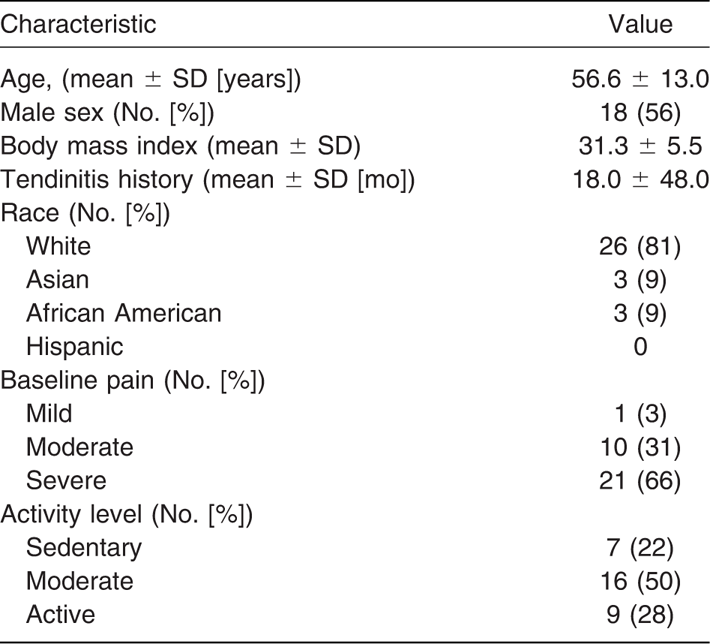
A total of 32 patients who had presented with Achilles tendinitis recalcitrant to conservative treatment were included in this retrospective analysis. Most patients were of white race, and slightly more men than women were treated (
Table 1). Other than the preponderance of white participants, reflecting practice demographics, patients were representative of those usually presenting with Achilles tendinitis: middle-aged “weekend warriors” with a moderate or active activity level.
Table 1.
Baseline Characteristics of the 32 Study Patient.
Table 1.
Baseline Characteristics of the 32 Study Patient.
The changes in overall pain scores at baseline, the first follow-up visit, and the second follow-up visit within 45 days of injection treatment were assessed. Before treatment, 21 patients (66%) described their pain as severe and ten (31%) as moderate in intensity. At the first follow-up visit after injection (mean ± SD of 8.1 ± 2.7 days), 84% of patients (27 of 32) had responded to treatment, reporting pain reduction: 22% of patients (n = 7) were now pain free, and 41% (n = 13) reported only mild discomfort. At the time of the second follow-up visit after injection (mean ± SD of 23.1 ± 6.2 days), all 32 patients had responded favorably to treatment, that is, had moved to a lower pain category: 72% (n = 23) were now pain free, 25% (n = 8) reported mild pain, 3% (n = 1) reported moderate pain, and none reported severe pain.
In addition to pain associated with Achilles tendinitis, patients also reported their clinical outcomes as improvement in overall symptoms at the final visit (
Table 2). Sixty-six percent of patients reported complete resolution and 34% reported improvement in symptoms. All of the patients reported at least some improvement in overall symptoms within 45 days of treatment.
Table 2.
Reported Change in Overall Symptoms Related to Achilles Tendonitis within 45 Days of Treatment with Micronized Dehydrated Human Amnion/Chorion Membrane.
Table 2.
Reported Change in Overall Symptoms Related to Achilles Tendonitis within 45 Days of Treatment with Micronized Dehydrated Human Amnion/Chorion Membrane.
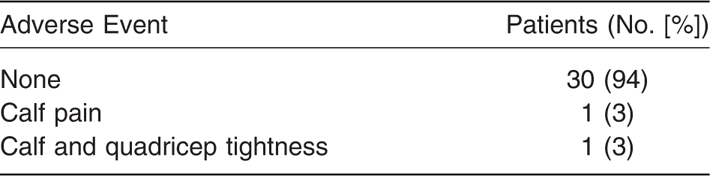
The EMRs were also examined to identify adverse events associated with mdHACM injection. Overall, 30 of 32 patients (94%) reported no adverse events associated with mdHACM injection. Calf pain or calf and quadricep tightness after injection was reported by two of the patients (6%) (
Table 3). No serious or ongoing, unresolved adverse events were observed.
Table 3.
Adverse Events Associated with Micronized Dehydrated Human Amnion/Chorion Membrane Treatment.
Table 3.
Adverse Events Associated with Micronized Dehydrated Human Amnion/Chorion Membrane Treatment.
Discussion
Although most patients experience resolution of symptoms from acute Achilles tendinopathy after conservative care, some progress to a chronic form of the disease. In these patients, reduced mobility and repetitive damage to the Achilles tendon can lead to further progression of the disease, chronic pain, and sometimes rupture of the tendon, necessitating invasive surgical intervention. Surgical intervention can often be complicated by the formation of adhesions between the tendon and its sheath or surrounding soft tissue, further complicating the clinical course. Investigation of alternative therapies that allow patients to return to normal activity in a timely fashion for cases that do not resolve after conservative treatment would be beneficial.
Allografts composed of human amniotic membrane, which contains essential, active, healing growth factors, is one such alternative therapy. Amniotic membrane is composed of structural extracellular matrix, which includes collagen types IV, V, and VII, as well as specialized proteins, fibronectin, laminins, proteoglycans, and glycosaminoglycans. In vivo and in vitro studies have shown that the biochemical properties of amniotic membrane help to modulate inflammation and enhance soft-tissue healing, with antibacterial and pain reduction properties. [
12,
13] Tissue repair is facilitated through the growth factors contained in the membrane tissue.
The use of an injectable version of mdHACM as a treatment for chronic degenerative soft-tissue conditions refractory to conservative therapy is not unprecedented. In a study by Zelen et al, [
14] 45 patients with chronic plantar fasciitis were followed prospectively in a randomized controlled study evaluating injectable mdHACM versus a saline control. After 1 week of treatment, significant mean ± SD improvements in American Orthopaedic Foot and Ankle Society Hindfoot scores were observed (38.7 ± 11.4 points and 33.7 ± 14.0 points in the 0.5- and 1.25-mL treatment groups, respectively, versus only 2.2 ± 17.4 points in the control group). These results were confirmed by Cazzell et al, [
15] reporting 3-month safety and efficacy outcomes on the use of injectable mdHACM versus saline placebo in 145 patients from 14 centers. In that study, mean visual analog scale pain scores at 3-month follow-up in the mdHACM treatment group were 76% lower compared with a 45% reduction in the control group (
P < .0001). Foot Function Index–Revised scores for patients receiving mdHACM treatment had a mean reduction of 60% versus baseline, and those in the control group had a mean reduction of 40% versus baseline (
P = .0004). In addition, Gellhorn and Han [
16] published a case series of 40 patients injected with 40 mg of mdHACM for the treatment of tendinopathy (n = 20) or arthritis (n = 20). Patients in that series reported substantial and statistically significant decreases in pain, improvement in function, and reductions in the use of concomitant pain medications. In the case series published by Gellhorn and Han, [
16] average patient-reported pain scores for the cohort as a whole decreased from a baseline value of 6.4 to 2.7 at 1 month, 1.7 at 2 months, and 1.4 at 3 months (
P < .001 for all). Decreases in worst pain experienced and significant improvement from high levels to low levels of functional impairment (based on the Patient-Specific Functional Scale) were also observed. These scores included patients with osteoarthritis or tendinopathy but were similar for each group. [
16] Overall satisfaction with the procedure was reported by 92.5% of the patients in that study. [
16]
Although the present study is the first report on the use of mdHACM specifically for Achilles tendinitis, there are several limitations to this retrospective case series. One such limitation is the relatively small sample size and the limitations typically inherent in a retrospective review. The patients were not randomized or blinded to treatment, and no control was used. In addition, the data presented were constructed from subjectively derived patient data recorded in the EMR. Because this was not designed as a prospective study, no treatment-specific questionnaires were completed. Observations regarding response would be further enhanced with the addition of objective data such as the measurement of range of motion and strength, or the observance of before and after magnetic resonance images. The follow-up period was relatively short. We were unable to assess treatment effect over a longer period. This is not unexpected. Patients obtaining relief of symptoms did not return with complaints or need for additional treatment. Nonetheless, given the encouraging short-term response data and product tolerability, further investigation into the benefits of mdHACM injection in patients with chronic, refractory Achilles tendinopathy is warranted.
Conclusions
Chronic Achilles tendinopathy refractory to conservative treatment often results in a need for surgical intervention, which can be both costly and risky to the patient. Alternative therapies that promote healing and reduce pain and inflammation before surgical intervention have been and are being investigated. Based on the favorable outcomes in this series of patients, injectable mdHACM might prove to be a viable treatment option in patients with chronic Achilles tendinopathy.