The foot can be classified into three foot postures: high-arched foot posture, normal-arched foot posture, and flat foot posture. The high-arched foot is also sometimes referred to as the supinated foot and is defined as a foot with a higher arch profile than the normal-arched foot. The flat foot posture is also sometimes referred to as a pronated foot, and is defined as a foot with a lower arch profile compared to the normal-arched foot. Foot posture is an important aspect of clinical assessment. High- and flat-arched foot postures have been found to exhibit different gait patterns [
1,
2] and an increased risk of injury occurrence [
3-
5].
Static measures of foot posture have been used in clinical settings and include direct measurements of the foot such as measuring navicular drift and drop [
6] and calcaneal eversion angle [
7]. There are also indirect measurements such as measuring various indices (eg, Footprint Index [
8] and the Arch Index [
9]) from footprints. However, these foot classification methods have not been able to consistently predict foot movements during dynamic gait ie, a foot classified as a flat foot using static measurement did not always produce the expected gait deviations of a flat foot [
2]. Furthermore, these methods allowed the classification of the foot into only normal-arched and flat foot postures. Because there are three foot posture classifications, studies that did not include high-arched foot postures could be considered incomplete. Foot classification methods that included the classification of a high-arched foot will allow a comprehensive study of the effect of foot posture on gait patterns.
The Foot Posture Index (FPI) is a validated tool [
10] that is commonly used by clinicians to classify feet into pronated and supinated foot postures. The FPI has been found to correlate well with other measures of foot postures [
11,
12]. It was also found to be a reliable measurement tool for arch height in adults [
13] and highly associated with rearfoot eversion [
14] and navicular height and drop [
15] during walking gait. However, walking and running are distinctly different locomotion styles, and the association between foot posture (as measured by the FPI) and running gait has not been evaluated. This study aims to investigate the association between the FPI scores and foot movements during running.
The FPI relies on six validated criteria to classify feet into supinated, normal, and pronated categories, with supinated feet equating to high-arched feet, and pronated feet equating to flat feet. The FPI considers aspects of the foot in three planes, and in multiple segments [
16]. Chuter [
14] studied the walking gait of 40 individuals whose feet were classified using the FPI. The FPI was found to correlate positively to frontal plane rearfoot maximum eversion (
r = 0.92;
P < .05), meaning that the higher the FPI score (flatter feet), the greater the magnitude of rearfoot eversion. Linear regression analysis showed that 85% of variance in maximum rearfoot eversion can be explained by FPI scores (
P < .00), indicating that FPI scores are highly predictive of rearfoot eversion angles. Unfortunately, only rearfoot eversion was analyzed and reported. In examining foot function, the movement of the arch would be an important aspect to investigate. Nielson et al [
15] found that the drop in arch height during gait, as measured by navicular drop and minimal navicular height from the ground, correlated positively with FPI scores, with FPI explaining 13.2% of the variance in navicular drop and 45.0% in minimum navicular height. These two studies suggest that foot posture affects rearfoot and forefoot movements during walking. Walking and running are distinctly different locomotion styles. During walking, there is a double support phase where both feet are supporting the body (ie, one foot is at the toe-off phase while the other foot is at the heel-strike phase, followed by a single support phase where one foot is on the ground. During running, there is a “float phase,” where neither foot is on the ground, followed by a single-limb support phase. This results in a difference in timing of events and muscular activation in the trunk and lower limb [
18]. Kinematically, compared to walking, there is considerably more flexion in the foot joints during running, where the limb acts in a more “spring-like” fashion [
17]. The kinematic coupling within the foot joints has also been found to be greater when running than when walking [
18], namely, there was more rearfoot eversion and forefoot dorsiflexion (arch deformation) in running than in walking. Kinetically, the load taken by the feet increases from 1.2 times body weight when walking to 2.5 times body weight when running; the loading rate also increases from eight times body weight per second when walking to 30 times body weight per second [
19]. A previous study investigated the association between the longitudinal arch angle and arch deformation during walking and running and found that arch profile explained 85.4% of the variance in longitudinal arch deformation during walking and 84.6% of the variance in longitudinal arch deformation during running [
20]. This implies that foot posture affects arch movements during running as well.
Within running, foot strike pattern and kinematics change with speed; foot strike patterns have been observed to change from rearfoot to midfoot strike when running speed was increased from 3.0 m/sec to 6.0 m/sec, and kinematic changes are a result of speed rather than foot posture [
21]. In looking for an appropriate running speed to study, Segers et al [
22] found that the normal walk-to-run transition speed was approximately 2.0 m/sec, denoted by the presence of a “flight phase” when both feet are off the ground. This was agreed by Farris and Sawicki [
23], who found that at 2.0 m/sec, it was more efficient to run than walk from an energy consumption perspective and suggested that this was why most subjects would prefer to break into running from walking at this speed. Therefore, in this study, a slow run (running at around 2.0 m/sec) was selected as the movement mode to examine for changes in gait that may be attributed to foot posture and not to other confounding factors such as running speed.
Because walking and running are distinct locomotive styles, an investigation into the relation between FPI scores and foot movement during running is warranted. The correlation of FPI scores to foot kinematics during running has not yet been fully investigated. This study will assess participants with flat, normal-arched, and high-arched feet, and consider foot movements during slow running. The movement of the rearfoot in eversion (in the frontal plane) and the forefoot in dorsiflexion (arch deformation in the sagittal place) during running has been selected for examination. The results of this study will provide clinicians with a better understanding on how these scores relate to foot function during running, and will aid them in assessing individuals who are runners.
Methods
Participants and Screening Measures
Participants were recruited from a convenience sample of the general public and students in the Nanyang Technological University (Singapore). The inclusion criteria were as follows: participants had to be between 21 and 45 years of age, be self-reported recreational heel/rearfoot strike runners, and be able to run at least 10 minutes barefoot on a treadmill. Exclusion criteria also consisted of participants who had foot deformities, operations, and/or foot pain 6 months before data collection; had a body mass index greater than 36 kg/m2; suffered from medical conditions that altered gait pattern (eg, stroke and Parkinson's disease); and had known allergies to adhesives or double-sided tape.
All procedures were approved by the Institutional Review Board (IRB-2012-09-004) of the Nanyang Technological University (Singapore). All trials were conducted in the Sports Biomechanics Laboratory situated in Block 5, Level B3, Room 01, Physical Education and Sports Science, Nanyang Technological University. All participants received an information sheet providing details and requirements for participation. All participants provided written informed consent before commencement of the study.
Foot Posture Classification
A podiatrist (M.H.T.D.) with 2 years of clinical experience using the FPI performed all clinical assessments of foot posture. The participant was asked to stand in an area where the tester would be able to move freely around the subject to assess the foot. The participant marched on the spot for a few steps before settling into a comfortable relaxed stance position, with arms to the side. The FPI was scored based on the observation of six criteria of foot posture. Each criterion was scored using a five-point Likert-type scale, from –2 to 2, resulting in a score on a continuous scale between –12 and 12. A score ranging from –12 to –1 classified the foot as high-arched, a score ranging from 0 to 5 classified the foot as normal-arched, and a score ranging from 6 to 12 classified the foot as flat footed.
To ensure reliability of the assessor, these measurements were pretested on eight participants (16 feet), where each foot was scored according to the FPI on two sessions 3 months apart. The scores for the first session were not available to the assessor during the second session to reduce scoring bias. The FPI raw scores between two sessions showed good correlation; the single measures intrarater correlation coefficient was 0.92, with a 95% confidence interval (CI) of 0.75 to 0.97. Kappa value for FPI categorization also showed good agreement (κ = 0.87; P < .01). This shows that the assessor was consistent and reliable.
Kinematic Gait Analysis
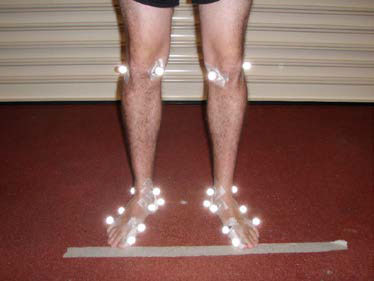
Three-dimensional kinematic data were collected using a three-dimensional motion capture system (Motion Analysis Corp, Santa Rosa, California) with six Hawk cameras (capturing at 60 Hz) positioned around an instrumented treadmill (Gaitway; Kistler Instrument Corp, Amherst, New York). The side bars of the treadmill were removed to prevent occluding the view of the Hawk cameras. This marker set used for this study was adapted from the Oxford Foot Model [
24] marker set. Eleven 25-mm reflective markers were placed on different parts of the lower limb (
Fig. 1) to obtain the required segmental movement of the foot. The markers were placed on the lateral fibula head and the medial tibial condyle, medial and lateral malleoli, medial and lateral calcaneus, navicular tuberosity, and styloid process of the fifth metatarsal; the medial aspect of the first and the lateral aspect of the fifth metatarsophalangeal joint; and the medial first interphalangeal joint. One of the adaptations to the Oxford Foot Model marker set was the absence of a posterior calcaneal marker. This was because during the pilot tests, the posterior calcaneal marker kept getting displaced, likely because of the rapid dorsiflexion and plantarflexion of the foot during heel-strike running and vibration caused by impact. Therefore, the marker set was modified with corresponding adjustments to the foot and leg model created for kinematic joint angle analyses.
Figure 1.
Marker placements on the participant's lower limb.
Figure 1.
Marker placements on the participant's lower limb.
The participants ran on an instrumented treadmill between the speeds of 1.4 and 2.2 m/sec. This range of speed was selected based on a pilot study that measured the self-selected comfortable running speed of eight participants. The mean self-selected comfortable running speed was 1.8 ± 0.4 m/sec. Therefore, in the main study, participants who were unable to run comfortably within this range of speeds were excluded from the study at this juncture. The instrumented treadmill provided real-time kinetic data on vertical ground reaction force (vGRF) during the participant's trial. The participant is defined as running when the kinetic vGRF graph shows distinct nonoverlapping left and right graphic readings, indicating single support locomotion or a float/flight phase. The participants continued running at this constant pace for 6 minutes before collection of the kinematic data commenced. Six minutes of running was the time previously suggested for participants to acclimatize to running on a treadmill [
25,
26]. All participants ran barefoot with a heel-strike running gait. This is confirmed with the presence of a vertical impact peak observed in the real-time vGRF graphs provided by the instrumented treadmill software. Ten seconds of continuous data were collected. If an error occurred, the trial was abandoned and a new trial repeated after a 5-min rest period to prevent participant fatigue. These errors include inconsistent heel-strike running gait pattern as observed from the absence of an impact peak in the vGRF graph output, and/or accidental marker displacement during the running trial.
Data Processing
Five consecutive consistent foot contacts were selected from the 10-sec running trial for analysis. The data were filtered using a Butterworth low-pass, fourth-order, zero-phase filter at 10 Hz [
27]. The data were then exported in C3D format onto the Visual 3D software (C-Motion Inc, Germantown, Maryland) for further processing.
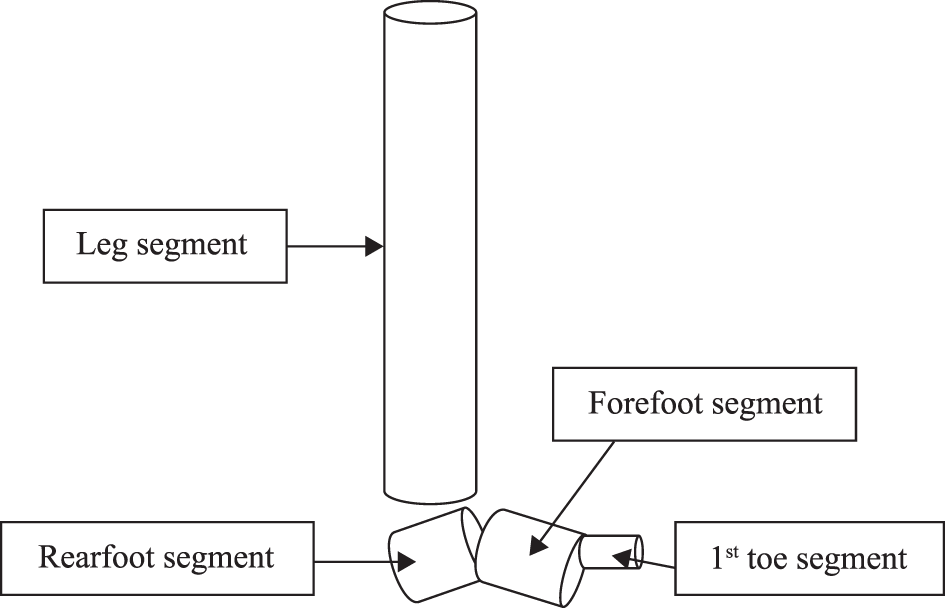
A model consisting of four rigid segment legs and feet was created consisting of the leg, rearfoot, forefoot, and first toe to quantify the rearfoot and forefoot dorsiflexion movement (
Fig. 2). The segments were modeled as simple geometric solids with uniform densities. The modeled leg segment was formed proximally by the marker on the lateral fibular head and the medial tibial condyle and distally by the lateral and medial malleoli markers. The rearfoot segment was formed by the lateral and medial calcaneal markers and distally by the markers on the styloid process of the fifth metatarsal and navicular tuberosity. The forefoot segment was formed proximally by the markers on the styloid process of the fifth metatarsal and the navicular tuberosity and distally by the markers on the fifth and first metatarsophalangeal joints.
Figure 2.
Segment model of the right foot.
Figure 2.
Segment model of the right foot.
Signal Processing
The origin of the local coordinate system was located at the proximal endpoint, midway between the medial and lateral location markers. For example, for the leg segment, the local coordinate system was located midway between the medial tibial condyle marker and the lateral fibula head marker. When the coordinate systems of two segments were perfectly aligned, the angle between them would be zero.
Joint angles were measured in Visual 3D as previously described by Cole et al [
28]. To measure the rearfoot eversion angle, a virtual rearfoot was created so that the local coordinate systems of the leg and rearfoot could be aligned. The virtual rearfoot was created where the proximal and distal endpoints were the same as the leg segment, but the markers on the rearfoot (medial and lateral calcaneal and navicular tuberosity and styloid process markers) were used as tracking markers [
29]. The angular movements between the leg and the virtual rearfoot were measured with rearfoot inversion/eversion observed by measuring the movement of the virtual rearfoot segment relative to the leg segment.
As the proximal aspect of the forefoot segment shared the same markers as the distal aspect of the rearfoot, the forefoot segment had only 1 degree of freedom (ie, the segment was free to rotate only in the sagittal plane). Forefoot dorsiflexion/plantarflexion was observed by the movement of the forefoot segment relative to the rearfoot segment. Both movements were verified manually by visually inspecting the segment movement and the segment coordinate system in Visual3D's Model Builder mode.
The joint angles (signals) were processed within the Visual 3D software and a low-pass Butterworth filter at 10 Hz was used to smooth the data and remove noise. The stance phase (from heel strike to toe-off) was normalized over 101 frames, and the mean values of the variables over five steps were compared between participants.
The determination of heel strike and toe-off were adapted from kinematic events according to an algorithm described previously [
30]. Heel strike was determined when the lateral calcaneal marker of the foot began moving backward on the treadmill. The point in time in which the lateral calcaneal marker began moving in the direction of locomotion was labeled as toe-off.
The difference between the maximum and minimum values during the stance phase was measured as the total range of movement of the joint. The mean and standard deviations of the angular movements throughout five consecutive selected steps were measured.
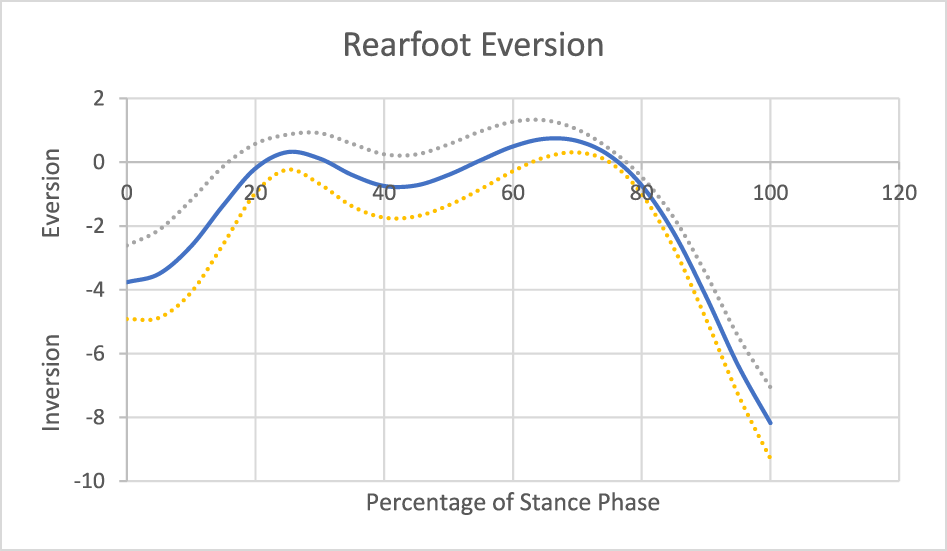
Figure 3 demonstrates a rearfoot eversion graph of a participant. It was noted that there was a slight perturbation in rearfoot movement during the stance phase. This may be attributable to minor rearfoot movements during running. Manual checking of the data revealed that this was consistent with the other participants, and there was no error or artifact. The total range of motion was measured by subtracting the minimum eversion angle from the maximum eversion angle.
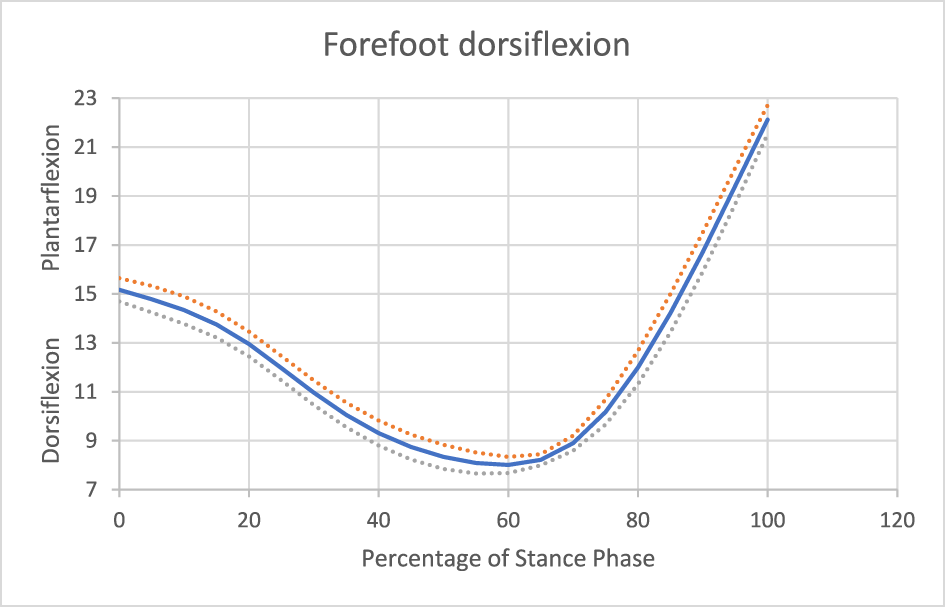
Figure 4 shows the forefoot dorsiflexion angle of the same participant. The total range of motion was measured by subtracting the minimum dorsiflexion angle from the maximum dorsiflexion angle.
Figure 3.
Rearfoot eversion range of motion (with 95% confidence levels) of one high-arched participant.
Figure 3.
Rearfoot eversion range of motion (with 95% confidence levels) of one high-arched participant.
Figure 4.
Forefoot dorsiflexion range of motion (with 95% confidence levels) of one high-arched participant.
Figure 4.
Forefoot dorsiflexion range of motion (with 95% confidence levels) of one high-arched participant.
Statistical Analysis
Descriptive statistics were used to show the incidence of high-arched feet, normal-arched feet, and flat feet within the sample population. To study the effect of foot posture on rearfoot eversion and forefoot dorsiflexion during slow running, the mean and standard deviation of these two movements between the three foot structures was compared using one-way analysis of variance and a Bonferroni post hoc test. A Pearson correlation test was also used to find the relationship between FPI scores and rearfoot eversion and forefoot dorsiflexion, and Cohen's d was used to report effect size.
Results
Thirty-eight participants (mean age, 30.5 ± 7 years; mean body mass index, 22.7 ± 4 kg/m
2) were recruited for this study. The distribution of foot structure in this study shows that 13% were classified as high-arched, 48% were classified as normal-arched, and 39% were classified as flat foot, according to the FPI. The mean FPI was 7.43 ± 1.58 for the flat foot group, 2.04 ± 1.86 for the normal-arched group, and −1.50 ± 0.51 for the high-arched group.
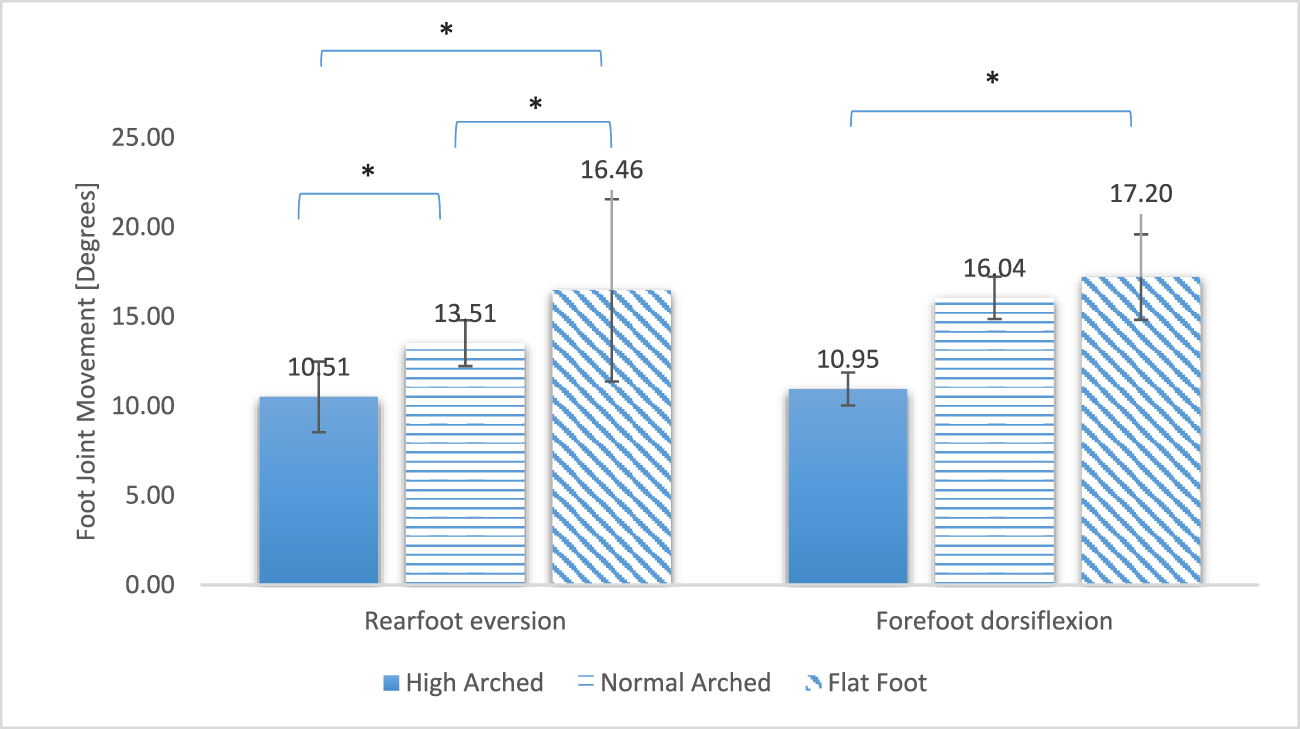
Figure 5 shows the rearfoot eversion and forefoot dorsiflexion angles in the high-arched, normal-arched, and flat foot groups.
Figure 5.
Total rearfoot eversion, forefoot dorsiflexion, and the 95% confidence intervals between the three foot posture groups.
Figure 5.
Total rearfoot eversion, forefoot dorsiflexion, and the 95% confidence intervals between the three foot posture groups.
The mean rearfoot eversion was 10.51° (95% confidence interval [CI], 8.54°–12.48°), 13.51° (95% CI, 12.59°–14.43°), and 16.46° (95% CI, 15.42°–17.51°) for high-arched, normal-arched, and flat foot groups, respectively. A one-way analysis of variance showed that the rearfoot eversion differed significantly between foot structures (F2,135 = 18.62; P = .00). A Bonferroni post hoc test revealed that differences were significant between all three groups. Rearfoot eversion was 21.9% greater in the flat foot compared to the normal-arched foot group (SPSS Bonferroni adjusted P = .00); normal-arched feet had 22.2% more rearfoot eversion than the high-arched group (SPSS Bonferroni adjusted P = .04), and the flat feet had 56.7% more rearfoot eversion than the high-arched group (SPSS Bonferroni adjusted P = .00).
The mean forefoot dorsiflexion was 10.95° (95% CI, 9.67°–12.23°), 16.04° (95% CI, 14.86°–17.22°), and 17.20° (95% CI, 15.86°–18.54°) for the high-arched, normal-arched, and flat foot groups, respectively. Forefoot dorsiflexion was also significantly different between the three groups (F2,135 = 4.32; P = .02). A Bonferroni post hoc test showed that the difference was significant between the high-arched and flat foot groups only. The flat foot group had 57.1% significantly more forefoot dorsiflexion compared to the high-arched group (SPSS Bonferroni adjusted P = .00). There was no significant difference between the normal-arched and high-arched groups (SPSS Bonferroni adjusted P = .31) and normal-arched and flat foot group (SPSS Bonferroni adjusted P = .14).
Pearson correlation showed that FPI correlated linearly and positively to rearfoot eversion and forefoot dorsiflexion. The correlation coefficient was r = 0.48 (P = .00) between FPI and rearfoot eversion and r = 0.24 (P = .00) between FPI and forefoot dorsiflexion. The Cohen's d value shows a moderate effect size for rearfoot eversion (d = 0.23) and a low effect size for forefoot dorsiflexion (d = 0.05).