Next Article in Journal
Reliability and Repeatability of the Footwork Plantar Pressure Plate System
Previous Article in Journal
Is TCC-EZ a Suitable Alternative to Gold Standard Total-Contact Casting?
 
 
Journal of the American Podiatric Medical Association is published by MDPI from Volume 116 Issue 1 (2026). Previous articles were published by another publisher in Open Access under a CC-BY (or CC-BY-NC-ND) licence, and they are hosted by MDPI on mdpi.com as a courtesy and upon agreement with American Podiatric Medical Association.
Article

A Bibliometric Evaluation of Worldwide Research of the Podiatry Field from 1965 to 2017

by
Laura Carrasco Cortijo
1,
Jose A. Quesada
2,
Adriana Lopez-Pineda
2,*,
Domingo Orozco-Beltrán
2,
Vicente F. Gil-Guillen
2 and
Concepcion Carratala-Munuera
2
1
Diabetic Foot Unit, Marques de Valdecilla University Hospital, Santander, Spain
2
Catedra de Medicina de Familia, Clinical Medicine Department, Miguel Hernandez University, Ctra. Nnal. 332 Alicante-Valencia s/n 03550 San Juan de Alicante, Spain
*
Author to whom correspondence should be addressed.
J. Am. Podiatr. Med. Assoc. 2021, 111(6), 18008; https://doi.org/10.7547/18-008
Published: 1 November 2021

Abstract

Background: To identify the strengths and weaknesses in a given research area, it is necessary to analyze the published literature. International studies on podiatry research productivity are scarce. This study aimed to analyze scientific productivity in the area of podiatric medicine from 1965 to 2017. Methods: This was a retrospective, observational, bibliometric study. The MEDLINE database was used to identify research published between 1965 and 2017. Literature searches were performed in 2010 and 2017 through RefWorks, and research production per year, author, document type, country, institution, journal, and language were calculated. Podiatry's contribution to global scientific production was measured by calculating the ratio of podiatry publications to total production, and Price's law was applied to analyze the temporal evolution. Author productivity index, coauthorship, geographic distribution, and the distribution by institution type and journal (Bradford's law) were analyzed. Results: The MEDLINE search yielded 1,256 publications, representing 4.75 articles per 100,000 publications in global scientific research. The growth rate followed Price's law after linear adjustment. The 2,229 identified authors presented a transience index of 85.73%; 0.38% were highly productive authors. The coauthorship index increased from 1.40 in 1965 to 5.80 in 2017. The most common document type was the journal article, whereas 2.1% were clinical trials. Only one document reported a controlled clinical trial. The United States led scientific production, with 77.15% of the documents; 60.5% of the publications were concentrated in four journals. Conclusions: Podiatry is still an emerging research field, and literature is concentrated in a small number of journals, categorized into different subjects.

It is widely accepted that research is important to countries' development [1]. High-quality science leads to better decisions and more effective systems to support those decisions [2]. Health research can provide relevant information about disease trends and risk factors, outcomes of treatment or public health interventions, patterns of care, and health care costs and uses [3,4].
To identify top-performing journals and researchers and to determine the strengths and weaknesses in a given research area for the ultimate goal of informing future research priorities, it is necessary to analyze the published literature [5]. The American Library Association Glossary of Library Information and Science defined bibliometrics as “the use of statistical methods in the analysis of a body of literature to reveal the historical development of subject fields and patterns of authorship, publication, and use.” [6]. Bibliometrics can be useful for assessing the productivity and influence of individuals and institutions and for comparing different knowledge areas and journals [7]. It is gradually becoming accepted as a useful tool for the professional community and not just an academic tool for bibliometricians [8].
The definition and scope of the practice of podiatry varies according to geographic areas. Podiatry is a Medical Subject Headings (MeSH) term [9] and is defined as “a specialty concerned with the diagnosis and treatment of foot disorders and injuries and anatomic defects of the foot.” Research projects in this field are difficult to carry out [10], and to our knowledge, international studies on research productivity are scarce. Barske and Baumhauer et al [10] found that physicians, rather than podiatrists, were performing most clinical foot research. In 2011, an editorial [11] reported that podiatrists thought that despite their residency programs getting larger and longer, there was no corresponding increase in research and publications. Also, despite the large volume of elective foot care performed by podiatrists, there is a general lack of commitment in the podiatric community to critically examine their work and present their outcomes in peer-reviewed journals [11]. Moreover, quality indicators show many areas for improvement in the foot literature [10]. Previous studies have reported that podiatrists have low research capacity skill levels [12].
To understand how to improve the scientific level in this field, it is necessary to analyze and assess the status and trends of podiatry research. Thus, this study aims to analyze scientific productivity in the area of podiatric medicine from 1965 to 2017.

Methods

Bibliographic Search

This was a retrospective, observational, bibliometric study, exempt from institutional review board ethics approval, as no patient data were included. The National Library of Medicine's MEDLINE database was used to identify podiatric medical research published between 1965 and 2017. The literature search for the period 1965 to 2010 was performed in 2011 through RefWorks 2.0 [13], an online research management, writing, and collaboration tool, and the last update was on August 30, 2011. The literature search for the period 2011 to 2017 was performed on June 28, 2018.
The search was based on the MeSH Major “Podiatry.” The search strategy was the following: “Podiatry” [Mesh] AND (Journal Article [ptyp] AND (“1965/01/01” [PDAT]: “2010/12/31” [PDAT]) AND “humans” [MeSH Terms]) in 2011, and “Podiatry” [Mesh] AND (Journal Article [ptyp] AND (“2011/01/01” [PDAT]: “2017/12/31” [PDAT]) AND “humans” [MeSH Terms]) in 2018. Only research documents from January 1, 1965, to December 31, 2017, were included. Articles published in any language were included, and the search was limited to human studies.

Data Collection

The authors reviewed each retrieved item and recorded the following data from MEDLINE: title of the article, journal, year of publication, authors, number of authors, first author, institutional affiliation of the first author, country, language, MeSH terms, and document type. In addition, the Web of Science (WOS) was consulted to obtain additional information on the publications.

Bibliometric Indicators

The production of scientific activity was studied by analyzing output per year, author, document type, country, institution, journal, and language. Podiatry's contribution to global scientific production was measured by calculating the ratio of podiatry publications to total production (ie, we calculated the ratio of the total number of publications related to podiatry and the total number of publications during the study period). The result was multiplied by 100,000, and we give the rate per 100,000 publications. The increase in scientific literature was analyzed by applying Price's law [14], which states that “half of the publications on a subject are contributed by the square root of the total number of authors publishing in that area.” The transience index and the productivity index (PI) of the authors were also calculated. The PI (logarithm of the number of articles for each author) allowed us to establish four levels of productivity [15]: occasional authors (PI = 0, transience index, authors with a single publication); moderately productive authors (0 < PI < 1, authors that have published between two and nine articles); highly productive authors (1 ≤ PI ≤ 1.3, authors that have published between 10 and 19 articles); and top-producing authors (PI > 1.3, authors with more than 19 articles).
Coauthorship along with geographic and institutional (university, hospital, or other) distribution of the scientific production was analyzed. Regarding distribution by journal, the most productive journals were examined, and Bradford's law [16] was used to identify core podiatry journals. Bradford explained that, for a specific field, “there are a few very productive periodicals, a larger number of more moderate producers, and a still larger number of constantly diminishing productivity.” The top third (zone 1, or core journals) represents the journals that are the most frequently cited in the literature of that subject. The middle third (zone 2) includes the journals that have had an average number of citations. The bottom third (zone 3) consists of the journals that are seldom cited. To assess the visibility of the journals, the impact factor of the Journal Citation Reports (JCR) database was used in the following categories: orthopedics, sports sciences, dermatology, and surgery. Through the WOS, information on the publication year was retrieved from the publication year field; on the type of document, from the source field; on the languages, from the language of the article field; on the countries, from the country of publication field; and on the institutions, from the author and address fields.

Statistical Analysis

Data from RefWorks were exported to Microsoft Office Excel (Microsoft Corp, Redmond, Washington) and then to IBM SPSS (IBM Corp, Armonk, New York) software to carry out the statistical analysis. Values are described as frequencies, percentages, and cumulative percentages. To assess whether the increase in scientific publications followed Price's law of exponential growth, linear and exponential adjustments were made to the data obtained. To determine the Bradford zones, a semilogarithmic diagram representing the cumulative number of articles against the logarithm of the cumulative number of journals was created. Once the data are represented, the division of the number of articles in several parts is apparent. This model allowed the identification of the top journals in the podiatry field [17].

Results

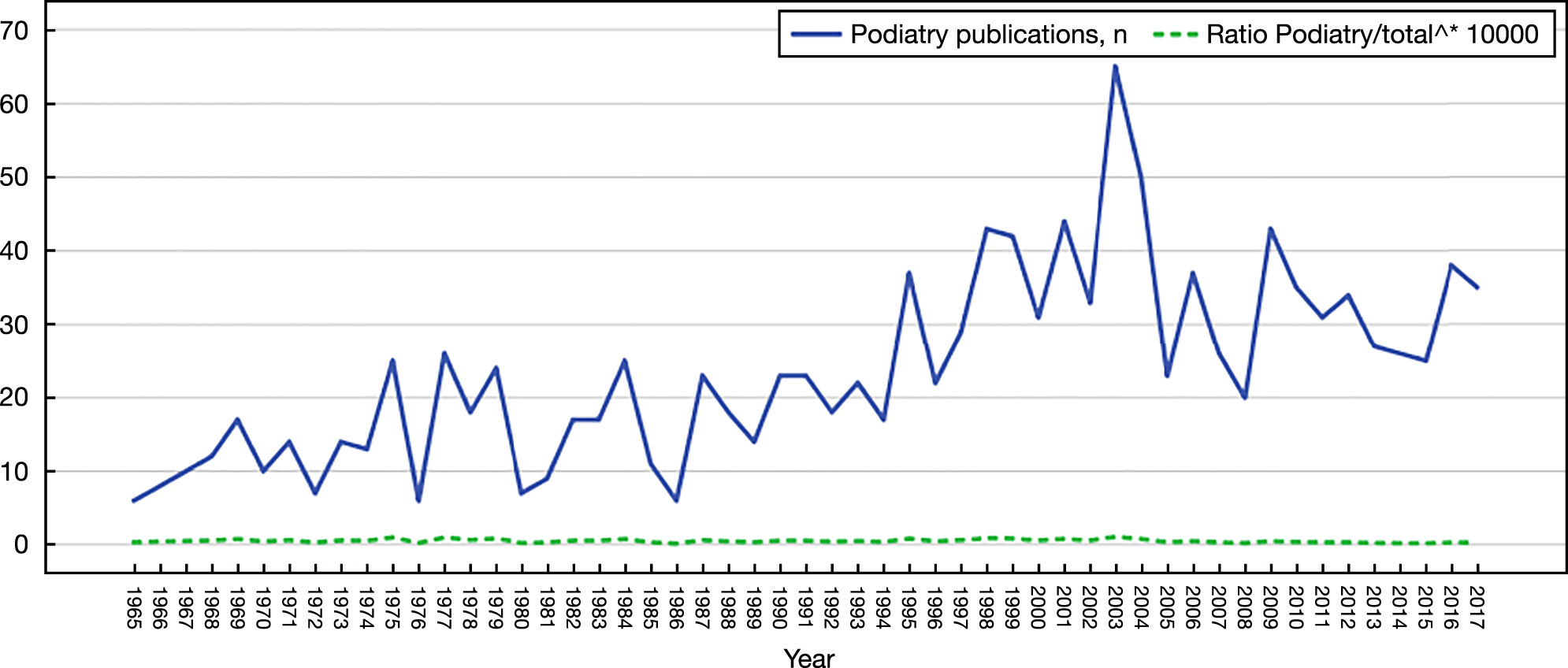
A total of 1,256 publications related to podiatry were retrieved from MEDLINE from 1965 to 2017. Figure 1 shows the annual evolution in the number of publications and podiatry's relative contribution to global scientific production. On average, 4.76 of every 100,000 publications indexed in MEDLINE dealt with podiatry. Publications in this area grew by 483.33% over the study period, and the mean annual growth rate was 9.12%. The year of maximum production was 2003, with a total of 65 documents. Our results confirmed the fulfillment of Price's law after linear adjustment (r2 = 0.486; F = 48.176; P < .001).
Figure 1. Temporal evolution of scientific production in podiatry from 1965 to 2017.
Japma 111 18008 f01
Of the total 2,229 authors identified, 1,911 authored a single article (transience index = 85.73%). Table 1 shows the PI of authors, who are distributed in levels of productivity as follows: 85.73% were occasional authors; 13.95% were moderately productive authors; and 0.25% were highly productive authors. The most prolific author was A. E. Helfand, from the United States, who authored 46 contributions. With regard to the coauthorship index (mean number of authors per publication), this increased from 1.40 in 1965 to 5.8 in 2017 (mean, 2.4 for the entire study period).
Table 1. Productivity Index of the Authors 
Japma 111 18008 t01
Over the study period, the most common document type was journal article (original research), contributing approximately 74.3% (n = 933) to the total publications. This was followed by comparative study (n = 75 [6.0%]), case report (n = 41 [3.3%]), and clinical trial (n = 26 [2.1%]), of which only one (0.1%) was a controlled clinical trial. The remaining 14.3% were not defined by the Clarivate's WOS as citable (ie, editorials, letters, comments, historical articles, biographies, and other).
Most documents (n = 969 [77.15%]) were published in the United States, followed by the United Kingdom (n = 178 [14.17%]), France (n = 20 [1.6%]), and Australia (n = 14 [1.1%]). Denmark, Germany, The Netherlands, Russia, Canada, New Zealand, Spain, Belgium, Japan, and Norway also contributed to the scientific literature on podiatry. Consistent with the countries of publication, English was the predominant language of podiatry publications, constituting 95.7% (n = 1,202) of the total. French is the second most common language (n = 21 [1.7%]), followed by German (n = 7), Russian (n = 7), Spanish (n = 6), and Swedish (n = 3).
With regard to institutions, universities produced a plurality of the articles, with a clear institutional affiliation (n = 268 [39.1%]), followed by hospitals (n = 106 [14.4%]). Temple University School of Podiatric Medicine published 38 publications (the highest number), followed by La Trobe University and Broadlawns Medical Center. Almost half of the publications (n = 313 [45.6%]) were classified as “other” because they were produced by a myriad of other institutions that were difficult to classify. No information on the rest of the documents (n = 569) was available.
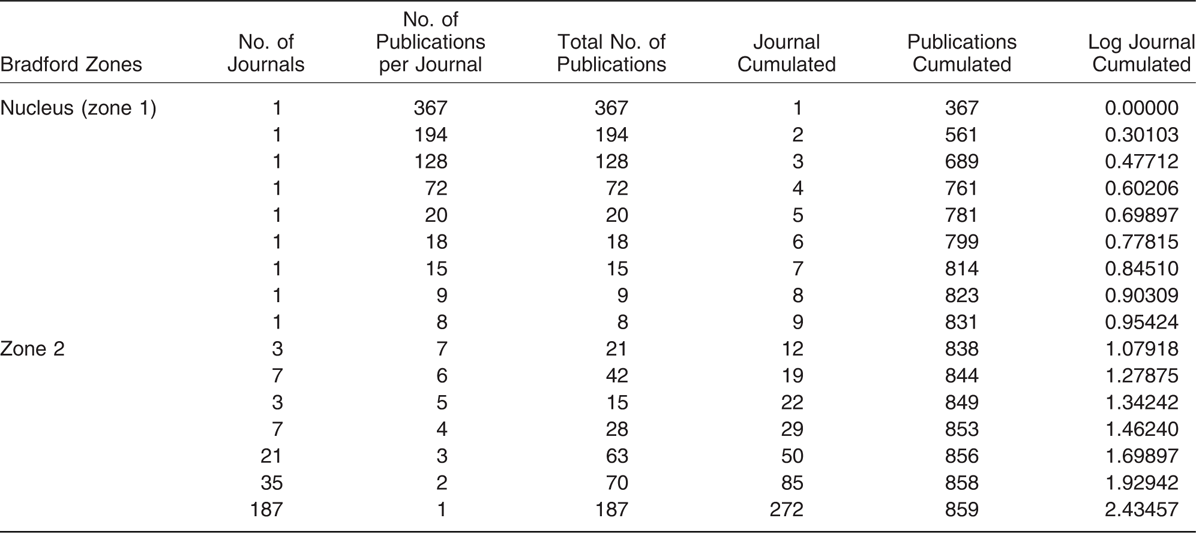
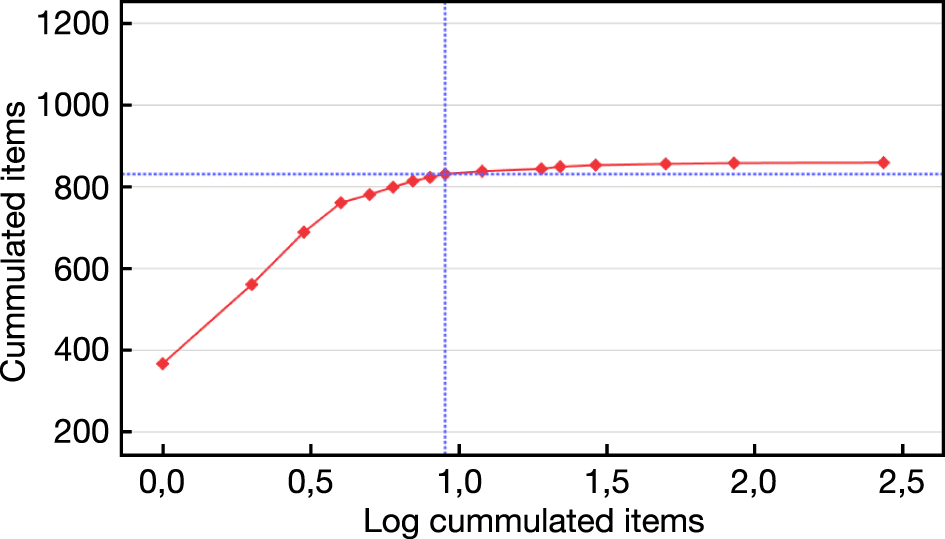
Table 2 describes the distribution of the articles according to the journal of publication and other characteristics. Our sample includes 272 journals, and of these, 187 published a single document about podiatry. The graphic distribution of the Bradford nucleus for all journals is shown in Figure 2, and Table 3 shows the division by Bradford zones. The nucleus of journals (zone 1) consists of nine journals containing 66.2% of publications (Table 2). The rest of the documents were published in the remaining journals (263 journals).
Table 2. Distribution of the Podiatry Publications Published Between 1965 and 2017 per Journal 
Japma 111 18008 t02
Figure 2. Diagram of Bradford distribution from 1965 to 2017.
Japma 111 18008 f02
Table 3. Bradford Law and Distribution per Zone 
Japma 111 18008 t03

Discussion

This bibliometric study shows the considerable evolution in podiatry research over the study period, although its contribution to global scientific production is still modest. Moreover, the body of research shows a lack of specialization, as most authors were only occasional producers. This research area does not have its own category, and most documents are published in four journals from the United States.
Over the study period, 4.76 research documents on podiatric medicine were published for every 100,000 publications in MEDLINE. This figure is small compared with other areas (eg, the proportion of research on surgery is eight articles per 100,000 publications) [20]. Scientific production increased steadily from 1965 to 2003 (year of peak production); after a short period of decreasing production from 2004 to 2008, the number of publications began to recover again (2009–2017). These findings confirm that the podiatry discipline is still emerging, and is not yet a well-developed research field.
Regarding productivity, the high transience index indicates that this research area is young and there are no stable research groups yet. Previous studies indicate that allied health professions, such as podiatry, report significantly lower levels of research capacity and culture compared to medical and nursing professions [18-21]. The lack of time, skills, and general resources to undertake research has been identified as a barrier to building research capacity and culture in these health professions [19,22]. Regarding the coauthorship index, this trended upward over the study period, which might demonstrate the development of this discipline, especially in universities, where articles were most frequently produced.
The journal article was the most common document type used by podiatrists, whereas there was only one identified controlled clinical trial—the study design that provides the best scientific evidence. In addition, a high proportion of documents were not citable, such as editorials or letters. This pattern is also suggestive of an emerging research field, and it confirms the conclusion of Lazzarini et al [20], who stated that podiatry practitioners were skilled at searching and reviewing relevant literature, but that their skills in performing other research activities were low.
As MEDLINE is a US-based database, it is to be expected that the United States was the most productive country in the field of podiatry research and English the predominant language. However, the United States was also the single largest country of origin of scientific articles catalogued in the Science Citation Index of Thomson Reuters' WOS, with 25.3% of the total articles worldwide in 2014 [23]. In addition, there are many differences between countries' contributions to podiatry research attributable to their differential progress in the professionalization process of the discipline, which produces variations in professional competencies and training [24].
Throughout the study period, the core literature about podiatry was concentrated in a small number of journals. Nine core journals were identified; most were published in the United States and in English. Five of the core journals were included in the Science Citation Index. The broad subject terms of core journals were podiatry, surgery, and orthopedics. The JCR-indexed journals were categorized into four subjects: orthopedics, sport sciences, dermatology, and surgery. The fact that no podiatry category exists confirms the emerging nature of this discipline. Thus, journals meeting the highest quality criteria and with international dissemination through a rigorous system of selection of original articles are needed in the field of podiatry.

Limitations

There are some limitations in this study. The search was limited to publications included in the MEDLINE database, which is the most accessible and frequently used in biomedical research [25]. Although MEDLINE indexes 94% of its medical literature [26], nonindexed journals and publications may have been missed. This database was selected because it is suitable for bibliometric studies of scientific production in biomedicine [27], it is open access, and it facilitates the bibliographic searches through the use of MeSH. MEDLINE provides the affiliation of only the first author, but the WOS was used to obtain additional information. Gray literature was not included in this bibliometric study because its quality might be low. Regarding the search strategy, the search was limited to documents that used the term “podiatry” as a MeSH, so documents about podiatric medicine that did not use the correct heading were not retrieved. Other possible MeSH such as “biomechanics” were investigated, but they are very generic. Moreover, in this study, other means of dissemination, such as conference proceedings, were not analyzed. This bibliometric research focused on production and distribution, and the quality of research was not analyzed.


Conclusions

This bibliometric analysis shows that podiatry is still an emerging research field, and the literature is concentrated in a small number of journals, categorized into different subjects. It is necessary to encourage podiatrists from different types of institutions to carry out experimental studies and clinical trials. In addition, promoting and raising the visibility of research in this field is important.

Financial Disclosure

None reported.

Conflict of Interest

None reported.

References

  1. García-RíoFSerranoSDorghamA: A bibliometric evaluation of European Union research of the respiratory system from 1987-1998. Eur Respir J17: 1175, 2001.
  2. VogtTMElston-LafataJTolsmaD: The role of research in integrated healthcare systems: the HMO Research Network. Am J Manag Care10: 643, 2004.
  3. Institute of Medicine (US) Committee on Health Research and the Privacy of Health Information. The HIPAA Privacy Rule. Beyond the HIPAA Privacy Rule: Enhancing Privacy, Improving Health Through Research, edited byNass,SJLevit,LAGostin,LONational Academies Press, Washington, DC,2009.
  4. The Value, Importance, and Oversight of Health Research.Available at: https://www.ncbi.nlm.nih.gov/books/NBK9571/. Accessed October 1,2017.
  5. University of Leeds: Research metrics: bibliometrics.Available at: https://library.leeds.ac.uk/researcher-bibliometrics-about. Accessed November 20,2017.
  6. YoungHBelangerT:The ALA Glossary of Library Information and Science. Madrid, Spain: Editiones by Diaz de Santos;1983.
  7. HaddadM:Use and relevance of bibliometrics for nursing. Nurs Stand31: 55, 2017.
  8. EllegaardOWallinJ:The bibliometric analysis of scholarly production: how great is the impact?Scientometrics105: 1809, 2015.
  9. National Library of Medicine: MESH Database. Podiatry.Available at: https://www.ncbi.nlm.nih.gov/mesh/?term=podiatry. Accessed November 21,2017.
  10. BarskeHLBaumhauerJ:Quality of research and level of evidence in foot and ankle publications. Foot Ankle Int33: 1, 2012.
  11. MalayDSSchepersTBibboCet al: Editorial: the state of research in the realm of foot and ankle surgery. J Foot Ankle Surg50: 1, 2011.
  12. LazzariniPAGeraghtyJKinnearEM: Research capacity and culture in podiatry: early observations within Queensland Health. J Foot Ankle Res6: 1, 2013.
  13. RefWorks Web Based Bibliographic Management Software. Available at: https://www.refworks.com/. Accessed November 20,2017.
  14. SenguptaIN:Bibliometrics, informetrics, scientometrics and librametrics: an overview. Libri42: 75, 1992.
  15. SeglenPO:Citations and journal impact factors: questionable indicators of research quality. Allergy52: 1050, 1997.
  16. BradfordSCEganMEShera JH: Documentation, 2nd Ed, Crossby Lockwood, London,1953.
  17. Povedano Montero FJ, López-Muñoz F, Hidalgo Santa Cruz F: Bibliometric analysis of the scientific production in the area of optometry. Arch Soc Esp Oftalmol91: 160, 2016.
  18. SgròAAl-BusaidiISWellsCI: Global surgery: a 30-year bibliometric analysis (1987–2017). World J Surg43: 2689, 2019.
  19. WilliamsCMLazzariniPA:The research capacity and culture of Australian podiatrists. J Foot Ankle Res8: 11, 2015.
  20. LazzariniPAGeraghtyJKinnearEM: Research capacity and culture in podiatry: early observations within Queensland Health. J Foot Ankle Res6: 1, 2013.
  21. PickstoneCNancarrowSCookeJ: Building research capacity in the allied health professions. Evid Policy4: 53, 2008.
  22. PagerSHoldenLGolenkoX:Motivators, enablers, and barriers to building allied health research capacity. J Multidiscip Healthc5: 53, 2012.
  23. UNESCO: Facts and figures: publications. UNESCO Science Report, Towards 2030.Available at: https://en.unesco.org/node/252282. Accessed June 15,2018.
  24. SkipperJKJr,HughesJE:Podiatry: a medical care specialty in quest of full professional status and recognition. Soc Sci Med17: 1541, 1983.
  25. García-RíoFSerranoSDorghamA: A bibliometric evaluation of European Union research of the respiratory system from 1987–1998. Eur Respir J17: 1175, 2001.
  26. RoylePBainLWaughN:Systematic reviews of epidemiology in diabetes: finding the evidence. BMC Med Res Methodol5: 2, 2005.
  27. PestañaA:El MedLine como fuente de información bibliométrica de la producción española en biomedicina y ciencias médicas. Comparación con el Science Citation Index. Med Clin (Barc)109: 506, 1997.