Hindfoot and ankle arthrodesis is a complex surgical procedure generally reserved for primary osteoarthritis, post-traumatic arthritis, congenital deformity, neuromuscular disease, avascular necrosis of the talus, failed total ankle arthroplasty, and Charcot’s neuroarthropathy (CN). In 1948, Adams [
1] was the first to publish on achieving tibiotalocalcaneal arthrodesis (TTCA) using intramedullary nailing (IMN), but the procedure has become increasingly common in recent years. [
2]
Tibiotalocalcaneal arthrodesis has been shown to provide a stable limb for a variety of pathologies including inflammatory arthropathies, primary and secondary osteoarthritis, avascular necrosis, failed total ankle replacement, neuropathic joints, substantial varus or valgus deformities, and even fractures. A successful union rate of 86.7% was reported in a large systematic review of 641 procedures, but only a small portion of these patients were neuropathic. [
3] The authors noted that among their cases of nonunion, only 26% required a revision arthrodesis because of inadequate symptoms to warrant a revision procedure.
Tibiotalocalcaneal arthrodesis has become especially popular for reconstruction of the Charcot foot and ankle for several reasons. In particular, it has been shown that diabetic patients fear major amputation more than any other complication, including death, and that maintaining a functional limb, if possible, is a major factor in a patient’s quality of life. [
4,
5,
6,
7] The 63% to 78% union rates and 84% to 100% limb salvage rates in patients with CN undergoing TTCA make it a favorable option when considering the difficult nature of CN, especially with reported mortality of 28.3% at 5 years in CN compared with 57% mortality at 3 years for those who have undergone major amputation. [
8,
9,
10,
11,
12,
13,
14,
15]
Available hindfoot-specific intramedullary devices come straight or with a valgus bend and have internal and/or external compression components. The reported outcomes of TTCA are relatively good, but there is little consensus on which nail characteristics, if any, improve patient outcomes. At our institution we routinely use a femoral nail as opposed to a hindfoot-specific device because it offers a larger variety of sizes (length and diameter), it offers robust fixation in the calcaneus through a spiral blade plate, and it features a bend similar to hindfoot-specific valgus nails.
A previous study from our institution demonstrated that patients with and without diabetes mellitus have a high likelihood of successful limb salvage with TTCA using three different hindfoot specific IMNs. [
16] The purpose of the present study was to evaluate the success of a single surgeon’s experiences with TTCA using a retrograde/anterograde femoral nail in a similar patient population. The primary outcome measures were limb salvage and clinical union rates. The secondary outcome measures included infectious and noninfectious complications. We hypothesized that limb salvage and union rates are negatively influenced by poorly controlled diabetes, peripheral neuropathy, and CN, whereas complications are positively influenced by the same risk factors.
Materials and Methods
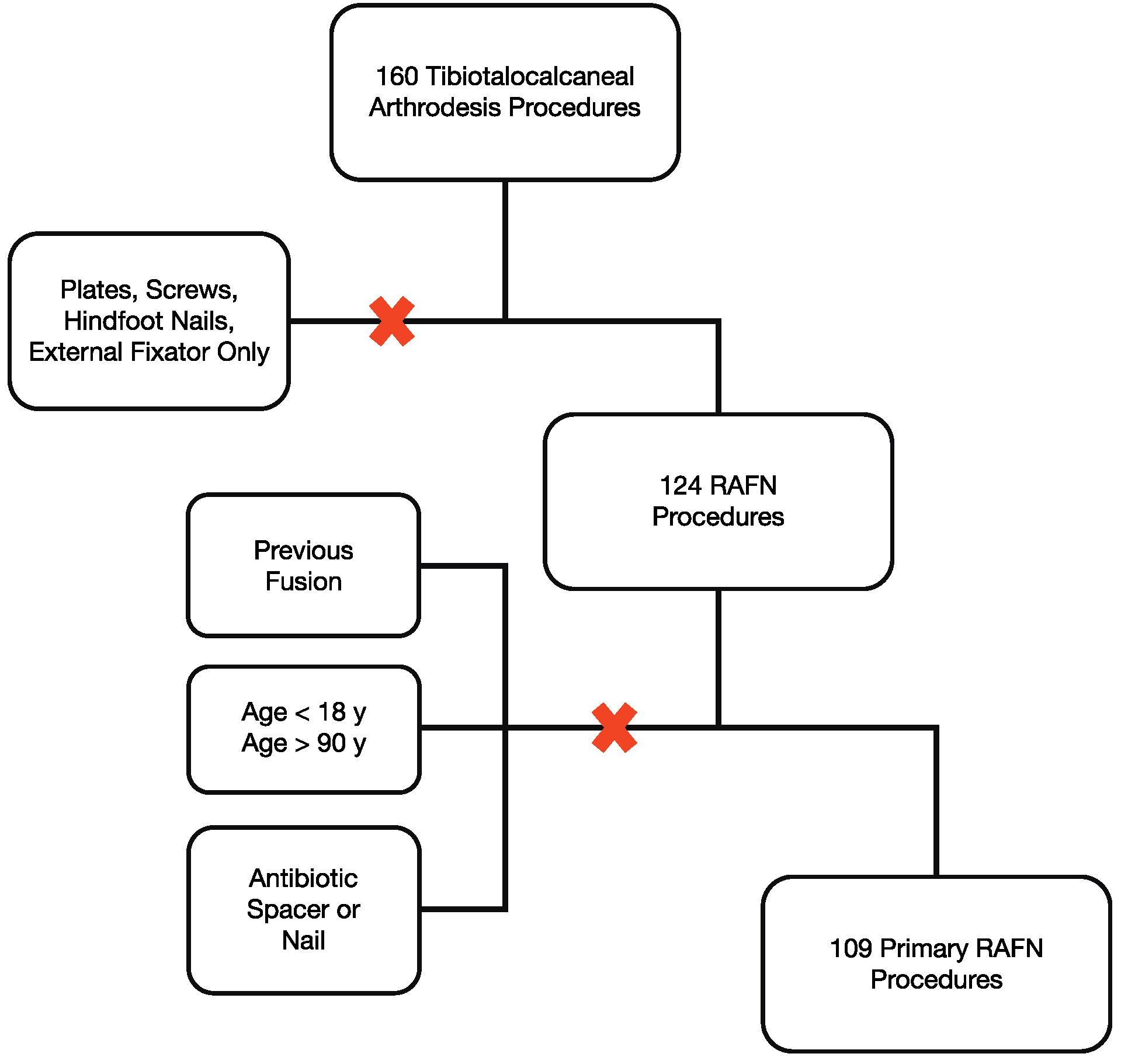
The institutional review board at the University of Pittsburgh Medical Center Mercy Hospital (Pittsburgh, Pennsylvania) approved this study with an expedited review. Three of us (N.S.P., P.R.L., J.D.P.) reviewed the surgical database and corresponding medical records of one of us (P.R.B.) for patients who had undergone hindfoot and ankle arthrodesis between January 1, 2006, and December 31, 2016. The review identified 160 TTCA procedures during the study. Patient medical records were reviewed, and selection criteria were applied (
Figure 1), generating 109 total procedures. To be included in the study, patients had to have primary TTCA with a retrograde/anterograde femoral nail performed by one of us (P.R.B.) and had to be older than 18 years. Patients were excluded if they were younger than 18 years, had previous ankle or subtalar joint arthrodesis, used other hindfoot arthrodesis nails and plates, or had previous or concurrent management of infection via an antibiotic-impregnated cement spacer or nail. The demographic data, including age, sex, laterality, body mass index, presence of diabetes mellitus, insulin use, peripheral neuropathy, active tobacco use, history of ulceration, and presence of autoimmune disorder, were extracted from the medical records and are presented in
Table 1. Hemoglobin A
1c (HbA
1c) values were recorded if they were available within 3 months of the initial procedure. The total number of procedures was recorded, and the interval from the primary procedure to the initial revision and final revision procedures was evaluated along with overall follow-up time. Indications for the initial procedure are reported in
Table 2: avascular necrosis of the talus, fracture, failed total ankle arthroplasty, nonunion/malunion, osteomyelitis, acquired equinovarus deformity, primary or secondary osteoarthritis, posttraumatic arthritis, and CN.
The primary outcome measures were limb salvage and union rates, and the secondary outcome measures included infectious and noninfectious complications. Limb salvage was defined as maintaining a stable, plantigrade foot and avoiding transtibial amputation. Union and nonunion were considered clinical diagnoses. The clinical stability, presence of pain, and need for revision procedures were used in combination with radiographic evaluation owing to the difficult evaluation with significant hardware placement and lack of consistent computed tomography. The infectious complications were limited to deep infections, which required hospital admission with intravenous antibiotics and/or operative debridement. Noninfectious complications included nonunion or malunion requiring revision, postoperative tibia fractures, proximal amputation, and mortality. We also reported the number of ambulatory patients and the need for bracing or prosthesis postoperatively.
Continuous variables are summarized with the mean ± SD for normally distributed data. Descriptive statistics for categorical variables are summarized with frequencies and percentages. Categorical variables were then tested for an association with each outcome using the Fisher exact test, and continuous variables were tested with the Wilcoxon rank sum test as appropriate. Statistical significance was defined using a 95% confidence interval (P ≤ .05).
Results
Retrograde/anterograde femoral nails were used for primary arthrodesis in 104 patients and 109 limbs. Fifty-four men and 50 women with a mean ± SD age of 51.50 ± 15.23 years (range, 21–82 years) were included in the study. Mean ± SD follow-up time was 24.27 ± 18.59 months (range, 10.66–93.40 months). Patients underwent a mean ± SD of 2.50 ± 1.73 related procedures (planned and unplanned), and 32 of 109 (29%) were placed into a circular ring external fixator for staged management before definitive fixation with IMN. The mean ± SD body mass index (calculated as the weight in kilograms divided by the square of the height in meters) at the preoperative appointment was 34.13 ± 10.74 (range, 20.3–68.1). Peripheral neuropathy was the most common demographic variable in the study population, followed by diabetes mellitus, history of ulceration, and tobacco use. Less commonly reported were peripheral arterial disease and autoimmune disorders (
Table 1). Thirty of the 44 diabetic patients (68%) were insulin dependent. Glycemic control was reported with HbA
1c values within 3 months of the initial surgery. Data were available for 29 of 44 diabetic patients, and the mean ± SD HbA
1c concentration was 7.75% ± 1.61% in the diabetic population.
The most common indication for TTCA in the cohort was CN with 42 procedures (39%). Equinovarus deformities and arthridities were also common. Traumatic injuries or nonunion/malunion, failed total ankle replacements, and osteomyelitis were less common indications (
Table 2). Overall, we had a clinical union rate of 89 of 109 (81.7%), and nearly all of the patients experienced successful limb salvage at final follow-up (n = 105, 96.3%), with many dependent on prosthesis or bracing (n = 37, 35.2%).
The infectious and noninfectious complications are reported in
Table 3. Deep infection was noted in 25 limbs (22.9%), and recurrent or new postoperative ulceration was noted in 27 (24.8%). Other complications included nonunion/malunion requiring surgical intervention (n = 20 [18.3%]) and painful hardware (n = 13 [11.9%]). Tibial fracture was noted in five limbs (4.6%), all of which had staged treatment with circular external fixation. Of the 104 patients, four (3.8%) had a below-the-knee amputation and 11 (10.6%) died during follow-up at a mean of 38.0 ± 22.78 months. Twenty-three patients underwent revision procedures at a mean ± SD of 9.38 ± 10.21 months.
The primary outcome measures of limb salvage and clinical union rates were tested for association with poorly controlled diabetes (HbA
1c) using the Wilcoxon rank sum test and for association with peripheral neuropathy and CN using the Fisher exact test (
Table 4). Diabetes mellitus was the only preoperative risk factor demonstrating a significant negative association with limb salvage (
P = .03), whereas peripheral neuropathy and CN were negatively associated with clinical union (
P = .02 and
P = .03, respectively). Hemoglobin A
1c levels were notably higher in the failure groups for both limb salvage and clinical union but did not reach statistical significance.
Infectious complications (deep infection) and noninfectious complications (ulcer) were also tested for association with poorly controlled diabetes (HbA
1c) using the Wilcoxon rank sum test and for association with peripheral neuropathy and CN using the Fisher exact test. The results are reported in
Table 5 and
Table 6. Infection showed a significant positive correlation with all preoperative risk factors measured, including diabetes mellitus (
P = .02), peripheral neuropathy (
P = .03), and CN (
P = .01). Poor glycemic control was noted to be significantly more prevalent in the infection group as well, with a mean ± SD HbA
1c concentration of 8.82% ± 1.57% compared with 7.19% ± 1.36% in the cohort without infectious complications (
P = .02). Similarly, all of the preoperative risks were positively correlated with recurrent or new ulceration postoperatively. Diabetes mellitus (
P < .001), peripheral neuropathy (
P = .04), and CN (
P = .001) demonstrated significance, and poor glycemic control trended toward more ulceration but did not exhibit significance (
P = .08).
Discussion
Tibiotalocalcaneal arthrodesis with IMN fixation is a successful method for treating complex hindfoot and ankle deformities with high overall fusion and limb salvage rates, but it also has high overall complication rates. The present results are comparable with those reported in the literature. The overall clinical union rate of 81.7% and revision rate of 21% are similar to the overall fusion rate of 86.7% and revision rate of 22% reported in a systematic review of 613 patients with 641 procedures despite our prevalence of patients with CN being nearly double that in their review. [
3]
The hypothesis that outcomes would be negatively affected by the higher-risk patients with poorly controlled diabetes, peripheral neuropathy, and CN was shown to be at least partially true. The data suggest that CN, poorly controlled diabetes mellitus, and peripheral neuropathy were all negatively associated with at least one of the outcomes reviewed. On the contrary, patients who underwent TTCA for primary osteoarthritis or post-traumatic arthritis seemed to have better outcomes, likely because they were less likely to have diabetes, neuropathy, or CN. Only diabetes mellitus was statistically significantly associated with major amputation, but this is likely secondary to the small number of patients involved. Eleven of 104 patients (10.6%) died during follow-up as well, but no cases were directly related to their TTCA (infection/sepsis, pulmonary embolism).
Although the data are presented in aggregate for all indications for TTCA, a large proportion of the procedures (42 of 109 [39%]) were performed in patients with CN. Comparing the present outcomes with the literature for this patient population, the present results are comparable, with a limb salvage rate of 105 of 109 (96.3%). In a review of 117 patients, Wukich et al. [
16] demonstrated an overall 95% salvage rate in patients with and without diabetes for a similar range of indications. One study of 18 patients with CN demonstrated a 71.4% union rate and a 92.8% limb salvage rate for treatment of rearfoot and ankle CN with TTCA via IMN, and another review showed a limb salvage rate of 100% in a series of 18 TTCAs. [
8,
11] Similarly, Chraim et al. [
10] reported a CN limb salvage rate of 16 of 19, with three patients having below-the-knee amputation for persistent infection.
To address some of the shortcomings of current hindfoot arthrodesis nails, we used a retrograde/anterograde femoral nail, which is commonly available for trauma applications and offers a wide range of size options (length, 160–480 mm; diameter, 9–15 mm). Thordarson and Chang [
17] identified an area of radiographic lucency about the proximal tip of the IMN and theorized an area of local stress concentration, and Pinzur et al. [
18,
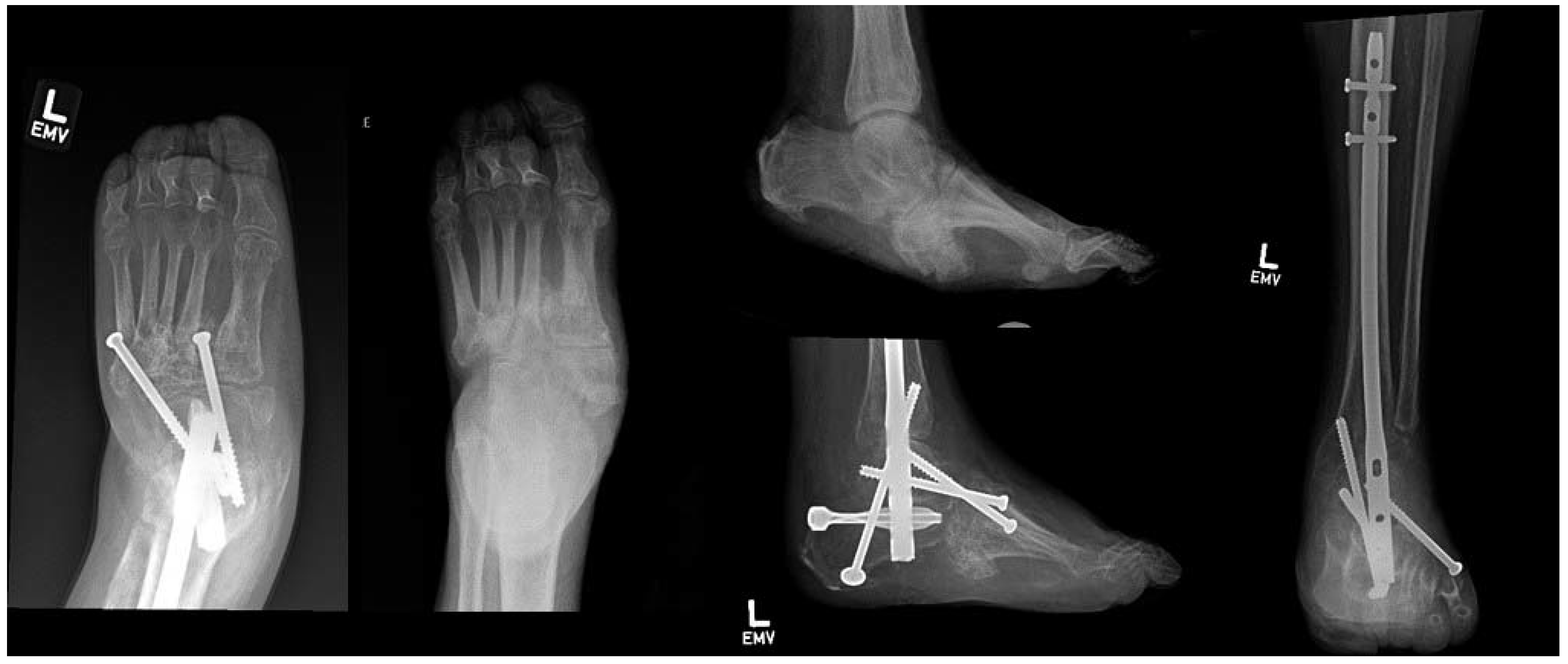
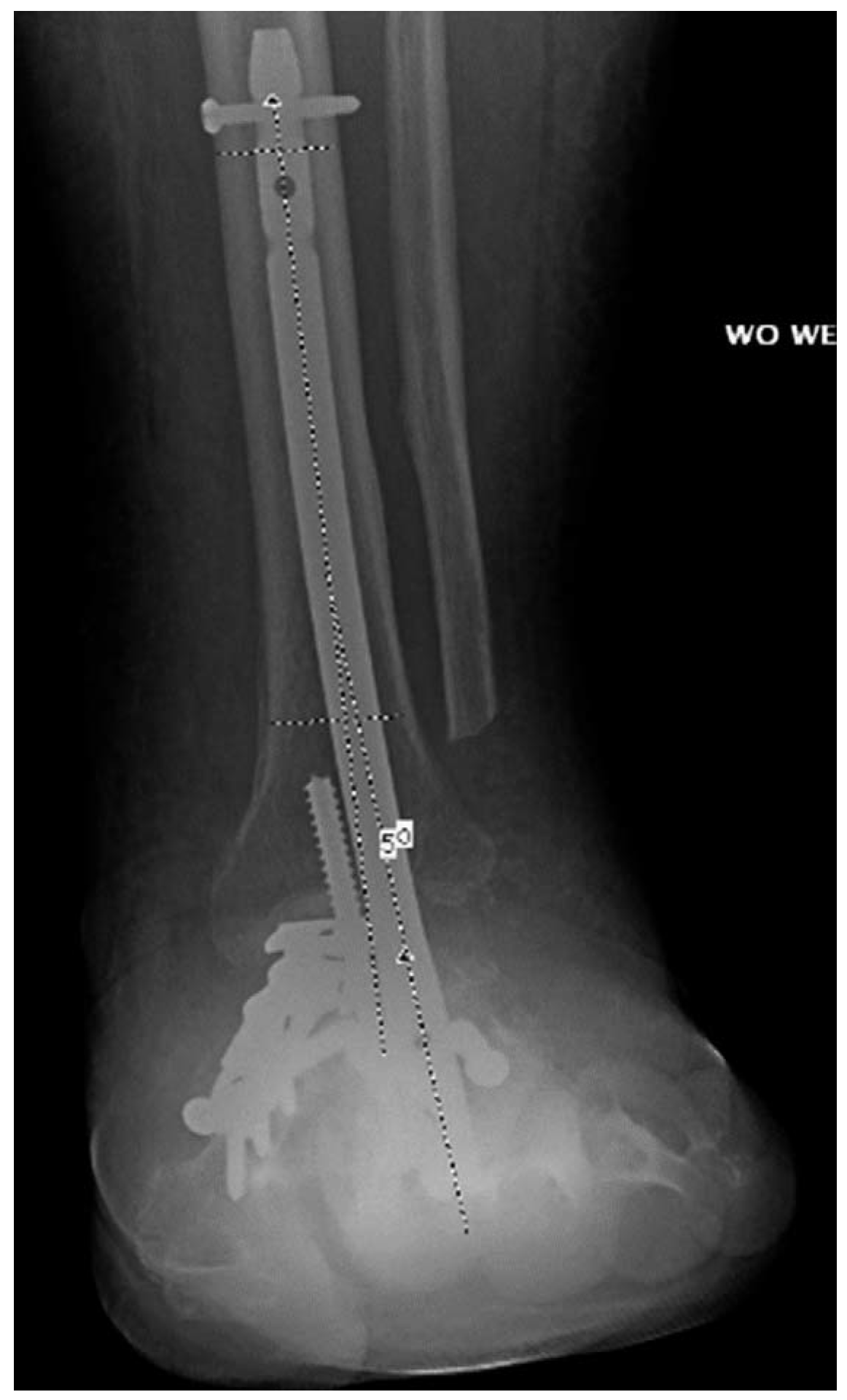
19] later described five patients who developed displaced stress fractures in the same area, which he later overcame with the use of a longer femoral nail. The femoral nail we used has a 1,500-mm femoral anteversion for lengths greater than 200 mm, which correlates to approximately 58 of valgus bend when inserted appropriately (
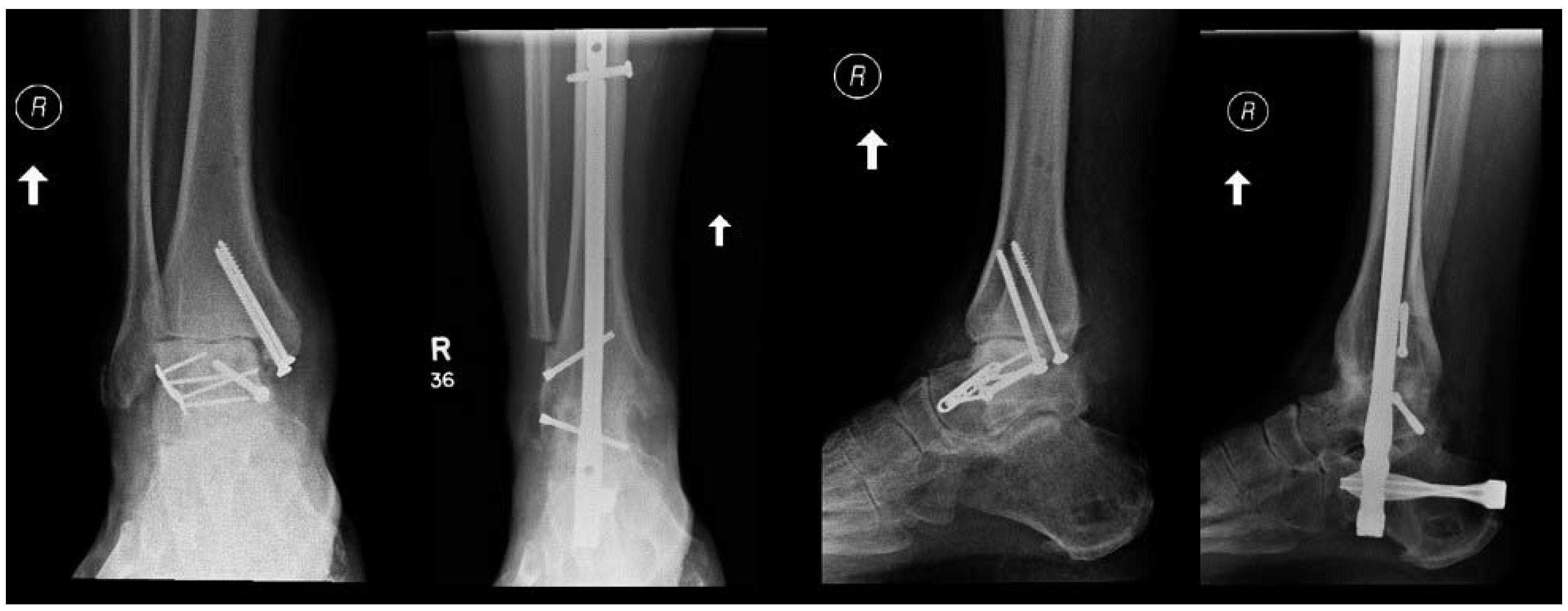
Figure 2). Another advantage of the femoral nail is the option to add a spiral distal interlocking plate for superior purchase in soft or osteoporotic bone (
Figure 3 and
Figure 4). There are also some disadvantages of using this femoral nail, including lack of any internal compression component and no integrated talar screw fixation. To overcome this, we manually compress externally and often augment with additional 6.5-mm headed partially threaded cancellous screws from the plantar calcaneus crossing the subtalar and ankle joints and purchasing the distal anterior tibia. Results of a cadaveric study suggest that screws provide less compression compared with intrinsically compressive IMN or plate fixation; however, this does not directly assess the utility of the screws augmenting a noncompressive IMN. [
20] A technical disadvantage is the lack of a guide for proximal interlocking fixation; however, this is often necessary with the longer hindfoot-specific nails as well secondary to deflection with jig systems.
There are several limitations of this study that must be addressed. There is inherent selection bias in this study, as there is in any retrospective review. In addition, data collection was somewhat limited by the quality of the documentation in the medical record, and as such, some outcomes, such as use of bracing or assistive devices, may be underrepresented. Although the data set treats each of the variables and outcomes individually, there are likely confounding variables that contribute to the outcomes as well. Finally, this study lacks any true control group and instead attempts to compare the data with that reported in the literature, and as such there are certainly differences in methods or definitions, such as radiographic versus clinical union and what constitutes limb salvage or failure.
In conclusion, the results of this study suggest that a femoral nail is a viable alternative to current hindfoot-specific IMNs with similar outcomes to those reported in the literature for a wide array of indications. It offers several lengths and diameters, provides robust calcaneal fixation, and comes with a bend similar to valgus hindfoot nails, but it lacks direct talar fixation and internal compression.