An angioleiomyoma is a benign soft-tissue tumor typically less than 20 mm in diameter that arises from vascular smooth muscle cells [
1,
2,
3]. Angioleiomyoma accounts for 5% of all soft-tissue neoplasms and affects women more often than men (male-to-female ratio, 1.7:1), most frequently presenting between 30 and 60 years of age. Although they can arise anywhere, they disproportionately affect the lower extremity (50%–70% incidence) [
1,
4].
Presentation of angioleiomyoma depends on type and location. Sixty percent of angioleiomyomas present with pain, and many are accompanied by regional swelling [
5]. Depending on tissue origin and size, a palpable, mobile nodule may be recognized during clinical examination, although deeper manifestations will not show this [
2,
5,
6,
7,
8,
9,
10]. Signs of local ischemia may also present as the tumor enlarges and begins to compress the surrounding vasculature [
8]. Although the most common site of angioleiomyoma is the lower extremity, most cases report its location in the superficial layers of subcutaneous or cutaneous tissues [
2,
3,
5,
6,
8,
9,
10,
11,
12,
13,
14]. It has been hypothesized that this is because of the high capillary density within these tissues, which creates a favorable environment for tumorigenesis [
14].
Among cases of angioleiomyoma in the foot and ankle, there are three documented occurrences within the tarsal tunnel [
7,
15,
16]. In each of these, the lesion presented with some degree of nerve compression and required operative excision. In two of the cases, the tumor was palpable on clinical examination and arose from the subcutaneous tissue overlying the tarsal tunnel [
7,
16]. In one case, the tumor arose within the tarsal tunnel in close proximity to the tibialis posterior nerve [
15]. To our knowledge, the present case is the first documented occurrence of an angioleiomyoma presenting as a pseudoaneurysm of the tibialis posterior artery.
Case Report
A 55-year-old woman presented to a podiatry clinic with a chief complaint of left heel pain and left ankle pain along the tibialis posterior space that persisted intermittently for 2 to 3 months before her visit. The patient denied any trauma to the area and claimed that the pain had not limited her activity but had caused some soreness in the foot. Swelling, bruising, temperature inequality, or sensations of numbness or tingling were not present at the time of examination. She also denied having any previous vascular issues.
A radiograph of the left ankle revealed no osseous abnormality or fracture. The patient was then referred for a diagnostic ultrasound scan to examine the soft-tissue structures within the region. The ultrasound scan demonstrated slight thickening of the plantar fascia origin, a small plantar fibroma arising 5 cm from the plantar fascia origin, and what appeared to be a small pseudoaneurysm arising from the lateral aspect of the tibialis posterior artery within the tarsal tunnel.
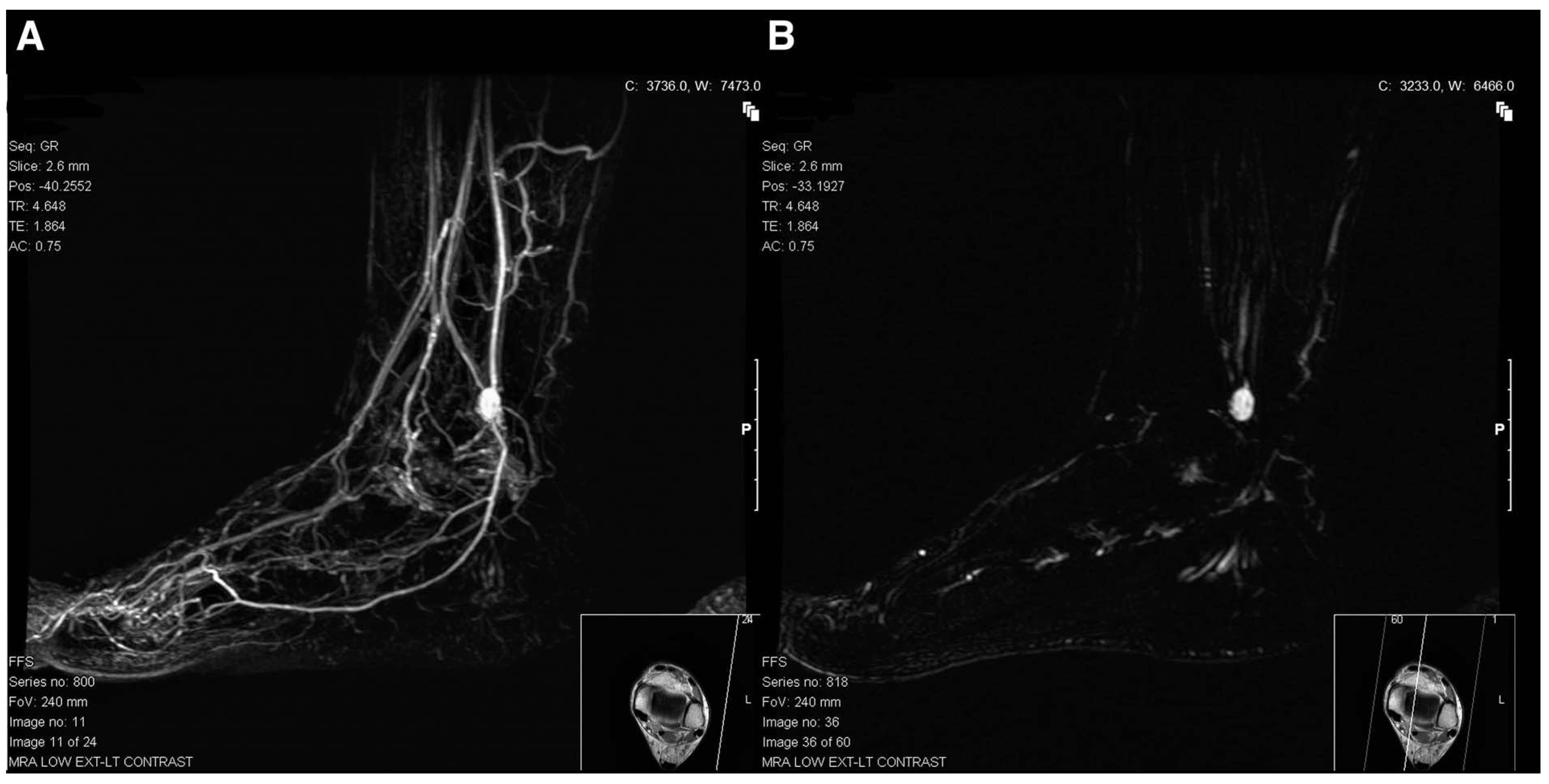
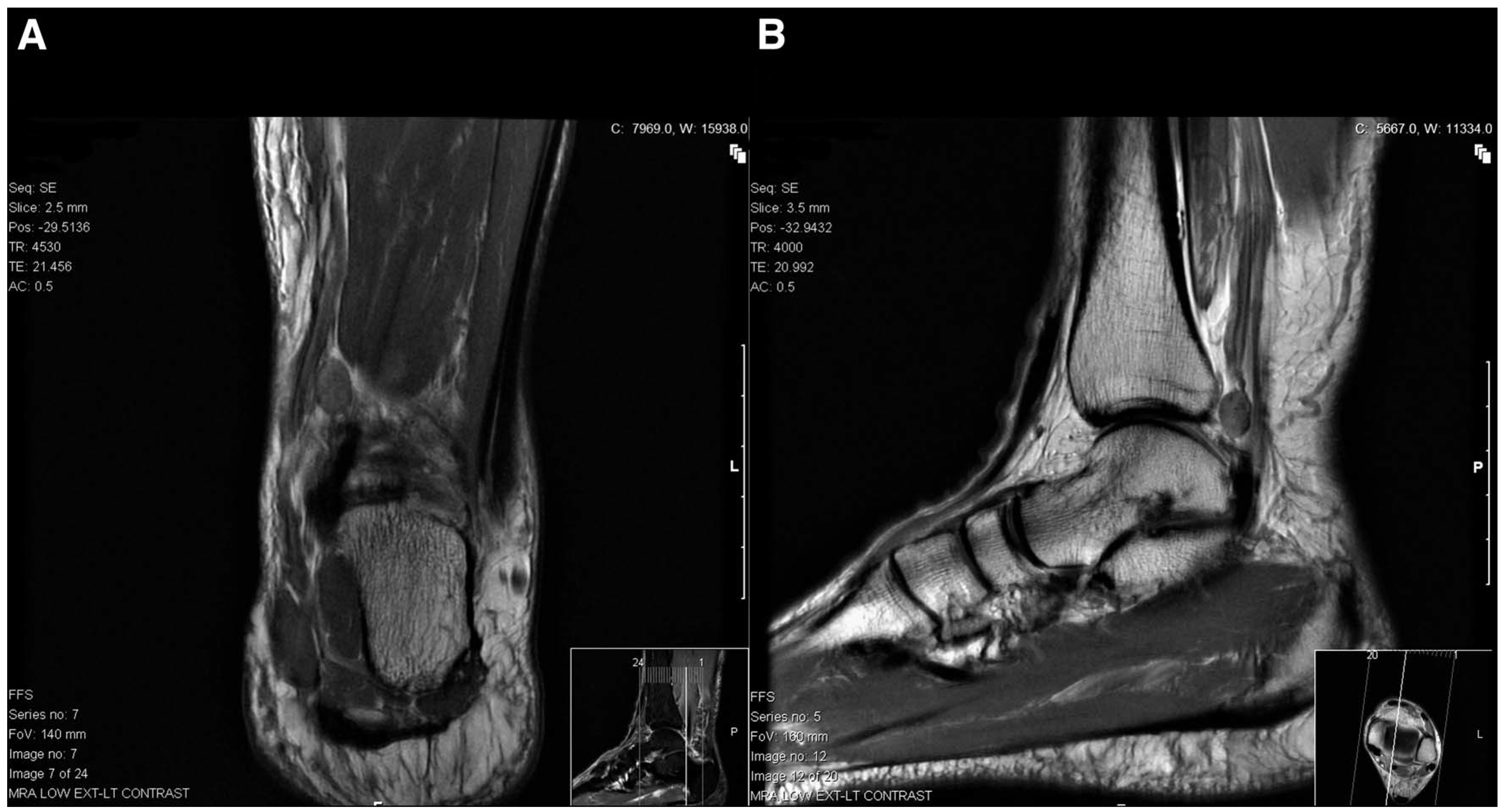
The patient was referred for magnetic resonance angiography and magnetic resonance imaging (MRI) for further characterization of the tibialis posterior artery, tibialis posterior tendon, and tarsal tunnel. Magnetic resonance angiography with contrast also visualized a well-defined, hyperintense, oval mass measuring approximately 1.0 cm, believed to be a pseudoaneurysm arising from the lateral aspect of the tibialis posterior artery at the level of the malleolus (
Figure 1). Magnetic resonance imaging also visualized this mass as possessing a uniform hyperintense structure with well-defined boundaries (
Figure 2). Additional MRI findings included mild juxtainsertional tibialis posterior tendinosis, plantar fascia thickening and fibroma, a plantar calcaneal spur, scar remodeling of the lateral collateral ligaments, and tendinosis of the peroneus brevis superimposed with a low-grade split tear distal to the lateral malleolus.
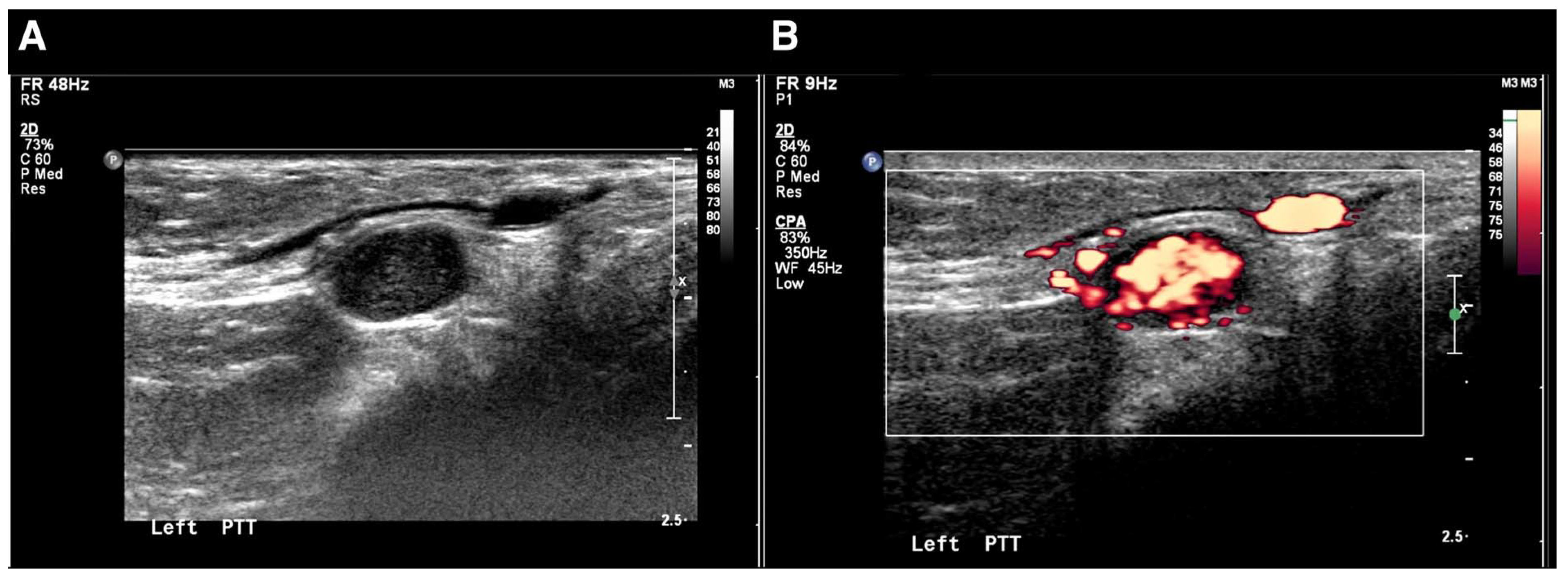
A follow-up ultrasound examination 4 months later demonstrated a persistent mild insertional tibialis posterior tendinosis and moderate degeneration of the plantar fascia at its calcaneal origin, without tear. The presumed tibialis posterior pseudoaneurysm was visualized with the same diameter of approximately 1.0 cm. Doppler imaging also revealed hypervascularity within the mass (
Figure 3). The tibialis posterior artery was also shown to demonstrate pulsatile flow.
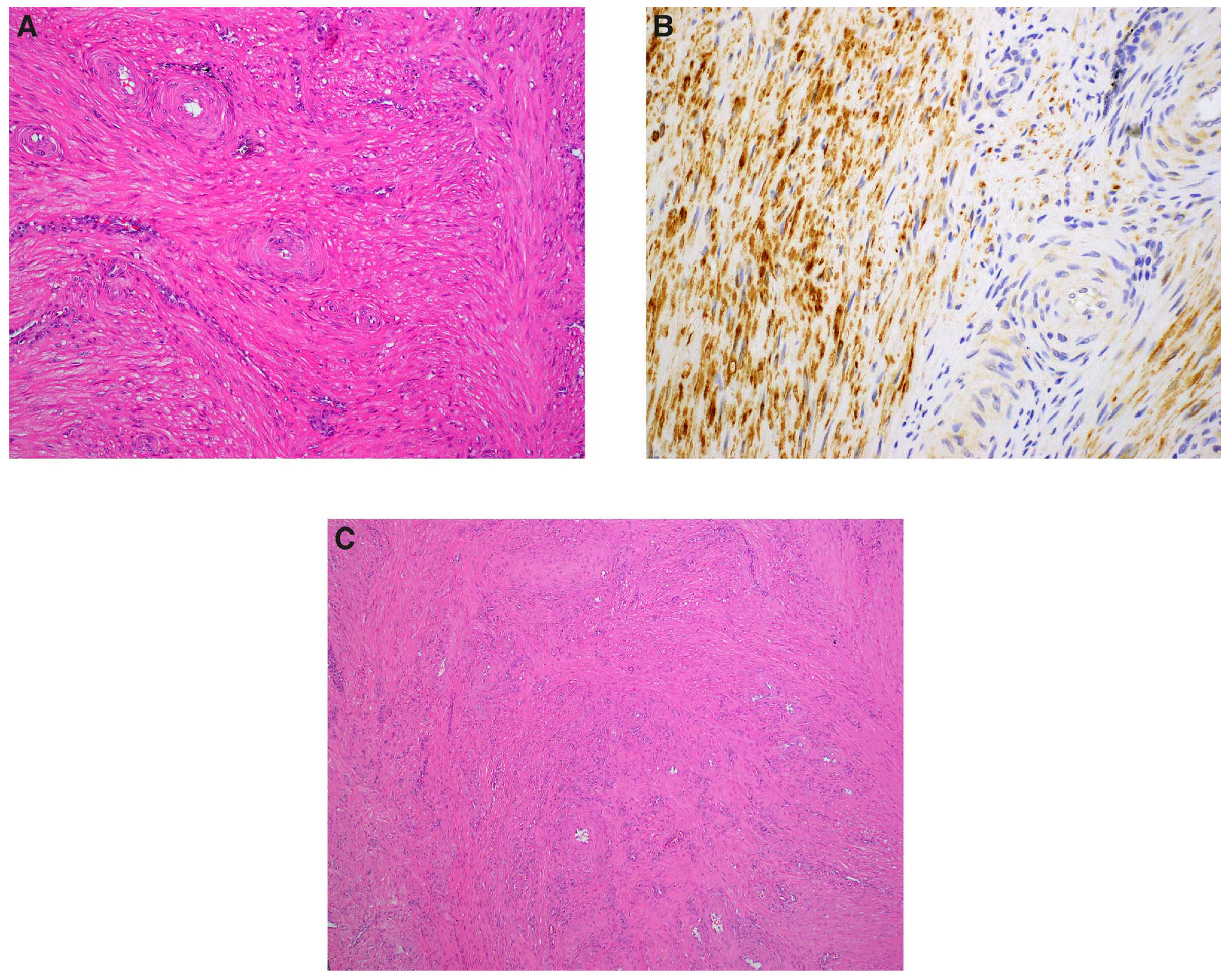
The patient was referred to a vascular surgeon for consultation, at which point the decision was made to proceed with surgical exploration and open repair of the presumed pseudoaneurysm to prevent restriction of pedal blood flow. At the time of surgery, the tibialis posterior artery was a normalappearing vessel. There was a 1.5-cm soft-tissue mass immediately adjacent to the tibialis posterior artery with a vascular pedicle, representing what initially was believed to be a pseudoaneurysm. The vascularized mass was excised and the vascular pedicles were ligated and divided. The excised mass was sent for pathologic evaluation, which identified it to be an angioleiomyoma (
Figure 4).
At follow-up visits, the patient was shown to respond well to the procedure. Complete recession of the tumor was noted, without any indication of recurrence. The patient’s symptoms also diminished greatly postoperatively, again indicating a positive response to the procedure.
Discussion
Definitive diagnosis of an angioleiomyoma is rarely made preoperatively. In the present case, preoperative diagnosis would have been especially difficult given the uncommon location of the tumor and because it was not palpable on clinical examination.
Although there are no documented cases of an angioleiomyoma presenting in this way, there are several cases of an angioleiomyoma manifesting in the tarsal tunnel [
7,
15,
16]. In the study by Bartoli et al, the lesion presented as a palpable nodule in the retromalleolar space and was accompanied by swelling in the tarsal tunnel [
16]. It was determined through MRI that the lesion arose from the subcutaneous tissue overlying the tarsal tunnel in close proximity to the neurovascular bundle. Cancilleri et al describe an angioleiomyoma that went undetected on MRI, but was seen in the tarsal tunnel in close proximity to the tibialis posterior nerve during surgery and was excised [
15]. In that case, the tibialis posterior nerve showed some signs of compression. Finally, Hamoui et al present another case of a palpable angioleiomyoma located in the subcutaneous tissue overlying the tarsal tunnel that required operative excision [
7]. In each of these cases, the patient’s symptoms included a positive Tinel sign, accompanied by numbness and paresthesia radiating to the first three toes. These are signs of nerve compression within the tarsal tunnel. In the present case, these symptoms were not present. In addition, this lesion presented much deeper than in other cases, and farther away from the neurologic structures.
There are a few documented cases of a true tibialis posterior pseudoaneurysm at the level of the malleolus. In each of these cases, some form of trauma to the artery was attributed to the manifestation of the pseudoaneurysm. Sources of trauma include manipulation under anesthesia following a total ankle replacement, laceration of the rearfoot, and calcaneal fracture [
17,
18,
19]. To our knowledge, there have been no reports of a true pseudoaneurysm of the tibialis posterior artery at the level of the malleolus that did not involve trauma. In the present case, there was no recent history of trauma to the foot or ankle. Only minor scar remodeling of the lateral collateral ligaments, slight tendinosis of the tibialis posterior tendon, and a small longitudinal tendinosis of the peroneus brevis tendon were noted. These findings are more likely to coincide with degenerative, ‘‘overuse’’ injuries to the foot, rather than a significant source of trauma that could generate a pseudoaneurysm.
Given the atypical presentation of this lesion, it is important to consider characteristic radiographic findings and information from the patient’s history when developing the differential diagnosis. Ultrasound and MRI examinations will reveal a homogenous structure with well-demarcated margins [
2,
20]. Ultrasound also reveals a high resistance of vascular flow, suggesting the presence of muscular arteries within the mass [
8]. T2-weighted magnetic resonance images can be somewhat more specific, showing a hypointense fibrous capsule surrounding a hyperintense mass that would correspond to areas of smooth muscles and numerous vessels [
20,
21,
22]. Because ultrasound and MRI provide an incomplete understanding of the mass, differential diagnosis must include other nodular, soft-tissue lesions of the lower extremities, such as ganglion, lipoma, fibroma, synovial sarcoma, giant cell tumor, and traumatic neuroma [
5,
7]. In this case, however, the lesion’s proximity to the tibialis posterior artery could indicate that an angioleiomyoma is the likely diagnosis. This is because angioleiomyomas require the presence of smooth muscle tissue and a vascular source, which could be supplied by the tibialis posterior artery. In addition, angioleiomyomas arise more frequently among women in the fourth to sixth decades of life, which fits the demographic of this patient [
1,
4]. Therefore, when considering aspects of the patient’s history, including demographic information and lack of trauma to the foot or ankle, in conjunction with the lesion’s close proximity to the tibialis posterior artery and characteristic radiographic findings, angioleiomyoma could arise as a likely pathology in the preoperative differential diagnosis.
Conclusions
This case is the first to document an angioleiomyoma presenting as a tibialis posterior pseudoaneurysm at the level of the medial malleolus. In previous cases, angioleiomyoma in this anatomical region presented with a palpable nodule on clinical examination and with enough distance from arteries that it did not act as a pseudoaneurysm, or as an incidental finding on an MRI in proximity to the tibialis posterior nerve. This case therefore required additional attention, because the tibialis posterior artery is a major source of pedal blood supply. In cases of pseudoaneurysm of the tibialis posterior artery, therefore, angioleiomyoma should be considered in the differential diagnosis, especially for women in the fourth to sixth decades of life.