Chronic plantar heel pain (CPHP) is one of the most common conditions of the foot, affecting up to 10% of the population.[
1] The US national economic burden of treatment for CPHP is estimated to be
$284 million annually.[
2] Plantar fasciitis is a commonly used medical diagnosis for individuals with plantar heel pain and implies an acute inflammatory process. Lemont et al[
3] noted, however, that the pathogenesis of plantar heel pain is actually similar to the chronic necrosis found in tendinosis. As with many conditions in which the true pathology is unclear, CPHP has been used in the literature to describe a wide-ranging group of conditions that affect the plantar heel region of the foot, including subcalcaneal bursitis, neuritis, plantar fasciitis/faciosis, and subcalcaneal spurs.[
4,
5] A recent clinical practice guideline[
6] and a systematic review[
7] have reported on current evidence to support the use of conservative interventions for individuals identified as having CPHP. Although both the clinical practice guideline and the systematic review indicated that there is evidence to support the use of typical conservative interventions (such as foot orthoses, foot taping, plantar fascia or calf muscle stretching, night splints, and manual therapy), Martin et al[
6] reported that soft-tissue mobilization procedures should also be considered in the plan of care for individuals with CPHP. Several techniques to improve soft-tissue mobility in individuals with CPHP have been reported, including muscle trigger point therapy,[
8] aggressive manual soft-tissue mobilization,[
9] and instrument-assisted soft-tissue mobilization (IASTM).[
10] The proposed effect of the IASTM treatment is stimulation of connective tissue remodeling by facilitating the repair and regeneration of collagen secondary to fibroblast recruitment.[
11,
12] In a recent systematic review assessing the efficacy of IASTM, Cheatham and colleagues[
13] identified 183 scientific articles and included seven that met the inclusion criteria for final analysis. The authors concluded that although current evidence does not support the use of IASTM for treating certain musculoskeletal pathologies, there was weak evidence that IASTM does increase lower-extremity range of motion. In their review, no studies were found that assessed the effectiveness of IASTM in the treatment of CPHP. Cheatham et al[
13] noted that future studies are needed to assess IASTM protocols, such as the Graston technique, using stringent research methods.
To date, two case-based studies have assessed the effectiveness of IASTM using the Graston technique in the management of CPHP. Looney et al[
10] conducted a case series with ten participants diagnosed as having plantar heel pain who were treated with the Graston technique and static stretching of the triceps surae complex and plantar fascia. Successful outcomes were determined using the minimally clinically important difference (MCID) as the threshold. The authors reported that the participants demonstrated clinically meaningful improvements in pain ratings and functional improvements in Global Rating of Change Scale and Lower Extremity Functional Scale scores.[
10] More recently, Daniels and Morrell[
14] reported the effectiveness of using the Graston technique to perform IASTM in addition to joint manipulation to manage a 10-year-old male athlete with bilateral plantar fasciitis. Although both case-based studies would support the use of IASTM as a plan of care component for patients with CPHP, limitations when interpreting these results include the lack of a control group and the assessment of only short-term outcomes. In addition, combining IASTM with typical interventions for CPHP, such as plantar fascia stretching, calf muscle stretching, and foot intrinsic muscle strengthening, would clarify whether IASTM is more effective in the management of CPHP than are traditional conservative interventions. Thus, the purpose of this pilot study was to determine the feasibility of including IASTM, using the Graston technique, as a component of the treatment program for CPHP compared with a standard conservative care regimen of exercise and stretching. The primary outcome measure for this study was functional improvement measured using the Foot and Ankle Ability Measure (FAAM). The secondary outcome was improvement in pain ratings assessed with the Numeric Pain Rating Scale (NPRS). The findings of this pilot study will be used to determine the viability of conducting a future large-scale randomized controlled clinical trial to assess the effectiveness of IASTM in the management of CPHP.
Materials and Methods
Participants
Eleven individuals with a mean age of 46.1 years (range, 39–54 years) were identified as eligible to participate in this pilot study. All of the eligible participants met the following inclusion criteria: 1) age 18 to 60 years; 2) reported plantar heel pain lasting greater than 6 weeks; 3) presence of plantar heel pain on the medial calcaneal tubercle or plantar aponeurosis confirmed by palpation; and 4) reported pain with the first step out of bed in the morning or with the first step after prolonged immobilization or plantar heel pain with prolonged standing. Individuals were excluded if they 1) reported that the duration of CPHP was longer than 1 year; 2) reported a previous history of cancer, severe vascular disease, lower-extremity fracture, rheumatoid arthritis, or osteoporosis; 3) had a history of trauma or surgery to the foot or ankle; 4) had an NPRS score of less than 3 of 10 for both current pain and pain with the first step; or 5) did not possess sufficient English language skills to accurately complete the outcome tools.
Participants were recruited from a population of patients referred to one of three outpatient physical therapy clinics in a large health network. Potential participants needed to obtain a prescription from an appropriate referral source for physical therapy treatment of plantar heel pain or plantar fasciitis. Before participating in the study, all of the individuals who met the criteria and agreed to participate signed an informed consent form approved by the University of Indianapolis and the Community Health Network institutional review boards. After enrollment, participants were randomly assigned into one of two groups via a random number generator: one group received IASTM using the Graston technique and exercise (IASTM+EX group) and the other group received exercise alone (EXONLY group). The recruitment period was approximately 15 months (December 2012 to February 2013), with 11 participants enrolled in the study for a recruitment rate of 0.73 per month. There was no attrition in this study as all consenting participants completed the study protocol, with no participants lost to follow-up.
Outcome Measures
Participants were administered the FAAM to self-assess activity and participation limitations. To reflect changes in pain intensity, an NPRS in paper form was completed by the participants. Outcome measures were obtained at the initial evaluation (baseline), at the end of the final physical therapy visit, and again 90 days after the final therapy visit.
The FAAM. The primary outcome was improvement in functional levels as assessed using the FAAM. The FAAM is a self-reported survey that comprehensively assesses the physical function of those with musculoskeletal conditions of the leg, foot, and ankle. It has a 21-item subscale for measuring the function of the individual with his or her activities of daily living (ADLs) and a ten-item subscale for measuring function with sports. The ADL subscale was used for this study. The instrument is scored on a Likert scale from 4 to 0, with 4 representing “no difficulty” with the stated item (ie, going up stairs) and 0 representing “unable to do.” The answers are then converted to a scale from 0 to 100, with a higher score representing a higher functional level. It has been shown to be a reliable, valid, and responsive measure of physical function for those with foot, ankle, and leg musculoskeletal disorders. The MCID of the FAAM ADL subscale has been reported to be 8 points.[
15]
The NPRS. The secondary outcome was heel pain and was assessed using the NPRS. The NPRS was reported at two points in time: pain at the time of survey administration (current pain) and pain with the first step in the morning. The NPRS is a rating of the intensity of the pain that the individual is experiencing in his or her heel at any given time. This was administered by asking the individual to rate his or her pain on an 11-point scale, with 0 representing “no pain” and 10 representing “the worst imaginable pain.” The NPRS has been shown to be a reliable measure, with test-retest reliability reported as excellent (
r = 0.79–0.92) for the frequency of administration used in this study (twice weekly).[
16] This tool is also a valid measure and is commonly used in clinical settings to assess pain.[
17] The MCID for this tool has been reported to be 2 points, with this change representing the concept of “much better” improvement.[
18]
Interventions
Interventions were administered by one of three physical therapists in the same health network. Each therapist was certified in the Graston technique and completed additional medical ethics training. In addition, each therapist also had a 2-hour training session with the principal investigator on the protocol, administration, and procedures for the study.
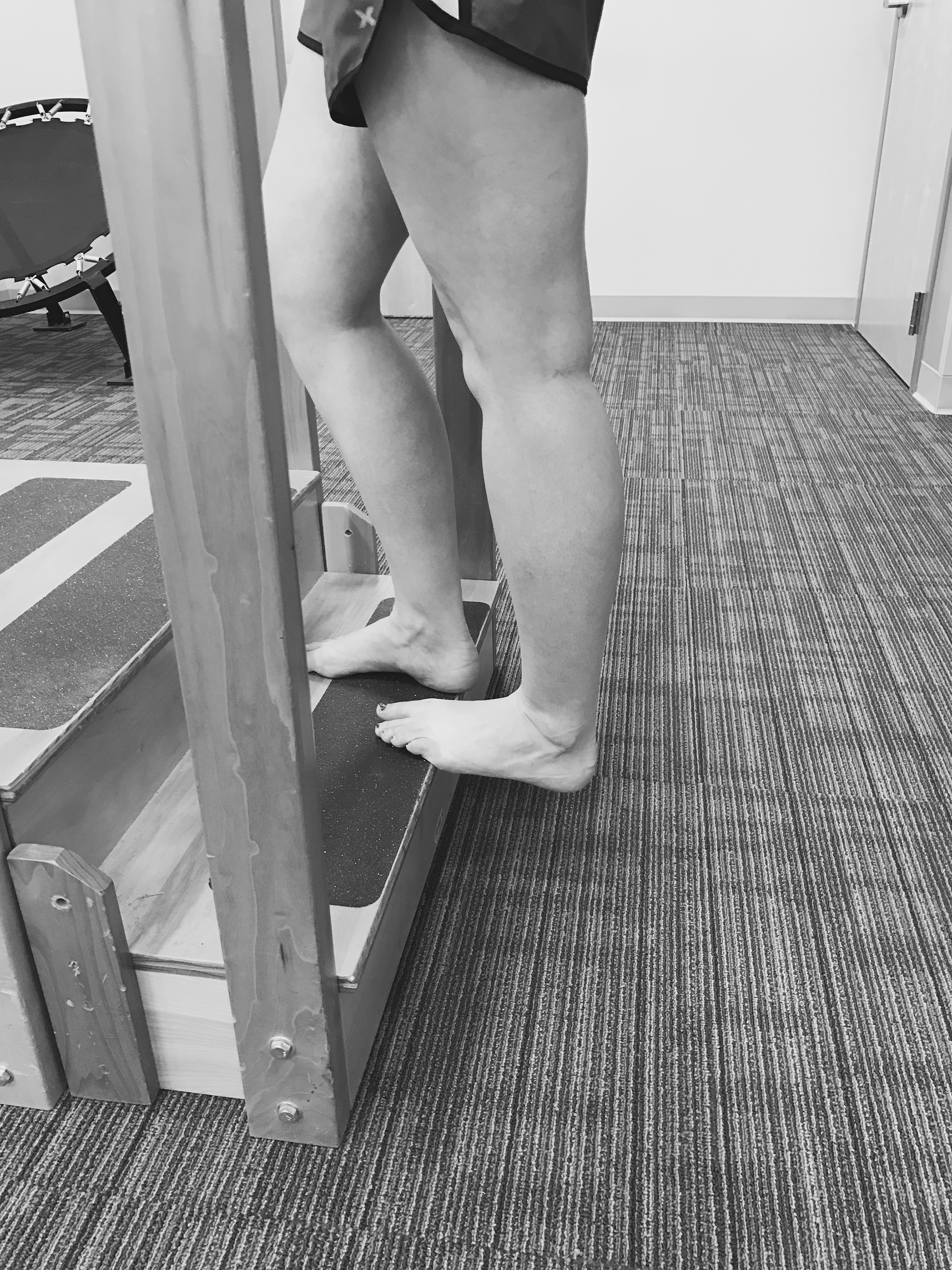
Participants in both the IASTM+EX and EXONLY groups had an initial evaluation session in which baseline outcome measurements were obtained and treatment was initiated. They then returned for up to seven additional therapy visits (twice weekly for up to 4 weeks) for a total of up to eight treatment sessions. The treatment sessions for the participants in the EXONLY group consisted of pedaling an exercise bicycle for 5 min with minimal resistance to warm the tissues, gastrocnemius stretches performed on a step for three repetitions held for 30 sec each (
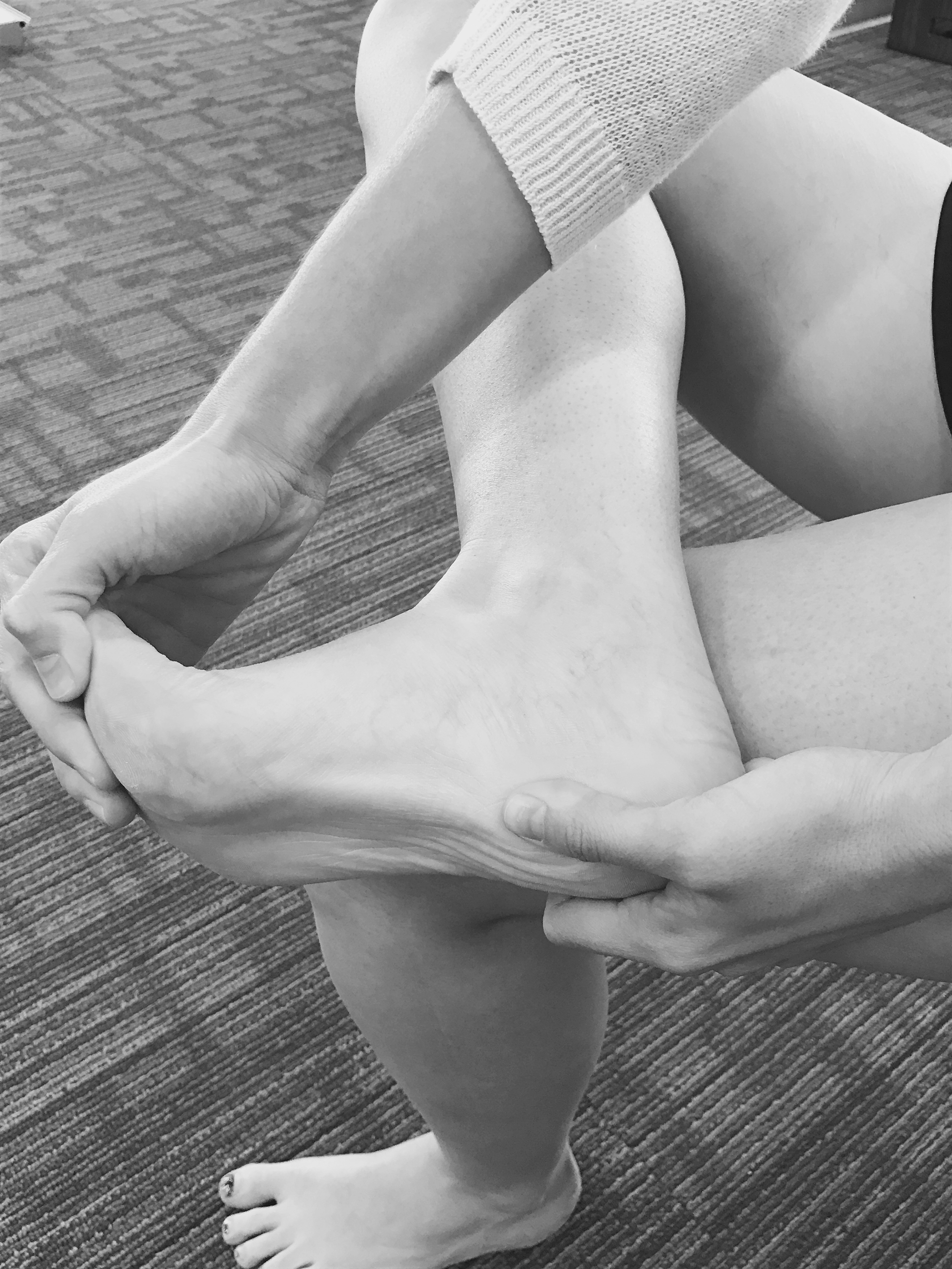
Fig. 1), plantar fascia stretching performed in a seated position for three repetitions held for 30 sec each (
Fig. 2), and foot intrinsic muscular strengthening using a short foot exercise described by Lynn et al[
19] (50 repetitions in bilateral standing). Ice was offered as needed for pain management after each session; none of the participants in either group requested this treatment. Each treatment session for this group lasted approximately 20 min.
Figure 1.
Gastrocnemius stretch.
Figure 1.
Gastrocnemius stretch.
Figure 2.
Plantar fascia stretch.
Figure 2.
Plantar fascia stretch.
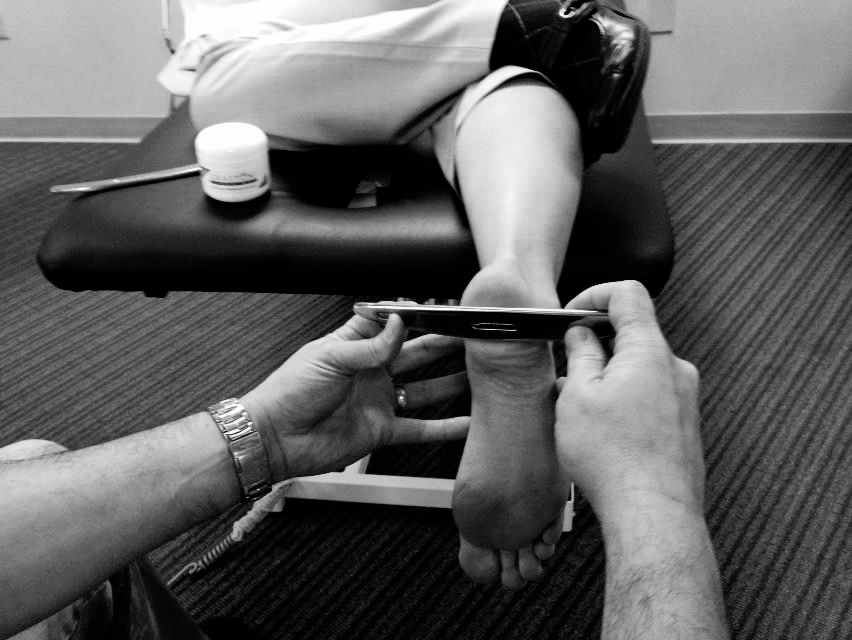
The treatment sessions for the IASTM+EX group were identical to those for the EX group with the addition of IASTM using the Graston technique after the bicycle warm-up and before the exercises. Each participant received 10 min of IASTM using the Graston technique, which included application of a cream to the posterior calf and plantar foot from the knee to the toes to reduce friction on the skin. The Graston tools were then used to mobilize the tissues of the triceps surae and plantar foot by passing the tools along the leg and foot (
Fig. 3). In areas where the clinician perceived increased tissue restriction, more aggressive IASTM treatment was applied using increased force and shorter strokes over the areas of restriction. Each treatment session for this group lasted approximately 30 min.
Figure 3.
Graston technique instrument-assisted soft-tissue mobilization treatment.
Figure 3.
Graston technique instrument-assisted soft-tissue mobilization treatment.
In addition, participants from each group were given a home exercise program and were asked to complete the program twice daily. The home exercise program consisted of calf muscle stretches (three repetitions held for 30 sec each) and plantar fascia–specific stretches (three repetitions held for 30 sec each). Participants documented the number of times each day they performed the home exercise program with a provided exercise log.
Feasibility
Consideration was given to multiple factors to determine the feasibility of the study, including recruitment, retention, and compliance rates of the participants; additional administrative burden reported by clinicians for the study procedures; and an estimation of the treatment effect. Estimation of the treatment effect was based on the calculation of within-group differences of the IASTM+EX and EXONLY groups on the final therapy visit and 90 days after the final therapy visit using effect size calculations via the formula (M1–M2)/SD(pooled). Using effect sizes, a priori sample sizes were computed to advise feasibility and direction for continued research. Taking into account these factors, the decision to continue with a larger study was considered in the context of the success of the application of the protocol as well as the time needed to realize a clinically significant result. Feasibility options for this pilot study included 1) stop (main study not feasible), 2) continue but modify protocol (feasible with modifications), 3) continue without modifications but monitor closely (feasible with close monitoring), and 4) continue without modifications (feasible as is).
Results
Based on the group assignment, five participants were assigned to the IASTM+EX group and six were assigned to the EXONLY group. Descriptive statistics for each group can be found in
Table 1. None of the 11 participants reported adverse events as a result of the treatments administered during the study. Both groups reported compliance with the home exercise program on their completed exercise logs, with all of the participants completing the exercises at least daily.
Table 1.
Demographic Data for the EXONLY and IASTM+EX Groups
Table 1.
Demographic Data for the EXONLY and IASTM+EX Groups
Mean ± SD values for current pain on the NPRS (at the time of survey administration), NPRS with the first step in the morning, and the FAAM at each time interval are listed in
Table 2. Because of the small number of participants, previously established MCIDs were used to assess the changes in pain and functional outcomes for each group. Regarding function, five of the six participants in the EXONLY group and three of the five participants in the IASTM+EX group achieved the MCID for the FAAM between baseline and the end of the treatment sessions. All six participants in the EXONLY group and four of the five participants in the IASTM+EX group achieved the MCID for the FAAM between baseline and follow-up at 90 days after treatment.
Table 2.
Outcomes by Group
Table 2.
Outcomes by Group
Compared with the baseline measures, both groups demonstrated improvement over time for current pain and pain with the first step in the morning. Two of the six participants in the EXONLY group and all five participants in the IASTM+EX group achieved the MCID for current pain between baseline and the end of the treatment sessions. Three of the six participants in the EXONLY group and four of the five participants in the IASTM+EX group achieved the MCID for current pain from baseline to follow-up at 90 days after treatment.
Five of the six participants in the EXONLY group and four of the five participants in the IASTM+EX group achieved the MCID for pain with the first step in the morning between baseline and the end of the treatment sessions. Four of the six participants in the EXONLY group and all five participants in the IASTM+EX group achieved the MCID for current pain from baseline to follow-up at 90 days after treatment for pain with the first step in the morning.
Cohen
d effect sizes were also calculated to determine trends in the data between groups at each interval. Effect sizes were defined using Cohen classifications (small effect:
d = 0.2; medium effect:
d = 0.5; and large effect:
d = 0.8).[
20] These results are available in
Table 3.
Table 3.
Cohen d Effect Sizes in the IASTM+EX and EXONLY Groups
Table 3.
Cohen d Effect Sizes in the IASTM+EX and EXONLY Groups
The NPRS measure of current pain and the FAAM measure both demonstrated medium effect sizes between baseline and the end of treatment. In addition, a large effect size was noted between baseline and follow-up at 90 days after the end of treatment for the FAAM. Small effect sizes were also noted for the NPRS measure of current pain from baseline to 90-day follow-up and for the NPRS measure of first-step pain between baseline and follow-up at 90 days after the end of treatment.
Based on the effect sizes between the groups, a power analysis was calculated to determine the appropriate population sample needed to realize a statistically significant between-group difference at an α level of 0.05 and power of 0.8. These sample size calculations are available in
Table 4. Feasibility was then examined for this study using these effect size calculations and the a priori sample size estimates in the context of the feasibility considerations regarding implementation of the protocol. Although application of the protocol, compliance rates, retention rates, and a lack of administrative burden to the clinicians all support feasibility, the recruitment rate for this study did not. At the current recruitment rate for this setting, data collection would need to continue for more than 4 years to provide the sample size (n = 42) needed to realize a difference between groups. Based on these considerations, further investigation was determined to be feasible with modifications necessary for success of the larger study: continue but modify protocol.
Table 4.
Power Analysis Based on Effect Sizes
Table 4.
Power Analysis Based on Effect Sizes
Discussion
The results of this study show that although improvement was noted over time in both groups, the chronic and stable nature of the condition (>6 weeks) for the participants suggests that the changes noted can be attributed to the interventions provided. This means that the clinician can be confident that conservative treatment incorporating these exercises with or without IASTM can yield improvements in pain and function for patients over time.
Functional improvements on the FAAM favored the EXONLY group at the end of the treatment sessions, with a larger percentage of participants in this group achieving the MCID. However, 90 days after the final treatment session, nearly all of the participants demonstrated functional improvements whether or not they received IASTM. This finding is in agreement with Cheatham et al,[
13] who suggested that weak evidence supports the use of IASTM but that the efficacy of this intervention for the treatment of lower-extremity conditions is yet to be fully determined.
Although both groups demonstrated improvements that were clinically meaningful for the participants, a larger percentage of those receiving the IASTM treatment had scores exceeding the MCID at the end of the treatment sessions as well as at 90-day follow-up. This was true of both overall pain and pain with the first step in the morning. This finding is important for clinicians because general heel pain and pain with the first step in the morning are primary reasons individuals seek treatment for CPHP. These findings are in agreement with other studies suggesting that the addition of manual therapy to a traditional conservative approach of CPHP management may be more helpful than traditional care alone.[
8-
10]
This study is the first to compare conservative treatment of CPHP with and without inclusion of IASTM. Considerable effect sizes were demonstrated between groups favoring the IASTM+EX group. These results favoring the IASTM+EX group over the EXONLY group suggest that further study using larger sample sizes is indicated to determine whether IASTM should be included in the management of CPHP lasting more than 6 weeks.
A limitation of this study was the small sample size. Power analyses using the between-group effect sizes demonstrate that future studies should include a sample size of at least 42 participants to allow for advanced statistical analysis to demonstrate significant differences in these outcomes. Given that the effect size calculations and sample size estimations reflect a small and variable sample, further research can determine whether these estimates will demonstrate a true difference between groups receiving these interventions.
The intent of this pilot study focused on the feasibility of including IASTM as an intervention for the management of CPHP. The findings suggest that further research is warranted to determine the efficacy of this intervention. Although outcomes using the study interventions seem to be meaningful for the patient, a primary concern specific to study protocol involves the recruitment rate. The present study recruited fewer than one participant per month, which is not feasible for a larger, more powerful study. The estimated sample size needed (n = 42) to further examine this intervention with this population is not unrealistic but would require more treatment sites and a higher recruitment rate to be successful.
Another limitation of this pilot study was the use of three clinicians providing treatment at multiple clinical sites. Although all of the clinicians used in this study were licensed, trained, and certified, there may have been interclinician differences in application of the Graston technique. Cheatham et al[
13] noted in their systematic review that optimal protocols have yet to be established in the literature for this treatment approach. To allow for the consistent application of the Graston technique in this pilot study, the treatment procedures used by all three clinicians were based on recommendations by the manufacturer of the Graston tools.
Conclusions
This pilot study demonstrates that the inclusion of IASTM using the Graston technique for the management of CPHP lasting longer than 6 weeks is a feasible intervention warranting further research. The pilot study protocol would need significant modifications specific to the participant recruitment rate for the larger study to be successful. Future studies should include larger sample sizes, as demonstrated by the power analysis calculations, to allow for more advanced statistical analysis and further clarification of the efficacy of this treatment.