Next Article in Journal
The Misdiagnosis of Acral Lentiginous Melanoma: Three Case Presentations
Previous Article in Journal
Risk Factors for Below-the-Knee Amputation in Diabetic Foot Osteomyelitis After Minor Amputation
 
 
Journal of the American Podiatric Medical Association is published by MDPI from Volume 116 Issue 1 (2026). Previous articles were published by another publisher in Open Access under a CC-BY (or CC-BY-NC-ND) licence, and they are hosted by MDPI on mdpi.com as a courtesy and upon agreement with American Podiatric Medical Association.
Article

Analysis of YouTube as a Source of Information for Diabetic Foot Care

by
Peter E. Smith
1,*,
James McGuire
2,
Michael Falci
3,
Dilli Ram Poudel
3,
Richard Kaufman
4,
Mary Ann Patterson
3,
Benjamin Pelleschi
3 and
Esther Shin
4
1
Department of Podiatry, Reading Hospital, King of Prussia, PA. Dr. Smith is now with the Department of Orthopedics and Podiatry, General Leonard Wood Army Community Hospital, Fort Leonard Wood, MO
2
Department of Podiatry, Temple University School of Podiatric Medicine, Philadelphia, PA
3
Department of Podiatry, Reading Hospital, West Reading, PA
4
Department of Podiatry, Hahnemann University Hospital, Philadelphia, PA. Dr. Kaufman is now with Ankle and Foot Centers of Georgia, Alpharetta, GA
5
Department of Podiatry, Mercy Health System, Conshohocken, PA
*
Author to whom correspondence should be addressed.
J. Am. Podiatr. Med. Assoc. 2019, 109(2), 122-126; https://doi.org/10.7547/16-149
Published: 1 March 2019

Abstract

Background: Increasing amounts of diabetes-focused content is being posted to YouTube with little regulation as to the quality of the content. Diabetic education has been shown to reduce the risk of ulceration and amputation. YouTube is a frequently visited site for instructional and demonstrational videos posted by individuals, advertisers, companies, and health-care organizations. We sought to evaluate the usefulness of diabetic foot care video information on YouTube. Methods: YouTube was queried using the keyword phrase diabetic foot care. Original videos in English, with audio, less than 10 min long within the first 100 video results were evaluated. Two reviewers classified each video as useful or nonuseful/misleading. A 14-point usefulness criteria checklist was used to further categorize videos as most useful, somewhat useful, or nonuseful/misleading. Video sources were categorized by user type, and additional video metrics were collected. Results: Of 87 included videos, 56 (64.4%), were classified as useful and 31 (35.6%) as nonuseful/misleading. A significant difference in the mean length of useful videos vs nonuseful/misleading videos was observed (3.33 versus 1.73 min; P < .0001). There was no significant difference in terms of popularity metrics (likes, views, subscriptions, etc) between useful and nonuseful/misleading videos. Conclusions: This study demonstrates that although most diabetic foot care videos on YouTube are useful, many are still nonuseful/misleading. More concerning is the lack of difference in popularity between useful and nonuseful videos. Podiatric physicians should alert patients to possibly misleading information and offer a curated list of videos. (J Am Podiatr Med Assoc 109(2): 122-126, 2019)

The Centers for Disease Control and Prevention (CDC) estimates that 29.1 million Americans are directly affected by the diabetes epidemic (9.3% of the total US population), with 21.0 million already diagnosed.[1] In addition to that figure, an estimated 86 million Americans aged 20 years or older have prediabetes.[2] The complexities and comorbidities of the diabetic foot lead to serious complications, such as neuropathy, ulceration, infection, and amputation. In 2010, the CDC reported 73,000 nontraumatic lower-limb amputations performed in adult diabetic patients.[2] In 2012, diabetes was responsible for $245 billion in health-care costs ($176 billion in direct costs and $69 billion in indirect costs) in the United States.[2] In addition, diabetic patients experience prolonged hospital stays, lost productivity, and decreased quality of life.
Diabetic foot education has been shown to reduce ulceration rates and amputations, leading to cost savings.[3,4,5,6,7,8] Two hours of diabetic foot care education has been shown to be highly effective in preventing diabetic foot ulcers in high-risk patients.[3,9] However, time is a limiting factor with both podiatric physicians and diabetic educators. Telemedicine has been demonstrated to improve treatment outcomes for patients with diabetes and has even been shown to be more effective than conventional care in type 2 diabetic patients.[10]
YouTube.com is the third most popular website in the United States behind only Google.com and Facebook.com.[11] With more than 1 billion users (one-third of all Internet users), YouTube serves as an important source of video information, reaching more 18- to 49-year-old Americans than any traditional cable network.[12] A literature review confirms that YouTube is a useful source of information for numerous diseases and pathologic processes, ranging from peripheral neuropathy to varicose veins to Ebola.[13,14,15,16,17]
In this study, the source and quality of medical information about diabetic foot care found on YouTube were evaluated. Additional video metrics were also evaluated. The goal of the study was to alert physicians to the quality of diabetic foot care information on YouTube and establish whether YouTube is a useful source of patient information for diabetic foot care.

Methods

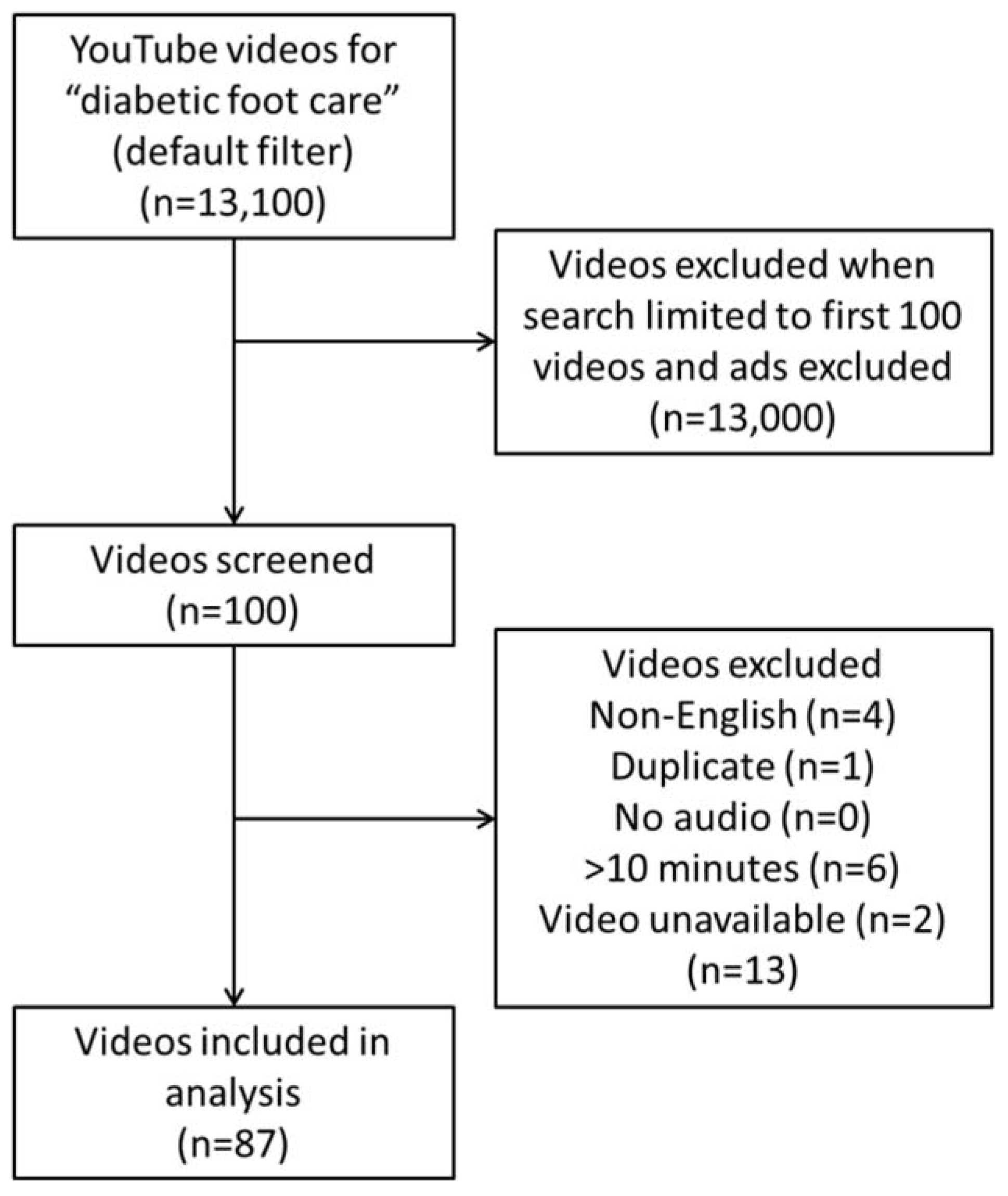
YouTube (http://www.youtube.com) was searched using the phrase diabetic foot care. The search was performed March 13, 2016, and included search results to that point. Additional inclusion and exclusion criteria were similar to those used by Pathak et al.[14] The default relevance filter that YouTube applies was used from a public profile (language: English; content location: United States; restricted mode: off; upload date: any; type: any; duration: any; features: any; sort by: relevance). The search phrase diabetic foot care was selected after reviewing more than 50 YouTube videos related to diabetic foot care. English language videos with content related to diabetic foot care that were no longer than 10 min were included. Search results were restricted to the first 100 videos (Figure 1). Non– English-language videos, duplicate videos, videos without audio, and videos longer than 10 min were excluded. Videos labeled as ads were also excluded.
Five podiatric physicians served as reviewers. Each reviewer went through a uniform teaching session and was given identical instructions and explanation of usefulness criteria. Each video was analyzed by two independent reviewers who classified the video as useful[15] or nonuseful/misleading. Any discrepancy was resolved by a third reviewer. Reviewers also evaluated each video using a 14-point usefulness criteria checklist created from the recommendations of leading health-care organizations in the diabetic foot care field (Table 1).[18,19,20,21] Results from the checklist were used to classify videos as very useful (>7 of the usefulness criteria satisfied), somewhat useful (1–7 of the usefulness criteria satisfied), or nonuseful/misleading (no usefulness criteria satisfied). Videos containing misleading information were automatically classified as misleading. Misleading information was defined as inappropriate recommendations such as debriding wounds yourself or hot soaks, or incorrect information such as diabetes is a government conspiracy. Overall usefulness was calculated as an average of the scores from the usefulness criteria.
Additional metrics were collected on each video, including title, channel, likes, dislikes, comment count, views, length, age of video, category, license, description, description character count, presence of ads, username, and uploader type. Uploader type defined each video’s uploader as a company, an individual, an organization (government, health care, health-care professional, medical education facility), a hospital, or a news agency. These were reclassified into two broad groups as health-care organization related and not related (individual, news agency, and company).
Interrater agreement was evaluated by calculating kappa coefficients (http://www1.cs.columbia.edu/~julia/courses/CS6998/Interrater_agreement.Kappa_statistic.pdf).The Student t test or one-way analysis of variance was used to compare means, and the 𝒳2 test or Fisher exact test was used for categorical variable analysis. Logistic regression was used to calculate the odds ratio. A two-tailed P < .05 was considered statistically significant. A statistical software program (Stata Statistical Software: Release 13; StataCorp LP, College Station, Texas) was used for statistical analysis.

Results

We screened 100 videos for inclusion and included 87 unique videos with a total duration of 264.63 min and 941,211 total views in the final analysis. The oldest video was from April 2007, and the newest from April 2016. All of the videos were submitted under standard YouTube license, and none of them had an overlying advertisement. Most of the videos were submitted under the YouTube category of ‘‘People and Blogs’’ (n = 49, 56.3%), followed by ‘‘Education’’ (n = 24, 27.6%) (Table 2). Most videos were classified as useful (n = 56, 64.4%), but many were classified as misleading (n = 31, 35.6%). The kappa coefficient of usefulness agreement was 0.42 (P < .001), with 74.7% agreement. Classification based on a 14-point usefulness criteria checklist revealed similar numbers of somewhat useful (score of 1–7) videos (n = 32, 36.8%) and misleading (score of 0) videos (n = 31, 35.6%) and fewer most useful (score >7) videos (n = 24, 27.9%). There were no differences in mean numbers of views, likes, dislikes, or channel subscribers among misleading, somewhat useful, and most useful videos (Table 3). However, the mean length of most useful videos was longer versus somewhat useful and misleading videos (5.05 versus 2.81 and 1.73 min, respectively; P < .0001). Also, the mean character length of the video description was different and significant (1,746 versus 1,330 versus 619 characters; P = .02) among misleading versus somewhat useful versus most useful videos. The character length had an inverse relation with usefulness (odds ratio = 0.99; 95% confidence interval, 0.9994–0.9999; P = .30). Health-care–related organizations uploaded most of the videos (n = 54, 62.1%) and were more likely to upload useful videos (n = 39 of 54, 72.2%), but this was not significant (odds ratio = 1.98; 95% confidence interval, 0.80–4.87; P = .14) (Table 4). There was no significant relationship between usefulness and the YouTube category to which the video was submitted (Fisher exact P = .157).

Discussion

Health-care–related groups such as podiatric physicians, health-care organizations, medical education facilities, and hospitals, as the primary producers of useful videos, should be encouraged to generate and post educational material.
Interestingly, the mean length of useful videos more closely coincided with the average online content video length of 4.4 min.[22] The Pew Research Center found the median length of the most popular YouTube videos to be 2 min and 1 sec and that 32.7% of the most popular news videos were between 2:01 and 5 min long.[23] This timing is something that should be kept in mind when creating future educational videos.
The mean character length of the video description was found to be statistically significantly different among misleading, somewhat useful, and most useful videos, with mean character length having an inverse relation to usefulness. This was an unexpected finding that warrants further study, especially regarding how description length affects ranking.
A concerning result of this study is the lack of ‘‘popularity’’ differentiation of useful and nonuseful or misleading videos. There were no statistically significant differences in the number of views, subscribers, or likes garnered between useful and potentially misleading videos. Patients viewing these videos may be unaware that they are receiving misleading information, as evident by the increase in likes and views. We recommend that health-care groups posting videos look for a clearly recognizable means of differentiating their video uploads from the rest. A hospital logo or physician credentials may be an efficient means of lending useful videos credibility without adding substantial length to the video.
In conclusion, YouTube may not be the most useful source of information on diabetic foot care, but a carefully selected collection of videos curated by a podiatric physician or other diabetic foot care educator may serve as a useful resource. Podiatric physicians should alert patients to possibly misleading information and should offer a curated list of videos. National or state organizations, such as the American College of Podiatric Medicine, could serve as thought leaders in this process, offering their ‘‘seal of approval’’ to videos deemed useful. Future efforts to design and post diabetic foot education video resources should also consider the character count of the description as well as the length of the video, keeping it shorter than 5 min.

Financial Disclosure

None reported.

Conflicts of Interest

None reported.

References

  1. Centers for Disease Control and Prevention: 2014 Statistics Report j Data & Statistics j Diabetes j CDC. Available at: http://www.cdc.gov/diabetes/data/statistics/2014statisticsreport.html. Accessed June 21, 2016.
  2. CENTERS FOR DISEASE CONTROL AND PREVENTION: National diabetes statistics report, 2014. Available at: http://www.cdc.gov/diabetes/pdfs/data/2014-report-estimates-of-diabetes-and-its-burden-in-the-united-states.pdf. Accessed June 21, 2016.
  3. MONAMI M, ZANNONI S, GAIAS M, ET AL: Effects of a short educational program for the prevention of foot ulcers in high-risk patients: a randomized controlled trial. Int J Endocrinol 2015: 615680, 2015.
  4. RAGNARSON TENNVALL G, APELQVIST J: Prevention of diabetes-related foot ulcers and amputations: a costutility analysis based on Markov model simulations. Diabetologia 44: 2077, 2001.
  5. VAN NETTEN JJ, PRICE PE, LAVERY LA, ET AL: Prevention of foot ulcers in the at-risk patient with diabetes: a systematic review. Diabetes Metab Res Rev 32 (suppl 1): 84, 2016.
  6. SLOAN FA, FEINGLOS MN, GROSSMAN DS. Receipt of care and reduction of lower extremity amputations in a nationally representative sample of U.S. elderly. Health Serv Res 45: 1740, 2010.
  7. APELQVIST J, BERGQVIST D, ENEROTH M, ET AL: The diabetic foot: optimal prevention and treatment can halve the risk of amputation [in Swedish]. La¨ kartidningen 96: 37, 1999.
  8. CARLS GS, GIBSON TB, DRIVER VR, ET AL: The economic value of specialized lower-extremity medical care by podiatric physicians in the treatment of diabetic foot ulcers. JAPMA 101: 93, 2011.
  9. MAZZUCA SA, MOORMAN NH, WHEELER ML, ET AL: The diabetes education study: a controlled trial of the effects of diabetes patient education. Diabetes Care 9: 1, 1986.
  10. SU D, ZHOU J, KELLEY MS, ET AL: Does telemedicine improve treatment outcomes for diabetes? a metaanalysis of results from 55 randomized controlled trials. Diabetes Res Clin Pract 116: 136, 2016.
  11. ALEXA: Top sites in United States. Available at: http:// www.alexa.com/topsites/countries/US. Accessed June 21, 2016.
  12. YOUTUBE: Statistics. Available at: https://www.youtube.com/yt/press/statistics.html. Accessed June 21, 2016.
  13. GUPTA HV, LEE RW, RAINA SK, ET AL: Analysis of YouTube as a source of information for peripheral neuropathy. Muscle Nerve 53: 27, 2016.
  14. PATHAK R, POUDEL DR, KARMACHARYA P, ET AL: YouTube as a source of information on Ebola virus disease. North Am J Med Sci 7: 306, 2015.
  15. PANDEY A, PATNI N, SINGH M, ET AL: YouTube as a source of information on the H1N1 influenza pandemic. Am J Prev Med 38: e1, 2010.
  16. GU¨ NEST, SERINKEN M, ALUR I˙, ET AL: YouTube as a source of information on varicose veins. Phlebology 31: 501, 2016.
  17. NAGPAL SJS, KARIMIANPOUR A, MUKHIJA D, ET AL: YouTube videos as a source of medical information during the Ebola hemorrhagic fever epidemic. SpringerPlus 4: 457, 2015.
  18. AMERICAN PODIATRIC MEDICAL ASSOCIATION: Todays podiatrist talks about diabetes. Available at: http://apma.files.cms-plus.com/Diabetes%20Brochure%202015%20-%20 FINAL.pdf. Accessed June 21, 2016.
  19. AMERICAN DIABETES ASSOCIATION: Foot care. Available at: http://www.diabetes.org/living-with-diabetes/complica tions/foot-complications/foot-care.html. Accessed June 20, 2016.
  20. NATIONAL DIABETES EDUCATION PROGRAM: Take care of your feet for a lifetime. Available at: http://www.niddk.nih.gov/health-information/health-topics/Diabetes/take-care-feet/Pages/publicationdetail.aspx. Accessed June 20, 2016.
  21. AMERICAN PODIATRIC MEDICAL ASSOCIATION: Diabetes j foot health j learn about feet. Available at: http://www.apma.org/Learn/FootHealth.cfm?ItemNumber=980. Accessed June 20, 2016.
  22. COMSCORE INC: Comscore releases January 2014 U.S. online video rankings. Available at: http://www.com score.com/Insights/Press-Releases/2014/2/comScore-Releases-January-2014-US-Online-Video-Rankings. Accessed August 23, 2016.
  23. PEW RESEARCH CENTER JOURNALISM AND MEDIA STAFF: Video length. Available at: http://www.journalism.org/2012/07/16/video-length/. Accessed August 23, 2016.
Figure 1. Inclusion and exclusion criteria flowchart.
Japma 109 00122 g001
Table 1. Usefulness Criteria Checklist for Evaluation of Diabetic Foot Care YouTube Videos. 
Japma 109 00122 i001
Table 2. Classification of Videos by Category Submitted to YouTube. 
Japma 109 00122 i002
Table 3. Characteristics of the Misleading and Useful Videos. 
Japma 109 00122 i003
Table 4. Classification of Videos by Uploader Source. 
Japma 109 00122 i004