In vitro biomechanical testing of the human foot often involves the use of fresh frozen cadaveric specimens that are subjected to a series of experiments in the loaded/unloaded state to investigate various interventions that would otherwise be detrimental to human subjects. Fresh frozen specimens, which are the current gold standard for laboratory evaluations,[
1] have the closest attributes similar to actual living human tissue and most often are preferred to modeling because of the complexities that the latter method entails. Although the behavior of dead tissue compared with living tissue has been questioned, conclusions that arise are that this seems to be regarded as an acceptable limitation if care is taken in the use of the tissues.[
2] One obvious disadvantage when using this type of specimen is the short time window available before human flesh starts to deteriorate,[
3] thus rendering the specimen unusable for scientific experimentation, together with risk of contamination with pathogens because embalmed cadavers could be a source of infection for tutors and students during dissection.[
1,
4] Thus, experiments using this modality have to be well prepared beforehand, with only a short period being available for actual experimentation.
Embalming Techniques
To overcome the problem of early decay of fresh frozen cadavers, various embalming techniques have been identified by Balta et al,[
5] including the Genelyn, Thiel, Anderson, Forlich, St George’s, ESCO, and Universidade Nova de Lisboa techniques. These embalming techniques strive to resemble living tissue for as long as possible, preferably without presenting health risks. Indeed, the European Union is expected to ban the use of formaldehyde; the main purpose of formaldehyde is to crosslink tissue constituents and proteins, thus rendering the tissue less prone to infection, but its use presents health risks.[
5]
Thiel’s embalming is an alternative method of preservation that is claimed to maintain soft-tissue consistency similar to that of living tissue.[
6,
7] This preservation method, which uses very low levels of formalin and depends primarily on a variety of salts, including boric acid and ammonium nitrate, is characterized by a high maintained degree of suppleness, allowing almost natural mobilization of various body parts as would be available in a fresh cadaver. This allows several applications in surgery and anesthesiology,[
8,
9] which underlines the very lifelike characteristics of the preserved cadavers.[
10,
11,
12] With Thiel’s embalming, unlike other preservation methods, such as traditional formaldehyde preservation, color is maintained, together with tissue flexibility and articular joint mobility.[
6,
7,
9] This method of embalming was devised to overcome shortcomings of traditional methods of preservation that are known to alter the biomechanical properties by extensive tissue crosslinking.[
13] However, because the Thiel fixative contains small amounts of formalin and ethanol, the mechanical properties of human tissue may be altered in a similar way to formalin and ethyl alcohol fixation.[
1]
Studies Using Thiel’s Specimens
In their microscopic comparison of biopsies taken from biceps brachii muscle and brachioradialis tendons from fresh cadavers, formaldehyde-preserved cadavers, and cadavers preserved by Thiel’s method, Benkhadra et al[
9] speculated that the suppleness of the two Thiel-embalmed specimens could be due to the presence of considerable fragmentation of the muscle proteins, probably caused by corrosive chemicals such as boric acid present in Thiel’s embalming solution. They further admitted, however, that they could not exclude the possibility of alterations in tendon or muscle collagen because their experimental methods did not allow for the study of collagen ultrastructure. Fessel et al[
6] hypothesized that Thiel-embalmed tendons could have diminished elastic modulus and failure stress compared with fresh frozen tendons, with altered failure mechanisms that might hinder their use as biomechanical models. Subsequently, in their comparative investigation of three Thiel-preserved and two fresh frozen human flexor digitorum profundus tendons and rat tail tendon fascicles, they report lower failure stresses than fresh frozen tendons, also showing trends toward a reduced elastic modulus. Likewise, Benkhadra et al[
9] caution the use of Thiel’s specimens in applications concerning the precise biomechanical properties of muscle fibers while advocating more research on muscle and tendon mechanical properties.
Biomechanical Testing on Human Cadavers
Biomechanical testing involving human tissue is mostly performed on fresh frozen samples, such as the use of feet in dynamic gait replicators,[
14,
15] for testing of new surgical techniques,[
16] and in other anatomical studies.[
17,
18] Such samples have been used to great benefit in the assessment of various components of the foot during dynamic movement. McKinley et al[
19] inserted a pressure sensor in the ankle to measure intra-articular pressure distribution while the cadaveric foot specimen was loaded in an axial testing machine to simulate body weight. Miyazaki[
20] mounted accelerometers directly to the bone and the skin to investigate the reliability of the latter and the effect of impact on the heel using an instrumented 4-kg pendulum. Clearly, these experimental setups could not be performed on human subjects, thus attesting to the importance of the continuous availability of these human cadaveric samples. Several gait replicators, in which cadaveric feet are interfaced with mechanical actuators to simulate gait, are also major contenders for available cadaveric foot samples. These simulators permit the replication of human gait[
15,
21,
22,
23,
24] so that various interventions can be analyzed in the laboratory.
Kinematic investigations using motion capture as the main method of obtaining foot segment movement have been used extensively by various investigators. Kitaoka et al[
23] used a magnetic tracking system to assess the three-dimensional movement of the calcaneus, talus, and first metatarsal. Cadaveric samples also permit the direct adhesion of retroreflective markers to bones so that kinematics can be captured with an optoelectronic motion capture system.[
24] Likewise, different kinetic parameters have been collected experimentally through various methods, including force transducers,[
25] force plates,[
14] and pedobarography.[
15]
Consequently, most research papers use fresh frozen cadavers, which could imply inherent time constraints arising out of the limited time available to conduct the research. It is clear that few investigations have been conducted using Thielembalmed specimens owing to its novelty. Furthermore, no comparative studies have been conducted to determine whether these two different types of preservation methods behave biomechanically similarly or otherwise. It would be of great benefit to research and educational institutions that use cadaveric foot specimens for these purposes if Thiel-embalmed foot specimens were shown to have comparable biomechanical properties to fresh frozen specimens. This would open innovative potential applications for these preserved specimens because they last significantly longer and do not decay, providing a longer time window for research to occur, as evidenced by Eisma et al,[
26] who outlined the timeline of one Thiel-embalmed cadaver that was used for research purposes for 3 years before disposal because of the country’s legal requirements.
Thus, the aim of this study was to determine whether Thiel-embalmed foot specimens exhibit kinematic and kinetic biomechanical properties similar to those of fresh frozen specimens.
Materials and Methods
All of the experimental protocols followed in this observational study were approved by the University of Malta research and ethics committee before data collection. The human tissues used were received and stored in a facility at the University, which followed the strict guidelines outlined in the national legislation, which transposes the European Union directives dealing with human tissues and cells. All of the methods performed in this study are in accordance with the approved guidelines and protocols.
The feet from three cadavers voluntarily donated for scientific research were used throughout this study. Before preservation, within 24 hours of death to prevent significant decay, each cadaver had a single leg amputation 20 cm proximal to the medial malleolus, which was then maintained in a frozen state at –20°C until the experiment was performed. After the application of a tourniquet with a plastic seal to the amputated lower limb to prevent exuding of fluid, each cadaver was maximally perfused through the femoral artery with Thiel’s embalming fluid. This was achieved by a plastic tube inserted into the proximal and distal segments of the femoral artery sectioned just below the inguinal ligament. A second tube was inserted into the femoral vein at the same level and left to drain into the embalming table sump. Saline was pumped into the cadaver until the fluid that ran out of the venous drain was free of blood. Thiel’s solution was then injected into the cadaver after the femoral vein had been tied off on both proximal and distal limbs. After this, external embalming was performed in a tank for a variable period.
Although it is recognized that the two feet of the same person are not necessarily identical, the use of contralateral feet in a set ensured that these paired feet would have been subjected to the same number of loading cycles in their lifetime. Visual inspections for significant differences between the right and left foot of each cadaver were performed to ensure similarity. Signs of significant deformity, such as hallux valgus and retracted/hammer toes, and signs of past surgery would have rendered these specimens unusable.
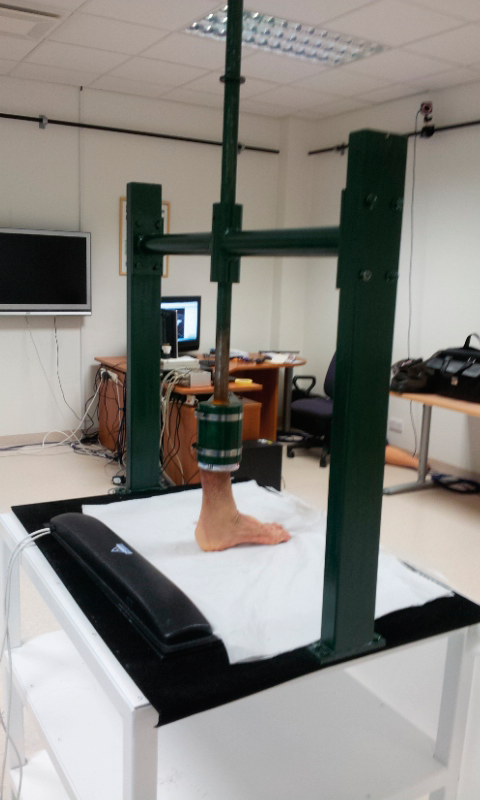
For the purpose of this research, kinematic and kinetic analysis of the whole foot as a structure was performed at a university clinical biomechanics laboratory. Testing was performed in a specifically designed jig capable of applying an axial load (
Figure 1) using both preserved feet harvested from each cadaver. Before attachment to the jig, all of the specimens were carefully measured again to confirm that the amputation was 20 cm proximal to the medial malleolus, following which soft tissues were dissected from around the proximal portion of the limb. The tibia-fibula end was ‘‘potted’’ in polymethyl methacrylate, which was gripped by the loading apparatus. During testing of fresh frozen samples, saline was sprayed on the sample to prevent desiccation of the tendons. The laboratory temperature was set at 15°C. All of the testing procedures were replicated for both fresh frozen and Thiel-embalmed specimens.
Each foot specimen was placed at the center of the axial loading jig, on a pressure-mapping system (Tekscan Inc, South Boston, Massachusetts), which has a resolution of 4 sensels/cm
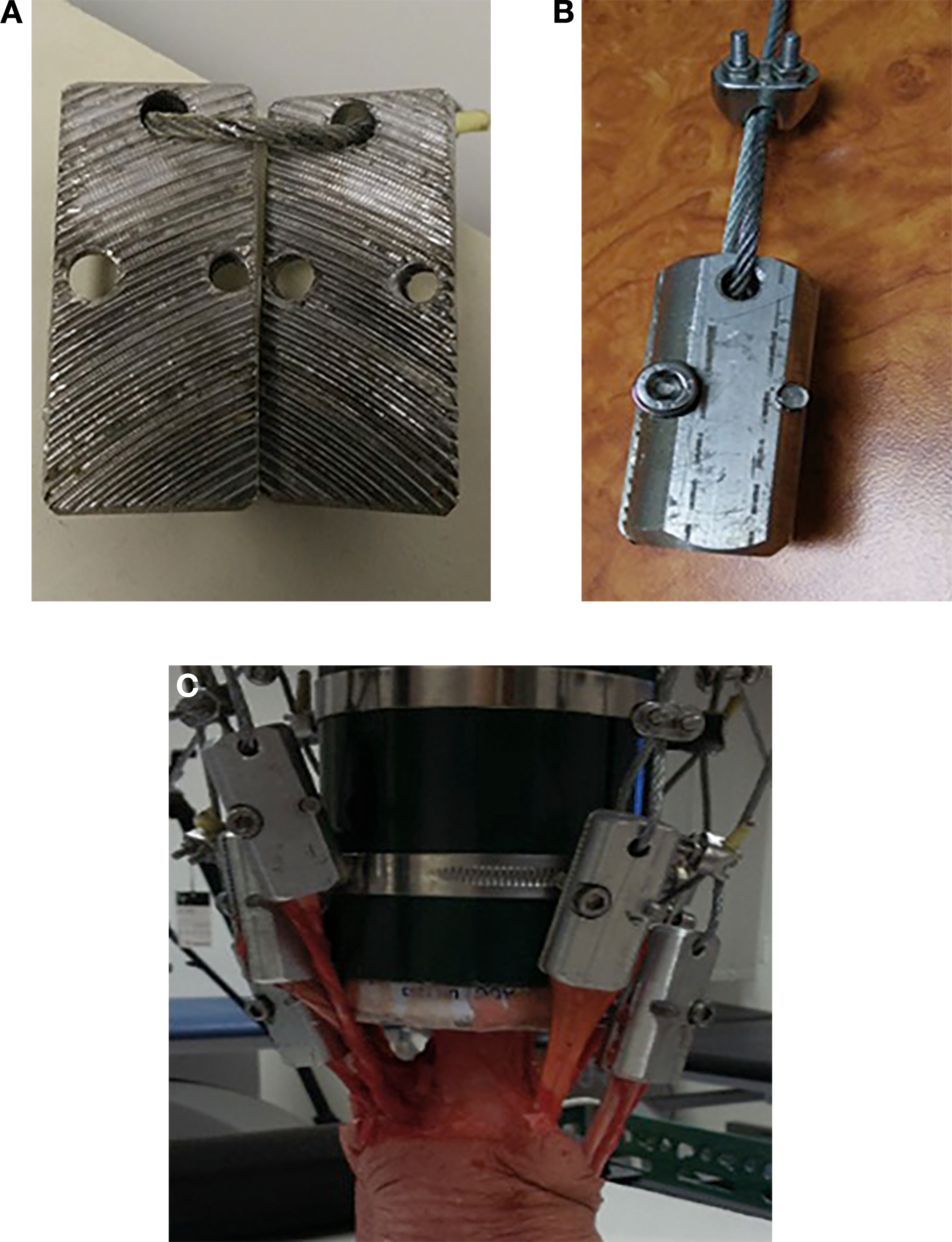
2 and was preset to acquire data at 60 Hz. The tendo Achilles, together with the tendons of the tibialis posterior, flexor digitorum longus, flexor hallucis longus, extensor hallucis and digitorum, and peroneus longus and brevis, were clamped using a custom-designed clamp (
Figure 2), which, in turn, was attached by a multistrand stainless steel rope and spring. Tension on this rope was applied so as to maintain these tendons under strain to ensure that the foot was in a plantigrade position.
The base of the jig was hinged at the rear so that its anterior aspect could move down to plantarflex the foot. Likewise, when dorsiflexion was being investigated, the base was hinged at the front.
Testing was initially performed with just the weight of the foot together with the jig’s vertical spindle on the pressure plate (denoted as the unloaded state). Then, a 10-kg weight was deposited on the top of the vertical spindle, and testing was repeated through inducing the motion by removing a small pin, allowing the base of the jig to plantarflex or dorsiflex around the hinge. This was followed by an additional 10-kg weight (total of 20 kg) being loaded onto the tibia. Each testing condition was repeated three times in both plantarflexion and dorsiflexion. Throughout all of the experiments, the foot always traveled through the same number of degrees as allowed by the jig.
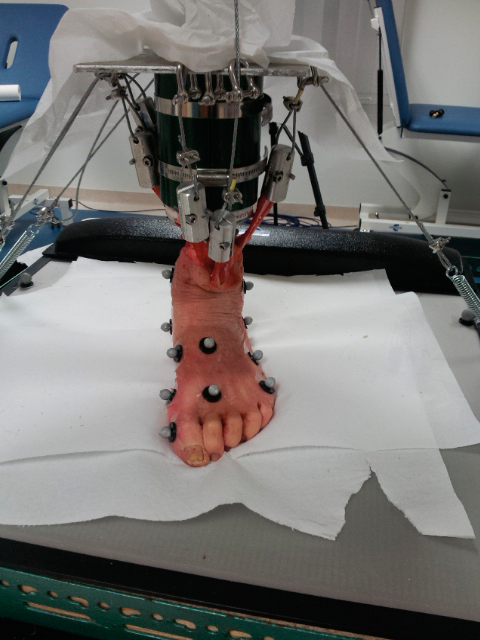
A six-camera optoelectronic motion capture system (Vicon, Oxford, UK), sampling at a rate of 100 Hz, was used to collect the kinematic data. Reflective markers were placed according to a foot model marker set as described by Leardini et al,[
27] which had been previously validated and used for the kinematic assessment of the various foot segments. This model divides the foot into forefoot, midfoot, calcaneus, hallux, and shank segments to enable the capture and consequently the measurement of the movement of these segments (
Figure 3).
When triggered, the base of the apparatus dropped for both plantarflexion and dorsiflexion. The motion capture system and foot pressure mapping system acquired data simultaneously throughout each cycle. The movement data were then exported and analyzed with Visual3D software version 5.01.18 (C-Motion Inc, Germantown, Maryland), and foot pressure data were analyzed with Tekscan research software version 6.70.
Three trials from each testing session were analyzed and then averaged. Thus, for each sample, the kinematics were divided into three groups—an unloaded state, with a 10-kg load, and then with a 20-kg load—in both plantarflexion and dorsiflexion. Thus, each sample resulted in six trials with three captures each from which means were calculated. For the kinematic model used, the degree of movement of the foot to shank, forefoot to midfoot, forefoot to rearfoot, midfoot to rearfoot, and rearfoot to shank was derived from the computational model. For the purpose of data analysis, the independent-samples t test was used to compare means between the two independent groups (fresh frozen versus Thiel-embalmed).
Likewise, with kinetics, three trials each for the six different states of loading, in plantarflexion and dorsiflexion, were analyzed and averaged. Mean force difference (before and after the induced dorsiflexion/plantarflexion movement), mean impulse (the area underneath the force/time curve), mean contact area, and mean peak plantar pressure difference were also analyzed with the independentsamples t test because each sample had been independently preserved and then compared for the two sample states, that is, fresh frozen and Thiel-embalmed.
Results
Six foot samples (three fresh frozen and three Thielembalmed) from three cadavers (two women and 1 man; mean age, 84 years) had undergone testing. The statistical analysis of the kinematic testing data is presented in
Table 1 for the fresh frozen and Thiel-embalmed samples. These data include the maximum angles attained by each foot segment in relation to its neighboring segment, as output by the Leardini foot model, including the foot to shank, forefoot to midfoot, forefoot to rearfoot, midfoot to rearfoot, and rearfoot to shank angles, initially for the unloaded and then for the loaded state for both the passive plantarflexion and dorsiflexion movements. The kinetic testing results are provided in
Table 2, including the mean force difference, mean impulse, mean contact area, and mean peak pressure difference.
As shown in these tables, most tests resulted in a nonsignificant difference between the two sample types, except for the mean contact area of the third sample (P = .04) and foot to shank dorsiflexion/plantarflexion of the same sample (P = .007).
Discussion
The statistical results of this study demonstrate that there is no significant difference in most of the tests performed, which implies that Thiel-embalmed feet can be exchanged for fresh frozen samples when laboratory experimentation of kinematic and kinetic parameters is performed. These results, given the limitation of a small sample size, now suggest that there may be no need to depend entirely on fresh frozen samples to perform these tests because these samples may be used for only a short time window before substantial decay starts to occur, thus rendering them inappropriate for further testing. The fact that Thiel-embalmed specimens may be used instead reduces the time pressure on researchers to finalize their experiments.
An exciting new opportunity arises, as it now becomes possible to even use these specimens for educational purposes to practically demonstrate to students the effect of intervention on the foot during the teaching of biomechanical concepts. In addition, the actual function of anatomical structures, such as muscles, tendons, and bones, can be visually observed in a dynamic manner. Students can now spend longer time using these for educational purposes without the fear of early decay and possible infection. Because these samples may be quite hard to obtain, with this type of embalming the same samples can be used over and over again throughout the academic year. Caution must be observed here, however, namely, that any significant loading can still potentially cause damage to the structure of these specimens, thus also rendering them inappropriate for further testing. The present study clearly did not investigate the behavior of these samples, either in their fresh frozen state or embalmed, when subjected to significant loading that could damage them.
The use of Thiel-embalmed specimens would also make it possible for long-term storage and repetitive utilization in, for example, practical physiologic demonstrations of gait, and the effect of tendon dysfunction because these could be programmed into a gait simulator. This new scope for using these samples opens up new and exciting opportunities for the teaching and practical demonstrations of the physiologic function of the human foot because they make it possible to use cadaveric samples in dynamic demonstrations, thus making it much easier for students to understand the complex role of foot mechanics during the dynamics of gait. This would certainly ensure that students can actually visualize the complexity of tendon function that occurs during the gait cycle, slowed down to an extent that can be visible to the naked eye. Gait parameters can be changed, and the effect of these changes can be followed through either motion capture or slow motion video.
An important observation that has to be made at this stage is that a sample size of three may not constitute the optimal size for such a study. However, this should be understandable when one considers the difficulty in obtaining human cadaveric specimens. The use of two differently preserved limbs from the same cadaver is a possible strength of this research, making this the first study to investigate the difference in foot biomechanical behavior. A statistical power calculation could not be performed due to lack of existing data in the literature, making this study the first of its kind to address this research field.
Further research in this field of biomechanics is certainly warranted because the use of cadaveric foot samples makes it possible to design new and bolder research projects that would otherwise be impossible to perform on living humans for obvious ethical reasons. This technique of Thiel’s embalming has opened up immense new possibilities for scientists investigating the dynamics of the human foot under different circumstances, such as in the orthopedics field, because the samples would last longer, without undue concerns about premature decomposition. This will make it possible to investigate gait-related parameters and the effect of, for example, the different designs of implants on foot biomechanics. Furthermore, the use of these samples in the field of surgery, such as orthopedic interventions, also opens up new exciting possibilities.
Benkhadra et al[
9] recommend that a study comparing the biomechanical properties of muscles and tendons preserved by Thiel’s method would be appropriate to also refine the model and the precise appropriate and inappropriate uses of Thiel-embalmed cadavers. The present study, which investigated the structure of the embalmed foot per se by analyzing foot segment movement and plantar pressure, attempted to address some of the gap in knowledge.
Finally, the limited sample testing shows that it is possibile that Thiel-embalmed feet behave similarly to fresh frozen ones; however, in agreement with the published literature, more comprehensive testing of the various components that compose the structure of the foot needs to be performed, together with further testing of these samples under wider conditions, such as active movement induced in proper gait replicators.
Conclusions
This study has shown that there are no significant statistical differences in the behavior of segment dynamics of fresh frozen foot specimens compared with Thiel-embalmed specimens when investigated for kinematic and kinetic behavior. The authors envisage the use of these embalmed specimens, which provide a definitive wider window of use and a greater span than their fresh frozen counterparts, in the educational biomechanical research field.